The Birth of John the Baptist

June 24, three months after the angel announces to Mary that Elizabeth is six months pregnant (March 25) John the Baptist is born.

From his birth John the Baptist was destined by God, not to follow Zachariah his father as a priest in the temple, but to go into the desert to welcome the Messiah, Jesus Christ. John is the last of the Jewish prophets, the first to recognize Jesus. His birth and death are celebrated in our church calendar.

It may have changed, but there’s an interesting Sunday walk in Rome I’d recommend.  Go out the city gate at the Porta di San Sebastiano and walk south along one of the oldest roads in the world, the Via Appia, to the catacombs and church of San Sebastiano. Outside the city gates, you’re in what the ancient Romans called the “limes,” the limits, the world beyond the city, a different world altogether.

To the ancient Romans the “limes” was the end of civilized, reasonable life. No place to live, they thought. Get where you’re going as soon as you can. “Speed limit” comes from the word. Go beyond the limit and you can lose your life.

Few people today are usually on that road, deserted fields all around. The only sound  you can hear is the sound of your own breathing and your footsteps.

The last line of St. Luke’s gospel for today’s feast says of John:

“The child grew and become strong in spirit, and he was in the desert until the day of his manifestation to Israel.”

How did John become strong in a desert? Centuries before, God told Abraham to go into a land he would show him. He led Jews from Egypt into the desert, and with no map or provisions, to a world unknown. They were in the hands of God, their strength.

Most of us stay within our limits; we don’t go to live in physical deserts. Yet, try as we may, we face them anyway in things we didn’t expect, like sickness or death or separation or divorce or the loss of a job or lost friends or lost places we know and love. The desert’s never far from any of us.

The Via Appia brings you to the catacombs, the great underground tunnels where early Christians buried their dead. They buried them there, I think,  not to hide them, but because this place was an image of a new unknown world.  The “limes,”  marked the end of this life and foreshadowed a new life. The dead no longer belonged in the city; they were going to  a new city.

Life holds its doubts, fears, uncertainty. But we don’t face limits alone. In the “limes” God alone has you in his hands. God gives you strength and brings you where you’re meant to be. God is there.  God is there.

Readings for the Feast:

Like other ancient church feasts, the Nativity of John the Baptist, June 24, is tied to cosmology. Three months after the angel announces to Mary that Elizabeth is six months pregnant (March 25) John the Baptist is born.John’s birth coincides with the summer solstice. He begins to decrease to make way for the one who will increase. Jesus will be born December 25. The Feast of the Nativity of John the Baptist is celebrated by all the ancient Christian churches. The Orthodox Church celebrates it June 24.

Birth of John the Baptist. Orthodox Church of America.

Readings here.

.

Genesis: 11-50

We might call our first readings at Mass this week the Jewish part of the Book of Genesis. (Gen 11–50) The origins of the world and the beginnings of the human race are described in first 10 chapters of Genesis. Chapter 11 begins with the call of Abram and recounts the beginnings of the Jewish people.

For Jews living in exile, when the Jewish scriptures were finally assembled, Abraham was someone to look to as they made their way in uncertain times, when the road ahead was unclear.

The road ahead doesn’t seem clear for us either, does it?

The Commentary from the New American Bible describes these chapters from Genesis as a book exiles can learn from:

Genesis 1150. One Jewish tradition suggests that God, having been rebuffed in the attempt to forge a relationship with the nations, decided to concentrate on one nation in the hope that it would eventually bring in all the nations. The migration of Abraham’s family (11:2631) is part of the general movement of the human race to take possession of their lands (see 10:3211:9). Abraham, however, must come into possession of his land in a manner different from the nations, for he will not immediately possess it nor will he have descendants in the manner of the nations, for he is old and his wife is childless (12:19). Abraham and Sarah have to live with their God in trust and obedience until at last Isaac is born to them and they manage to buy a sliver of the land (the burial cave at Machpelah, chap. 23). Abraham’s humanity and faith offer a wonderful example to the exilic generation.”

I like Jesssica Power’s poem on the great patriarch:

“I love Abraham, that old weather-beaten
unwavering nomad; when God called to him
no tender hand wedged time into his stay.
His faith erupted him into a way
far-off and strange. How many miles are there
from Ur to Haran? Where does Canaan lie,
or slow mysterious Egypt sit and wait?
How could he think his ancient thigh would bear
nations, or how consent that Isaac die,
with never an outcry nor an anguished prayer?

I think, alas, how I manipulate

dates and decisions, pull apart the dark

dally with doubts here and with counsel there,

take out old maps and stare.

Was there a call after all, my fears remark.

I cry out: Abraham, old nomad you,

are you my father? Come to me in pity.

Mine is a far and lonely journey, too.

12th Week of the Year: Readings and Feasts

This week’s first reading from Genesis begin with chapter 12 and the time of the patriarchs: Abraham, Isaac, Jacob and Joseph. They represent “a forward step in the divine plan to bring about recognition of the divine blessing promised to the world, if only humanity would obey and honor God.”   (BG 66. Catholic Study Bible)   

The Old Testament stories can be puzzling, sometimes unjust by our standards. Think about the sacrifice of Isaac and Sarah’s cruel treatment of Hagar. It’s hard for us to see this period as “a forward step” and realize that “the overall purpose of Genesis 12-50 is to carry forward God’s promise “despite all obstacles.” (BG 70)

Psalm 33, read on Monday, insists God’s promise is to make Israel that step forward and a blessing for all the nations: “Blessed the nation whose God is the LORD, the people he has chosen for his own inheritance. From heaven the LORD looks down; he sees all mankind.”

Our gospel readings from the Sermon on the Mount end this week. Jesus goes down to the plain, the real world, where he meets a leper and then a paralyzed man. (Saturday). His “real world” was like the world of Abraham and the Jewish prophets. He brought it a step forward to the Kingdom of Heaven God promised.

Still, it’s hard to see his times as a “step forward”, isn’t it? But, can we see our times now as a “step forward”? Yet they are.

We’re celebrating this week the Birth of John the Baptist (Tuesday) and feast of Sacred Heart. (Friday)

The Feast of Corpus Christi

The miracle of the loaves and fish that Jesus worked for a crowd of people by Sea of Galilee is one of his most important miracles. All four gospels report it. Mark reports it twice.

Jesus takes five loaves and two fish and feeds more than five thousand people, according to Luke’s Gospel.  They not only have enough, they have more than enough.

Why does Jesus work this miracle? The reason the gospel gives is that the crowd he’s talking to is hungry. They’re far from where they could buy food for themselves and they’re hungry.

So, the first reason Jesus works this miracle is not to prove he has divine power, but because people are hungry. They need to live, and to live you need to eat. 

But their hunger– which is also our hunger– is for more than food and drink.  We want a place to live, we want a life where we can flourish as human beings. Their hunger, like ours, is for more than eating and drinking.

Luke’s gospel today begins by saying that Jesus was speaking to the crowds about the kingdom of God and he healed those who needed to be cured. He gives meaning to their search for meaning and he restores life to them.

 He renews the promises of God, beginning with the good things of creation, signified by the bread and the fish. Bread from the land; fish from the sea. Bread stands for everything, all the blessings this life can bring. The fish stands for the blessings the waters bring. 

Yesterday Pope Leo addressed representatives of over 80 nations and spoke to them of the blessings the world is hungering for today. He spoke of their responsibility to listen and to defend the vulnerable and the marginalized.” This means working to overcome the unacceptable disproportion between the immense wealth concentrated in the hands of a few and the world’s poor,” he.said.

“Those who live in extreme conditions cry out to make their voices heard, and often find no ears willing to hear their plea…This imbalance generates situations of persistent injustice, which readily lead to violence and, sooner or later, to the tragedy of war.” 

Today Leo spoke of the hunger for peace. “Today more than ever, humanity cries out and pleads for peace,” he said. The cry for peace “demands responsibility and reason and must not be drowned out by the roar of weapons or by rhetorical words that incite conflict.”

Pope Leo urged every member of the international community to take up their moral responsibility to “stop the tragedy of war before it becomes an irreparable abyss.”When human dignity is at stake, he said, no conflict is distant. “War does not solve problems,”the Pope note. “On the contrary, it amplifies them and causes deep wounds in the history of peoples—wounds that take generations to heal… No military victory can ever compensate for a mother’s pain, a child’s fear, or a stolen future.”

The Pope expressed his hope for the din of arms to fall silent.“Let diplomacy silence the weapons!” he said. “Let nations shape their future with works of peace, not through violence and bloody conflicts!”

We pray today to Jesus Christ, who recognized the hunger of the crowd. May he recognize our hunger for justice and peace. He is present in our world, as the presence in the Eucharist assures us. He can reach places we cannot. He can speak to those we cannot. He can move hearts and minds beyond us.

We hunger for peace. Grant us peace, Lord.

Matthew 6: 19-23. The Treasures We Bring to Heaven.

In Matthew’s gospel today, Jesus speaks of treasures in heaven. Usually the treasures we think of are gold, silver, works of art, gems, degrees from school, signs of achievement. They’re the “treasures of earth” Jesus speaks of in the gospel. Thieves can steal them away; they can be eaten by moths and forgotten. They don’t last. (Matthew 6,19-23)

Other treasures are for heaven. St. Paul sees some of them in his trials for the gospel that we read today in his 2nd Letter to the Corinthians. God won’t forget his sufferings: the beatings, imprisonments, brushes with death, the long journeys over seas, rivers, and wildernesses where robbers waited. Paul lists dangers he faced, both from enemies and his own people. God wont forget any of them, down to his sleepless nights and bouts with the cold.

He ends his list with what might be the biggest treasure of them all; “the daily pressure upon me of my anxiety for all the churches. Who is weak, and I am not weak? Who is led to sin, and I am not indignant?” He’s tried to be responsible everyday with the people around him, whether they’re the weak or the trying. That’s the lasting treasure God holds in heaven. (2 Corinthians 11,18 ff)

We might not be able to match Paul’s of missionary travails, but let’s keep Paul’s last important achievement in mind. If we do what we have to do each day as well as we can, if we are faithful to our daily duty, if we bear our daily cross, if we bear with the weak and the difficult, won’t that be our treasure?

God counts it so.

Before he was executed St. Thomas More. wrote to his daughter Meg:

 “ I trust only in God’s merciful goodness. His grace has strengthened me till now and made me content to lose goods, land and life as well, rather than swear against my conscience.  I will not mistrust him, Meg, though I shall feel myself weakening and being overcome with fear. I shall remember how St. Peter at a blast of wind began to sink because of his lack of faith, and I shall do as he did: call upon Christ and pray for his help. And then I trust he shall place his holy hand me and in the stormy seas hold me up from drowning. “

Matthew 6: 7-15. Our Father

“This is how you are to pray: Our Father…….”

Gerhard Lohfink in his recent book “The Our Father” notes that ancient Near Eastern prayers always carefully address the god one wished to approach. An Akkadian prayer, for example, begins: “God of heaven and earth, firstborn of Anu, Dispenser of kingship, Chief Executive of the Assembly of the gods, Father of gods and men, Granter of agriculture, Lord of the air”.

“One senses that the forms of address had to be precise; otherwise the god would not listen. It’s not a simple matter to speak to him without making a mistake. Correct language and competence in praying are required. Above all, one must know the deity’s proper name.

Nothing of the kind in the Our Father! ‘Abba’ that’s the only address. It’s familial.”

The creed and other Christian prayers keep that address as first. “I believe in God, the Father Almighty, creator of heaven and earth.” The Creator is our Father. The creed tells us what we as God’s children have received from our Father and what we are promised. 

“We would not dare claim such a name in prayer, unless God himself had given us permission to pray this. And so, we should remember that when we call God our Father, we must live as his children.” (St. Cyprian)

It’s not in family or friends, some government agency or business that we find our the ultimate security we look for, but in God who gives us more than we ask for.

Matthew 6: 1-18: Praying in Secret

Where do we pray?

Jesus taught that we should pray “in secret.” Some may say that means pray in congenial places like the setting above. But St. Cyprian suggests that space may be wherever you find yourself. God is everywhere.

“The eyes of the Lord are everywhere.” So God is ready everywhere to engage us. Praying in secret testifies to the “everywhereness” of God. We can’t limit prayer to one place or time or some favored words..

What about the prayers we pray? Have they just become memorized words? “God hears our heart, not our words,” Cyprian says. God heard Anna who prayed for a child and the publican who prayed for forgiveness. They were not praying words, they prayed from the heart.

Prayer begins, not with yourself, the way the self-absorbed Pharisee prayed in the parable Jesus taught. Prayer begins with God. You are in the presence of God, everywhere. Be like the publican who knew he was a creature of the earth, waiting to the raised up. 

“Rejoice in the Lord” our psalm at Mass says. You are God’s children who call out “Abba.” And God hears us.

When we pray, we never pray only for ourselves. Here’s St. Cyprian: “Above all, the Teacher of peace and Master of unity did not want prayer to be made singly and privately, so that whoever prayed would pray for himself alone. We do not say My Father, who art in heaven or Give me this day my daily bread; nor does each one ask that only his own debt should be forgiven him; nor does he request for himself alone that he may not be led into temptation but delivered from evil. Our prayer is public and common, and when we pray, we pray not for one person but for the whole people, since we, the whole people, are one.”

Song at Daybreak

senic2


Does ordinary time, the days after Pentecost, mean that every day is the same? They’re not. Graces, challenges,  joys and sorrows,  hints of things, “our daily bread” are all there. We have to notice them. The Carmelite nun, Jessica Powers, ends a poem calling the day  “my beautiful unknown.” We just need eyes to see and ears to hear

SONG AT DAYBREAK

This morning on the way

that yawns with light across the eastern sky

and lifts its bright arms high –

It may bring hours disconsolate or gay,

I do not know, but this much I can say:

It will be unlike any other day.


God lives in his surprise and variation.

No leaf is matched, no star is shaped to star.

No soul is like my soul in all creation

though I may search afar.

There is something -anquish or elation-

that is peculiar to this day alone.

I rise from sleep and say: Hail to the morning!

Come down to me, my beautiful unknown.


Jessica Powers

Matthew 5:38-42. Turning the Other Cheek

You have heard that it was said, ‘An eye for an eye and a tooth for a tooth.’But I say to you, offer no resistance to one who is evil. When someone strikes you on [your] right cheek, turn the other one to him as well. If anyone wants to go to law with you over your tunic, hand him your cloak as well. Should anyone press you into service for one mile,* go with him for two miles. Give to the one who asks of you, and do not turn your back on one who wants to borrow.

Retaliation is often built into our legal systems and the way we think. “You do this, and you’ll get that.”  “An eye for an eye and a tooth for a tooth.” 

Jesus asks for something more than getting back at someone. God is merciful. He turns the other cheek, he walks more than a mile with us, he opens the door when beggars like us knock. 

Jesus offered an example of this when he suffered and died at the hands of others. “Father, forgive them, for they know not what they do.” 

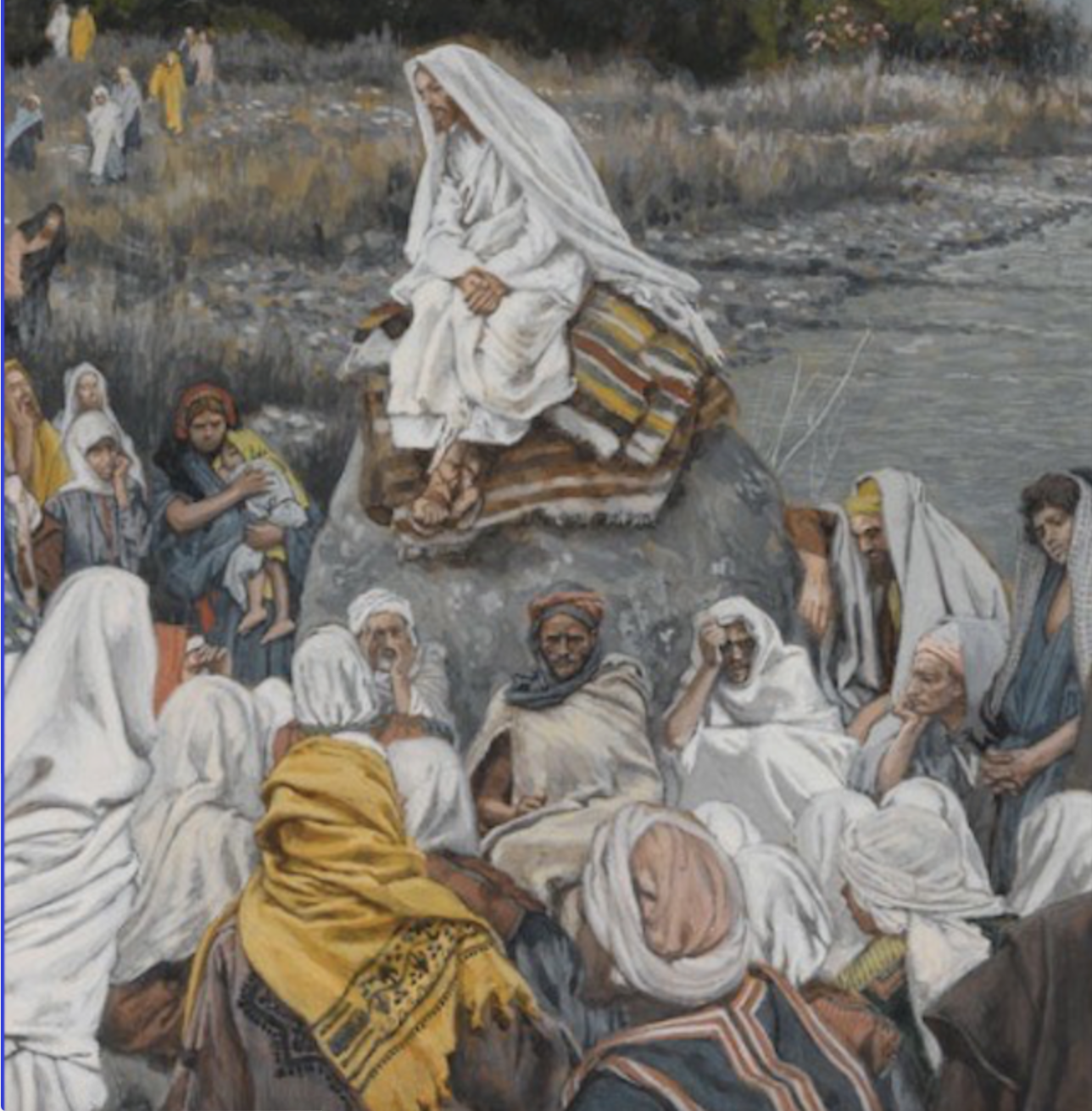
I have Tissot’s picture of Jesus teaching on most of the blogs these days. Those listening to him are not a picked group; everybody’s represented there. Some are still coming to hear him. Jesus does not wait for the perfect moment or the perfect audience. He teaches, continually. The Sower scatters seeds, even on uncertain ground.

11th Week: Readings and Feasts

We continue this week reading from the Sermon on the Mount, a summary of the teaching of Jesus found in chapters 5-7 in Matthew’s Gospel. After promising beatitudes (Mt. 5:1-16),  Jesus calls for addressing anger, lust, vengeance and our tendency to lie more deeply than we may like,  We must go beyond the scribes and pharisees in keeping God’s law, Matthew says. (Mt. 5:21-27) The Sermon on the Mount was considered the basic catechism of the Church from earliest times. It’s still teaches what we believe and hope for.

Jesus warns against giving alms to be seen and teaches prayer in chapter 6. The great prayer, the Our Father, is found in the Matthew 6: 7-15, read this Thursday. We will be quoting from S.t Cyprian, one of the greatest commentators on the teaching of Jesus on prayer.

We’re reading from the Sermon on the Mount until Friday of the 12 Week of the Year. On that day, Jesus comes down from the mountain. He enters a world that’s “troubled and abandoned.” There, people are “like sheep without a shepherd.” Even though a number of feasts interrupt the continuous reading from the Sermon on the Mount, it’s important to reflect on this important part of Matthew’s gospel.

The Nativity of John the Baptist is celebrated this Saturday.