Jacob Wrestling with God

Jacob wrestling

( Genesis 23, 33-43)

Our lectionary leaves out a number of the stories about Jacob and his wife Rachel, her brother Laban and his sons, that are far from edifying. They are hardly honest. They strike deals and, by hook or by crook, try to get the best deal they can. They’re not people you want for neighbors or do business with.

Yet, God promises Jacob what he promised Abraham:

“I, the LORD, am the God of your forefather Abraham and the God of Isaac; the land on which you are lying I will give to you and your descendants. These shall be as plentiful as the dust of the earth, and through them you shall spread out east and west, north and south. In you and your descendants all the nations of the earth shall find blessing. Know that I am with you; I will protect you wherever you go, and bring you back to this land. I will never leave you until I have done what I promised you.” (Genesis 22,1 8-28)

Even with those sublime words ringing in his ears, Jacob never seems to abandon his wheeling and dealing. It’s as if the most important thing in the world is the extra sheep he’s going to wheedle out of his father in law.

The Old Testament certainly portrays real life. The early Christian scholar Marcion wanted to throw out the Old Testament altogether, because he claimed it wasn’t spiritual enough. God wouldn’t promise such great things to people like Abraham, Isaac and Jacob and their wives and relations and slaves.

I suppose that’s one reason for us to keep reading the Old Testament:  God works in real life. “God is a Potter; he works in mud,” the Greek writer Nikos Kazantzakis entitled a chapter in one of his books.

Two things commentators note about the stories of Jacob. First, he doesn’t recognize the presence of God until afterwards. “When Jacob awoke from his sleep, he exclaimed, ‘Truly, the LORD is in this spot, although I did not know it!’” That’s an interesting discovery we all can make. God was there and we didn’t know he was there.–except afterwards.

Second, the commentator for the New American Bible says this about the story of Jacob wrestling in the dark at the river edge with the unknown figure: “The point of the tale seems to be that the ever-striving, ever-grasping Jacob must eventually strive with God to attain full possession of the blessing.”

God engages us and wrestles with us, “ever striving, ever grasping”, whether we like it or not, and we will have scars to prove it.


Jacob, His Wives and His Sons

Jacob blessing Isaac, Isaac blessing Jacob, by Govert Flinck, 1638

The Old Testament readings about Jacob, his wives and sons in our lectionary from Genesis begin on Saturday of the 13th week and continue through the 14th week. Saturday’s reading explains how Jacob, with the help of his mother Rebekah, stole Isaac’s blessing from Esau. (above)

Through the 14th week the stories of Jacob include his dream of God showing him a stairway to heaven at Bethel, his struggle in the dark wrestling with a mysterious stranger, and his son Joseph’s rise to power in Egypt after being betrayed by his brothers. We learn of Jacob’s entry into Egypt with his sons and finally, on this coming Saturday, his death and burial. 

We only read a few sections from the longer biblical account. They tend to be somewhat edifying. But looking at the whole biblical account of Jacob and his wives and his sons you wonder. Should we admire and imitate them? So many of these stories are complicated and unedifying–like real life.

A recent commentary on Genesis by Robert Alter approaches the story from the Jewish tradition. I like his approach to Jacob and his wives and his sons.

His name, Jacob, “can be construed as meaning ‘he who acts crookedly.’” Alter writes. “He’s willing to lie and cheat to get what he wants. He’s a suspicious bargainer, even with God. He’s a sharp dealer with others, like his father-in -law Labon. He’s leery of people. Wrestling with the mysterious stranger on his journey mirrors the way he wrestles with life. He doesn’t measure up to someone like Abraham. Yet “God is the God of Abraham, Isaac and Jacob.” 

Can the Jewish scriptures help us face our own complicated and usedifying times? I think they can. God engages humanity, sinful as it is, and mercifully guides it towards the Promised Land. “In you and your descendants all the nations of the earth shall find blessing. Know that I am with you; I will protect you wherever you go, and bring you back to this land. I will never leave you until I have done what I promised you.”

Those short, significant stories from the Jewish scriptures are what we need to hear. A merciful God is with us. Otherwise, life becomes a grim story, meaning nothing.

July 4: Independence Day

July 4th we celebrate our Independence Day in the USA. Parades, fireworks, speeches, hot dogs. What else? How about the meaning of it all? Today many wonder about the direction our country is taking.

Then there’s this beautiful prayer for the day.

Father of all nations and ages,
we recall the day when our country
claimed its place among the family of nations;
for what has been achieved we give you thanks,
for the work that still remains we ask your help,
and as you have called us from many peoples to be one nation, grant that, under your providence, our country may share your blessings
with all the peoples of the earth.
Through our Lord Jesus Christ, your Son,
who lives and reigns with you in the unity of the Holy Spirit, one God, for ever and ever.

St. Thomas: Going to God through Questions

Thomas

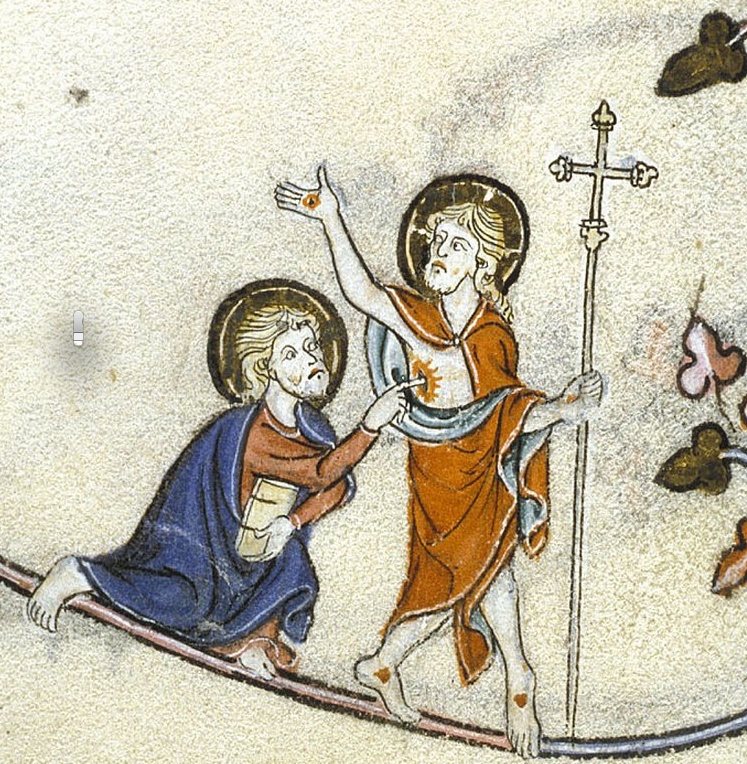
Today, July 3rd, we remember Thomas the apostle. We’re tempted to think that belief does away with troublesome questions and shelters us from unbelief, making our way to God smooth and undisturbed. Not so, Thomas reminds us; he found faith through his questions and by placing his finger into the wounds of Christ.

Gregory the Great reminds us today of the importance of Thomas the Apostle.

“In a marvellous way God’s mercy arranged that the disbelieving disciple, in touching the wounds of his master’s body, should heal our wounds of disbelief. The disbelief of Thomas has done more for our faith than the faith of the other disciples. As he touches Christ and is won over to belief, every doubt is cast aside and our faith is strengthened. So the disciple who doubted, then felt Christ’s wounds, becomes a witness to the reality of the resurrection.”

That’s an interesting statement, isn’t it? “The disbelief of Thomas has done more for our faith than the faith of the other disciples.” Is an unbelieving world strengthening our faith now?

We go to God through questions, and some troubles too. We’re healed by touching the wounds of Christ. How do we touch the wounds of Christ? Is it by touching those who are wounded like him?

Grant, Almighty God,
that we may glory in the Feast of the blessed apostle Thomas, so that we may always be sustained by his intercession
and, believing, may have life
in the name of Jesus Christ your son,
whom Thomas acknowledged as the Lord.
Who lives and reigns with you in the unity of the Holy Spirit, one God, for ever and ever.

Biographies of Jewish Saints:Genesis 21

Hagar Sent Away. Dore

We’re reading the biographies of Jewish Saints these days– stories of the patriarchs, their wives and times, from the Book of Genesis. The story we read today about Abraham, Sarah and Hagar is not the story you think of when you think of saints.

It’s a shocking story. After arranging for Hagar to become the concubine of Abraham and Hagar bearing him a son, (Genesis 16) Sarah turns on Hagar and demands that Abraham drive her away. She wants Isaac, her son, to be without a rival.

Sarah noticed the son whom Hagar the Egyptian
had borne to Abraham
playing with her son Isaac;
so she demanded of Abraham:
“Drive out that slave and her son!
No son of that slave is going to share the inheritance
with my son Isaac!”
Abraham was greatly distressed,
especially on account of his son Ishmael.
But God said to Abraham: “Do not be distressed about the boy
or about your slave woman.
Heed the demands of Sarah, no matter what she is asking of you;
for it is through Isaac that descendants shall bear your name.
As for the son of the slave woman,
I will make a great nation of him also,
since he too is your offspring.”

Early the next morning Abraham got some bread and a skin of water
and gave them to Hagar.
Then, placing the child on her back, he sent her away.
As she roamed aimlessly in the wilderness of Beer-sheba,
the water in the skin was used up.
So she put the child down under a shrub,
and then went and sat down opposite him, about a bowshot away;
for she said to herself, “Let me not watch to see the child die.”
As she sat opposite Ishmael, he began to cry.
God heard the boy’s cry,
and God’s messenger called to Hagar from heaven:
“What is the matter, Hagar?
Don’t be afraid; God has heard the boy’s cry in this plight of his.
Arise, lift up the boy and hold him by the hand;
for I will make of him a great nation.”
Then God opened her eyes, and she saw a well of water.
She went and filled the skin with water, and then let the boy drink.

God was with the boy as he grew up.(Genesis 21:8-20)

No one looks good in this story.

The Jewish biographies of saints don’t hesitate to tell their dark sides in the scriptures.. Even God’s words and actions are puzzling here..

Pope Francis offers a caution in “Gaudete et exultate”:  “Not everything a saint says is completely faithful to the Gospel; not everything he or she does is authentic or perfect. What we need to contemplate is the totality of their life, their entire journey of growth in holiness, the reflection of Jesus Christ that emerges when we grasp their overall meaning as a person.” (22)

Saints are imperfect people; the world is imperfect. God is a potter who works in mud.

Stories That Raise Questions

Flight of Lot, Dore

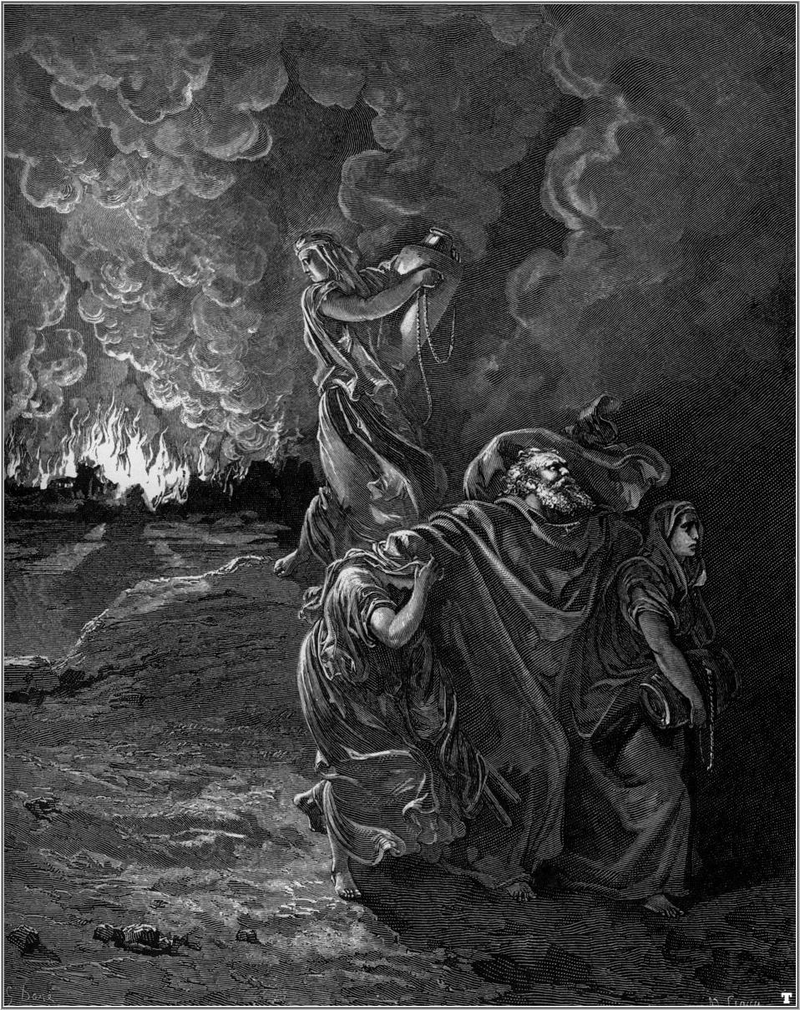
The readings from the Old Testament these weeks at Mass are made for questions. For example, today’s reading from Genesis 19,15-29. Why was Lot’s wife turned to a pillar of salt when she looked back at the destruction of Sodom and Gomorra? Was she overly curious, or overly regretful? Jesus has some harsh things to say about people who look back. Or maybe it’s just a piece of human caution– watch out where you’re going when you’re in a hurry.

Lot himself is slow to leave the place he’s chosen for his own. He asks to go to a town close by. Is he hoping to get back soon to the place he wants to be? Then why isn’t he turned to a pillar of salt? 

In these Genesis stories God often seems to be on the side watching it all like everyone else. Isn’t that what we think at times? God is a spectator as human events unfold, watching it all like everyone else. But that’s not true, is it?

Questions like these have kept Jewish commentators busy for centuries. We tend to pass them by for stories more easily understood. Or, we’re convinced the answers are there in some book we haven’t read,, and so we don’t give them much thought. 

But the scriptures are meant to raise questions. We go to God through questions.

Sodom and Gomorrah: Genesis 19:15ff

Today’s reading, about the destruction of Sodom and Gomorrah and the cities of the Plain, tells us that not only are individuals meant to follow God’s law,  but cities and nations are too. There’s a public morality as well as a private morality. God holds cities and countries and communities accountable.

Lot seems to be the only one open to help strangers in Sodom.  The whole city is against him. Commentators say that Lot is the first example in the Bible of the lone person seeking justice pitted against a whole city and community  

The cities of Sodom, Gomorrah, the cities on the Plain existed south of the Dead Sea and were destroyed by a major earthquake, archeologists say.  The Bible sees them destroyed because they ignored God’s law. Not even ten people can be found in them who can be called just.

Lot, his wife and two daughters escape, thanks to an angel and the prayers of Abraham. Lot chose to live in Sodom because it presented good economic possibilities, it seems.   Lot’s wife, who looks back, is turned into a pillar of salt. Why did she look back? Like so many other  scripture stories, we are left to answer that question ourselves.

There are no signs of repentance in Sodom and Gomorrah, unlike in Nineveh, the city Jonas preached to. 

Yet, God does not condemn cities, or human plans or human achievements. We are living in a time when cities face enormous challenge. In so many parts of the world today people are moving to the cities. They’re meant to be places of justice and mercy and human flourishing, not destruction. They are called to be cities of God. 

Precious Blood

durer crucifixion

July 1 is the Feast of the Precious Blood of Jesus in the Passionist calendar. It was a feast dear to St. Vincent Strambi, an Italian Passionist who lived in the 19th century when Europe was convulsed by Napoleon’s dreams of world conquest. Over 4 million people, military and civilian, were killed in the Napoleonic wars that stretched out for decades after Napoleon came to power. Bent on victory, Napoleon saw war and the blood shed in mass warfare as the price of empire.

I suppose we can say Napoleon began the armaments race that we see still in progress today. And empire building, or preserving, still goes on today.We are watching a brutal war today between Russia and Ukraine. So much blood spilled. Then there’s. Gaza and the Sudan and so many places today.

Strambi had great devotion to the Precious Blood of Jesus and often preached about it. He saw a new crucifixion in blood shed by soldiers in fierce battles raging then through Europe and the suffering of those caught in “collateral damage” . Their blood mingled with the blood of Jesus, a precious blood God mourned and judged holy.

The Feast of the Precious Blood turns our eyes not only to the blood flowing from Jesus’ side as he died on the cross but also to the blood shed in today’s vicious wars. So much money and resources spent on guns, as we cut down on the needs of the poor.

Painters like Durer (above) pictured angels holding cups catching blood from Jesus’ wounds. Don’t let his blood fall to the ground unnoticed, he tells us. It’s precious. All human life is precious.