The weekday readings from Matthew’s gospel this week are parables Jesus taught his disciples as he faces growing opposition. We closed last week on Saturday with his parable of the weeds and the wheat. A parable for understanding hard times.
This Saturday our reading recalls the death of John the Baptist, which foreshadows the death of Jesus. Another reading for understanding hard times.
Readings from Exodus and Leviticus this week remind us how important the events at Sinai were for the Jewish people and, consequently, for us. God enters into a covenant with his people who receive a way of life. Still, they turn away looking for false gods. Moses intervenes for his errant people. I like his simple prayer:
“If I find favor with you, O LORD, do come along in our company.This is indeed a stiff-necked people; yet pardon our wickedness and sins, and receive us as your own.”
July 29th we celebrate the family that welcomed Jesus to their home in Bethany: Martha, Mary, and their brother Lazarus. This feast gives these friends of Jesus recognition in our calendar they did not have before; at the same time the feast separates the various Marys in the gospel accounts.
St, Ignatius Loyola and St, Alphonsus Liguorii are important saints of the church after the reformation.
We celebrate the Feast of Ann and Joachim today, parents of Mary, the Mother of Jesus. The New Testament says nothing about them, but an early 2nd century document called the Gospel of James tells their story,
Ann and Joachim lived in Jerusalem, the ancient source says, where Joachim, a descendant of David and a wealthy man, provided sheep and other offerings for the temple sacrifices. The two had ties to Bethlehem nearby and Nazareth in Galilee.
They were well off but for twenty years disappointment clouded their marriage: they had no child. Even after vowing to dedicate their child to God, no child came. And so, at a time when children were treasured, they were thought poor. Descendants of David, they were blamed also for failing to continue the line the Messiah would come from.
Stung by criticism, Joachim spent more time in the mountains, brooding among the shepherds and their flocks. As her husband distanced himself from her, Ann too grew sad. God seemed far away.
In the garden one day, noticing some sparrows building a nest in a laurel tree, Ann burst into tears: “Why was I born, Lord?” she said, “birds build nests for their young and I have no child of my own. The creatures of the earth, the fish of the sea are fruitful, and I have nothing. The land has a harvest, but I have no child in my arms.”
At that moment, an angel of the Lord came and said, “Ann, the Lord has heard your prayer. You shall conceive a child the whole world will praise. Hurry to the Golden Gate and meet your husband there.”
At the same time, In the mountains an angel in dazzling light spoke to Joachim, “Don’t be afraid, the Lord hears your prayers. God knows your goodness and your sorrow and will give your wife a child as he did Sara, Abraham’s wife, and Hannah, mother of Samuel. You will have a daughter and name her Mary. Give her to God, for she will be filled with the Holy Spirit from her mother’s womb. Go back to Jerusalem. You’ll meet your wife at the Golden Gate and your sorrow will turn into joy.”
Joachim and Ann met at the Golden Gate to the temple, the place of God’s presence. They embraced as they spoke of the angel’s promise. Returning home, Ann conceived and bore a daughter, and they called her “Mary.”
When she was three years old, Ann brought Mary to the temple to learn the scriptures, to pray and take part in the Jewish feasts. She watched her father bring lambs to be offered in sacrifice. She grew in wisdom and grace in God’s presence.
When Mary approached marriage age– then 15 or so–her parents arranged for her marriage as it was customary. They sought the high priest’s advice, tradition says, and Joseph of Nazareth was chosen as her husband. Nazareth was then their home.
The angel Gabriel appeared to Mary and announced that she was to be the Mother of Jesus. By the power of the Holy Spirit she conceived the Child.
After Jesus was born in Bethlehem, Mary and Joseph returned to Nazareth where Jesus grew up. He was raised in a large extended family that included his grandparents, Ann and Joachim, who cared for him as a child.
No one knows just when or where Ann and Joachim died, but Jesus must have treasured them in life and on their passage to God.
The 2nd century Protoevangelium of James repeats a fundamental theme of the Book of Genesis: God promises Adam and Eve many children who will enjoy the blessings of the earth. God repeats the promise to an aged, childless couple, Abraham and Sarah, and again to Hannah, who bemoans her childlessness to the priest Eli in the temple. In the same way, God gives a child to Ann and Joachim. Mary, their daughter, brings blessings to the nations through her son Jesus Christ, born of the Holy Spirit.
Giotto’s 14th century illustrations (above) from the Arena Chapel in Padua. helped popularize the story of the parents of Mary in Italy, Europe and the rest of the western world.
It’s an important story for grandmothers and grandfathers. Like Ann and Joachim they have a big role raising the next generation. More than they think.
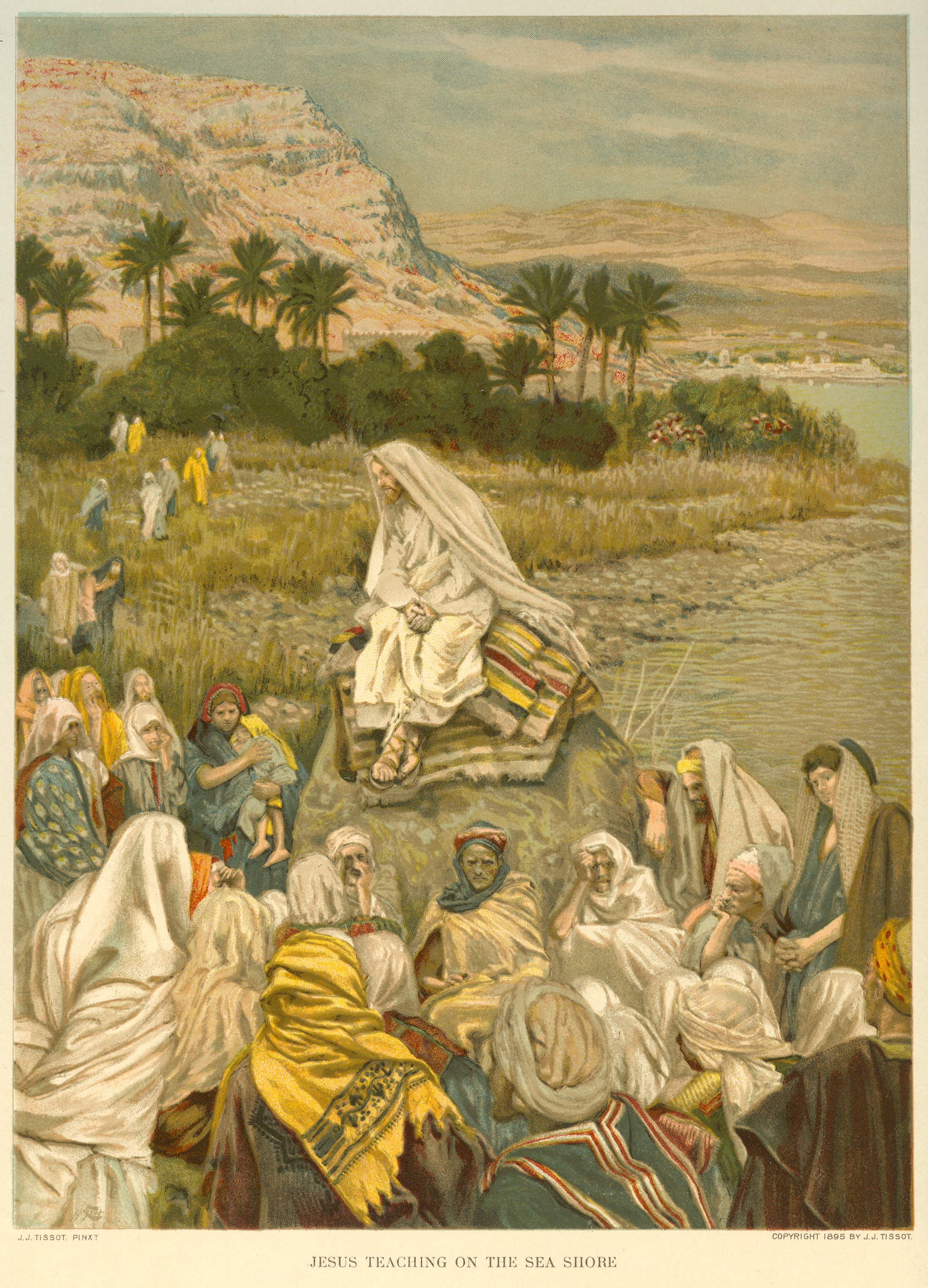
“Explain to us the parable of the weeds in the field, ” his disciples ask Jesus. (Matthew 13:36-37) Why do they want him to explain this parable about the weeds in the field before any other parable, we wonder ? What’s so important about it?
The parable, about a man and his servants who plant wheat, immediately follows Jesus’ opening parable of the sower in Matthew’s gospel. Once the wheat’s planted, they’re ready to go to sleep. All’s done; they have only to wait for the harvest.
But it won’t be so: an enemy comes and plants weeds in the wheat field. You can hear the servants’ distress as they wake up to it. They weren’t expecting this. Their immediate response is to go and pull the weeds up.
Like the rocky ground Jesus describes in the parable of the sower, they hear the word and receive it with joy, but “when some tribulation or persecution comes because of the word” they fall away. (Matthew 13:20-21) They’re overwhelmed by the sight of weeds.
Were Jesus’ disciples like them at this point in Matthew’s gospel? The pharisees are bent on putting Jesus to death. They’ re joined by the Herodians, the followers of Herod, ruler in Galilee. The cities that first received Jesus with joy now are rejecting him now. His own family wish him to abandon his mission.
His disciples envisioned a wheat field; now they see a world of weeds. And so their first request of Jesus: what’s this is all about?
Not just Jesus’ immediate disciples wonder about what they’re seeing, others do as well. As we celebrated the Feast of the Apostle James recently, Matthew described the mother of James and John appealing to Jesus for a privileged place in his kingdom. She saw a wheat field on the horizon. Jesus reminded her and her sons of a field of weeds as well.
Perhaps Matthew’s gospel also has the Galilean world of his day in mind, where the disciples of Jesus become overwhelmed by a resurgent Judaism led by the pharisees? One step more; as we see today a church in decline and a world split into factions, do we have a similar vision of things? We live in a field of weeds!
Parables raise questions and give answers. The parable of the weeds and the wheat proclaims, first of all, God’s confidence in the seed he has sown. Our world will never be a perfect wheat field, but it won’t become a field of weeds. We can’t eradicate every evil we see. As Jesus teaches today: we have to leave this world to the judgment of God.
The parable calls into question the way we look at life. Just weeds? No wheat? Or do we see both. Do we trust in the Sower who has sown wheat?
We read this parable at Mass today. The Lord comes to us as wheat. Ignatius of Antioch once said “I am God’s wheat.” And so are we.
A novena preparing for the Feast of Saints Ann and Joachim, the parents of Mary, the mother of Jesus, July 26 has begun, reminding us of the role parents and grandparents play in raising children. Some years ago I visited the ancient temple ruins in Jerusalem where Jewish women were fervently praying with their daughters before the temple’s western wall.
Ann and her daughter Mary must have prayed here too.
The picture above is a model of the temple from Jesus’ time at the Israel Museum. Tradition says Ann and Joachim were closely associated with the temple and may have lived nearby. An ancient church honoring St. Ann stands today near the Pool of Bethesda, near the temple. There, a paralyzed man was healed by Jesus. (John 5, 1-18) That’s the church in the ruins below.
Church of St. Ann, Jerusalem
A statue of Ann and her daughter Mary is in the Jerusalem church. Ann is teaching her daughter at her side.
What is she teaching her? Some statues show her teaching Mary the scriptures, but I’ve seen a statue, like the one below, showing Ann teaching her the ABCs and numbers. That’s what parents and grandparents do, isn’t it? They teach children life’s basics: how to live and how to pray.
Cathedral, Tegucigalpa, Honduras
Still true today. We put the little statue below of the two of them under our chapel altar for the novena. Parents and grandparents, the next generation is at your side. Ann and Joachim pray for us; show us the way.
The mother of the sons of Zebedee approached Jesus with her sons and did him homage, wishing to ask him for something. He said to her, “What do you wish?” She answered him, “Command that these two sons of mine sit, one at your right and the other at your left, in your Kingdom.” Jesus said in reply, “You do not know what you are asking. Can you drink the chalice that I am going to drink?” They said to him, “We can.” He replied, “My chalice you will indeed drink, but to sit at my right and at my left, this is not mine to give but is for those for whom it has been prepared by my Father.” When the ten heard this, they became indignant at the two brothers. But Jesus summoned them and said, “You know that the rulers of the Gentiles lord it over them, and the great ones make their authority over them felt. But it shall not be so among you. Rather, whoever wishes to be great among you shall be your servant; whoever wishes to be first among you shall be your slave. Just so, the Son of Man did not come to be served but to serve and to give his life as a ransom for many.” (Matthew 20:20-28)
James and John were sons of Salome and Zebedee, the gospels say, and at the Sea of Galilee Jesus called them to follow him. They were fishermen, relatives of Jesus. The gospels mention James first; he may have been the oldest.
The two brothers are described as quick-tempered and ambitious about restoring Jewish independence. They became part of the innermost circle of Jesus’ companions. They heard him teach, saw him transfigured in glory, then shaking with fear in the garden of Gethsemane before his death.
Our first reading at Mass for the Feast of St. James is a good description of James and John. “We hold this treasure in earthen vessels, that the surpassing power may be of God and not from us.” (2 Corinthians, 4,7) James and John were earthen vessels indeed, as our gospel describes them, using their mother Salome as their intermediary, looking for a big place in the kingdom they hope Jesus will bring. Earthen vessels break easily.
Jesus asks them if they can drink from the chalice that he will drink from, the chalice of serving others, no matter what the cost. “We can,” they say.
His brother John and his mother Salome stood near the cross of Jesus, but James must have fled immediately when Jesus was seized in the garden. Yet, God’s “surpassing power” filled him with treasures of faith, and James drank from the cup he asked to drink.
According to the Acts of the Apostles, James spoke bravely about Jesus risen from the dead to the people of Jerusalem and to the Jews visiting the Holy City from all parts of the world at Pentecost. He became a leader of the Jerusalem church but probably still clung to dreams of Jewish independence. Long held dreams don’t easily disappear.
In the year 41, Herod Agrippa, the grandson of Herod the Great, became king of Judea and ruled in Jerusalem. Educated in Rome, he knew how to favor the emperors of his time and he also knew how to please the powerful Jewish ruling class that had a key role in his kingdom. Were they also concerned about James’ continued political hopes for a Jewish kingdom?
When the Jewish Sanhedrin accused Christians of threatening the peace of Jerusalem, Herod sent his soldiers to seize James, the son of Salome and Zebedee, and had him executed by the sword. Strike the shepherd, Herod reasoned, and the sheep will scatter.
James, son of Zebedee, was the first of the apostles to die a martyr’s death. “My cup indeed you will drink,” Jesus promised, and his promise came true.
On the list of apostles there is another James, son of Alphaeus, commonly called James the Less. He is thought to be the son of Mary of Clopas, a sister of Mary, the mother of Jesus, who stood beneath the cross of Jesus with Mary Magdalen. (John 19: 25) His feast, along with the Apostle Philip is May 3. He was head of the church in Jerusalem and was martyred there in 62.
Civil wars are hard to understand. The American Civil War, the war in Rwanda in the 1990s, the war in Bosnia. That’s true also of the Spanish Civil War, which took place from 1936-1939 between forces of the left and the right. Great numbers of innocent people lost their lives. Outsiders from Germany, Russia and Italy made the war a testing ground for their own war machines. The scars are still there.
Many Catholic clergy were killed, especially in the early months of the war, including 13 bishops, 4,172 diocesan priests and seminarians, 2,364 men religious and 283 nuns in a period referred to as Spain’s “Red Terror.” Today the Passionists remember their Martyrs of Daimiel, Spain.
Between July 22nd and October 24th, 1936, twenty-six religious from the Passionist house of studies, Christ, the Light, outside the city of Daimiel, about eighty miles south of Madrid, died at the hands of anti-religious militiamen at the outbreak of the Spanish Civil War
They were: Niceforo Diez Tejerina, 43, provincial superior, who previously served as a missionary in Mexico and Cuba after being ordained in Chicago, Illinois.; Ildefonso García Nozal, 38; Pedro Largo Redondo, 29; Justiniano Cuestra Redondo, 26; Eufrasio de Celis Santos, 21; Maurilio Macho Rodríguez, 21; Jose EstalayoGarcia, 21; Julio Mediavilla Concejero, 21; Fulgencio Calv Sánchez, 19; Honorino Carraced Ramos, 19; Laurino Proáno Cuestra, 20; Epifanio Sierra Conde, 20; Abilio Ramos Ramos, 19; Anacario Benito Nozal, 30; Felipe Ruiz Fraile, 21; Jose Osés Sainz, 21; Felix Ugalde Irurzun, 21; Jose Maria Ruiz Martinez, 20; Zacarias Fernández Crespo, 19; Pablo Maria Lopez Portillo, 54; Benito Solano Ruiz, 38; Tomas Cuartero Gascón, 21; Jose Maria Cuartero Gascón, 18; German Perez Jiménez, 38; Juan Pedro Bengoa Aranguren, 46; Felipe Valcobado Granado, 62.
Most of those killed were young religious studying for ordination and destined for missionary work in Mexico and Cuba. Others were priests who taught them and brothers who served in the community. Father Niceforo, the provincial, was visiting the community at the time.
Militiamen entered the Passionist house on the night of July 21st and ordered the thirty-one religious to leave in one hour. Father Niceforo gathered them in the chapel, gave them absolution, opened the tabernacle and said:
“We face our Gethsemane. . . all of us are weak and frightened, , ,but Jesus is with us; he is the strength of the weak. In Gethsemane an angel comforted Jesus; now he himself comforts and strengthens us. . .Very soon we will be with him. . .To die for him is really to live. . . Have courage and help me by your example.”
He then distributed the sacramental hosts to them.
The militiamen ordered the group to the cemetery and told them to flee. At the same time, they alerted companions in the surrounding areas to shoot the religious on sight.
The Passionists split into five groups. The first group of nine was captured and shot outside the train station of Carabanchel in Madrid on July 22, 1936 at 11pm.
The second group of twelve, Father Niceforo among them, was taken at the station at Manzanares and shot by a firing squad. Father Niceforo and four others died immediately. Seven were taken to a hospital where one later died. Six of them recovered, only to be shot to death later on October 23, 1936
Three other religious, traveling together, were executed at the train station of Urda (Toledo) on July 25th. Two gave their lives at Carrion de Calatrave on September 25th. Only five of the thirty-one religious were spared.
Numerous eye-witnesses testified afterwards to the brave faith and courage shown by the Daimiel Community in their final moments, especially the signs of forgiveness they gave their executioners.
They were beatified by Pope John Paul II on October 1, 1989, who said of them: “None of the religious of the community of Daimiel was involved in political matters. Nonetheless, within the climate of the historical period in which they lived, they were arrested because of the tempest of religious persecution, generously shedding their blood, faithful to their religious way of life, and emulating, in the twentieth century, the heroism of the Church’s first martyrs.” (Homily: October 1, 1989)
Today their bodies are interred in the Passionist house at Daimiel, Spain.
St. Bridget of Sweden, whose feast is July 23rd, was a 14th century mystic.She was a woman who challenged the powerful of her day, first the court of Sweden and later the papacy. She influenced Christian spirituality and art,
Born into a powerful Swedish family with ties to the royal court. Bridget married Ulf Gudmarrson when she was 14. They had 8 children, one of whom is also honored as a saint, Catherine of Sweden. Bridget was known for the care she took of the sick around her. She brought her children with her on her visits, to teach them this work of mercy.
As a child of 10 Bridget was attracted to the mystery of the Passion of Jesus and that mystery inspired her prayer and spirituality ever afterwards. Her deep understanding of his mystery made her fearless in challenging injustice when she saw it. Bridget protested the wanton living of Swedish royalty and its uncaring attitude towards the poor. After her husband’s death in 1334 she founded a religious community, continuing to speak out fearlessly against the lifestyle and privileges of the powerful.
In 1350 Bridget went to Rome to gain approval for her Order of the Most Holy Savior, the Brigittines. There she was inspired to confront the papacy. The pope , fearing the turmoil in the Papal States, had fled to in Avignon in France. Bridget strongly urged him to return to Rome. The pope was a shepherd, she said; he should be with his sheep, especially in times of turmoil.
Bridget’s prayers and revelations, widely circulated in her time, were reminders of what Jesus said and did, especially the example he gave in his Passion. She inspired people to meditate on the mysteries of Christ for their wisdom.
Artists were inspired in their portrayals of the mysteries of Christ. She saw in a vision Mary and Joseph adoring the Child lying on the ground. His Incarnation made the earth his home. Previously, Mary was portrayed at the crib, lying down after giving birth. In Bridget’s portrayal she joins Joseph, the shepherds (humanity) and the earth itself adoring the Word made flesh.
Adoration of the Child, Giorgione, 1507, National Gallery, Washington
Bridget also inspired the portrayal of Mary holding the body of Jesus after his crucifixion and the devotion of the Pieta. Cradling him in her arms,, she recalls holding him at his birth in Bethlehem, Bridget said.
Rhine Valley, 14th century
In 1371, Bridget and some of her family went on pilgrimage to the Holy Land; her vivid accounts from there further stimulated the religious imagination of her contemporaries. On July 23, 1373 she died in Rome. Bridget is a patron of Sweden and of Europe.
The church always needs strong women like Bridget, firm in faith and unafraid to speak out. Society too needs women like her in politics and business to steer its course into the future.
Our church today seems to be alive with visionaries, people who claim God has revealed something to them. Bridget was always aware of the possibility that her visions could come from another source rather than God. She prayed to be saved from delusions and pride. This 15th century Swedish painting depicts Satan trying to influence her, but is hit over the head by an angel.
Prayer of St. Bridget
Jesus, true and fruitful Vine! Remember the abundant outpouring of blood shed from your sacred body as juice from grapes in a wine press. From your side, pierced with a lance by a soldier, blood and water poured out until not a single drop was left in your body.
Through your bitter Passion and your precious blood poured out, receive my soul when I come to die. Amen.
O good Jesus! Pierce my heart so that my tears of penance and love will be my bread day and night; may I be converted entirely to you, may my heart be your home, may my conversation please you, may I merit heaven at the end of my life and be with you and your saints, to praise you forever. Amen
Today’s reading from Exodus tells us that one month after they leave Egypt,” the whole assembly of the children of Israel grumbled against Moses and Aaron.” The children of Israel said to them, “Would that we had died at the LORD’s hand in the land of Egypt, as we sat by our fleshpots and ate our fill of bread! But you had to lead us into this desert to make the whole community die of famine!” (Exodus 16:4-5)
One month after they leave Egypt, they’ve forgotten the Lord’s mighty deeds and promises.
Food and water run out, triggering their complaints, but God gives them enough to go on. Manna, bread from heaven is their daily food. Water comes from the rock that Moses strikes with his wooden staff. A cloud by day and fire at night guide them.
Still, they grumble, and so do we. Food and water figure in climate change today, so does a confusion of leadership. As the world moves on through the desert now, can we learn from our ancestors’ journey then?
That’s what St. Paul told the Corinthians to do in the 10th chapter of his first letter to them. “These things happened to them as an example, and they have been written down as a warning to us…”
Jesus promises to be Bread from heaven, the rock for our thirst. (1Cor. 10:4) The Spirit is a cloud by day and a pillar of fire by night.
Let’s expect grumbling–these are tough times– but hopefully that grumbling leads to a deeper faith and also a determination to take on the challenges of our time. The Book of Deuteronomy, the last of the 5 books of the Law, ends with Moses and the people poised to enter a new land after almost 40 years of desert wandering. Significantly, they’re poised, not there yet, not yet in possession, still hoping in the promises of God.
We need this large view of history today, don’t we?
Jesus answers the opposition described in chapters 11-12 in Matthew’s gospel with a series of parables that begin with the parable of the sower sowing his seed. (Chapter 13) The seed doesn’t always fall on good ground, he reminds his disciples. Sometimes it falls on the path where it quickly dries up– like the towns that welcome him enthusiastically and soon forget him.
The parable of the weeds and the wheat points to enemies who want to poison the power and beauty of his words and deeds because of their own claims. The Pharisees did that.
The kingdom of God comes in smallness. It’s like the mustard seed, not a full grown tree. You can miss it if you’re looking for something fully grown and done. The treasure is hidden in a field; you may discover almost accidentally. Maybe Jesus’ own extended family in Nazareth still saw him as just the little boy they knew before and could not appreciate him now. We underestimate small things and what they can grow to be.
But the kingdom of heaven is also like a merchant in search of fine pearls. You have to keep searching for it all your life. You can’t give up that search. Keep looking, hoping searching.
Jesus concludes his teaching with the parable of the net cast into the sea that catches fish of every kind, good and bad. At the end of time, the net will be dragged to shore and the good will be separated from the bad. God is the ultimate judge, leave judgment to him.
His parables are about the real world, the world Jesus experienced. They also help us look at the world we live in, which is not far from his.




 The Victor's Place