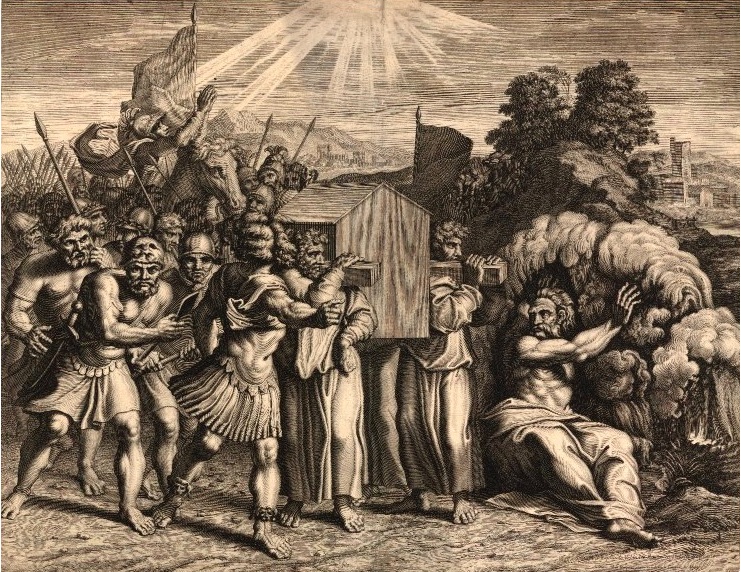
Robert Hecquet, Israelites Crossing the Jordan River, c. 1720-1775
Our Old Testament readings for the next few days are from the Book of Joshua, the successor of Moses. He was a man of battles and wars, who led the Israelites in their conquest of Canaan and their possession of the Promised Land. “Joshua fit the battle of Jericho, and the walls came tumbling down.”
As a warrior he was concerned with preparing troops for battle, getting weapons ready, strategizing for the battle, but Joshua begins his campaign by first reminding the people what’s more important than all that: “Remember who you are.”
Gathering the Israelites before the Jordan River, Joshua orders the priests to bring before them the ark of the covenant, God’s pledge that they are his people. They bring the jar of manna reminding them that God sustains them. They are God’s people, not insignificant slaves. They’re God’s children, cared for, with rights and privileges and promises.
Only by remembering who they are will they be able to cross the Jordan and break down the walls of Jericho and take possession of the land.
We celebrate the Feast of the Assumption of Mary into heaven August 15th. It’s the most important feast of Mary in the church’s calendar. Where did it come from?
There’s no account of Mary’s death or assumption into heaven in scripture. An account in the apocryphal body of literature called the Transitus Mariae, popular in the Christian churches of the east from the 5th century, describes the return of the apostles to Jerusalem for Mary’s burial and their discovery that her body was taken up to heaven. The writings attest to an early interest in the death of Mary in some parts of the early church.
The first liturgical celebrations of Mary’s death and assumption to heaven took place in Jerusalem at her tomb (above) on the Mount of Olives about the 5th century. The Roman Catholic Church draws her present belief from this early tradition and her conviction that Mary is “wholly united with her son in the work of salvation.” For scriptural support, the church looks to sources like Paul’s First Letter to the Corinthians–the second reading at Mass for August 15th – to understand this mystery.
Paul wrote that letter about the year 56 AD to Corinthian Christians who had questions about the resurrection of Jesus. Their precise difficulty seems to be that they saw only the soul surviving death and not the body, a common conception of the Greek mindset of the day. That belief brought a low appreciation of the body and the place of creation itself in the mystery of redemption. The created world wasn’t worth much and was passing away, so let it go.
Paul countered that opinion with the belief he received, a belief from the beginning: “For I handed on to you as of first importance what I also received: that Christ died for our sins in accordance with the scriptures; that he was buried; that he was raised on the third day in accordance with the scriptures; that he appeared to Cephas, then to the Twelve. After that, he appeared to more than five hundred brothers at once, most of whom are still living, though some have fallen asleep” (1 Corinthians 15: 3-6).
Jesus was raised bodily from the dead, Paul affirms, and we will rise bodily too. Jesus is “the first fruits of those who have fallen asleep.” Mary’s bodily assumption follows the bodily resurrection of Jesus. Because of her unique role in the mystery of redemption she is among the “first fruits of those who have fallen asleep.” Her assumption is part of the mystery of the resurrection; it’s an affirmation we will follow Jesus who rose body and soul.
In her prayer, the Magnificat – the gospel read on the Feast of the Assumption – Mary accepts her mission from God to share in the mission of her Son, the Word made flesh, who came to redeem the world.
The church gradually understood the mystery of Mary’s Assumption over time. A rising Gnosticism in the 3rd and 4th centuries certainly promoted appreciation of this mystery. Gnosticism promised escape from the limits of bodily life through a higher knowledge. As a result, human life and creation itself didn’t matter.
Mary’s Assumption claims they do.
The Roman Catholic Church formally defined the dogma of the Assumption on November 1, 1959, on the Feast of All Saints, but the belief was firmly held for centuries before:
“…the Immaculate Virgin, preserved free from all stain of original sin, when the course of her earthly life was finished, was taken up body and soul into heavenly glory, and exalted by the Lord as Queen over all things, so that she might be the more fully conformed to her Son, the Lord of lords and conqueror of sin and death.” The Assumption of the Blessed Virgin is a singular participation in her Son’s Resurrection and an anticipation of the resurrection of other Christians: ‘In giving birth you kept your virginity; in your Dormition you did not leave the world, O Mother of God, but were joined to the source of Life. You conceived the living God and, by your prayers, will deliver our souls from death'” (Catechism of the Catholic Church 966).
Mary’s Assumption was defined in a century when human life and the planet itself were threatened. World War I ended in 1918 after four years when millions perished. World War II, ending in 1945, left the real possibility that war and nuclear weapons could bring about the destruction of the human race. The Holocaust seemed to prove the capability of human evil.
Threats to human life continue and creation itself is increasingly endangered by climate change and consequent poverty. August 15, the date for the celebration of this feast from earliest times, is the time of harvest for most of the Western Hemisphere. Our belief in the resurrection of the body sees creation itself promised a share in this mystery. The readings and prayers of the feast describe Mary in heaven as the woman clothed with the sun, the moon and the stars beneath her feet. (Revelation 11)
The Feast of Mary’s Assumption is the oldest and most important of Mary’s feasts in our church calendar.
When I was a little boy, on August 15, the Feast of the Assumption of Mary into Heaven, my mother would tell me to go down to the Newark Bay, just a few blocks from my home in Bayonne, NJ, and go into the water. There’s a blessing in the water today, she told me.
I learned later where that custom came from. In medieval Europe the Feast of the Assumption was the day the fields were blessed. The middle of August was harvest time, and on this day herbs were gathered from the fields and brought to the church to be blessed with water. After they were blessed they were brought home to be medicines for the sick. We still get many if not most of our medicines today from herbs.
Customarily, a sprig was placed on the wall where children slept, asking God to keep them healthy and strong.
We will have herbs, a small olive tree, fruits of the earth and flowers before our altar for the feast on August 15 and then we will have a procession to our Mary Garden to bless them..
Many important feasts of our church occur in one of nature’s cycles. The birth of Jesus Christ, December 25, is celebrated as darkness gives way to light in the Western Hemisphere. Easter, the celebration of the death and resurrection of Jesus takes place during the Passover celebration, which occurrs at the spring harvest. Mary’s Assumption, August 15th, falls as the summer harvest begins.
You can see why Mary’s Assumption into heaven is a day to bless herbs and to bless the fields. It’s a feast of life. On this day Mary followed Jesus, her Son, into the mystery of his death and resurrection in a unique way. Mary’s body, her humanity, like the humanity Jesus assumed, like the humanity we all share, came from the earth.
We all come from dust, from creation, and to dust we shall return.“From dust you are, and to dust you shall return,” we are reminded on Ash Wednesday. But the promise we have from Jesus is that this dust will rise again to new life.
Mary witnesses to his promise in a unique was. Mary’s body, like the body of Jesus, never returned to the dust. She was assumed body and soul into heaven to become a sign of bodily resurrection. The promise of resurrection given to her is also given to us. Not only is it given to us, but to all God’s creation. Mary is the sign of a new creation, promised by God.
The first reading for her feast, from the Book of Revelation, describes Mary as a woman “ clothed with the sun, with the moon under her feet, and on her head a crown of twelve stars. She gave birth to a son, a male child, destined to rule all the nations.” After his resurrection, Jesus was enthroned in heaven and Mary was taken up to heaven to join him.
The Assumption of Mary is a time to rejoice in “the resurrection of the body and life everlasting”, the whole created world also rejoices in the promise of a new creation. Listen to Psalm 96:
O sing a new song to the Lord, sing to the Lord all the earth. O sing to the Lord, bless his name. Let the heavens rejoice and earth be glad, let the sea and all within it thunder praise, let the land and all it bears rejoice, all the trees of the wood shout for joy at the presence of the Lord for he comes, he comes to rule the earth.
The Feast of the Assumption of Mary into Heaven offers a future so different than the bleak picture of life we’re tempted to see today. She visits us today as she did her cousin Elizabeth long ago announcing a great mystery. We are called, like Mary, to a heavenly place with Jesus her Son. Our world, so battered with the storms and disease, so threatened by a changing climate, wars and poverty, also sees a glorious future in her assumption into heaven.
Pray for us, O Holy Mother of God, that we may be made worthy of the promises of Christ.
A number of martyrs are remembered in our liturgy in mid-August. August 9, we remembered Teresa Benedicta of the Cross, Edith Stein, who died in the concentration camp at Auschwitz August 9, 1942.
August 10th, we remembered Lawrence the Deacon, one of the most important martyrs of the early church. August 13 Pontian and Hippolytus.
August 14 we remember Maximillian Kolbe, a Polish Franciscan priest, who died in Auschwitz about a year before Edith Stein, August 14, 1941.
Peter Brown, an historian of early Christianity, says it wasn’t the bravery of Christian martyrs that impressed the Romans. The Romans, a macho people, had war in their blood. They prided themselves on dying bravely.
Rather, the Romans marveled at how Christian martyrs approached death. They saw something beyond death. They considered themselves citizens of another world, who followed Jesus Christ in how they lived and believed in his promise of everlasting life.
Lawrence the deacon, for example, could have escaped Roman persecution, but he wouldn’t abandon the poor of Rome in his care. Jesus said take care of the poor.
Centuries later, Maximillian Kolbe was a priest who wouldn’t abandon the vocation God gave him.
Before World War II, Kolbe was active as a Franciscan priest, promoting devotion to Mary, the Mother of Jesus. He ran a large, successful Franciscan printing enterprise in Warsaw.
In 1939, after invading Poland, the Nazi arrested him and a number of other Franciscans and imprisoned them for some months. They ransacked their printing place, probably hoping to intimidate them. Then, they left them go.
Instead of being intimidated, Kolbe began to house refugees from the Nazis, some of them Jews. That got him into trouble, so he was arrested again, on February 14th, 1941, and sent to Auschwitz to do hard labor.
Concentration camps like Auschwitz where Maximillian Kolbe and Sr.Teresa Benedicta died are the nearest thing to Calvary in modern times. More than 1500 of them were spread mostly through German occupied territories in Europe. Twenty million people died in the camps in the Second World War, 6 million were Jews. 1.3 million people went to Auschwitz; 1,1 million died there.
Five months after Kolbe entered Auschwitz, in July 1941, a prisoner from his barracks escaped. In reprisal, the Nazis took 10 men from the barracks to put them to death by starvation. One of them cried out that he had a wife and children who would never see him again. Father Kolbe stepped forward and offered to take the man’s place.
He was the last of the ten men to die of starvation and an injection of carbolic acid two weeks later, on August 14, 1941.
Many stories of Kolbe’s ministry among the prisoners in Auschwitz were told after his death when Auschwitz was liberated. He was canonized by Pope John Paul II on October 19, 1983, who called him “Patron Saint of Our Difficult Age.”
He was a sign of God’s love in a place where God seemed absent.
Maximillian Kolbe’s death on the vigil of Mary’s Assumption into Heaven has been seen as a further sign. God’s hand reached into the dark horror of Calvary to save his Son. God reached out to Mary to bring her, body and soul, to heaven. God reached into Auschwitz and other camps of horror to bring suffering human beings to glory and peace.
St Pontian, Pope and Martyr, and St Hippolytus, Priest and Martyr. August 13
Pontian and Hippolytus lived in 3rd century Rome and died in Sardinia in the persecution of Maximus Thrax about the year 235. Sardinia was Roman penal colony no one escaped from, the Romans called it the “Isle of the Dead.”
They’re considered important martyrs in the early church and their bodies were taken back to Rome by Pope Fabian. Pontian was buried in the chapel of the popes in the cemetery of St. Callistus. Hyppolytus was buried in a cemetery along the Via Tiburtina.
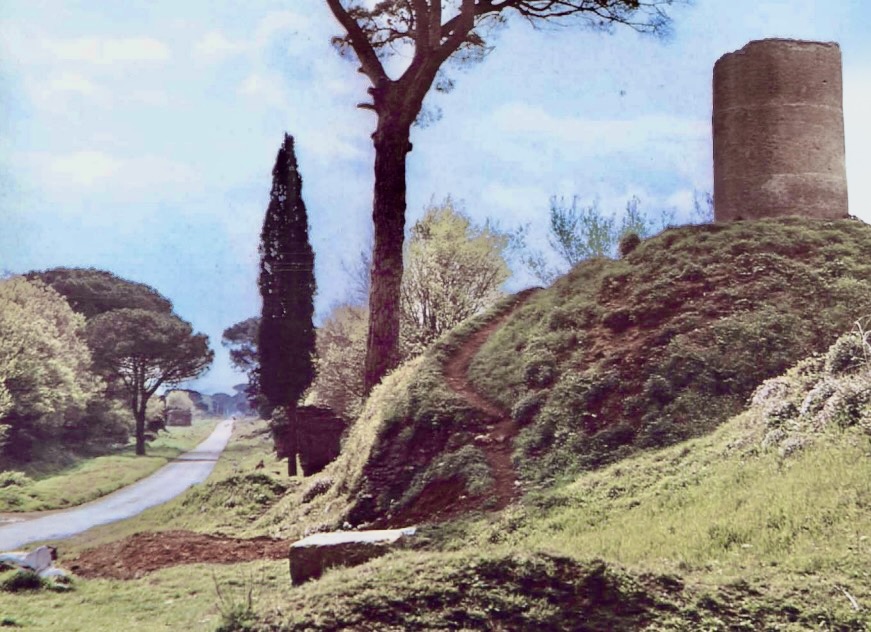
Via Appia to the Catacomb of St. Callistus
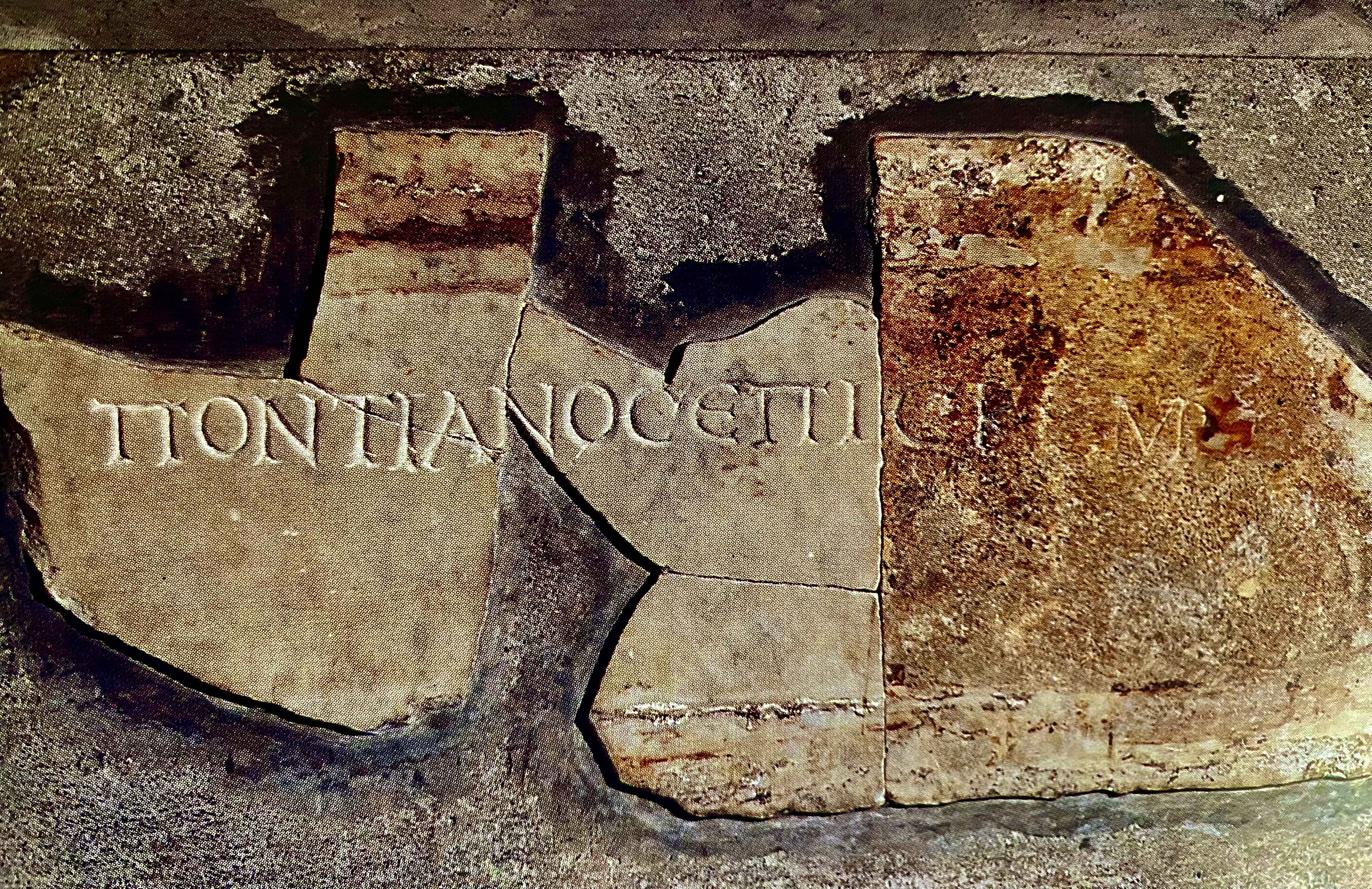
Pontian, Cemetery of Callistus
Originally they were honored separately in our liturgical calendar, but in 1969 when our calendar was reworked after Vatican II they were given a feast together. One reason was that they were rivals for power in the Roman church and were reconciled as they faced death together. Forgiveness is always identified with martyrdom.
They also give us a picture into the early development of the papacy in Rome. It was not the smooth process often pictured in church history books. .
The early church in Rome emerged from the large Jewish community in that city, which gradually separated from the synagogues to settle into house churches, modeled after the Jewish synagogue. There’s evidence that the separation was not peaceful.
Historians like Eamon Duffy say that the house churches in Rome were less centrally organized than the communities in Antioch, for example.“To begin with, indeed, there was no ‘pope’, no bishops as such, for the church in Rome was slow to develop the office of chief presbyter, or bishop.” (Saints and Sinners, A History of the Popes, New Haven, USA, 1997 p 7)
That’s not say that the Roman church wasn’t looked up to. From earliest times the Roman church was seen as the church founded by two great apostles, Peter and Paul. It was also the church of Rome, seat of Roman government. Some of its members served in Caesar’s household.
The papal office developed in response to heresy. Rome was a magnet drawing teachers like Marcion who came to Rome in 140 and wished to do away the Old Testament and all Jewish teaching. About the same time, Tatian and the gnostic Valentinus visited Rome. They had to be dealt with.
That’s where figures like Hippolytus come in. He was a brilliant theologian and champion of orthodoxy. Yet, according to some sources he thought he should be bishop of Rome rather than someone like Callistus, a former slave whose abilities he considered far inferior to his own. The papacy then was far from the well-ordered institution we know today.
The saintly martyrs we honor today didn’t live or die in a vacuum. They were fully involved in their own. unsettled times. I wonder if Pope Fabian, who was a peacemaker, brought their remains back to Rome as examples of peace and reconciliation for a church experiencing heretical teachers and periodic outbursts of persecution.
Living in your own times is always a form of martyrdom.
The Old Testament books of Exodus, Leviticus, Numbers and Deuteronomy describe the journey of the Israelites from Egypt up to their entrance to the Promised Land, but these books are also a biography of Moses, their great leader. They describe 120 years of Moses’ life and what he did and said.
Today, his death on Mount Nebo overlooking the Promised Land is described. Yesterday, we read from the Book of Deuteronomy. (Dt 31, 1-8) some of his final words. “I am now one hundred and twenty years old and am no longer able to move about freely.” Then he gives over leadership to Joshua; he’s not going to enter the Promised Land.
Moses speaks little about himself or his accomplishments, his failures or regrets, as his life ends. Even his place of burial is unknown. Rather, he speaks about the Lord God and what God has done. It’s not me, it’s not Joshua, it’s not human power and wisdom that will be with you, Moses says to the people. “It is the Lord, your God, who will cross the Jordan before you.” And to Joshua:
“Be brave and steadfast, for you must bring this people into the land which the Lord swore to their fathers he would give them; you must put them in possession of their heritage. It is the Lord who marches before you; he will be with you and will never fail you or forsake you. So do not fear or be dismayed.”
Moses’ last gift to those who follow him is a fearless faith. A great gift to pass on.
A Pew Survey awhile ago mentioned that some scientists think we will live to 120 years old in the future. The survey asked representatives of the various religious traditions what they thought about it. I noticed the Jewish response was for it. Were they thinking of Moses?
I’m celebrating Mass at St. Mary’s Parish in Colts Neck, New Jersey, these last two days.Kids from a summer camp are coming for Mass along with the usual morning community.
I told the kids today that when I was young in grammar school in Bayonne, NJ, my sister and I would go to the 9 AM Children’s Mass each Sunday. The priest who celebrated the Mass, usually a Passionist from Union City, NJ, came to our house for breakfast afterwards.
His first question to my sister and me was “What were the readings at Mass today?” That was followed by another: “What did I say in my homily?”
I learned early on to listen to the readings and prayers at Mass.
“Speak, Lord, your servant is listening.” The young boy Samuel was told to say that when God called out to him by name in the temple. God calls each of us by name when we pray. There is something in the readings we hear and the words of our prayer meant for us.
It’s not enough to know our prayers and how to say them. We need to listen to them.
April 11th is the feast of St. Clare who, like Francis of Assisi, heard God’s word and saw it meant for her. It’s not enough to know all the facts of the lives of the saints. We have to listen to the wisdom they want to teach us and make it our own.
“Sacred scripture is of the greatest importance in the celebration of the liturgy,” the church stated at the Second Vatican Council ( SC 24), and in its reform of the liturgy it directed that “the treasures of the bible are to be opened up more lavishly, so that richer fare may be provided for the faithful at the table of God’s word. In this way a more representative portion of the holy scriptures will be read to the people in the course of a prescribed number of years.” (SC 51)
In the scriptures ” the Father who is in heaven meets His children with great love and speaks with them; and the force and power in the word of God is so great that it stands as support and energy for the Church, strength of faith for her sons and daughters, food for the soul, a pure and everlasting source of spiritual life.” (DV 21)
The Word of God is supposed to be a feast.
Our present Sunday and weekday lectionaries, which we follow in this blog, try to answer the church’s wish. They make the treasures of the scriptures more available for the faithful. They’re a feast.
Yet as we know feasts, meant to be fulfilling, can sometimes be overwhelming. We may not be able to take them all in.
Our lectionaries may seem like that: too much to take in. For example, we read from Mark 1-12 for the first 9 weeks of our church year. We read from Matthew 5-25 from weeks 10 to 21. We’ll read afterwards from Luke till the end of November, when Advent begins.
In that same period we read numerous selections from the Old Testament and the New Testament, this week from Jeremiah, one of the major prophets. A big banquet.
We might be tempted to yearn for the older lectionary for the Tridentine Mass, which was used in the Extraordinary Celebration of Mass in Latin. It contains a much smaller sample of scripture readings: about 22 percent of the Gospels, 11 percent of the epistles and less than1 percent of the Old Testament. But that approach abandons the church’s desire to be open to the treasures of the scripture and a deeper biblical spirituality.
We might also be tempted to abandon the liturgy altogether for another way of spirituality or devotion. But that would means abandoning the prayer of the church.
In her Constitution on the Liturgy, the church emphasizes the place of the Word of God in the mystery of the Eucharist. She believes that “the two parts which, in a certain sense, go to make up the Mass, namely, the liturgy of the word and the eucharistic liturgy, are so closely connected with each other that they form but one single act of worship.”
In both the liturgy of the word and the liturgy of the Eucharist we’re to “taste and see the goodness of the Lord.” (SC 56) Jesus Christ is with us in the liturgy, not just to be adored, but to be our Teacher and Lord. He speaks to us through the scriptures and comes to us in the Bread.
As he was with his first disciples, he is with us as our patient Teacher and Lord. The lectionaries are meant to be read again and again. Let’s patiently learn from them.
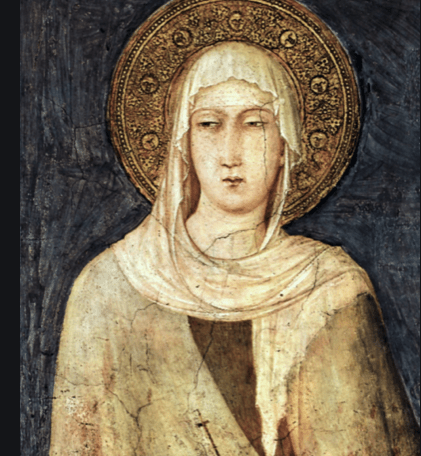
August 11 is the feast of St. Clare of Assisi, an important saint in the 13th century Franciscan movement that had a profound impact on the Christian world. Besides her example of faith, Clare was a woman who advanced women’s rights, changing the society she lived in.
Clare came from a powerful aristocratic family of landowners who held extensive farmlands around Assisi in Italy and controlled the peasants working them. A private army of knights protected and advanced her family’s interests.
Clare, like Francis of Assisi, came from a family of merchants intent on bettering themselves by exploiting the new trade routes linking Italy to the rest of Europe, but Clare felt called to another way of life. She wished to follow Jesus Christ.
She left her wealthy family as a young woman of 18 to embrace a life without property. “Foxes have dens and the birds of the air have their nest, but the Son of Man has nowhere to lay his head,” Jesus said. Like Francis, who encouraged her, she began searching for treasures of another kind.
As she wrote to Agnes of Prague, princess of Bohemia:
“Happy is she who clings with her whole heart to him whose beauty the hosts of heaven admire, whose tenderness touches, whose contemplation refreshes, whose kindness overflows, whose delight overwhelms, whose remembrance delightfully dawns, whose fragrance brings the dead to life again, whose glorious vision brings happiness…
He is the radiance of eternal glory, the brightness of eternal light and the mirror without blemish.
Gaze on the mirror each day and study your face in it…Indeed in that mirror blessed poverty, holy humility and inexpressible charity shine forth.”
Assisted by Francis, Clare and some young companions, including her sister Agnes, moved to the abandoned church of San Damiano outside Assisi after Holy Week in 1212.There they renounced a life of privilege and properties to live humbly and simply, following Jesus Christ.
The community she founded would be known later as “The Poor Clares.” It drew together women from the ranks of royalty to the poorest peasants.
Clare and women like her were part of an important spiritual movement in medieval Christianity which enriched the church with new forms of religious life and devotion. They were young people reacting to a world in love with success and insistent on class. In a time of violence and competition, ruthless pursuit of wealth and privilege, they pursued another way:
“You are the spouse, and the mother and the sister of my Lord Jesus Christ.” It came down to that.




 The Victor's Place