Feast of the Birth of Mary (September 8)

st.ann basilica

After consulting local traditions, the Emperor Constantine and his successors built churches over important biblical sites in Jerusalem and the Holy Land in the 4th century. One of the churches, built near the ancient pool of Bethesda, just north of the Jewish temple in Jerusalem, was associated with Mary, the mother of Jesus.

It was built on a spot pointed out in John’s gospel:  “Now there was in Jerusalem at the Sheep Gate, a pool in Hebrew Bethesda, with five porticoes. In these lay a large number of the blind, lame and crippled,”  (John 5,2) Jesus healed a paralyzed man at this healing place, where pagan gods  like Asclepius and Serapis were honored.

Third century traditions concerning Mary, the Mother of Jesus, were associated with the church built over the ancient healing site. The traditions claimed that Mary’s birth and early life took place in this area. By the 5th century, Mary’s birth was celebrated here September 8. Christian pilgrims, returning home, began ti celebrate the feast of her birth on this day.

Barnett - 771
Ruins of Bethesda and ancient church
Paralytic

In the last century archeologists uncovered the ancient healing pool with its porticoes, parts of an ancient church and ruins of a temple of Asclepius (2nd-4th century) ..

Jerusaelm streets
Ruins of the Temple of Serapis

The early traditions said that Mary’s mother was Anne and her father Joachim. He provided sheep for the temple sacrifices. They were looked down upon as old and childless, but angels came and told them they were to conceive a daughter. Like Abraham and Sarah, their faith was rewarded.

Stories of Mary’s birth and her childhood strongly influenced the spirituality and devotional life of the early Christian churches of east and west. The feast of her birth is still celebrated by all the ancient churches on September 8 . Her parents are honored September 9 by the Greek Church. The Roman Church celebrates their feast July 26th.

When the Crusaders conquered the Holy Land in the 11th century they rebuilt the small church over the healing pool, which had fallen into ruins, and also built a new, larger church honoring St. Anne, the mother of Mary, southeast of the pool.

The present Church of St. Anne is one of the most beautiful of Jerusalem’s churches today. A favorite destination for pilgrims, it stands overlooking the remains of the old church and the ancient healing pool.

Readings for today’s feast see Mary’s birth awaited by all her ancestors. The gospel, St.Matthew’s genealogy of Jesus, begins with Abraham whose hopes and the hopes of generations before him were fulfilled when Mary brought Jesus Christ into the world. “We commemorate the birth of the blessed Virgin Mary, a descendant of Abraham, born of the tribe of Judah and of David’s seed,” (Antiphon, 1st Vespers, Roman rite)

“This feast of the birth of the Mother of God is the prelude, while the final act is the foreordained union of the Word with flesh. Today, the Virgin is born, tended and formed and prepared for her role as Mother of God, who is the universal King of the ages…
Today the created world is raised to the dignity of a holy place for him who made all things. The creature is newly prepared to be a divine dwelling place for the Creator.”
(St. Andrew of Crete, bishop, Office of Readings, Roman rite)

The Birth of Mary is the first great feast in the Orthodox Church calendar which begins in September. Their calendar ends with the feast of Mary’s Dormition, on August 15th.

The Orthodox liturgy sees Mary as the mysterious ladder that Jacob saw in a dream reaching from earth to heaven. (Genesis 28,10-17) She is the way the Word came down to earth’s lowest point, death itself, and returns to heaven having redeemed humanity. The Orthodox liturgy also associates  Mary with the miracle of the paralyzed man at the Pool of Bethesda. She has a role in healing our paralyzed humanity.

May your Church rejoice, O Lord, for you have renewed her with these sacred mysteries, as she rejoices in the Nativity of the Blessed Virgin Mary, the hope and the daybreak of salvation for all the world. Through Christ our Lord.

23rd Sunday c: Going to School

For this week’s homily, please watch the video below.

September School

Our young people are going back to school this month of September.

What about those of us who are not going to school?

You are all learners, Jesus says in the gospel, and learning goes on all our life. Whether we know it or not, we’re in school, all our life. 

Our first reading today from the Book of Wisdom reminds us how little we know:

 “Scarce do we guess the things of earth and what is without our grasp we find with difficulty.” (Wisdom 9:13-18) There’s a lot we don’t know. And we are slow learners; we learn with difficulty.

“Teach us to number our days aright that we may gain wisdom of heart,”  our psalm today says. We’re learners all the days of our life and we’re looking for wisdom of heart. 

Wisdom of heart. Where will we find wisdom of heart?

Artificial intelligence is in the news these days. Will that give us all the answers we’re looking for? If you listen to our gospel today we’re going to need more than artificial intelligence to make our way through life.

Jesus speaks of fundamental human relationships in today’s gospel. ( Luke 14;25-33) Will artificial intelligence help us the solve how we handle the way we live together as human beings, in a family, in marriage, in the way we made choices in life? I don’t think so.

Will artificial intelligence be the answer to the crosses we carry in life? Sickness? Disappointment? Failure? Death? I don’t think so.

In today’s gospel Jesus speaks of a king marching into battle? Will artificial intelligence solve the wars that are multiplying in our world today? It may give us a more sophisticated arsenal. But will it help us bring peace and justice to the table? Will it take away greed and pride that so often cause our wars and our lack of care for the world we live in? 

Press a button and you will find it there? I don’t think so.

“Teach us to number our days aright that we may gain wisdom of heart,” we pray today.

For one thing, I wish we could make our Sundays our school through the year. Sunday is our Sabbath rest, which we inherit from our Jewish ancestors.

On the Sabbath God rested from the work of creation, the Book of Genesis says. And so should we. God saw creation as good, the Book of Genesis says, and so should we. The Sabbath rest invites us to turn from the regular cares that preoccupy us, turn from the television, the internet, the things that fascinate us, turn from the usual work that engages us, and be open to the presence of God, who is our Teacher and Savior. 

Jews and Catholics both follow the commandment of God “Keep holy the Sabbath Day.” Both of us see the Sabbath as the day God rested, and so should we. Our only difference is instead of Saturday, our Sabbath is Sunday, the day Jesus rose from the dead. Sunday was the day  Jesus revealed himself to his disciples. Sunday is still the day he reveals himself. 

 Jesus cured  on the Sabbath.  He raised people from the dead. On the Sabbath he told his disciples to eat lest they go hungry. Sunday should be a day of joy and replenishment.  The Jewish tradition says you always receive a gift on the Sabbath. We say the same thing, but we say  Jesus Christ is the gift we receive.  

He knows us as we are. We’re learners, slow learners. “Scarce do we guess the things of earth and what is without our grasp we find with difficulty.” He is always here as our Teacher and Savior to bless us. Sometimes it’s a bit of wisdom, sometimes it’s just the strength to go on. But he will always bless on our Sabbath, our Sunday, our Sunday School.  

Wouldn’t it be good to see our Sunday Mass, not something we have to go to, but a time to experience a gift of God?                

Thomas Berry’s Meadow

Thomas Berry was a Passionist priest and scholar dedicated to the care of creation, which we remember this season, September 1- October 4. In the video above he describes the simple, moving experience of a meadow he had as a child, an experience that influenced all his later scholarly work and reflections.

This season, let’s look at the gifts of creation around us, the water we drink, the food we eat, the trees, flowers and plants around us, and ask them to speak to us. As Pope Francis says: “The simple gifts of creation have a value in and of themselves and each one reflects in its own way a ray of God’s infinite wisdom and goodness. Its value and ray of divine light must be discovered and to discover it, we need to be silent, we need to listen, and we need to contemplate. Contemplation heals the soul.”

In the  Eucharist we take bread and wine into our hands and bless God for the whole of creation they represent.They become our spiritual food and drink.The celebration of the Eucharist in the Season of Creation is a good time to deepen our vision and visit our brothers and sisters of creation in the light of this mystery.

Epistle to the Colossians

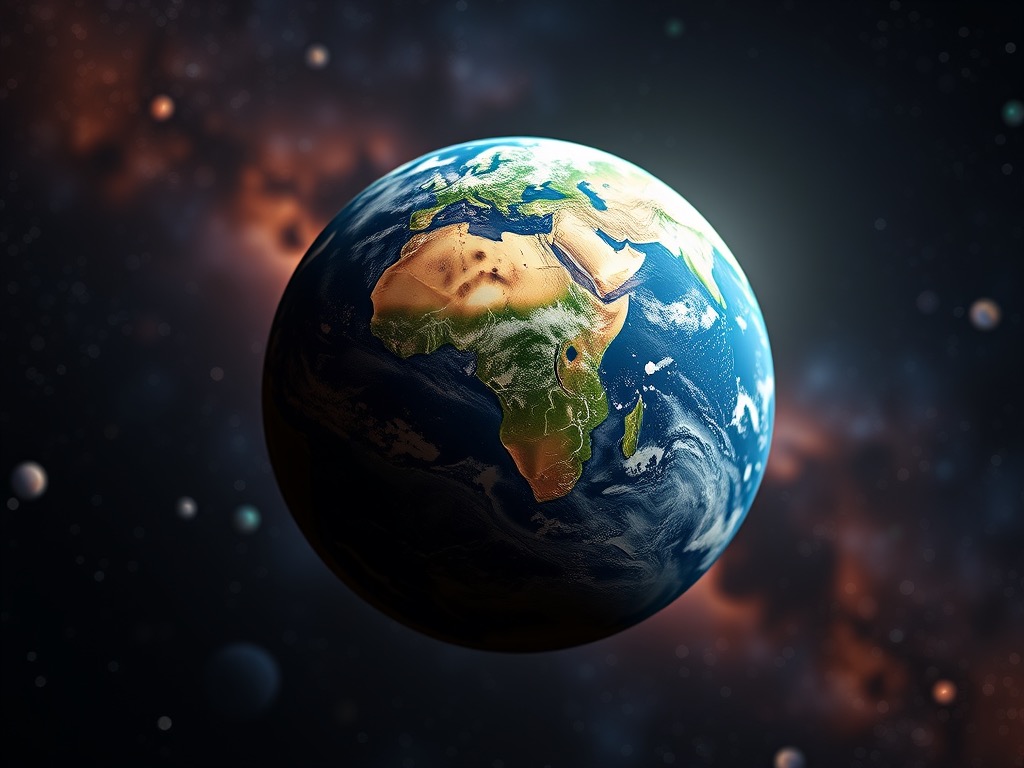
NASA. Photo

We begin reading the Letter to the Colossians this week in our liturgy. Paul never visited this church near Ephesus. Commentators don’t agree about the situation Paul addresses in the letter. It’s not about human behavior or questions about human morality as the letters to the Corinthians are. 

The Colossians have faith in Christ; they love for one another. But some of them are trying to understand the cosmos. What’s this world beyond our human world all about? 

Don’t leave Jesus Christ out of that larger world, Paul says. He speaks to the Colossians– and also the Ephesians– about the Cosmic Christ. 

“Jesus is the image of the invisible God, the firstborn of all creation. For in him were created all things in heaven and on earth, the visible and the invisible, whether thrones or dominions or principalities or powers; all things were created through him and for him.He is before all things, and in him all things hold together. He is the head of the Body, the Church.He is the beginning, the firstborn from the dead, that in all things he himself might be preeminent. For in him all the fullness was pleased to dwell, and through him to reconcile all things for him, making peace by the Blood of his cross through him, whether those on earth or those in heaven.”  (Colossians 1, 15-20)

Is Paul’s letter to the Colossians a timely message for our age too? Jesus Christ seems to have little place in our discussions on cosmology. Jesus Christ is not just Jesus of Nazareth, rejected by his own people in a little corner of the Middle East long ago. He is not just a teacher who tells us how to get along with one other. “Jesus is the image of the invisible God…in him were created all things in heaven and on earth.” “He holds all things together” for 4.5 billion years and beyond.. He brings peace through the blood of his cross. He lives and reigns with Father and the Holy Spirit, now and forever.  

Like the Colossians, we need to hear this, today.

St. Gregory the Great: September 3

September 3rd is the feast of St. Gregory the Great – greatest of the popes, many say. Gregory’s remembered, not on the day of his death, but on the day he became pope, September 3, 590, which probably was the day he thought himself condemned to death.

Years ago, I lived across the street from Gregory’s home on the Celian Hill in Rome. On my way to school, I would peek through the doors of the library of Pope Agapitus, a relative of Gregory’s, where archeologists were at work learning about what was once the largest Christian library in Rome. Barbarian tribes later plundered the place on one of their regular sweeps through the city. 

Bad times. Gregory was called from his monastery, not just to be pope, but to lead a city under siege. He was never healthy and never had much support. Most of Rome’s leading families moved to safer parts; the imperial government relocated in Milan. The burden of the city and the church fell on him. 

Called to a position he didn’t want, Gregory drew wisdom and strength from the scriptures, especially from figures like Job and Paul the Apostle. In his Commentary on Ezechiel, Gregory saw himself like Ezechiel appointed the city’s watchman, who had to go up to the heights and see what’s coming,

“I’m not doing this very well, ” Gregory says. 

“I do not preach as well as I should nor does my life follow the principles I inadequately preach.

  “I don’t deny my guilt, I get tired and negligent. Perhaps by recognizing my failure I’ll win pardon from a sympathetic judge. When I lived in the monastery I was able to keep my tongue from idle topics and give my mind almost continually to prayer, but since taking on my shoulders the burden of pastoral care, I can’t keep recollected, with my mind on so many things.

“I have to consider questions affecting churches and monasteries and often have to judge the lives and actions of others; I have to take part in certain civil affairs, then I have to worry about barbarians attacking and wolves menacing the flock in my care; I have a political duty to support those who uphold the law; I have to put up patiently with thieves and then I have to confront them,  in all charity.

  “My mind is torn by all the things I have to think about. Then I have to put my mind on preaching. How can I do justice to this sacred ministry? 

“Because of who I am I have to associate with all kinds of people and sometimes I say too much. But if I don’t talk to them the weaker kind of people wont come near me, and then we wont have them when we need them. So I have to listen to a lot of aimless chatter. 

 “But I’m also weak myself and I can get drawn into gossiping and then find myself saying the same things I didn’t care to listen to before. 

  “Who am I — what kind of watchman am I? I’m not standing  on the heights, I’m down in the depths of weakness. And yet the creator and redeemer of all can give me, unworthy as I am, the grace to see life as it really is and power to speak effectively of it. It’s for love of him that I do not spare myself in preaching him.”

You have to admire Gregory. However he felt, he’s the watchman caring for his city and his church. Weakness doesn’t prevent him from serving or being far-sighted. From the Celian Hill Gregory sent monks to England, then the ends of the world, to found the church there.

On his tomb in the Vatican is the simple inscription that describes him so well. “Servant of the servants of God.” 

We shouldn’t limit Gregory’s teaching on service to popes, bishops and priests either. It applies to anyone who directs others, like parents, teachers, politicians, directors and mentors of all kinds. You can’t serve others well if you don’t know yourself and your own weakness.

September School

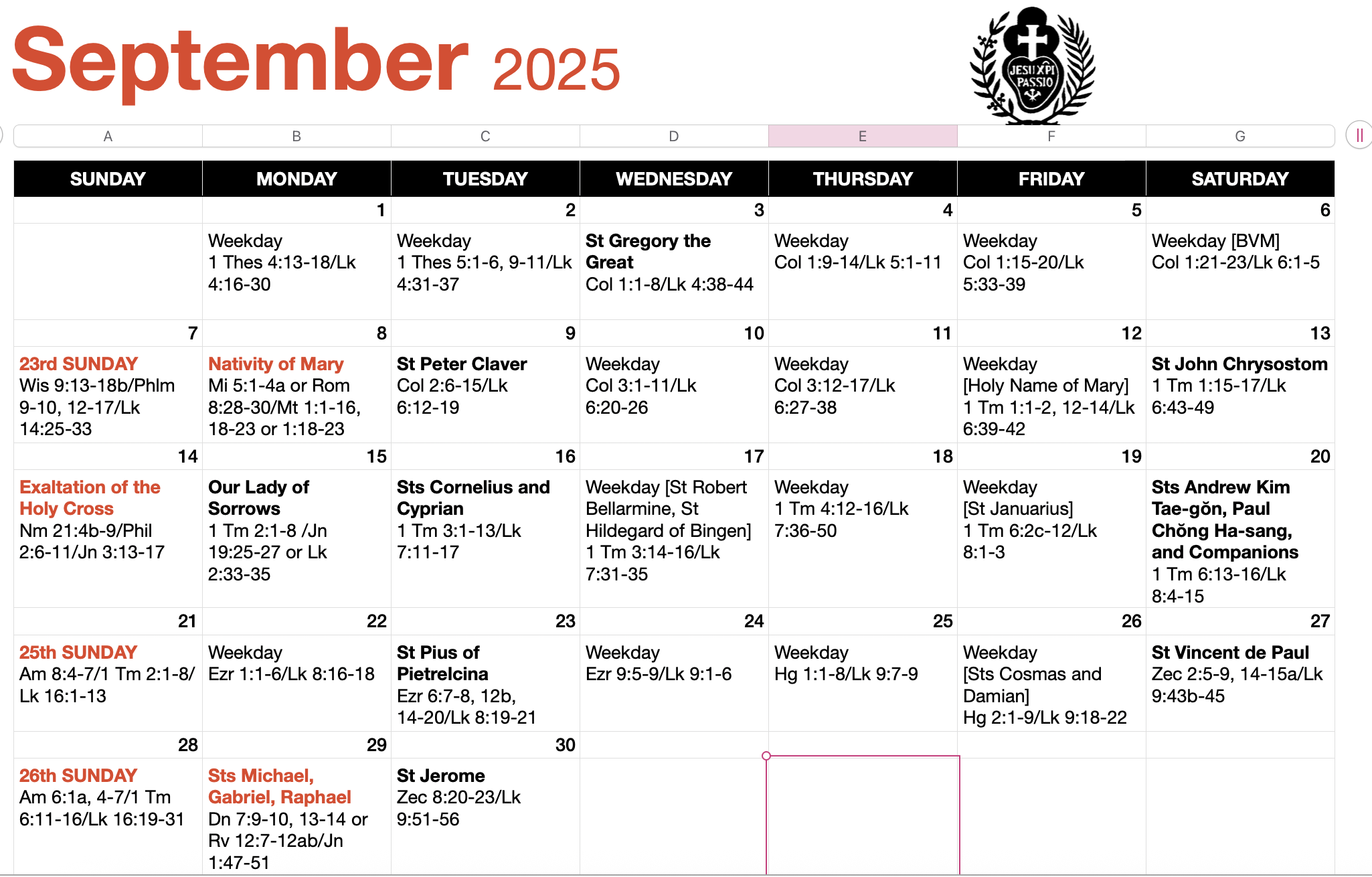
Kids go back to school in September and  I ask myself: are you going to school too? I’m looking at the church calendar for September. It’s a school of another kind, isn’t it? It calls for celebrating feasts, reflecting on the scriptures and listening to saints. They’re good teachers, not afraid to offer their lessons year after year.

The saints in our calendar are wonderful people, good teachers. St. John Chrysostom, September 13th, complained about people of his time who don’t know much about the church’s calendar at all: “Many people today just about know the names of the feasts we celebrate in church. They know hardly anything about where we come from and what it means… What a shame.” We’re forgetful listeners, the saint says.s

September has a parade of interesting saints, like Gregory the Great, September 3rd, the pope who lived when the Roman world was falling apart, but he didn’t fall apart. He believed in doing something and he wasn’t afraid to think big. He sent missionaries out to faraway England and northern Europe. 

In a world falling apart, he tells us don’t give up, be courageous. There are still things to be done. 

St. Peter Claver, September 9th, worked among the black slaves in Colombia, South America. He reminds us not to forget there’s still slavery in our world. Don’t forget it: let’s try to get rid of it.

Saints Cornelius and Cyprian, September 16, early Christian martyrs, remind us that people died for the faith we believe in. It’s that important. They were concerned too about God’s forgiveness. The world goes round because of the mercy of God.

September 26th , St. Vincent De Paul was inspired by God to take care of the poor in France. He started a whole movement in the church of people who looked after the poor. Is there someone at work now speaking for the poor?

St. Matthew, the tax collector, September 21. Jesus called him to be one of his apostles. Others looked down on him. But God didn’t look down on him, nor does he look down on us. 

St. Jerome. September 30th was a saint who loved the bible and constantly studied it. That’s something we should do too. Some of our calendars give us a list of the scriptures we’re reading in church. So why not read them with the church day by day. That would be a wonderful way to keep learning and hearing God speak.

September 14th we celebrate the Feast of the Exaltation of the Holy Cross. It’s like Holy Week in September. We need to be lifted up by the mysteries of Jesus continually. He died and he rose again. We die and rise again with him. 

September 15 we remember the sorrows of the Mary. Every month we have at least one feast of Mary, this month, September, we have two. We remember her birth on September 8. She’s our companion as we follow her son. She can help us understand him and do whatever he tells us.

On September 1st this year, Pope Leo called again to remember creation and care for the creation we are part of. Leo wants us all to join together and lift up this world we’ve endangered by our abuse.

September is a school. October, November….they’re schools too.

The Season of Creation: September 1-October 4

Ten years ago, Pope Francis called for A World Day of Prayer for the Care of Creation for September 1st. The day of prayer, coinciding with the publication of his letter Laudato si’ , began a Season of Creation, an ecumenical endeavor shared with other churches and communities that extends from September 1st to October 4th, the Feast of St. Francis of Assisi. 

Our church calendar, besides feasts and seasons, has days of prayer when particular causes  arise. In a recent letter, Pope Leo called the care of creation a particularly timely issue to pray for:

“…given the evidence in various parts of the world that our earth is being ravaged. On all sides, injustice, violations of international law and the rights of peoples, grave inequalities and the greed that fuels them are spawning deforestation, pollution and the loss of biodiversity. Extreme natural phenomena caused by climate changes provoked by human activity are growing in intensity and frequency (cf. Laudato Deum, 5), to say nothing of the medium and long-term effects of the human and ecological devastation being wrought by armed conflicts.

As yet, we seem incapable of recognizing that the destruction of nature does not affect everyone in the same way. When justice and peace are trampled underfoot, those who are most hurt are the poor, the marginalized and the excluded. The suffering of indigenous communities is emblematic in this regard.

That is not all. Nature itself is reduced at times to a bargaining chip, a commodity to be bartered for economic or political gain. As a result, God’s creation turns into a battleground for the control of vital resources. We see this in agricultural areas and forests peppered with landmines, “scorched earth” policies, [1] conflicts over water sources, and the unequal distribution of raw materials, which penalizes the poorer nations and undermines social stability itself…

Environmental justice – implicitly proclaimed by the prophets – can no longer be regarded as an abstract concept or a distant goal. It is an urgent need that involves much more than simply protecting the environment. For it is a matter of justice – social, economic and human. For believers it is also a duty born of faith, since the universe reflects the face of Jesus Christ, in whom all things were created and redeemed. In a world where the most vulnerable of our brothers and sisters are the first to suffer the devastating effects of climate change, deforestation and pollution, care for creation becomes an expression of our faith and humanity.

Now is the time to follow words with deeds.”

 ( For THE 10th WORLD DAY OF PRAYER
FOR THE CARE OF CREATION 2025)

Recently, the Dicastery for Divine Worship provided a preliminary text for a Mass for the Care of Creation. A good resource for prayer during the Season of Creation.

MASS FOR THE CARE OF CREATION

Entrance Antiphon Ps 18: 2

The heavens declare the Glory of God,

and the firmament proclaims the work of his hands.

Collect

God our Father,

who in Christ, the firstborn of all creation,

called all things into being,

grant, we pray, that docile to the life-giving breath of your Spirit, we may lovingly care for

the work of your hands.

Through our Lord Jesus Christ, your Son,

who lives and reigns with you in the unity of the Holy Spirit,

God, for ever and ever.

Prayer over the Offerings

Receive, O Father,

these fruits of the earth and of our hands:

bring to completion in them the work of your creation,

so that, transformed by the Holy Spirit,

they may be for us the food and drink of eternal life.

Through Christ our Lord.

Communion Antiphon All the ends of the earth have seen the salvation of our God.

cf. Ps 97: 3

Prayer after Communion

May the sacrament of unity

which we have received, O Father,

increase communion with you and with our brothers and sisters,

so that, as we await the new heavens and the new earth,

we may learn to live in harmony with all creatures.

Through Christ our Lord.