Today the church celebrates two early saints and martyrs, Cornelius, a pope who died in 253, and Cyprian, a bishop who was martyred in Roman Africa shortly after in 258.
At the time barbarian tribes in the west and the Persians in the east were invading Roman territory; the Roman emperors Decius and Valerian called for absolute loyalty from their people. The empire was imperiled.
To prove their loyalty, Roman citizens lined to offer sacrifice in honor of the emperor. Christians refused, and so at first church leaders were executed or imprisoned, wealthy, influential Christians lost their property, their positions and possibly their lives. Finally, all Christians could expect punishment for not performing the rites of sacrifice.
Not every Christian remained loyal to the faith at the time. Many offered sacrifice, betraying their faith, then afterwards sought to return to the church. Hard liners called for them to be banned for life for their lack of loyalty. Let God judge them when they die, they said. Others, like Cornelius and Cyprian, called to reconcile them after a time of penance, since God is all merciful.
Mercy and justice are always hard to reconcile. The gospels come down on the side of mercy. So should we.
In the persecution, Cornelius, bishop of Rome, was executed first, Cyprian, bishop of Carthage in Africa, was executed a few years later. The two men were from different social backgrounds and not always on good terms, historians say, but they found support in their common faith, as this letter of Cyprian to Cornelius, written shortly before Cornelius’ death, reveals:
“Cyprian to my brother Cornelius,
Dearest brother, bright and shining is the faith which the blessed Apostle praised in your community. He foresaw in spirit the praise your courage deserves and the strength that can not be broken; he was heralding the future when he testified to your achievements; his praise of the fathers was a challenge to the sons.
Your unity, your strength have become shining examples of these virtues to the rest of us. Divine providence has now prepared us. God’s merciful design has warned us that the day of our own struggle, our own contest, is at hand. By that shared love which binds us close together, we are doing all we can to exhort our congregation, to give ourselves unceasingly to fastings, vigils and prayers in common. These are the heavenly weapons which give us the strength to stand firm and endure; they are the spiritual defences, the God-given armaments that protect us.
Let us then remember one another, united in mind and heart. Let us pray without ceasing, you for us, we for you; by the love we share we shall thus relieve the strain of these great trials.”
As far as I remember there are three miracles in which Jesus raises someone from the dead. The most famous is the raising of Lazarus, his friend. His sisters, Mary and Martha, were also well known to him. Jesus stayed with them at Bethany, on the outskirts of Jerusalem. That miracle led his enemies to plot to put him to death.
Earlier, in Capernaum, Jesus raised the little daughter of Jairus, an official of the synagogue, from the dead. The official pleaded with him. Jesus goes to his house, where the mourning had already begun, and took the little girl by the hand and raised her up and told her parents to give her something to eat.
Today’s reading at Mass recalling the miracle in which Jesus raises the widow’s son as they carry him through the gates of the town of Naim seems somewhat different. The mother and son are strangers to him. We don’t know their names; they have no claim of friendship or position that may influence him. It’s the very opposite. The mother is a widow. Her son was the last asset she had and now he’s dead. She has nothing. Absolutely poor.
Our reading from Luke (Luke 7,11-17) provides the answer Jesus will give to John’s disciples as they approach him after this incident and ask “Are you he who is to come?” Tell John, Jesus says, “the blind see, the deaf hear, the dead are raised and the poor have the gospel preached to them.”
“The poor have the gospel preached to them.” Those who have nothing and who know they have nothing, like the widow, are given the greatest gifts. God notices them. God’s heart goes out to them.
That was an important teaching of St. Paul of the Cross, the founder of the Passionists. “Go to God in your nothingness,” he said to people looking for guidance. Learn from the poor widow. Go to God with nothing.
In the years Paul of the Cross founded the Passionists, a lot of men left his community for one reason or another, and Paul respected them, but he reacted when someone left for the wrong reasons.
St Vincent Strambi, his biographer, tells about a priest who left the Passionists to make a career for himself in the church. He wanted to be a success so he got a string of degrees and began to climb the church bureaucracy. He wrote Paul a very self-congratulatory letter informing him how much better he was now for leaving the Passionists. At the end he signed his name, noting all his new degrees and honors after it.
Paul answered his letter, thanking him for letting him know how he was making out and wishing him well. But at the end of the letter he simply signed his name: “Paolo, n,n.n”– “Paul, a nobody, no one, having nothing.”
Our first reading today is all about bishops and deacons. (1 Timothy 3,1-13) Our gospel is about a widow. Who’s more important?
The Memorial of Our Lady of Sorrows is celebrated the day after the Feast of the Exaltation of the Cross (September 14). Eight days after Mary’s birth (September 7) her sorrows are recalled, her lifelong sorrows.
The old man Simeon spoke of her lifelong sorrows when hetold Mary a sword would pierce her heart when Jesus was born. Her greatest sorrow, of course, came when she stood beneath the Cross of her Son.
What, then, were her lifelong sorrows? The gospels indicate some of them, but perhaps more important was Mary’s experience of the sorrow every human being experiences. An infant cries as it enters this world. “Our life is over like a sigh. Our span is seventy years, or eighty for those who are strong. And most of these are emptiness and pain.” (Psalm 90) Everyone experiences the human sorrow the psalms describes. Mary experienced that human sorrow.
The sword of sorrow struck Mary most deeply at the death of her Son. Some of Jesus followers stood at a distance when he was crucified. But John’s gospel describes Mary as the first of those standing close by, beneath the cross itself. “Standing by the cross of Jesus were his mother and his mother’s sister, Mary the wife of Clopas, and Mary Magdalene.”
Mary stands by the Cross of Jesus, close by, not at a distance. She’s not absorbed in her own suffering, not afraid to see. Her closeness to the Cross is significant. She enters the mystery of her Son’s suffering through compassion.
She stood by him. Compassion doesn’t experience another’s suffering exactly, and it may not take another’s suffering away. Compassion enters suffering to break the isolation suffering causes. It helps someone bear their burden. The sword, the spear, the sorrow, pierces both hearts, in different ways.
Our prayer for today’s feast says that when her Son “was lifted high on the Cross” his mother stood by and shared his suffering. “Grant that your Church, participating with the Virgin Mary in the Passion of Christ, may merit a share in his Resurrection.
Basil (Ocimum basilicum), a sweet smelling herb that heals the body and flavors our foods, has been associated for centuries with the Feast of the Exaltation of the Cross, September 14.
Stories from the Orthodox tradition say that when the Empress Helena went to the Holy Land in the 4th century to pray where Jesus lived and died and rose again, she wanted, above all, to find the Cross on which he died. At first, she found nothing, but then on a bare hill in Jerusalem she smelled a basil bush and ordered workers to dig where the basil grew. They found the remains of the Cross.
Today, in many eastern churches, a relic of the Cross surrounded by basil leaves and plants is carried in procession through the church on the feast.
Another story says the women who went to the tomb on Easter Sunday found a basil plant in the tomb where the body of Jesus was placed. Stories like this illustrate how the eastern churches brought creation into the mystery of salvation.
Basil is a sign of life. it deserves to be before our altar as we celebrate the Feast of the Exaltation of the Cross.
Pilgims enteing the Church of the Holy Sepulcher, Jerusalem
This ancient ecumenical feast, celebrated by Christian churches throughout the world, commemorates the dedication of a great church in Jerusalem at the place where Jesus died and rose again. Called the Anastasis ( Resurrection) or the Church of the Holy Sepulcher, it was built by the Emperor Constantine and dedicated on September 13, 325. It’s one of Christianity’s holiest places.
Liturgies celebrated in this church, especially its Holy Week liturgy, influenced churches throughout the world. Devotional practices like the Stations of the Cross grew up around this church. Christian pilgrims brought relics and memories from here to every part of the world. Christian mystics were drawn to this church and this feast.
Tomb of Jesus
Calvary
Pilgrims still visit the church and the tomb of Jesus, recently renovated after sixteen centuries of wars, earthquakes, fires and natural disasters. They venerate the rock of Calvary where Jesus died on a cross. The building today is smaller and shabbier than the resplendent church Constantine built, because the original structure was largely destroyed in the 1009 by the mad Moslem caliph al-Hakim. Half of the church was hastily rebuilt by the Crusaders; the present building still bears the scars of time.
Scars of a divided Christendom can also be seen here. Various Christian groups, representing churches of the east and the west, claim age-old rights and warily guard their separate domains. One understands here why Jesus prayed that ” All may be one.”
Egyptian Coptic Christians
Seventeenth century Enlightenment scholars expressed doubts about the authenticity of Jesus’ tomb and the place where he died, Calvary. Is this really it? Alternative spots were proposed, but scientific opinion today favors this site as the place where Jesus suffered, died and was buried.
Saint John Chrysostom was born around 340 into a military family in Antioch, in modern Turkey. He studied under Libanius, the great rhetorician of the day and afterwards lived with monks in Syria for a few years, but poor health made him return to Antioch, where he served the church for five years as a deacon, taking care of the poor.
Ordained a priest in 386, John became a bishop of Constantinople, then the seat of Roman power. John was an outstanding preacher: his “golden mouth” (Chrysostom) delighted ordinary hearers with sermons on the gospels and the letters of Paul, but they got him into trouble with the city’s rulers and churchmen whom he attacked for their wealth and high living. The Empress Eudoxia exiled him briefly from the city in 402 AD.
John returned and resumed his fearless preaching against the city’s powerful political and church elite. Eudoxia finally sent him into exile on the Black Sea after John gave a sermon that began “Again Herodias is raging, again she is perturbed, again she wants to receive the head of John on a dish.” Not a way to win friends in high places.
“ Glory be to God for everything. Amen” John said as he made his way to exile and death. “If Christ is with me, whom shall I fear. Though the waves and the sea and the anger of princes are against me, they’re as weak as a spider’s web.”
He died on September 14, 407, the Feast of the Triumph of the Holy Cross, which we celebrate tomorrow.
Like other bishops of the time– Athanasius, Basil, Gregory Nazianzen– John faced a Roman government no longer intent on destroying the church but rather having it under its thumb. Like them, John suffered exile, yet still spoke out to power. In our prayer for his feast, we thank God for a bishop made “illustrious by his wonderful eloquence and his example of suffering.” We ask for brave church leaders like John. We need them now to lead a church that speaks to power.
Notice too that John spent some years as a deacon, taking care of the poor. His preaching was nourished by that experience. Here’s an example:
The waters are up; storms are on us, but we’re not afraid of drowning; we’re standing on a rock. The raging sea won’t break the rock. The rising waves won’t sink the boat of Jesus. What are we afraid of? Death? Life to me means Christ, and death is gain. Exile? The earth and its fullness belong to the Lord. Goods taken away? We brought nothing into this world, and we shall surely take nothing from it. I have only contempt for the world’s threats, I find its blessings laughable. I have no fear of poverty, no desire for wealth. I am not afraid of death nor do I long to live, except for your good.
I concentrate therefore on the present situation, and I urge you, my friends, to have confidence. Do you not hear the Lord saying: Where two or three are gathered in my name, there am I in their midst? Will he be absent, then, when so many people united in love are gathered together? I have his promise; I am surely not going to rely on my own strength! I have what he has written; that is my staff, my security, my peaceful harbour. Let the world be in upheaval. I hold to his promise and read his message; that is my protecting wall and garrison. What message? Know that I am with you always, until the end of the world! If Christ is with me, whom shall I fear?
September is a school month. We’re all still going to school. As Catholics we learn from the feasts and saints we celebrate and the readings before us, day by day, month by month.
We also learn from the prayers we say. If we listen closely our prayers tell us to pray from the world we live in. For example: “Grant that all the faithful of the church, looking into the signs of the times by the light of faith, may devote themselves to the service of the gospel. Keep us attentive to the needs of all that, sharing their grief and pain, their joy and hope, we may faithfully bring them the good news of salvation and go forward with them along the way of your Kingdom.” (Eucharistic Prayer)
We need to pray, not just for our ourselves or those close to us, but for all and for the world at large.
What are the signs of the times we should look for this September? On September 11, we remembered the destruction of the World Trade Center in New York and the thousands killed there. A sign that our world is in danger.
This month in New York City the United Nations meets. In September 2015 world leaders agreed to work together to achieve 17 Sustainable Development Goals by 2030.The goals aimed to “eliminate poverty, fight inequality and tackle climate change, while ensuring no one is left behind.” They recognized that ending poverty must go hand-in-hand with strategies that build economic growth and address.
We are not on target to achieve those goals. A pandemic and wars are presently dividing us. Doesn’t look good.
If we don’t look on these signs of the times in the light faith we can easily throw up our hands and hide in our own worlds, But faith says the world is in God’s hands, and ours too, so let’s not lose hope or give up.
September is also the Season of Creation. It’s time to open our minds to the created world around us and give it our attention and care. Technology is not the complete answer to climate change. Our religious traditions tell us to see creation as God’s creation. We need to welcome it into our prayer and our care.
Pope Francis in Laudato Si’ says we need to have “ an ecological conversion”. Let’s pray we do.
September is a month to go to school. Every month, every day we’re going to school.
Today is the 24th anniversary of the terrorist attach on the World Trade Center in New York City, September 11, 2001. Like many others I remember where I was then. I watched the towers fall from a rooftop in Union City, New Jersey, just across the river. Many from that area died that day and as the days went on their bodies were recovered and they were buried in nearby churches. A frightful time.
About a year later, I went to an exhibit about the attack called “Recovery,” at the New York Historical Society. The exhibition rooms were filled with debris from the tragedy: parts of smashed police cars and fire engines–I remember a little child’s doll, parts of one of the planes that crashed into the buildings. A black and white film of the disaster played silently in one section of the exhibit. Grim reminders of that awful day.
It was the exhibit’s opening day and media people were there. One of them came up to me with a notebook in hand. “What do you think of this?” he said. I had my clerical collar on so he knew who I was.
I told him I really couldn’t put into words what I thought. It was an overwhelming picture of evil.
He wrote what I had to say in his notebook and then put it in his pocket and said, “You know I don’t believe in evil.” That began a conversation that lasted for a hour or so.
I asked him first of all why he didn’t believe in evil, so evident here.
“Yes, this is bad,” he said, “ but we can change the way people behave. We can rinse out the evil in them by giving them a better world.” How? “Science and technology can change the world,” he said, “we can give people what they want and give them all they need.” Later I found out that he was a writer specializing in science and technology
“Do you believe in God?” “No, I don’t,” he said. “In fact, it would be better to get rid of God altogether. And that goes for religion too. Get rid of it. The fanaticism of religion was responsible for this.”
At the end of our conversation, it seemed to me his hope about creating a better world through science and technology seemed naïve and unreal. Even if everyone in the world were given a new iPhone, his kind of thinking doesn’t seem to be the answer. Evil is hard to rinse out of our world.
In a post-modern world, optimism about science and the rationalism that came with the Enlightenment seems on the decline and nothing is taking its place. Post modernism is against everything from the past, including religion and religious truth.
Our weekday lectionary gives us a succession of readings from the gospels of Mark, Matthew and Luke through the year. The compilers of the lectionary after the 2nd Vatican Council evidently followed the majority of scholars who see Mark as the first gospel written, and Matthew and Luke following Mark as they write their own story of Jesus for their own time and place.
Mark was written for the church of Rome, just recovering from the horrific persecution of Nero. Matthew was written for a Jewish Christian church struggling with a resurgent Pharisaic Judaism. Luke wrote for a church made up increasingly of gentiles. The compilers left the Gospel of John for the lenten and eastern seasons and some other days of the year.
Some weeks ago we read Matthew’s account of the beatitudes which Jesus preached on the mountain, as the new Moses. Today we read Luke’s account of the beatitudes which Jesus preaches on the plain, where “ he came down… and stood on a stretch of level ground and…a great crowd of his disciples and a large number of the people from all Judea and Jerusalem and the coastal region of Tyre and Sidon came to hear him.”
Luke indicates more than Jews came to hear Jesus.
In Luke’s account, Jesus speaks to his disciples. Luke Timothy Johnson says the crowds are like bystanders listening by in Luke’ account. It’s to his disciples Jesus speaks. He promises they will be blessed, but he also warns those who received much not to fail the poor, the hungry and those who weep. “Woe to you.”
Who are the disciples to whom Jesus speaks? They are not only those he chose on the mountain, but they are his disciples Luke sees in the communities of his day. They are those Paul speaks to and warns in his letter to the Corinthians which, appropriately, we read along with Luke’s Gospel these weekdays. All of them are ordinary Christians who were given much.
Commentators on Luke’s Gospel say that Luke is easy on the weak and hard on the strong. Think of the two sons in the parable of the Prodigal Son.
Blessed are you who are poor, for the Kingdom of God is yours.
Blessed are you who are now hungry, for you will be satisfied.
Blessed are you who are now weeping,for you will laugh.
Blessed are you when people hate you, and when they exclude and insult you, and denounce your name as evil on account of the Son of Man.
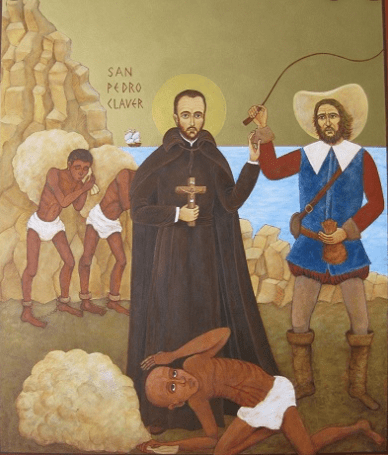
Today we remember St. Peter Claver, the Jesuit priest who ministered to slaves in South America in the 17th century. A native of Spain, he came to Cartagena, Colombia in 1610 and died there in 1654.
Catholic nations like France, Spain and Portugal, early colonizers of North and South America, imported an estimated 11 million Africans from 1519-1867 to work on sugar plantations, mines and farms in the New World. Cartagena was a center of the South American slave trade. Slaves bought in West Africa were transported in ships that made the journey in appalling conditions; about one third died on the 6 or 7 week voyage.
Peter Claver, enlisting Africans familiar with the various tribal languages and culture, helped the arrivals with food, medicine and the promises of faith. “This was how we spoke to them, not with words but with our hands and our actions. And in fact, convinced as they were that they had been brought here to be eaten, any other language would have proved utterly useless.”
Many of these poor human beings accepted Baptism from their hands and became Christian.
.Peter called himself the “slave of the slaves,” He pleaded with slave owners on local plantations and mines to treat slaves humanely, but Spain needed gold and colonists appreciated the wealth brought by slavery,
Unfortunately, at the time Catholic and Protestant churches alike hoped slavery might bring happiness and cultural enlightenment to the black race. Church leaders condoned slavery and most of the church’s moralists found reasons to justify the institution.The churches were not alone in condoning slavery, most figures of the enlightenment, convinced of the inferiority of African and native Americans, condoned it too.
By the end of the 19th century the major western powers abolished the institution of slavery.
Pope Leo XIII canonized Peter Claver in 1896 and designated him patron of all Roman Catholic missions to the African peoples. In the USA Catholic liturgical calendar his feast is a memorial, not an optional memorial as it is in the Roman calendar. He reminds the American Catholic Church that racism and slavery were major problems in the New World, and they still are.
A letter of St Peter Claver
The arrival of a slave ship
Yesterday, May 30, 1627, on the feast of the Most Holy Trinity, numerous blacks, brought from the rivers of Africa, disembarked from a large ship. Carrying two baskets of oranges, lemons, sweet biscuits, and I know not what else, we hurried towards them. When we approached their quarters, we thought we were entering another Guinea. We had to force our way through the crowd until we reached the sick. Large numbers of the sick were lying on wet ground or rather in puddles of mud. To prevent excessive dampness, someone had thought of building up a mound with a mixture of tiles and broken pieces of bricks. This, then, was their couch, a very uncomfortable one not only for that reason, but especially because they were naked, without any clothing to protect them.
We laid aside our cloaks, therefore, and brought from a warehouse whatever was handy to build a platform. In that way we covered a space to which we at last transferred the sick, by forcing a passage through bands of slaves. Then we divided the sick into two groups: one group my companion approached with an interpreter, while I addressed the other group. There were two blacks, nearer death than life, already cold, whose pulse could scarcely be detected. With the help of a tile we pulled some live coals together and placed them in the middle near the dying men. Into this fire we tossed aromatics. Of these we had two wallets full, and we used them all up on this occasion. Then, using our own cloaks, for they had nothing of this sort, and to ask the owners for others would have been a waste of words, we provided for them a smoke treatment, by which they seemed to recover their warmth and the breath of life. The joy in their eyes as they looked at us was something to see.
This was how we spoke to them, not with words but with our hands and our actions. And in fact, convinced as they were that they had been brought here to be eaten, any other language would have proved utterly useless. Then we sat, or rather knelt, beside them and bathed their faces and bodies with wine. We made every effort to encourage them with friendly gestures and displayed in their presence the emotions which somehow naturally tend to hearten the sick.
After this we began an elementary instruction about baptism, that is, the wonderful effects of the sacrament on body and soul. When by their answers to our questions they showed that they had sufficiently understood this, we went on to a more extensive instruction, namely, about the one God, who rewards and punishes each one according to his merit, and the rest. We asked them to make an act of contrition and to manifest their detestation of their sins. Finally, when they appeared sufficiently prepared, we declared to them the mysteries of the Trinity, the Incarnation and the Passion. Showing them Christ fastened to the cross, as he is depicted on the baptismal font on which streams of blood flow down from his wounds, we led them in reciting an act of contrition in their own language.
O God, who made Saint Peter Claver a slave of slaves and strengthened him with wonderful charity and patience as he came to their help, grant, through his intercession, that, seeking the things of Jesus Christ, we may love our neighbour in deeds and in truth.Through our Lord Jesus Christ, your Son, who lives and reigns with you in the unity of the Holy Spirit, one God, for ever and ever. Amen.



 The Victor's Place