4th Sunday of Advent a: The Witness of Joseph

For this week’s homily please watch the video below.

December 20: The Annunciation

St. Luke’s account of the Annunciation to Mary, read today at Mass,  follows the announcement of the birth of John to Zechariah in yesterday’s advent readings. Mary responds to the angel so differently than the priest Zechariah. (Luke 1, 5-25,)

In the temple where great mysteries are celebrated, the priest won’t believe he and his wife can conceive a child. They’re too old. He doubts.

In  Nazareth, an unlikely place for a great revelation, the angel approaches Mary with a message far more difficult to grasp. “ The Holy Spirit will come upon you and the power of the Most High will overshadow you. Therefore the child to be born will be called holy, the Son of God.”

Mary believes and does not doubt and by God’s power conceives a Son who will be born in Bethlehem. “Behold, the handmaid of the Lord, be it done to me according to your word,”

This is a golden moment, the 13th century painting above by Simone Martini and Lippo Memmi indicates. Mary is at home in prayer when the angel comes. Prayer enables her to believe and accept what is revealed. That’s true for all of us: prayer helps us discern and say yes to what God reveals.

“How can this be. I do not know man?” Mary says to the angel. Our painting seems to capture that moment in our gospel passage, but Mary will go on to respond in faith, “Be it done to me according to your word.” Mary is a woman of faith; we learn from her.

Today we pray:

O Flower of Jesse’s stem, you have been raised as a sign for all peoples; kings stand silent in your presence; the nations bow down in worship before you. Come, let nothing keep you from coming to our aid. 

Readings www.usccb.org

December 19: Zechariah in the Temple

Zachariah in Temple, William Blake Wiki Commons

The priest Zachariah goes into the temple bearing incense to worship the Lord , “In the days of King Herod”, our Advent readings says today. An angel appears next to the altar of incense and says to him. “Your prayer has been heard,..Your wife will bear you a son.”

Surely, the old priest was no longer praying for a son. Childbearing was over for his wife and himself. The promise of new life was long gone; there’s no hope for a child.

But the angel promises a child “great in the eyes of the Lord” to be called John, who will more than fulfill their hopes, turning “many of the children of Israel to their God.”

The old priest doubts and is punished with silence. He won’t speak until after the child is born. Then he speaks again,  as he announces to those at his birth that “his name is John.”

You lose your voice when you lose hope in God’s promises. You get it back when you believe. When John is born, Zechariah sings a song of praise at God’s unexpected  gift.

The Communion Prayer for today’s Mass says: “As we give thanks, almighty God, for these gifts you have bestowed, graciously arouse in us, we pray, the desire for those yet to come.”

Never doubt the gifts God wants to give, Zechariah tells us. Doubt silences us. God’s gifts give us a voice.

O Root of Jesse’s stem,
sign of God’s love for all his people:
come to save us without delay!

Readings here.

A Letter to Diognetus

An extract from the Letter to Diognetus is in the Office of Readings for December 18.  The letter, perhaps dating from the 3rd century, was written by an unknown educated Christian to a Roman official. Diognetus,  inquiring  about Christianity, 

“No one has ever seen God or known him, but God has revealed himself to us through faith, by which alone it is possible to see him. God, the Lord and maker of all things, who created the world and set it in order, not only loved man but was also patient with him. So he has always been, and is, and will be: kind, good, free from anger, truthful; indeed, he and he alone is good.”

God loves and is patient with humanity, even as human beings were being swept away by their passions and sins.              

The writer does not appeal  to the Jewish prophets or to the Jewish scriptures. Instead he describes a world of his day threatened with death and destruction because of its wickedness. 

Yet, God reveals his patience:“God bore with us , and in compassion took our sins upon himself; he gave his own Son as the price of our redemption, the holy one to redeem the wicked, the sinless one to redeem sinners, the just one to redeem the unjust, the incorruptible one to redeem the corruptible, the immortal one to redeem mortals. For what else could have covered our sins but his sinlessness? Where else could we, wicked and sinful as we were, have found the means of holiness except in the Son of God alone?” 

The Roman world described by the Christian writer to Diognetus seems to be  a world in trouble. Was it a world facing wars, perhaps, with barbarian armies breaking through its borders? Were large numbers of immigrants struggling to find a place to live in the Roman empire? Were Roman political structures breaking down? Was it a critical time?

If that were the world described, isn’t it like our world today? That world was looking for new wisdom and guidance the future. Did Diognetus come to believe in  Jesus Christ?

We pray that the people of our world welcome Jesus Christ.

The Gospel of St. Matthew and the Virgin Birth

holy family

“This is how the birth of Jesus Christ came about,”  Matthew’s gospel  describes the birth of Jesus  through the experience of Joseph, the husband of Mary. It’s summarized  in the creed. “I believe in Jesus Christ, the only-begotten Son of God…who by the Holy Spirit was incarnate of the Virgin Mary.”

Is this true? Here’s Pope Benedict XVI:

“The answer is an unequivocal yes. Karl Barth pointed out that there are two moments in the story of Jesus when God intervenes directly in the material world: the virgin birth and the resurrection from the tomb, in which Jesus did not remain, nor see corruption.

“These two moments are a scandal to the modern spirit. God is “allowed” to act in ideas and thoughts, in the spiritual domain–but not in the material. That is shocking. He does not belong there. But that is precisely the point. God is God and he does not operate merely on the level of ideas. In that sense, what is at stake in both of these moments is God’s very godhead. The question that they raise is: does matter also belong to him?

“Naturally we may not ascribe to God anything nonsensical or irrational, or anything that contradicts his creation. But here we are not dealing with the irrational or contradictory, but precisely with God’s creative power, embracing the whole of being. In that sense, these two moments – the virgin birth and the real resurrection from the tomb–are the cornerstones of faith.

“If God does not have the power over matter then he is simply not God. But he does have this power, and through the conception and resurrection of Jesus Christ he has ushered in a new creation. So as the Creator he is also our Redeemer. Hence the conception and birth of Jesus Christ from the Virgin Mary is a fundamental element of our faith and a radiant sign of hope.”

(The Infancy Narratives: Jesus of Nazareth, Joseph Ratzinger, Pope Benedict XVI, pp 56-57 )

.

December 18: Joseph, Son of David

Nativity

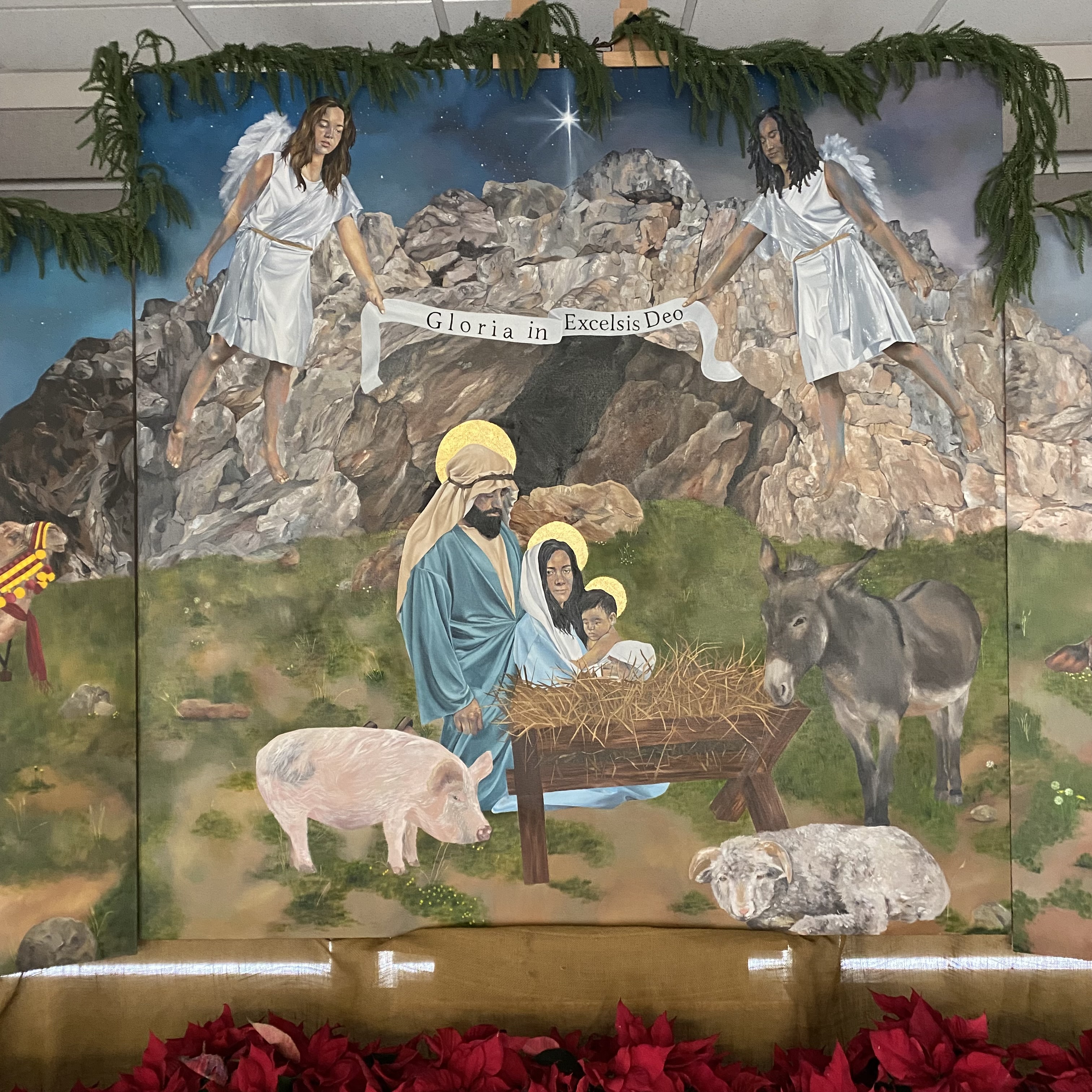
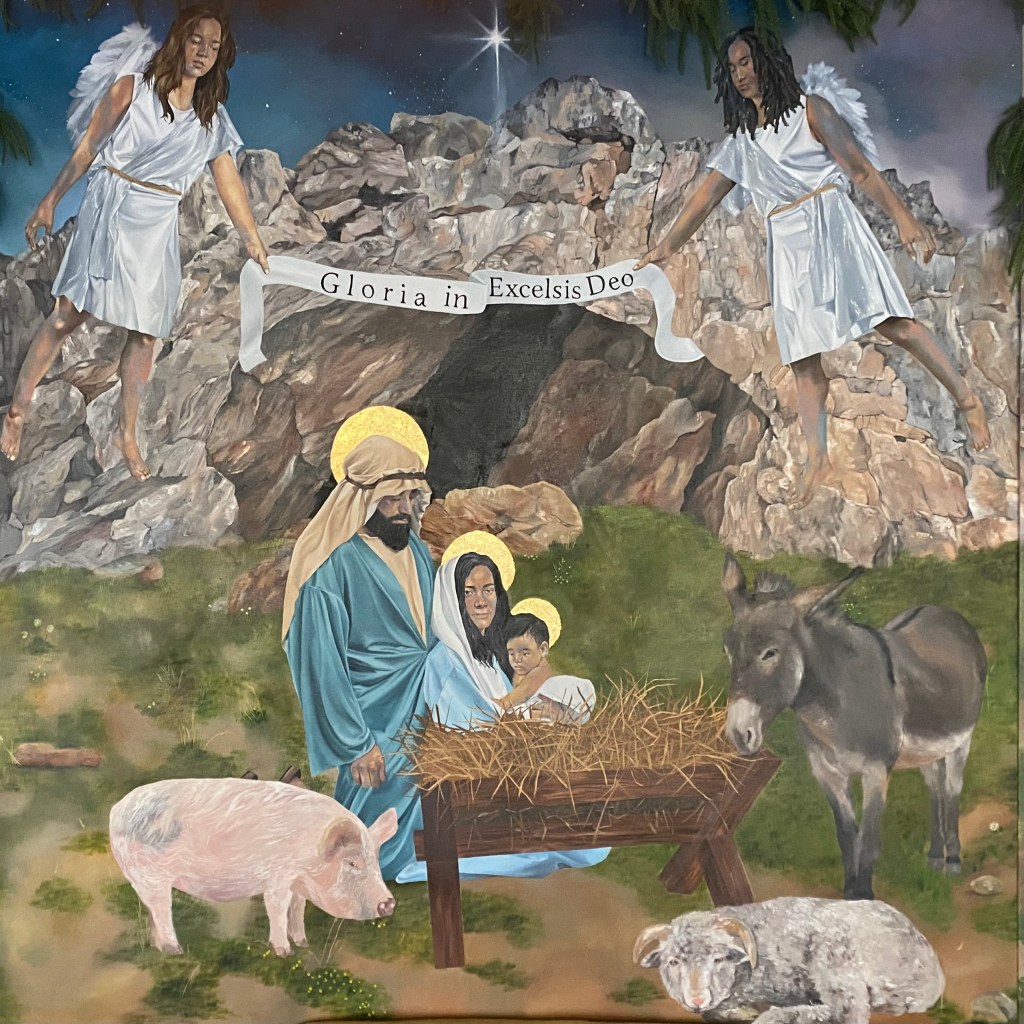
In the gospel of Matthew  Joseph, the husband of Mary, has an important role in Jesus’ birth and early years. Mary points to him to tell the story of the birth of Jesus in the illustration above.

Matthew’s gospel calls Joseph  a just man, someone who listens to God rather than to himself. He does God’s will. He’s a carpenter, the gospels say, certainly not someone privileged – but he’s a “son of David” from the royal family who gives the world a Messiah.

During their betrothal, which in Jewish tradition was more than the modern engagement we know, Joseph finds that Mary is pregnant. A just man, he struggles to find a way to divorce her quietly when, in a dream, an angel of God tells him not to be afraid to take Mary as his wife.

Here is the key part of the angel’s message: “For it is through the Holy Spirit 
that this child has been conceived in her. She will bear a son and you are to name him Jesus, because he will save his people from their sins.”

Like Mary, Joseph believes God’s message. Like Mary, he sees more than human eyes and a human mind sees. “When Joseph awoke, he did as the angel of the Lord had commanded him and took his wife into his home.” He believed what we say in our creed: “(Jesus) was conceived by the Holy Spirit, born of the virgin Mary.” Jesus became one of us, God was with us.

Artists early on pictured Joseph with his head in his hands, listening in sleep to the angel’s message. In a dream later he heard the angel telling him to take the child and his mother to Egypt to escape Herod, the king. He was a man of great faith.

The medieval artist who painted the picture above has Mary pointing to Joseph as a witness to whose Child this is who’s’ born in a stable. They are the first to believe and they will care for Jesus with all the love and care they can give him.

Joseph has his hand on his head.. The angel spoke to him in dreams. Faith is like a dream where God speaks to us in another way.

O Leader of the House of Israel,
giver of the Law to Moses on Sinai:
come to rescue us with your mighty power!

The gospels for the remaining days until Christmas are from St. Luke, recalling the angel’s visit to Mary and her relative Zechariah. Matthew’s gospel will be read again after the birth of the Child, when Joseph will be warned of danger and takes the Child and Mary to Egypt and then to Nazareth..

The Creator of Time is Born in Time

St. Leo the Great explains the importance of the genealogies of Jesus from the gospels of Matthew and Luke in the Office of Readings for December 17. God could have appeared as he did in the time of the patriarchs, in the guise of strangers who appeared to Abraham, in the mysterious figure who wrestled with Jacob. Instead, God chose to send his Son to be born in time and take on himself a human nature like ours.

“The divine nature and the nature of a servant were to be united in one person so that the Creator of time might be born in time, and he through whom all things were made might be brought forth in their midst.

  For unless the new man, by being made in the likeness of sinful flesh, had taken on himself the nature of our first parents, unless he had stooped to be one in substance with his mother while sharing the Father’s substance and, being alone free from sin, united our nature to his, the whole human race would still be held captive under the dominion of Satan. The Conqueror’s victory would have profited us nothing if the battle had been fought outside our human condition.

But through this wonderful blending the mystery of new birth shone upon us, so that through the same Spirit by whom Christ was conceived and brought forth we too might be born again in a spiritual birth; and in consequence the evangelist declares the faithful to have been born not of blood, nor of the desire of the flesh, nor of the will of man, but of God.

He dwelt among us. He did not engage us “outside our human condition.”

December 17: The Tree of Jesse

From December 17th until Christmas, we read from the infancy narratives  of Matthew and Luke to prepare for the  Christmas feast.

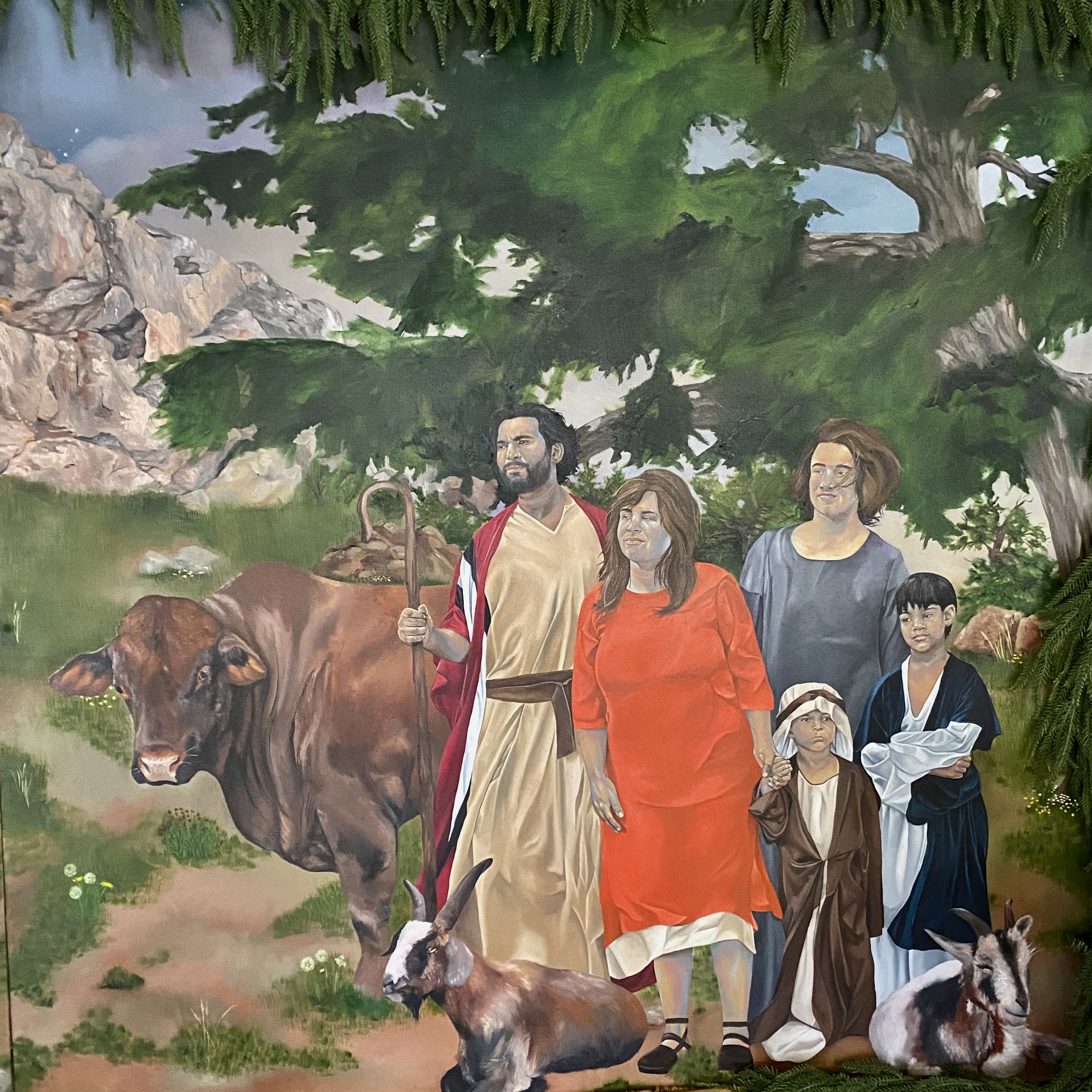
  Matthew’s genealogy of Jesus Christ traces his ancestry as “the son of David and the son of Abraham.” Descended from Abraham Jesus fulfilled the promise God made to the patriarch: “in your descendants all nations would be blessed.” Matthew ends his genealogy with “Joseph, the husband of Mary. Of her was born Jesus who is called the Messiah. ” In our portrayal above Mary points to Joseph as the one who can explain it to us all.

Matthew’s genealogy offers a Messiah whom Jew and Gentile can claim for their Savior. His ancestors reach beyond Palestine; his roots are worldwide. He’s not just a Jewish Messiah in Matthew’s listing either. His bloodline includes women like Tamar, Ruth and Bathsheba– foreigners and even women with questionable backgrounds.

 In his humanity,  Jesus didn’t come from perfect ancestors or untainted Jewish royalty ; he’s rooted in all humanity. His bloodline includes saints and sinners; he comes from a line of sinners and some saints. He shares our human DNA.

Matthew obviously wants us to look at Jesus’ family tree and see it as our own. We’re at home there. The Tree of Jesse, based on Matthew’s genealogy  was a favorite subject for medieval artists working on illuminated manuscripts or creating stained glass windows for churches. A great way to see the humanity of Jesus Christ.

Luke’s genealogy goes further and brings Jesus beyond Abraham to Adam. He becomes the new Adam. We are born from his side, we share his blood; he is the first born of many like us. So we pray:

“O God, Creator and Redeemer of human nature…your Only Begotten Son, having taken to himself our humanity, may you be pleased to grant us a share in his divinity.” (Collect)

O Wisdom of our God Most High,
guiding creation with power and love:
come to teach us the path of knowledge!

Tuesday, 3rd Week of Advent: The World of Unbelief

Our celebration of Advent is more than decorating a Christmas tree, lighting an Advent candle or singing carols. Advent is a time for dealing with belief and unbelief. Our readings for Monday and Tuesday this week from Matthew’s gospel speak of religious unbelief in the chief priests and elders as Jesus enters Jerusalem. (Matthew 21: 22- 32) They are religious leaders and scholars, but they do not recognize God’s plan revealed in him. 

Friday we will read Luke’s account of Zechariah, the father of John the Baptist. While carrying out his duty of prayer in the temple as a priest, he does not believe in an angel promising that he and his wife will have son. Even as a priest in a holy place, worshipping in God’s temple, he does not recognize God’s plan.

Besides the unbelief of religious people, political unbelief is described repeatedly in our Advent readings. Ahaz, king of Judea, sees the world through the lens of politics, as he turns a deaf ear to God’s word, spoken by the Prophet Isaiah. He will deal with his neighbors as he thinks best. His words and wisdom alone are what counts. 

Mary stands in contrast to an unbelieving world. She represents the “remnant” the prophets speak of. She believes and accepts the angel’s promise, even as she wonders “how can this be?”. 

The Advent season tells us to stand with her.

READINGS: DECEMBER 17 TILL CHRISTMAS

The Gospel of Luke is our principal guide through the final days of Advent till the feast of  Christmas. These days are our “novena” preparing for the mystery of Christmas.

 December 17th and December 18th we read Matthew’s genealogy of Jesus and his account of Jesus’ birth.

December 19 The angel’s announcement to Zechariah the priest about the birth of John the Baptist. (Luke 1: 5-26)

December 20. The angel announces to Mary that she will bring “the Son of God” into the world. (Luke 26-38) 

December 21. Mary visits her cousin Elizabeth to share this Good News. ( Luke 1:39-45 )

December 22. The 4th Sunday of Advent. The gospel account of Mary’s visit to Elizabeth is repeated. ( Luke 1:46-56) 

December 23. Elizabeth gives birth to John, who will announce the coming of Jesus: (Luke 1:57-66)

December 24. Zechariah praises God’s compassion towards those who “dwell in darkness and the shadow of death.” (Luke 1:67-79.)

December 25 Christmas. The evening readings for Christmas are:  

Isaiah 9: 1-6

Timothy 2:11-14

Luke 2:1-14, The story of the Birth of Jesus Christ

Old Testament readings add their voice to the gospel accounts.  A number of stories, like the unpredictable births of Sampson and Samuel accompany the story of the birth of John the Baptist and Jesus. They remind us that “nothing is impossible with God.” The prayers in Advent speak too of the gentle rain that makes the earth fertile and the numerous “miracles” found in the ordinary course of nature. From the created world we can gain a sense of wonder for this great wonder of God.

Our readings are stories of belief and doubt. Isaiah offers King Ahaz, the consummate doubter and cold calculator on December 20. He was mentioned on Wednesday mornings at morning prayer each week of Advent. Ahaz stands in contrast to Mary, who believes and accepts the angel’s promise. She wonders “how can this be?” before this mystery of God, but she believes.