I seem to go back to that familiar carol every Christmas. Maybe it’s because wonder is a Christmas word. Wonder is a reaction to something beyond what we expect, beyond our experience, so big it leaves us lost for words. And so we wonder.
The gospel story from St. Luke says that: the
‘In those days a decree went out from Caesar Augustus that the whole world should be enrolled.” Caesar Augustus, the ruler of the world orders a census.. “Quirinius was governor of Syria.” Quirinius , Caesar’s enforcer for Palestine, orders his jurisdiction to be counted. The big people have spoken.
But the big people, the important people don’t impress Luke. Rather, his eyes are drawn to a couple in the crowd being enrolled, from a little town in Galilee called Nazareth– Joseph and his betrothed wife Mary, who was with child. On their way to Bethlehem.
“While they were there, the time came for her to have her child, and she gave birth to her firstborn son. She wrapped him in swaddling clothes and laid him in a manger, because there was no room for them in the inn.”o
Luke gospel goes on to tell about this child born in Bethlehem. He grows up in Nazareth,and begins to preach and work marvels in Galilee, and draws followers and goes up to Jerusalem where he’s arrested, sentenced to death, crucified, then raised from the dead. Luke goes on further to describe the followers of Jesus who take his message to the ends of the earth, until finally his message comes down us today.
The word “wonder” describes the way to look on this story, because wonder seems to be a cautious word, it’s cautious before something great and unknown. Wonder is a word that questions. Why would God come among us like this? So small and powerless and helpless? Why not come in a more powerful way and make the world a new paradise. In the Advent season, prophets like Isaiah promised the nations would beat their swords into plowshares and the spears into pruning hooks: no one will train for war again. Yet, we seem to be building bigger armies and bigger weapons of mass destruction. The Messiah will make the deserts flower and the created world a feast. Yet, now our creation’s not flowering; it’s endangered; life itself threatened.
All peoples will come to God, the prophets say. Yet, so many turn away from him instead.
I wonder, as I wander out under the sky, why Jesus our Savior was born for to die, for poor, ornery people like you and like I…
God is with us. Immanuel. God reveals himself as God wills, not as we will or think it should be done. Faith doesn’t give us all the answers, but it gives us enough answers to trust in God who is with us. God with us, a humble God, born of Mary, born in a stable. God who lives among us, who knows our hopes and sorrows, who died on a Cross and rose again, and promises a new creation and that we will rise again.
We believe in God Father, Son and Holy Spirit. Amen.
Some time ago, at dinner, my atheist friend argued : “If God exists, He is so vast and powerful that He really has no time to even think of us, puny human beings . It’s as if the brain were to care about each intestinal bacterium in our gut. Do you even think about them at all?” I thought about this and said, “Our brains are not like the ‘brain’ of God. God actually loves those ‘intestinal bacteria’, each and every one of us individually. That is His power and choice. He even chose to become one of us !’ My friend found that idea so outlandish and untenable. Why would God do this?
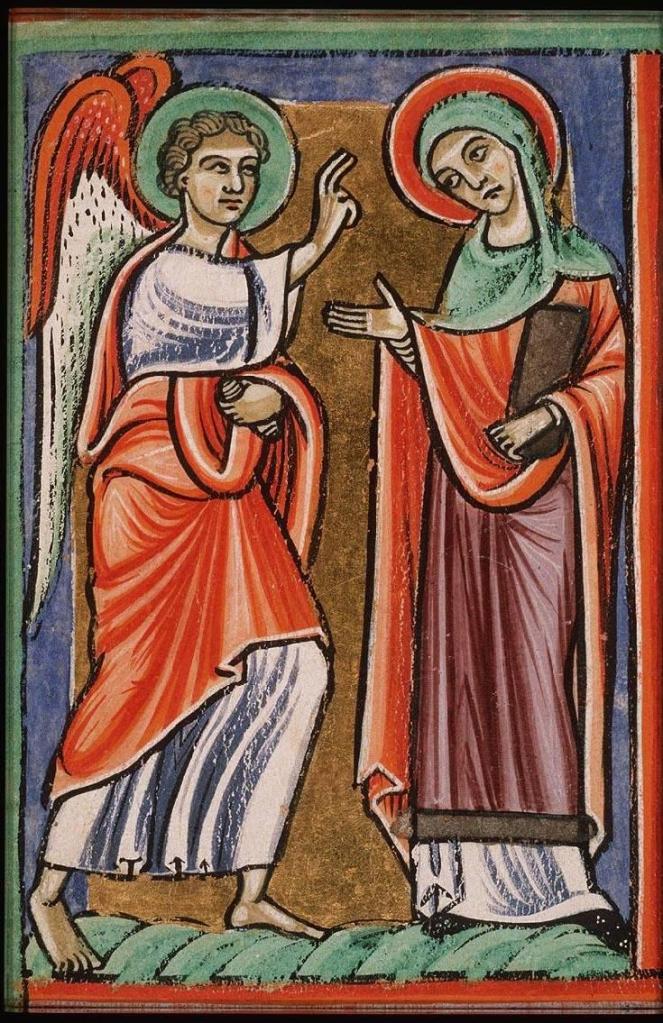
Nazareth, Israel, once a tiny mountain village, is now a bustling city. Here, crowds of pilgrims stream into the Basilica of the Annunciation, and jostle each other in uncomfortable lines in order to walk near, and pray before, the reconstructed ruins of an actual home from the 1st Century, in a grotto two stories under the ground. An altar was built there, and, if you look at the picture above, a plaque reads : “Verbum caro hic factum est.” (The Word was made flesh here). The Gospel of Luke tells us that in a chamber like this, perhaps this very one, the Virgin Mary was visited by the Angel Gabriel, and, through the power of God the Holy Spirit, the Incarnation took place.
A single human egg cell suddenly existed within the womb of this young, holy woman, with all the genes necessary for the formation, over the next nine months, of Jesus of Nazareth, our Savior. We believe that that developing, fully human child, was also fully Divine, the Logos, the Eternal God, “of one substance with the Father.” Such a mystery for the mind to apprehend! The baby Jesus is truly, 100%, a helpless human baby, and simultaneously and totally, 100%, the All-Powerful God, Creator of everything!
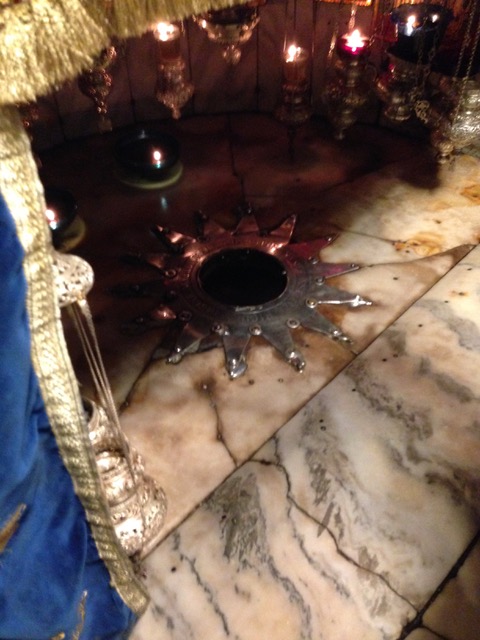
Miles away from Nazareth, in the city of Bethlehem, Palestine, the Church of the Nativity stands. From ancient times it commemorates the place where Jesus was born on Christmas Day. There is a grotto under the altar, where they say this holy event happened. Hundreds of people “line up” in a monstrous, thick queue that runs the length of the huge church, its width, and again its length . For over an hour I stood on this line, fighting my desire to just get off and forget about it, fighting my increasing annoyance at the people that pushed me from all sides and would “cut” in front of me. It did not feel at all like a holy experience. My back and feet were going into cramps as we squeezed our way down into a narrow, low, stone entrance into the Grotto.
The place was dark and crowded, but I was surprised to see how considerate and patient everyone was, as we made a single line to a structure that had a shape somewhat like a fireplace. We waited for each person to kneel for a few seconds inside the low, dark space, and touch or kiss a large silver star-shape bolted onto the marble floor, with a black, worn, flat stone in the center. This was designated as the place where our Lord was born. Strange, the need to have a precise spot, as if to challenge our faith: “Don’t you believe this?”
I took my turn and painfully crawled down to the spot, touched the dark, smooth stone, and closed my eyes. For those few intense seconds I was flooded with what I can only think of as the Power of God! Without any words, Jesus grabbed me and seemed to show me, “This is the Mystery of my Incarnation, I love you!”
I walked back up the steps on the other side as if in a daze. What had I experienced? Thoughts, ideas, things I had heard and read, and felt in prayer had come into my mind at lightning speed: The dance of the Holy Trinity, God’s overwhelming desire to save me, to die for me, to teach me to love, to live within me, to live with me for Eternity, Mary’s fear and then faith, her sufferings, her acceptance, her “Yes,” her woman’s power in participating with God in the creation of new life, a soft tender baby, Joseph trusting in God, the Angels, shepherds, Magi, sheep and cows, the dark yet starry night over Bethlehem, the vastness of the spinning universe, God’s embrace over all, God the fulness of Love…..
These were only some of the things I sensed as it all turned into a dark, bright maelstrom of mystery. But most of all what I felt was gratitude and love! I had never expected this gift from my Beloved, after so much frustration and physical pain, at such an unexpected moment. I wonder if the other people felt this? Why did God do this?
Mary, the Mother of God, must have “pondered” upon these things during the whole of her Son’s life. Like so many great saints, she might have had moments of questioning all of it. But she was the favored one of God, and faith carried her until that blessed Easter Sunday. She is our wonderful example.
The mind can be like that. A few minutes after my experience at the Grotto, a part of me was wondering if this had just been a fabrication of my mind, desperately longing to “feel something,” to “see God”, to have a “supernatural moment”. I just shook my head, smiled, and said, “ Thank You for the experience, my God. I still love You, but most importantly I know that You love me more than I can ever imagine.”
Hugo Enomiya-Lassalle was a German Jesuit priest who spent most of his life working in Japan, barely survived the Hiroshima bombing, and is actually the first non-Buddhist to achieve the authorization to be called Zen master. When I think of my experience in the grottoes in Israel I think of something he once wrote: “God absconditus cannot be seen. But to see Him in any way at all, one must enter into the darkness, into the night of consciousness and spirit, as into a dark cave.”
We’re reading at Mass in the days before Christmas Luke’s Infancy narrative, chapters 1-2. It begins with the simple statement “In the days of Herod, King of Judea,” but Luke says little about this king. The real news is what happens in a small village north of Judea, Nazareth, where an angel approaches Mary, inviting her to become mother of “the Son of the Most High.”
He’s the real news, not Herod and the politics of the day. Even in the temple in Jerusalem, the priest Zechariah, busy at worship, misses at first the message of an angel. But In Nazareth a woman of great faith immediately accepts what an angel says, though she does not understand it all.
Mary, “full of grace”, says to the angel Gabriel “Be it done to me according to your word”, and the Word became flesh and dwelt among us.
Mary’s faith enables her to see the mystery of God unfold in her Son’s birth, his hidden life, his ministry, his death and resurrection. Her faith prompts her to act. She visits Elizabeth in the hill country to share the mystery announced to her. Faith inspires her to sing a song. “My soul proclaims the greatness of the Lord…The Mighty One has done great things.”
In his infancy narrative Luke writes about faith. His account of the Annunciation offers Mary’s faith to us, a faith that believes without fully seeing, acts generously and spontaneously, and rejoices in the mystery the angel announces.
Beginning his account of the birth of Jesus, Luke will note once again the great figures of the time– Caesar Augustus and the political officials ruling with him. But the real news ( certainly not “fake new”) is what happens in Bethlehem. The shepherds hear it and rejoice, and so should we.
My mother loved to go to wakes and funerals. She would sit in O’Brien’s and Sweeney’s funeral homes in Bayonne, NJ for hours at a wake taking in who came to pay their respects and talking with them.. She told me once she was needed there because she knew all the Sorrowful Mysteries of the Rosary and could recite it when the time came. I also remember her complaint when O’Brien’s shortened the hours for visitation.
But the Tree of Jesse reminds me of something else. She had a remarkable memory for relationships and loved to trace peoples’ family connections. She would be at home with Matthew and Luke tracing the ancestry of Jesus in their gospels. She wasn’t a professional genealogist, she plied her gift at wakes and funerals.
I find myself at funerals doing the same thing. Some time ago, I recognized a young man who came from a family friendly with mine from years ago and I told him my mother and father met at his grandmother’s house at a celebration after a baptism–maybe it was his father’s baptism. My mother was washing the dishes.
He was delighted to hear that little story, a connection enlarging his family tree.
The Tree of Jesse, the Christmas Tree, the Family Tree. Connections are important. We need them.
Mattthew’s gospel begins this week with a story of unbelief. Those you would expect to receive Jesus reject him. They also rejected John the Baptist before him. Yet, prostitutes, tax collectors and sinners believed in him and they also believed in John, Jesus says.
Faith in Jesus doesn’t come from holding places of privilege and power, or from great learning.
The Old Testament offers a wonderful reading from the Book of Numbers.. It’s about Balaam, a foreign prophet, who’s offered handsome pay if he will put a curse on the tribes of Israel. Instead, Balaam, “whose eyes are true, who sees what God sees and knows what God knows,” blesses the tribes of Israel.
He promises a “star shall rise from Israel and a staff should appear from Jacob.”.
Even his donkey gets it right. He won’t take Balaam to the place where they want him to curse the Israelites. Is that why t a donkey appears at the manger in Bethlehem?
Beautiful illustration from the Middle Ages. The donkey won’t budge..
One thought on “3rd Sunday of Advent: Be who you are! Witness to the Light.”
Let Your Light Shine
Let your light shine for all,
Be a spark, make it glow,
Let it burn like a bright,
shining star.
Share the gift that you are,
Reaching out with your heart,
Pass it on, let your light shine
for all.
Let your light shine for all,
Be a spark, make it glow,
Let it burn like a bright,
shining star.
Share your hopes, share your
dreams,
Share your life, share your love,
Pass it on, let your light shine
for all.
The first time I saw a desert thirty-nine years ago, I was in no way religious, but I remember that I was struck in a way that can only be described as “spiritual”. It was dawn; the clouds had golden hues, and so did the stark Mohave landscape. The absence of any trees, the rockiness of the hills, made me feel I was surrounded by the very bones of the Earth. But what struck me with most power was the silence. It was so intense that in a strange way it felt like a scream, a loud cry that could not be heard with my ears, but with a part of me that I had never known existed. It’s really impossible to explain, but I have always had this mysterious reaction to the many different deserts that I have visited since. The Judean desert of Palestine, where I stood four weeks ago, was no exception.
Our tour guide had directed our bus driver to exit the Jericho-Jerusalem highway, and take us up a winding dirt road to the top of one of the countless beige-colored hills that covered this wilderness. I saw no living thing from the window except some antelopes running across the opposite slopes. We parked at a precarious spot and our group of pilgrims walked gingerly towards the very summit. And there was that quiet. Even the constant wind was silent.
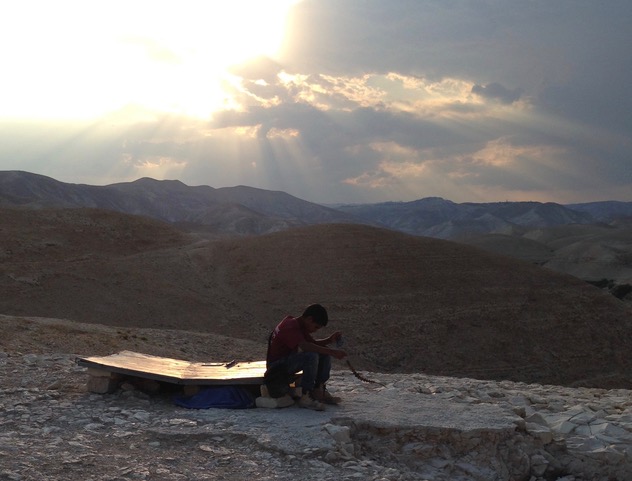
On a level spot, we walked past a group of Bedouin men who tried to sell us rosaries, bracelets, and other items. Among them was a boy, about twelve years old, who followed us up without saying a word.
I thought of Gypsy children and all the stereotypes about them. On the highway from Jerusalem we had passed a number of Bedouin settlements dotted with their strange, flat-roofed tents, surrounded by pens for their sheep and goats, along with all kinds of debris, including numerous cars in different stages of disrepair. Bedouins are considered one of the traditional ethnic groups of Israel, and are entitled to all the services that the government provides, but many of them choose to live in the wilderness, following what remains of their traditional customs. I wondered whether this boy went to school.
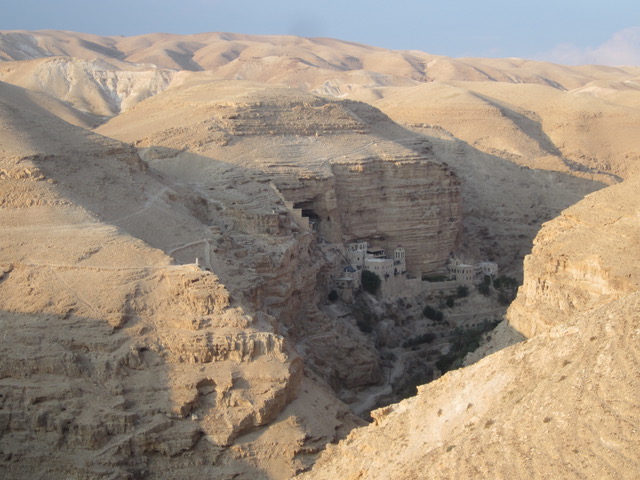
At the top of the hill we looked into the deep canyon of the Wadi Kelt, winding and twisting its way across the desolate landscape. There were so many hills , so many winding trails disappearing into the distance. And the incredible screaming silence. I thought of the passage from Isaiah 40: 3-4 :
“A voice cries out : In the desert prepare the way of the Lord! Make straight in the wasteland a highway for our God! Every valley shall be filled in, every mountain and hill shall be made low; the rugged land shall be made a plain, the rough country, a broad valley. “
I smiled and actually wondered why our God would want to change anything about this incredibly beautiful landscape! But then, a pilgrim in Biblical times, under 130-degree heat, making his/her way to the Holy City, might think otherwise.
We peered across the canyon at the Ancient Greek Orthodox Monastery of St. George, clinging to the side of the cliff like a Pueblo dwelling, and I thought of the silence and peace that 5th Century Syrian monks had been seeking here in this mysterious place, where the Holy Spirit flowed invisibly. Legend says that this deep ravine, which extends all the way up to Jerusalem, is the actual “Valley of the Shadow of Death.” They say that Elijah was fed by ravens (1 Kings 17 : 5-6) in one of the caves that the monastery covers, and centuries later, St. Joaquin came to pray and grieve over St Anne’s barrenness . Here we were in the wilderness where the Baptist preached, and my Lord Jesus fasted for 40 days! On the other side of the canyon along the ridge of the farthest hills the setting sun illuminated the jagged outlines of the city of Jerusalem, some 15 miles away. I realized was standing on the ground where our beloved Bible came to life. It was a dizzying feeling. The presence of the living God was as palpable here as in the holiest churches and sites up there in Jerusalem.
Fr. Charles asked us to come together and pray, except that there were to be no words, just to let God come to each of our souls in the silence. I don’t know how long we stood there. I can’t even put into words what I experienced, but I can say these are the blessed moments when our Lord comes and strengthens our faith.
Slowly, a little sound crept into my mind, a rhythmic sound, as of babies’ rattles. I opened my eyes and saw that some 20 feet from our group, the Bedouin boy was sitting on top of a large piece of metal, with his head down, as if he was praying with us, jiggling the little beaded bracelets and necklaces that he had brought up. I imagined a young Jesus looking just like this. I felt such tenderness for this poorly clad little man. He seemed to be covered with the very dust of the desert .
I was not the only one who had noticed him, for as soon as our prayer ended, all the women in our group, including my wife, went up to him and bought everything he was selling. He did not say a word. He indicated the prices with his fingers. They gladly overpaid him. Some of the women had tears in their eyes. One lamented about the state of his teeth. There was such concern and love. The silent voice of our Lord had touched their hearts.
I smiled ruefully as I wondered whether this was the routine that this boy followed with each busload of people that would come up to this place. The men would send the boy up alone and he would get the salesman’s job done. It really did not matter. This child was an instrument of God, and He was teaching us to love. On the way back to the hotel, as we rode in the darkness of the desert, everyone was silent in the bus. I felt the Peace of the Prince all around us. Thank You Beloved.
“ Cry out at the top of your voice, Jerusalem, herald of good news! Fear not to cry out and say to the cities of Judah: Here is your God!” (Isaiah 40: 9)


 The Victor's Place