Rejection is a special kind of pain. Matthew’s gospel today describes the rejection Jesus experienced when he entered Jerusalem before his death. At first, he’s acclaimed by a large crowd as “the prophet Jesus from Nazareth in Galilee.” They spread their cloaks and cast branches before him. “Hosanna to the Son of David. Blessed is he who comes in the name of the Lord.”
Then, Jesus goes into the temple and drives out those who were buying and selling there, a symbolic act that indicates he has come to restore this place of prayer. (Matthew 21, 1-18)
Reacting strongly, the Jewish leaders reject him and question his authority to do such things. He has been sent by God, Jesus says, and responds with a parable that condemns leaders like them who reject prophets sent by God.
Jesus remains convinced of his mission, but conviction does not insulate him from the pain that comes from rejection. Like the prophets before him he suffers from it, and his suffering only increases as the crowds that first acclaimed him fall silent and his own disciples deny and abandon him. All turn against him and he is alone.
The events described in today’s gospel and the parable Jesus told throw light on one suffering Jesus endured in his passion and death¬– rejection. Rejection and death will not be the last word, however: “the stone rejected by the builders will become the cornerstone.”
You went to Jerusalem, Lord,
to announce a kingdom come
a promise of God fulfilled.
a hope beyond any the mind could conceive.
Teach us to keep your dream alive
though we see it denied.
STATIONS OF THE CROSS: Friday is a traditional day. for remembering the Passion of Jesus
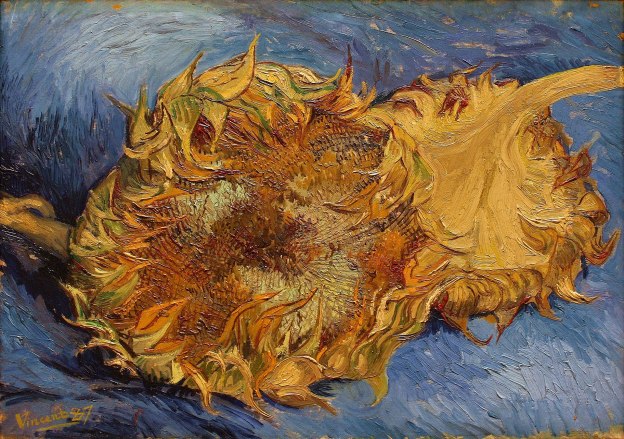
It has always fascinated me that when the giant sunflower plant bursts out to its glorious flower head, it is not long before it droops down (heavy with seed), upon the neck of its thick trunk. So intimately, even in nature, is humility joined to exaltation. “Whoever humbles himself shall be exalted.”
Vincent made many attempts to picture the wondrous sunflower, and here he gives us the plant’s apotheosis and its declension side-by-side. This tells us that the seeds within the flower head do not reach maturity until the plant bows low.
How exalted we’ve all felt, at times, in our youth and in our burgeoning years—to have accomplished something really good. And yet it was only when the weight of that glory (Augustine’s pondus gloriae) made us bow down before God in adoration—that our work was indeed well done.
I honor the Chinese tradition that finds in the chrysanthemum (the last of summer’s flowers) a symbol of old age. But here in the West, the sunflower serves us even more tellingly.
It is only when life seems to have ended that it really begins. Whoever loses his life keeps it. So, when we are beset with discouragement over the goods we lose or that are taken from us, it is important to remember that Jesus never did so much for this world as when He seemed to be doing nothing—on the Cross.
There is great feeling in this painting. The flowers seem to elicit the reach of your hand, the feel of your fingertips upon their surfaces—those marvelous double helix packages.
In Luke’s Gospel, read on Monday, Thursday and Saturday of this week, Jesus reveals the mercy of God and calls for care for the poor,. Luke’s story of the Prodigal Son is the gospel reading for Saturday.
Matthew’s Gospel for Wednesday reminds us that temptations about power, so obvious in the story of Jesus’ temptations, can also be seen in his disciples, like James and John.
On the 3rd Sunday of Lent in cycle a, the story of Jesus and the Samaritan woman is read, a key story on the Lenten catechesis.
March 9 Mon Lenten Weekday
[Saint Frances of Rome, Religious]
Dn 9:4b-10/Lk 6:36-38
10 Tue Lenten Weekday
Is 1:10, 16-20/Mt 23:1-12
11 Wed Lenten Weekday
Jer 18:18-20/Mt 20:17-28
12 Thu Lenten Weekday
Jer 17:5-10/Lk 16:19-31
13 Fri Lenten Weekday
Gn 37:3-4, 12-13a, 17b-28a/Mt 21:33-43, 45-46
14 Sat Lenten Weekday
Mi 7:14-15, 18-20/Lk 15:1-3, 11-32
15 SUN THIRD SUNDAY OF LENT
Ex 17:3-7/Rom 5:1-2, 5-8/Jn 4:5-42 or 4:5-15, 19b-26, 39a, 40-42
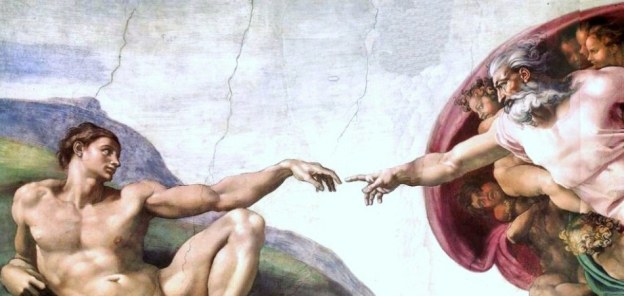
It was a stroke of genius to have left a space between Adam’s reach and His Maker’s. For, if it is man’s innate need to reach for God, it is in God’s power alone to satisfy that need.
Man, at his best, strives. He is most truly himself when he reaches beyond himself—to God. And yet the space between man and God is never so little that it is not infinite.
Man lives upon spaces, pauses. He can breathe and speak in no other way. And no matter how earnestly he strives, he must learn that waiting is the only way to meet God. For God comes to us, not we to Him.
Before completing His work of creating Mankind, God put Adam to sleep. In a sense, then, rest is the Creator’s visible signature upon our flesh. For sleep, or rest is an interval between nothing and something. And no truer description of man’s way to God was ever made than the Psalmist’s cry—“Wait for the Lord.” Nor did anything more truly describe our Lord’s humanity than the need He felt to wait for ‘the hour’ appointed by the Father—a waiting which Jesus described as an ordeal. (Luke 12:52)
It is very human to think: ‘If only there were something to hope for, I could be patient.’ But Paul reveals how far God’s ways are from ours, when he writes, ‘We wait for hope with patience.’ (Romans 8:25) So—patience first, then hope!
Let’s not put limits on God, Whose designs are beyond our measuring, while our own were limited before they began. (Psalm 139)
Be patient, then, when your situation seems hopeless—even as, in Faith, you believe what you do not see, and in Charity, you love what is naturally unlovable. Such is the nature of any virtue worthy to be called ‘theological’, that is, a virtue whose object is God Himself.
The Gospel for the First Tuesday of Lent (Mt 6: 7-15) tells us about Jesus’ introduction of the Lord’s Prayer for all of us. In his reflection for that Gospel, Fr. Victor writes: “St. Paul of the Cross saw prayer always leading to intimacy with God.” I have always felt that way, but it seems Our Father in heaven expects even more from us.
I love to approach, through Jesus, that bosom of my Heavenly Father, and just rest in there with Him, like His little baby. However, Jim Yhap, a friend and fellow Passionist Associate, who is studying for the Deaconate, told me his Theology professor says that we cannot relate to the Father in a one-to-one fashion, “my Father”. We must think of Him as “OUR Father.” Only in that matter can we properly approach Him. That’s what I think Jim said; we were in a hurry. All I could reply to him, in a whiny voice, was, “But I call Him Papa!”. How can I become intimate with Him if I have to come with a whole crowd of people at my side? How many people? Seven billion?
I have always preferred the first part of the Lord’s Prayer, where I enjoy the holiness and heavenliness, the power and the loving will of “Papa’”, more than the second half, where I have to ask not only for myself, but for everyone. It even bothers me a little sometimes when I have to rush through the prayer so I can keep up with he others in the Church. Of course, other times I relish in the company of so many people I love, who share my faith. I am always praying for others, but then I miss that blissful intimacy that fills me when I feel that I am alone with God. It’s O.K. My beloved God, Our beloved God, is constantly working on me!
Here is an example. I have written about this 8-year-old granddaughter of mine, and how the crazy love that we have for each other reminds me of my relationship with Our Father. She happens to also have four siblings who have blessed my life in equaly wonderful ways. They are getting older, and therefore more distant, so their grandmother and I end up spending the bulk of the time with the little one.
Last Friday, my wonderful wife decided to invite all five grandchildren to come have pizza with us at Villa Rustica Restaurant and then go to American Martyrs Parish and participate with us in the Stations of the Cross. Surprisingly, they all said “Yes!” Wow, what a blessed surprise! I thought they would be, as usually, busy.
On the way there I noticed that my eight year old was not saying a word. While we were waiting to be seated at the restaurant she seemed sullen and detached. So I asked her, “What’s the matter? Are you sad?”
She answered in a barely audible voice, “I thought I was the only one who was coming with you and abuela (grandma).” So I told her, “I love you, but you know they are also our grandchildren, and we love them too! You know what a treat this is?” Anyway, we sat down to eat and had a great time. She smiled and talked and ate all the spaghetti. For my part, I had not heard the teenagers and the 20 year old laugh, enjoy, interact, and say so much in a long time. The pizza tasted better than ever before. This was my best meal so far in 2020.
Then we went to Church and the graces of God were so powerful! My eight-year-old read along with every prayer and never seemed bored or distracted. All of us felt satisfied and peaceful. Nobody argued on the way home. My Loving God taught me that lesson I needed. He delights in all of us. We are His family. We are a community of beloved children. Since then, every time I approach Our Creator I remember that Jesus brought me there, in His Spirit, along with the whole of humanity. Dear Readers, I love you all! I do! You are certainly my brothers and sisters. This wonderful Father in Heaven, around us, and (intimately) within each of us wants it so!
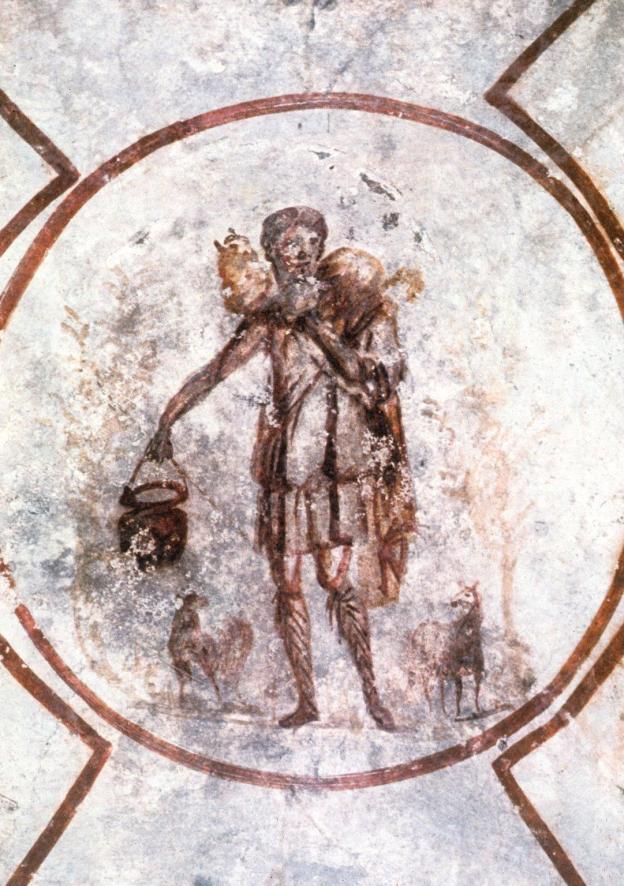
This is one of the oldest Christian paintings on plaster. It comes from the catacomb of the martyr, St. Callistus, in Rome.
Bearing an injured sheep across his shoulders, the shepherd carries a pot of burning oil in his right hand—away from his thighs—while two other sheep follow close by.
Obviously it portrays Jesus in his essential role as Savior.
This Christ has the face of a man hardly twenty years old. It isn’t clear whether he is slightly bearded, but he wears no moustache, and his tunic is short, cut well above the knees.
These are little touches, but they suggest an unpretentious Christ who could be facing a cave entrance where he’ll bed down for the night, the sheep sharing the warmth and flicker of the little fire, as His body blocks the cave entrance against attack.
It is a picture of utter selflessness and devotion, and it elicits, not worship, but love. It is a good beginning for Art that can only portray Jesus in human perspective or be false to its own limitations and those freely shared with us by God’s own Son.
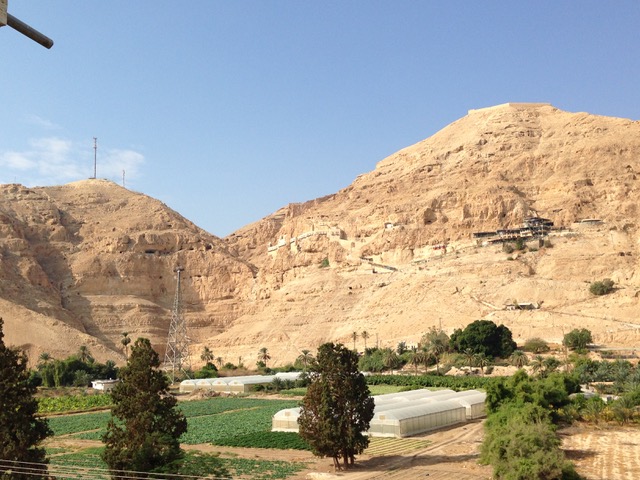
East of Jericho, Palestine, in the Judean Desert, and not far from the Jordan River, there is a Greek Orthodox monastery built into the rock of the steep side of a high hill called the Mount of Temptation. The ancient monastery buildings lead into a number of caves, where it is believed our Lord Jesus Christ found refuge during His forty days in the desert.
Eight years ago, when I first visited this site, the place was mostly stark, barren desert. When I returned last November, the area beneath the Mount was covered by irrigated farms and groves, even homes and apartment buildings. The city of Jericho had expanded into the area. There seemed to be some sort of resort built right beneath the monastery, with even cable cars going up the mountain. How time changes things. It seemed hard to believe that this place was a desolate, dry wilderness when Jesus spent His forty days there.
On the First Sunday of Lent, the Gospel remembers this story. (Mt 4: 1-11) In previous years, this Gospel has led me to meditate on different things, like my memory of this place in Palestine, what it is like to survive in a desert, what nuts and edible plants Jesus ate to stay alive all those days, where He located mountain springs to get water, how He found shade, how He felt at different moments. Was He lonely? Did He miss His mother? What kind of mystical experiences was He having with His Heavenly Father? Did He experience spiritual dryness? And of course, those temptations!
This Lent though, upon reading this passage, what struck me after all these years, were the actual WORDS of my Lord. It seemed as if He was personally talking to me, crystallizing my focus on what this new, long season of Lent can mean to me. Each statement led me to unexpected prayer with Him.
He tells me, “One does not live on bread alone, but on every word that comes forth from the mouth of God.” (Mt 4 : 4) I have been “fasting” since Ash Wednesday, at least trying to limit what I eat and trying to feel hungry for long periods of time. Normally I never feel hungry. I go to the Deli, or refrigerator, or the pantry, and satisfy my craving. I tend to overeat often. But lately, I am actually succeeding in getting these unexpected hunger pangs. I close my eyes and see in front of me a fat slice of Wonder Bread with butter, or Italian bread with olive oil, French bread with tuna fish, Indian naan with hummus, Cuban pastries, raisin bagels…..
Stop, please! I see my Lord, the Word of God, smiling before me, ready to fill me with His life-giving self (as if He doesn’t do that already!), and I find myself craving for Him: “Oh God, You are my God—for You I long, for You my body yearns; “ (Ps 63 : 2) I hear His Word: “Blessed are those who hunger and thirst for righteousness for they will be satisfied.” (MT 5: 6) Indeed, His Presence within me helps to “set me right.” Thank You Beloved, for reminding me through hunger, to pray with You. Then He admonishes me : “You shall not put the Lord, your God to the test.” (Mt 4: 7) Yes, I feel so infinitely loved by Him; it is wonderful. I trust Him to forgive me and straighten me out every time, but this does not mean that I am to just forget about His Mercy. This does not mean that I am to engage in reckless behavior, playing with the fire of my sinful instincts, and glibly expect Him to catch me every time I fall, like a little child “testing” the love and patience of his parents. Such Divine Love deserves respect, honor, adoration, and great effort at self-improvement and penance.
Finally, He warns me : “The Lord your God, shall you worship and Him alone shall you serve.” (Mt 4: 10) I have been amassing a list of bad habits to give up, along with acts of giving and sacrifice for this Lent. I think I have already come up with about 20-plus items. It’s stacking up to be a little mountain of promises which are hard to keep. My Lord helps me to realize that my primary focus should not be on all these goals and acts, but on Him, the Divine One who enables me to accomplish any of them. Yes, He appreciates my attempts at charity and piety, but I must remember that every act of love, or sacrifice, or kindness is in the end His Grace working through each one of us. If I start giving myself spiritual medals for being such a “good boy” I get dangerously close to idolatry of self, and pride.
Frankly, I admit I am really ill-prepared for this season of Lent. Without His loving company and strength I cannot make it through this desert. I surrender to His love and invite Him to walk with me through it all. My hope in Him sprouts, and flowers tentatively, like those gardens and groves that dot the Palestinian desert before the Mount of Temptation. Prayer is always the first step, the most important aspect of Lent, and for that matter, the whole year. Lord, help us to drink from the fountain of love which is You Holy Spirit. “Jesus, I trust in You.” Orlando Hernández
Our Lenten weekday readings begin with the final judgment, when “all the nations” appear before Jesus Christ to be judged for the way they have treated “the least” , the hungry, the thirst, the naked, the sick, the prisoner. “Christ in disguise”, to use a term of Mother Teresa.
“When did we see you in them”, those judged ask? (Monday)
The readings for the days that follow tell us the way to see– by prayer. On the mountain Jesus teaches his followers the Lord’s Prayer, the common prayer of all God’s children. God is our Father. We ask to be given our daily bread. We ask that we all be forgiven and not be tested beyond our strength.
God gives us a gift to pray that our eyes may see and our hearts be open. Like snow and rain, the gift of prayer falls on us all. God give us the gift to pray. (Tuesday)
Prayer is more than prayer for ourselves and our own needs. The story of Jonah points to a world bigger than our own. We’re children of the world and we must pray and work for its good. (Wednesday)
Never lose confidence in prayer and what it makes possible. “Ask and you will receive, seek and you will find. Knock and the door with open” Jesus teaches. (Thursday)
Make sure as you approach the altar to pray that your heart is free from resentment, harsh judgment and anger. Otherwise, your prayer become weak and blind. You cannot see. (Friday)
We must pray even for our enemies. For our Father causeS the sun to shine on the just and the unjust and the rain to fall on saints and sinners. (Saturday)

 The Victor's Place