Hail Mary


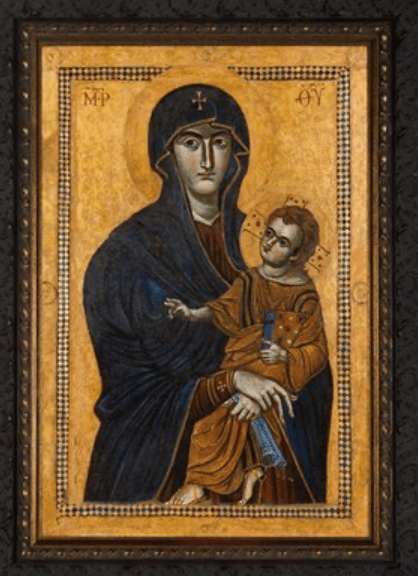
Praying the Hail Mary, we ask Mary the Mother of Jesus to lead us to God.  The prayer’s earliest form  developed  in the middle ages with the simple greeting of the angel Gabriel at Nazareth, from St. Luke’s gospel:


Hail Mary,
full of grace,
the Lord is with you.

You are favored by God, the angel announces to her. She brought Jesus Christ into the world. That message continues through the ages and is reflected in us.  Like her, we are favored by God and called to bring God’s Son into the world.  God’s promise of grace to Mary echoes in God’s promise to us. As  promised  to Mary, God will be with us.

Over time her cousin Elizabeth’s greeting to Mary, also recorded in St. Luke, was added to the prayer:
Blessed are you among women
and blessed is the fruit of your womb.

Finally by the 15th century, the remainder of the prayer appeared:
Holy Mary, mother of God,
pray for us sinners
now and at the hour of our death.

The prayer asks Mary, full of the grace of her Son, to intercede for us sinners now and at the hour of our death. She is a model for believers and she knows what it means to believe. She who knew her Son so well, can teach us  the way to him.

On Calvary Jesus entrusted her to us as a mother when he said to his disciple “Behold your mother.” Ever since, she brings Christ into this world. She knew Jesus from the beginning and witnessed his life, death and resurrection. She helps us to know him. She also knows our needs. Aware of  the needs of the newly married couple at Cana in Galilee, she approached Jesus, her Son. She is aware of our needs too.

By the end of the 16th century the practice of saying 150 Hail Marys in series or decades of 10 became popular among many ordinary Christians. Helped by her they remembered  the life, death and resurrection of Jesus. That practice of prayer is known now as the Rosary.

Mary is a model of faith for Christians. When the angel Gabriel came to her, she believed the words he spoke even to the dark test of Calvary. She helps the family of believers on their journey to believe..

The Hail Mary and the Rosary are blessed prayers,  simple and profound. They’re not beyond anyone’s reach; their repetition brings peace to the soul. They draw us into  the joys, sorrows and glory of Jesus, the world Mary knows so well.  We hope to “imitate what they contain and obtain what they promise, through Christ, Our Lord. Amen”

We will be celebrating the Feast of the Assumption of Mary this month..

Our Daily Bread

                                                             By Orlando Hernández


     The Gospel for the 18th Sunday in Ordinary Time (Mt 14: 13-21) recounts the story of how our Lord miraculously fed thousands of hungry people. Here are some thoughts on how this Gospel has FED me over the last few days. A friend pointed out that this Gospel illustrates how great God is and how little we are. We come to Him with almost nothing to offer and the Loving One does wonders with it, like He did with the mere five loaves and two fish that the disciples had.      

We pray, we intercede for so many others. We express our concern, like the disciples did for all those hungry people. Often the answer to our prayer is similar to what our Lord says:“Give them some food yourselves.” We think we have so little to give, especially during this pandemic. The little bit of love, attention, or support that we can give to alleviate the spiritual hunger of others, even in a phone call, can be amplified a thousand-fold if we just give it with love and acknowledge that this Love is God Himself.     An explosion of grace can suddenly take place.

This week we took a risk again, and we visited our 98 year old friend Alicia in her home. She has lost so many faculties, and grows weaker every week. She asks on the phone, “ I miss you; when can I see you, my beloved friends?” So we go and sit next to her and just listen to her thoughts and memories, some happy, some bitter. We play old romantic Latin songs that we bring in our iPod.  And then we pray.

She usually initiates our God talk and praise. This week she was especially animated and happy to see us and just thanked God again and again, for this moment, for this extra day of life, for her family, for her faith, and most of all, for the love God has shown her.    

 Our luminous moment was interrupted by the social worker, who came in for his monthly interview. Alicia can hardly see or hear but she was very attentive to the questions that he gave her: “ How are you feeling?” Her answer: “ I feel only joy in the presence of my loving God,” ( no complaints about her physical problems). The second question was, “ How are you eating?” She just said, “fine”, so the social worker tried a different tack : “ What is the food that you enjoy the most?”

She struck us with the light of her answer: “ My favorite food is the constant heavenly Manna that my loving Father let’s fall upon me. I am so blessed!”      

Wow! My wife and I, even the caretaker and the interviewer, felt something extremely special, and for a few seconds there was this bright silence in the room! Tears came to my eyes. I knew it was the power of the Holy Spirit, alive in the heart of this Godly woman. We had actually gone to her house reluctantly and afraid because of the virus, and here God multiplies our meager offering into a heavenly moment!

 “ Give us this day our daily bread,” Jesus teaches us to pray, and to make this prayer come alive through service. That day we got a powerful dose of that Daily Bread of Life that our Lord loves to give us.    

 Yes, He provides us with food for our bodies and our souls. I wrote last time that I would share with you some of my favorite prayer-meditations. This year we are celebrating the 300th Anniversary of the founding of the Passionist Order by our patron, St. Paul of the Cross. Here is some of his advice on how to pray. It goes very well with the message of the Gospel we were reflecting upon. He writes:        

  “Let the immense Good rest in your soul. God in you and you in God. A divine work. I don’t know how to say it, but God feeds on your spirit and your spirit feeds on the Spirit of God. My food is Christ and I am His.” (Letter 752- 5/25/1751)      

   This prayer is short and simple, but sometimes I can spend over a half-hour in this delightful state. It is a wonderful “ spiritual communion prayer.” I am fascinated at the thought that God cares to actually taste me as my spirit dissolves into that vast, “immense Good”.  

   Even before I pray, I pray! I pray that I might feel just a little of what Psalm 131 expresses so beautifully:       

 “Lord, My heart is not proud; nor are my eyes haughty. I do 

18th Sunday a: We Have Enough

For this week’s homily please watch the video below.

Martha Revisited

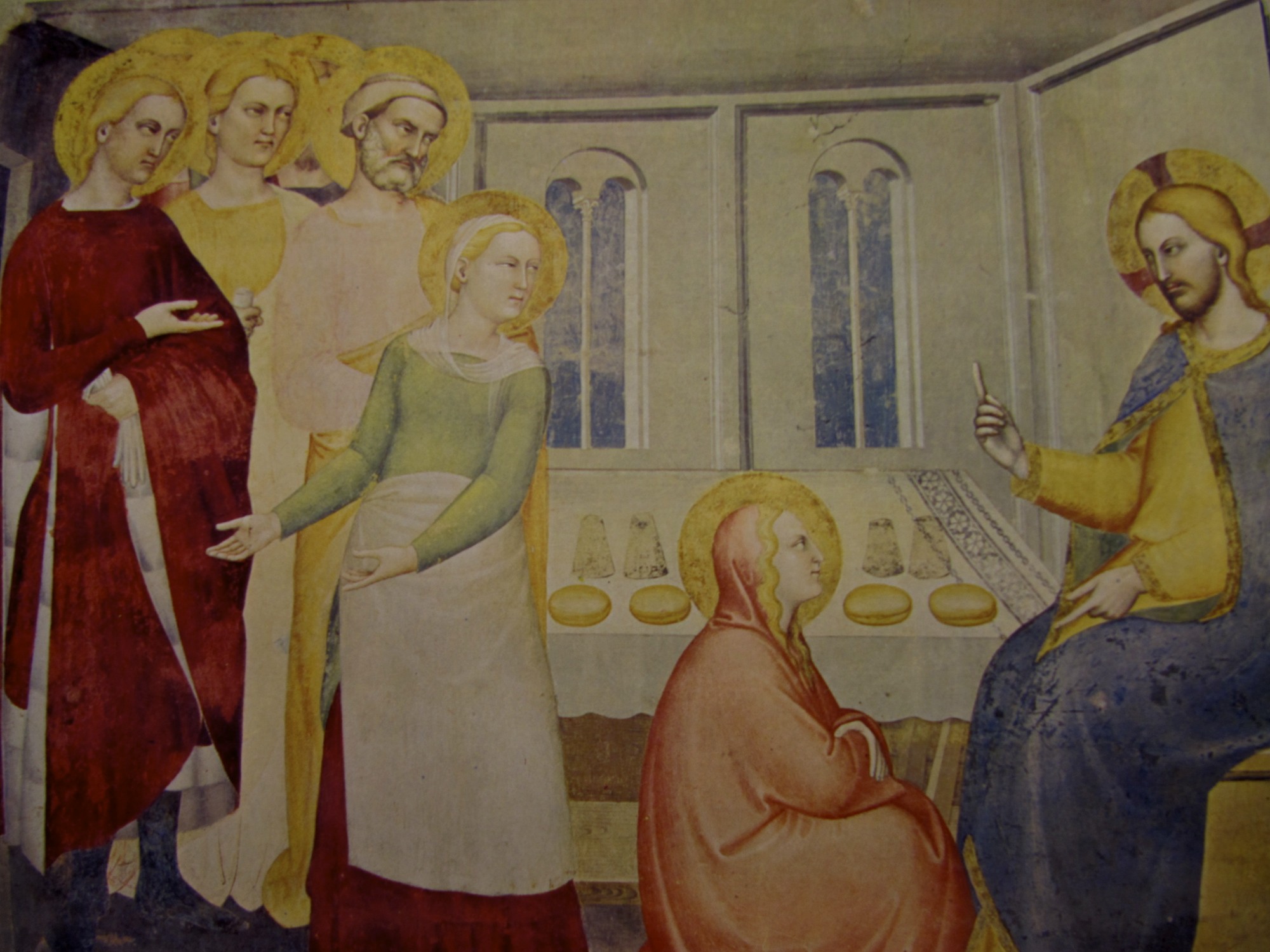
We listen to scholars who study the bible. How about artists too? Here’s  the 13th century Tuscan artist, Giovanni di Milano, looking into Luke’s gospel about  Jesus with Martha and Mary at Bethany.

The artist adds some delightful details of his own to Luke’s account. He’s let his imagination roam. The table’s set for four people. That would be Jesus, Lazarus, Mary and Martha.

But, who are those others coming in the door?  Obviously, they’re Jesus’ disciples, led by Peter. One of them gestures towards Peter, as if saying, “He told us to come.”

Poor Martha in her apron holds up her hands, “What are we going to do?”

There will be no miracle, except the miracle of Martha’s hospitality.

More than four are going to be fed.

We need to read the gospels like this too.

Almighty ever-living God, your Son was welcomed in Martha’s house as a guest, grant, we pray, that through her intercession, serving Christ faithfully in our brothers and sisters, we may be received by you in the halls of heaven.Through our Lord Jesus Christ, your Son, who lives and reigns with you in the unity of the Holy Spirit, one God, for ever and ever.

Celebrating With St. Mary Magdalene

    Years ago, when I spent my first “Holy Week Retreat” at the Bishop Molloy Retreat House in Jamaica, Queens, I was especially troubled by the Passion of our Lord Jesus Christ. Perhaps because my mother had died recently, I even found little consolation in the joy of the Easter Vigil. It had been a long, sorrowful, sleepless week and I fell into a tired, troubled sleep on that Saturday night after reading the Gospel (Jn 20: 1-2, 11-18) that is read on the feast day of St. Mary Magdalene, her experience at the tomb.


    I kept on waking from the same dream. In this dream many of us had fallen into a numb, restless slumber on the floor of the Upper Room. I was one of the women, and I was anxious about getting safely to our Lord’s tomb before daybreak so we could anoint His body. Mary Magdalene kept on waking us during the night but it was still too early.

When I finally woke up in the Retreat House room it was already day and I felt the sadness of being left behind by the others. It was only a dream, but it had felt so real, so urgent. Still half-asleep I imagined Magdalene all alone  ( without me!)  out there in the dark streets of Jerusalem going through an experience like the one described  in the first reading for the Feast:

 “On my bed at night I sought Him whom my heart loves-
  I sought Him but I did not find Him.
 I will rise then and go about the city;
 In the streets and crossings I will seek  Him whom my heart loves.
  I sought Him but I could not find Him. “
                                                                                    ( Song of Songs 3:1-2)

    I imagined her sitting within the dark, empty tomb, weeping hopelessly. In my reverie I share in her grief. It overwhelms me. Outside of the cave, the crimson dawn shines, and a voice asks: “Woman why are you weeping?” Like her, I pour out my bitter grief.  

And then, He calls me by  name. I know that Voice. It is my Beloved, my Rabbouni! It is Easter Sunday! My Lord lives and loves me! I run out and embrace Him with all my might. He hugs me right back, because He loves me so much, before He gently pushes me away and rises to His Father in joy and glory. It is going to be a wonderful day. On that last day of the retreat I would  find relief and hope. Thank you Resurrected Lord!


    Mariam of Magdala, the wonderful disciple, experienced this and so much more. She must have been rejuvenated and re-energized by this sacred experience. Her Beloved tells her, “go to my brothers and tell them.” She is sent to announce to them that Christ is risen. She is sent by Him. That is why she is called the Apostle to the Apostles.

I am so happy that Pope Francis elevated her “memorial” to a “ feast day” in the Church calendar, giving her the same level of celebration as the male apostles. I love and admire her for her courage, her faith, and her wonderful devotion to our Savior. She is such a great example to me. I imagine her in Christ, young, beautiful and strong, a role model that I share with my granddaughters. Her story makes me think of the first two paragraphs of Pope Francis’ apostolic exhortation to the young, CHRISTUS VIVIT:

    1. “Christ is alive! He is our hope, and in a wonderful way He brings youth to our world, and everything He touches becomes young, new, full of life. The very first words, then, that I would like to    say to every young Christian are these: Christ is alive and He wants you to be alive!
    2. “He is in you, He is with you and He never abandons you. However far you may wonder, He is always there, the Risen One. He calls you and He waits for you to return to Him and start over again. When you feel you are growing old out of sorrow, resentment or fear, doubt or failure, He will always be there to restore your strength and your hope.”

Orlando Hernandez

16th Sunday of the Year a: The Power of Good

For this week’s homily please watch the video below.

The Journey of the Mind: St. Bonaventure

You would expect a great theologian like St. Bonaventure (July 17) to tell you to hit the books if you would want to go to God. After all, his treatise we read on his feast is called “The Journey of the Mind to God.”

Instead he directs us to Christ and the Cross as our way to God.

” If you ask how such things can occur, seek the answer in God’s grace, not in doctrine; in the longing of the will, not in the understanding; in the sighs of prayer, not in research; seek the bridegroom not the teacher; God and not man; darkness not daylight; and look not to the light but rather to the raging fire that carries the soul to God with intense fervour and glowing love.”

A shelf of scripture commentaries and theology books wont bring us wisdom of themselves, St. Bonaventure says in his Breviloquium, otherwise only scholars would enter the kingdom of heaven.

“The stream of holy Scripture flows not from human research but from revelation by God. It springs from the Father of lights, from whom all fatherhood in heaven and on earth takes its name. From him, through his Son Jesus Christ, the Holy Spirit flows into us; and through the Holy Spirit, giving, at will, different gifts to different people, comes the gift of faith, and through faith Jesus Christ has his dwelling in our hearts. This is the knowledge of Jesus Christ which is the ultimate basis of the solidity and wisdom of the whole of holy Scripture…

If we are to follow the direct path of Scripture and come straight to the final destination, then right from the beginning – when simple faith starts to draw us towards the light of the Father – our hearts should kneel down and ask the Father to give us, through his Son and the Holy Spirit, true knowledge of Jesus and of his love. Once we know him and love him like this, we shall be made firm in faith and deeply rooted in love, and we can know the breadth, length, depth and height of holy Scripture.”

Sounds like Gregory of Nysaa, doesn’t it?

Kateri Tekakwitha (1656-1680)

KATERI

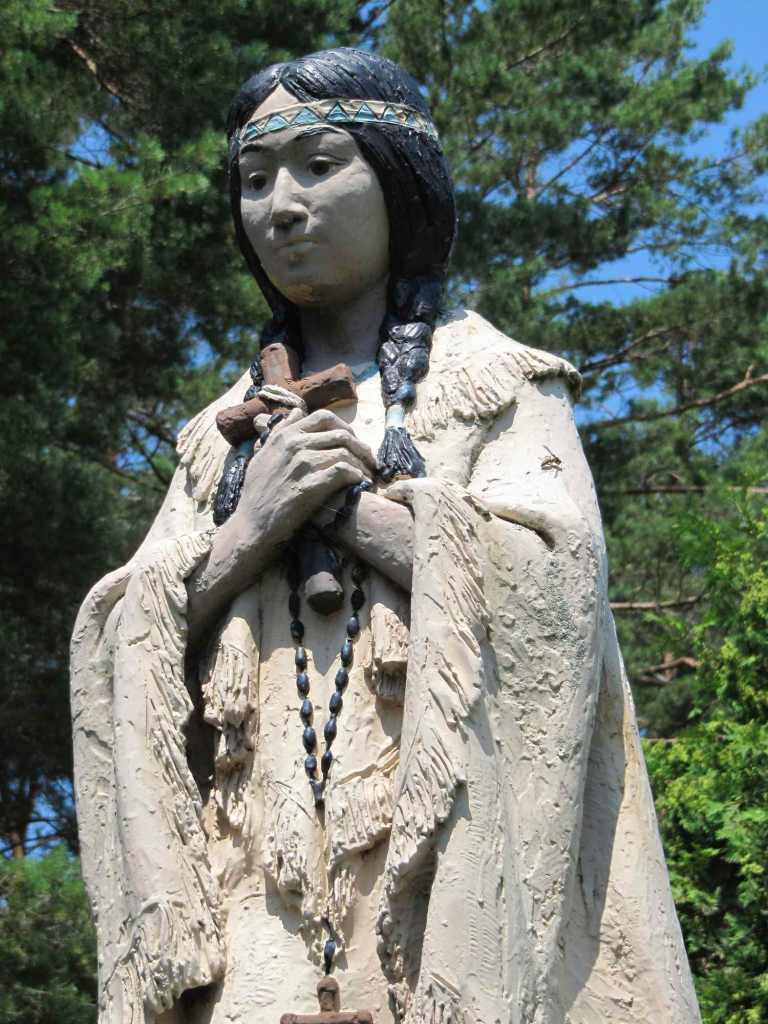
Kateri statue, Auresville

Sometime ago I stumbled on a map of New York rivers and lakes.  The rivers and lakes were the roads and highways used by the native peoples and early settlers centuries ago. Even today, the New York Thruway follows the Hudson and Mohawk Rivers from New York City to Buffalo.

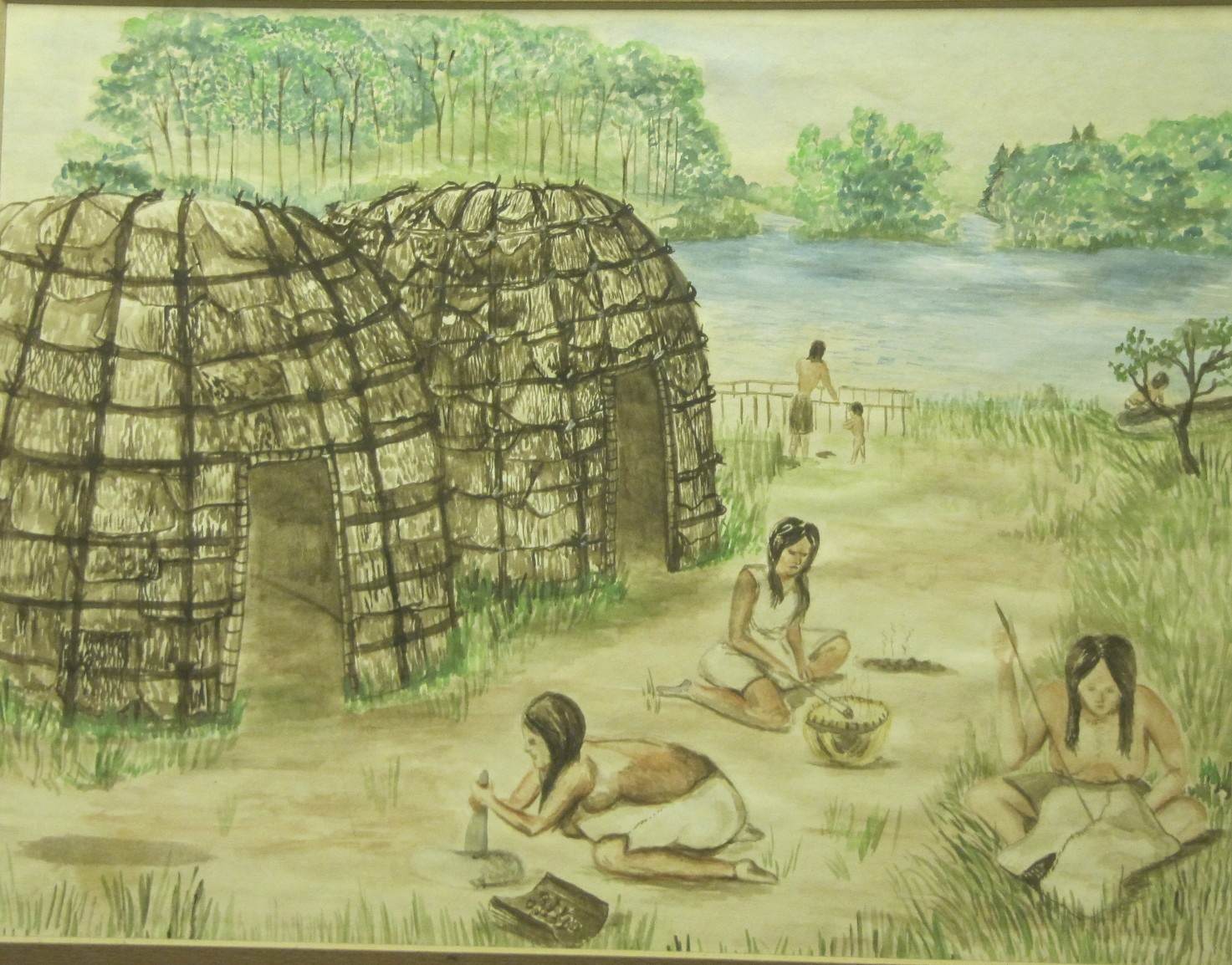
Just north of Albany near the town of Fonda are the ruins of the17th century Mohawk village of Caughnawaga, excavated in the 1950s by a Franciscan priest,  Thomas Grassmann. In the excavated village are traces of 12 long houses surrounded by a fortified stockade which was built in 1666 after a French army from Quebec destroyed an earlier Mohawk village at Osserneron (today, Auriesville) a few miles south.
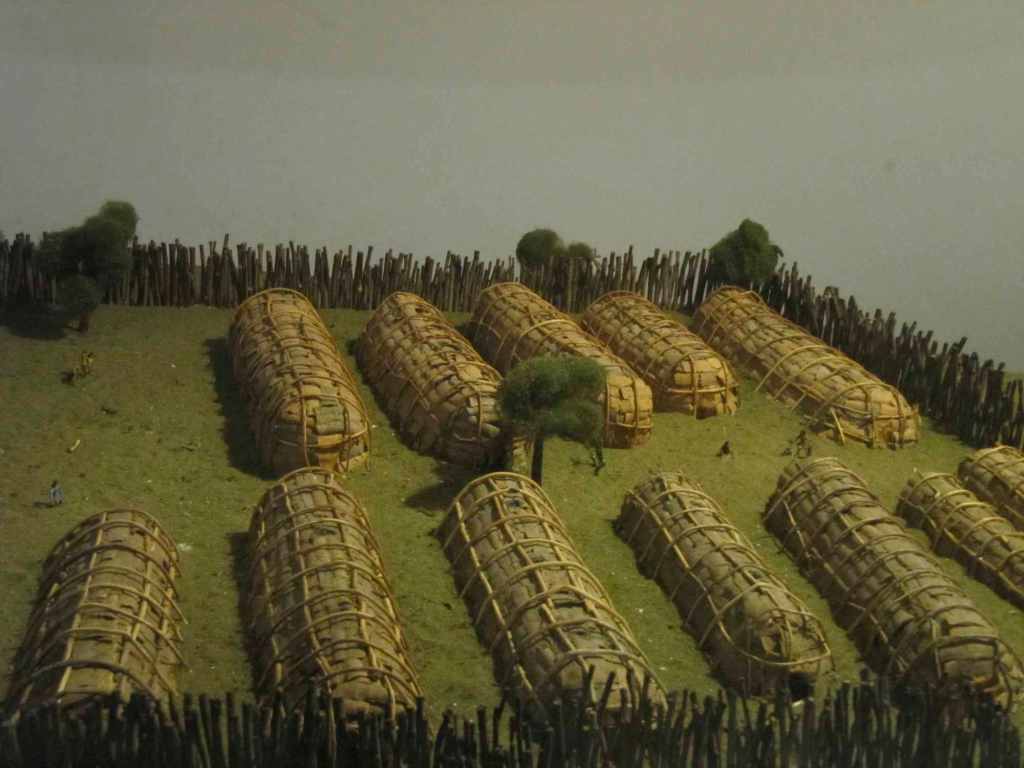
VILLAGE

Model of Longhouses, Fonda

The French army was punishing the Mohawks for their part in the Iroquois-Huron wars, when they plundered and destroyed villages along the St. Lawrence River belonging to the Hurons and Algonquins, Indian allies of the French. The Mohawks, members of the Iroquois confederation, wanted to gain control of the fur trade from their northern neighbors.

In destroying Ossernenon, the French army was also probably avenging the deaths of Fr. Isaac Jogues, SJ, and Rene Goupil and Gabriel Lalande, three French missionaries  killed in that village some years before:  honored  today by the Church as martyrs.

In the war against their neighbors to the north, the Mohawks  took women and children captive.  At the time,  native tribes replenished  their own numbers–diminished by wars or disease– by kidnapping members from other tribes. One of the Christian Algonquin women captured in an earlier raid married a Mohawk brave from Ossernenon and they had a daughter,  Kateri Tekakwitha (1656-1680), whom the Catholic Church  honors as a saint.

An epidemic of smallpox ravaged Ossernenon when Kateri was four years old, killing   many children and adults. The young girl almost died of the disease that left her disfigured. Her early Jesuit biographer says, “ She almost lost her eyesight, and her eyes hurt so much from this illness that she covered herself with a blanket when out in strong light.” (The Life of the Good Catherine Tekakwitha, Claude Chauchetiere, SJ , 1695)

Both parents died when Kateri was a little girl and she was taken in by relatives in the new Mohawk village of Caughnawaga, where she lived most of her life. Her mother was a devout Christian and must have told her about Christianity, but Kateri’s new family and  tribe strongly opposed the religion.

The French military, as one condition for not returning to the Mohawk villages, demanded that Jesuit missionaries be allowed to visit them and minister to captive Christians or others interested in their faith. Jesuit missionaries visited Caughnawaga for three days in 1667 and received hospitality in the long house where Kateri lived with her uncle, a Mohawk leader opposed to Christians.

According to witnesses, Kateri  was a normal Indian girl and young woman.  “She brought wood and tended the fire when her aunt ordered her, and got water when those in the long house needed it. When she had nothing to do she amused herself making small jewels and dressing as other girls of her age. She placed shell bead necklaces around her neck, shell bead bracelets on her arms, rings on her fingers and ornaments in her ears.” (The Life of the Good Catherine Tekakwitha, Claude Chauchetiere, SJ , 1695)
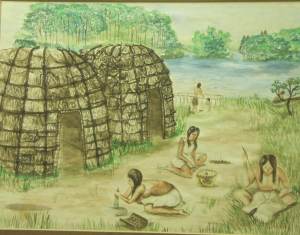
Though sickly, she was not lazy or proud. She never talked about others. Timid, she avoided dances and games. She didn’t like seeing captives harmed or people tortured, witnesses said.

In the spring of 1675  Jesuit Father Jacques de Lamberville visited Caughnawaga . Kateri was alone in her long house because a foot injury prevented her from working in the fields and the priest entered her lodge. She spoke to him of her desire to receive baptism and on Easter, 1676, the young Indian girl was baptized and took the name Kateri, after St. Catherine of Siena, the mystic and a favorite patron of Christian Indian women. She was 20 years old.

Her uncle and relatives in the long house opposed her conversion to Christianity and pressured her to marry and follow their ways, though against  her beliefs. The early Jesuits considered it a miracle for a Christian to resist family and tribal pressure such as Kateri experienced in Caughnawaga. Yet, her early biographer says “She practiced her faith without losing her original fervor and her extraordinary virtue was seen by all. The Christians saw her obeying their rules exactly, going to prayers every day in the morning and evening and Mass on Sunday. At the same time she avoided the dreams feasts and the dances,” practices endangering her belief.  (The Life of the Good Catherine Tekakwitha, Claude Chauchetiere, SJ , 1695)

Father de Lamberville finally recommended that Kateri escape to the newly-established  Indian Christian village in Kahnawake near Montreal, where she could live her faith more easily. In 1676, aided by other Christian Indians, she made the dangerous journey northward.  There she lived a fervent life of prayer and faith;  she died and was buried on April 17th, 1680.

KATERI 2

Early Painting of Kateri, Fonda

She was canonized by Pope Benedict XVI on October 21, 2012, Her feast day is July 14.

15th Sunday a: Sowing Seed

For this week’s homily please watch the video below.