Tuesday, 3rd week of Lent

Peter’s question about forgiveness in today’s gospel ( “How many times must I forgive my brother?”) isn’t just his question. He’s asking the question for all of us.

Measure your forgiveness by God’s forgiveness, Jesus says to Peter. It’s beyond measure, and he gives Peter and all of us a story of two servants. Both are involved in a money operation gone wrong. As we know money brings out the worst in people.

There’s a big difference in the money owed. The first servant owes ten thousand talents, a huge sum, and in a unexpected display of mercy, his master forgives the entire debt.

After being forgiven so much, however, that servant sends off to debtors prison another servant who owes him a few denarii, a small sum. The ten thousand talents his master has forgiven him would be worth about 10 million denarii. Big difference!

The story isn’t our only teacher, however.  God’s unmeasurable forgiveness finds its greatest expression in the passion and death of Jesus: “Father, forgive them for they know not what they do,” he cries out from the cross. He pleads, not for one, or a few, but for the whole world. Jesus reveals the mercy of God beyond measure.

We’re called to measure our forgiveness of others against his.

Lord, let me hear your call for forgiveness from the cross,

and let me make your call mine.

March 8-13. 3rd Week of Lent

March 8 Mon Lenten Weekday [Saint John of God, Religious]

2 Kgs 5:1-15ab/Lk 4:24-30 

9 Tue Lenten Weekday [Saint Frances of Rome, Religious]

Dn 3:25, 34-43/Mt 18:21-35 

10 Wed Lenten Weekday

Dt 4:1, 5-9/Mt 5:17-19 

11 Thu Lenten Weekday

Jer 7:23-28/Lk 11:14-23 

12 Fri Lenten Weekday

Hos 14:2-10/Mk 12:28-34 

13 Sat Lenten Weekday

Hos 6:1-6/Lk 18:9-14

14 SUN FOURTH SUNDAY OF LENT

2 Chr 36:14-16, 19-23/Eph 2:4-10/Jn 3:14-21

or, for Year A, 1 Sm 16:1b, 6-7, 10-13a/Eph 5:8-14/Jn 9:1-41 or 9:1, 6-9, 13-17, 34-38

Last week’s weekday readings ended with the story of the Prodigal Son; this week’s end with the tax collector who prays in the temple and finds mercy. 

Readings from the Book of Hosea occur the last two days of this week; he’s the prophet whose unbroken love for his unfaithful wife reminds us of God’s faithful relationship with humanity. God always wants us back.

Naaman the Syrian (Monday) came to appreciate the saving waters of the Jordan. He reminds us of the mystery of Baptism we celebrate this season.

God is faithful. May we come to see God’s fidelity, who makes us his own.

Naaman’s story follows the story of the Samaritan woman, read on Sunday, week 3. She is also promised life-giving water.

The World’s on a Lenten Journey Too


Pope Francis is in Iraq on an historic journey these days seeking peace for that part of the world. He addressed Iraq’s government leaders and the diplomatic corp on March 5th, then visited Christians, closing with a mass in the Chaldean cathedral in Baghdad. Ten years ago 58 people were killed there by ISIS gunmen. 

March 6th, he journeyed around 5:30 AM to Najaf, where he met privately with Grand Ayatollah Ali al-Sistani, one of the leading figures in Shia Islam.Then he went to Ur, the home of the Abraham, for a meeting with religious leaders. Later, he celebrated the liturgy at the cathedral  in Baghdad.

On March 7th, the pope went to Mosul, a former ISIS stronghold where at 10 AM he will have a prayer service for the victims of war. At 11:30 AM he rededicates the Church of the Immaculate Conception which ISIS occupied and left in ruins. Finally at 4 PM he will celebrate the Eucharist at Erbil, before returning to Rome.

You can see coverage of his trip on VaticanNews.  l

The pope obviously wants to bring peace to one of the most troubled places in our world. His journey reminds us that Lent is more than a personal journey to God, a time to stay home and pray. He wants a world turned to God, where people live in harmony with one another.  

I was moved especially by his trip to Ur, Abraham’s birthplace, where he pleaded with religious leaders, Christian, Moslem and others, to remember our common “father in faith.”

“Father Abraham, who was able to hope against all hope (cf. Rom 4:18), encourages us. Throughout history, we have frequently pursued goals that are overly worldly and journeyed on our own, but with the help of God, we can change for the better. It is up to us, today’s humanity, especially those of us, believers of all religions, to turn instruments of hatred into instruments of peace. 

It is up to us to appeal firmly to the leaders of nations to make the increasing proliferation of arms give way to the distribution of food for all. It is up to us to silence mutual accusations in order to make heard the cry of the oppressed and discarded in our world: all too many people lack food, medicine, education, rights and dignity! It is up to us to shed light on the shady maneuvers that revolve around money and to demand that money not end up always and only reinforcing the unbridled luxury of a few. It is up to us preserve our common home from our predatory aims. It is up to us to remind the world that human life has value for what it is and not for what it has. That the lives of the unborn, the elderly, migrants and men and women, whatever the colour of their skin or their nationality, are always sacred and count as much as the lives of everyone else! It is up to us to have the courage to lift up our eyes and look at the stars, the stars that our father Abraham saw, the stars of the promise.”

Is it possible? Obviously an old man in his late 80s, hobbled by sciatica, believes it is. Blessed are the peacemakers. 

3rd Sunday of Lent b

Fr Rick Frechette is a Passionist, a priest and a physician, who has spent most of his priesthood  in developing countries.

He was born in 1953 in Connecticut, joined he Passionists as a novice in 1974, was ordained in 1979, and received a Doctorate in Osteopathic Medicine in 1998.

The movement he started in Haiti to both  improve the lives of the very poor and empower them with leadership, is under the patronage of St Luke, evangelist and physician.

For more information, see StLukeHaiti.org

2nd Sunday of Lent:

For this week’s homily, please watch the video below.

Fr Rick Frechette is a Passionist, a priest and a physician, who has spent most of his priesthood  in developing countries.

He was born in 1953 in Connecticut, joined he Passionists as a novice in 1974, was ordained in 1979, and received a Doctorate in Osteopathic Medicine in 1998.

The movement he started in Haiti to both  improve the lives of the very poor and empower them with leadership, is under the patronage of St Luke, evangelist and physician.

For more information, see StLukeHaiti.org

Saturday, First Week of Lent: Loving Enemies

Lent 1

“Jesus said to his disciples: ‘You have heard that it was said,

You shall love your neighbor and hate your enemy.

But I say to you, love your enemies,

and pray for those who persecute you,

that you may be children of your heavenly Father,

for he makes his sun rise on the bad and the good,

and causes rain to fall on the just and the unjust.” (Matthew 5: 43-48) 

When people talk about love today,  they’re usually focused on romantic love, “falling in love”, or loving yourself. Not much talk about loving others or loving your enemies today.

 “Love your enemies”, Jesus says in today’s gospel. Have a love that imitates God’s love,  our heavenly Father “who makes his sun rise on the bad and the good and causes rain to fall on the just and the unjust.”

Is that love beyond us?

We’ve been told from earliest years that there are some people you can’t trust; they’ll take advantage of you; they’ll harm you. You have enemies in this world. Be careful.

Certainly Jesus doesn’t condemn reasonable caution. He had enemies too and he was careful what he said and how he dealt with them. Evil exists. Rather, Jesus warns against  a pessimism that leads us to condemn someone or some groups absolutely. We see no possible goodness or possible change in them, only intractable evil.

We don’t see as God sees when we think like that. The sun of God’s goodness shines on this world; the rain of his mercy softens its hardest places. His love changes people for the good.

We can’t just reason our way to a love of enemies, we must pray to grow in this love.  Jesus not only taught us, but showed us by his own example how to love our enemies. Look at him in his Passion, says St. Aelred:

“Listen to his wonderful prayer, so full of warmth, of love, of unshakeable serenity – Father, forgive them.  Is any gentleness, any love, lacking in this prayer?
 
  Yet he put into it something more. It was not enough to pray for them: he wanted also to make excuses for them. Father, forgive them, for they do not know what they are doing. They are great sinners, yes, but they have little judgement; therefore, Father, forgive them.
 
They are nailing me to the cross, but they do not know who it is that they are nailing to the cross: if they had known, they would never have crucified the Lord of glory; therefore, Father, forgive them.
 
They think it is a lawbreaker, an impostor claiming to be God, a seducer of the people. I have hidden my face from them, and they do not recognise my glory; therefore, Father, forgive them, for they do not know what they are doing.”
 

Teach us, Lord, a love like yours,
that never gives up or draw limits,
or settles for those in its small circle.
Help us to love like the sun and the rain
that reach everywhere.
FEBRUARY 22-27: Ist WEEK OF LENT

FEBRUARY 22 Mon The Chair of Saint Peter.Feast

1 Pt 5:1-4/Mt 16:13-19

23 Tue Lenten Weekday. Is 55:10-11/Mt 6:7-15

[Saint Polycarp, Bishop and Martyr]

24 Wed Lenten Weekday Jon 3:1-10/Lk 11:29-32 

25 Thu Lenten Weekday Est C:12, 14-16, 23-25/Mt 7:7-12 

26 Fri Lenten Weekday Ez 18:21-28/Mt 5:20-26

27 Sat.  ST.GABRIEL POSSENTI, CP 

[Saint Gregory of Narek, Abbot and Doctor of the Church]

Dt 26:16-19/Mt 5:43-48 

28 SUN SECOND SUNDAY OF LENT

Gn 22:1-2, 9a, 10-13, 15-18/Rom 8:31b-34/Mk 9:2-10 

Our Lenten readings for the 1st week teach us how to see as Jesus sees–through prayer. On the mountain Jesus teaches the Lord’s Prayer, the common prayer of God’s children. God is Father of us all, the One who gives us daily bread, forgiveness and strength when testing comes. God’s gift of prayer opens our eyes and our hearts. Like snow and rain, the gift of prayer falls on all. All can pray. (Tuesday)

Prayer is about more than ourselves and our own needs. The story of Jonah points out a world bigger than our own. As children of the world we must pray and work for its good. (Wednesday)

Never lose confidence in prayer and what it makes possible. “Ask and you will receive, seek and you will find. Knock and the door with open” Jesus teaches. (Thursday)

Make sure as you approach the altar to pray that your heart is free from resentment, harsh judgment and anger. Otherwise, your prayer become weak and blind. You cannot see.  (Friday)

We must pray even for our enemies. For our Father causes the sun to shine on the just and the unjust and the rain to fall on saints and sinners. (Saturday)

This week opens with the Feast of the Chair of Peter. (Monday) Our church is a teacher of prayer. The Passionists celebrate the Feast of St. Gabriel on Saturday.

Lent is an important time to teach children to prayer. Here’s a site that can help. OurChildrenPray. You may also find this new website on Prayer helpful in your own prayer:

https://praydaybyday.org

A Book for Lent

St. Paul Cross

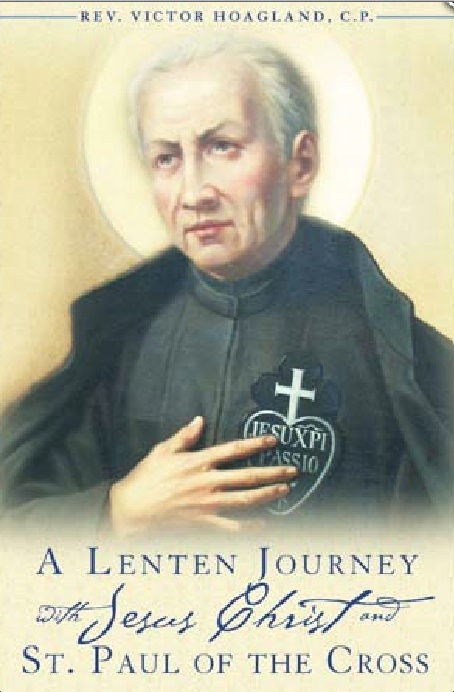
Lent begins next Wednesday, February 14th. Some years ago a publisher asked me to write a book entitled A Lenten Journey with Jesus Christ and St. Paul of the Cross, to be part of a series of reflections on the daily lenten gospels that included thoughts of saints of different religious orders. The book has just been translated into Japanese.

I was initially skeptical about the project. From early on I’ve seen lent as a time to give up something and take up some devotional practice like the Stations of the Cross. Yes, Lent was a journey with Jesus, and I appreciate the daily scriptures that take us through the season with him, but where does a saint come in, even a saint important to me, like St. Paul of the Cross, the 18th century founder of my community the Passionists ?

Working on the book made me see lent differently. First, for St. Paul of the Cross lent was a time to leave the quiet mountain at the edge of the Mediterranean Sea where he lived and prayed and go to work in the Tuscan Maremma, then a swampy, malaria infested region of Italy, overrun with robbers and desperately poor. All through lent, carrying a cross and a bible Paul went from village to village preaching God’s love to people whose lives were often on edge with fear and lost hope.

Lent isn’t a time for turning inward, away from world you live in, Paul reminds me. Lent is a time to go out to the wounded world before you.

Secondly, Paul engaged his world, the world of the Tuscan Maremma, in the light of the gospel, especially the Passion of Jesus Christ. For him that mystery was not limited to a time long ago, when Jesus suffered on a Cross; it was there in the people before him. From village to village, he held up a Cross to anyone who would hear as a mirror of their reality and a pledge of the great mercy of God. Jesus died and rose again.

The Passionists celebrate two feasts immediately before Ash Wednesday to prepare for Lent. Last Friday we celebrated the Commemoration of the Passion of Jesus Christ. Tomorrow, Tuesday before Ash Wednesday, we celebrate the Prayer of Jesus in the Garden. Both feasts come from our missionary founder.

I can see him packing his bags for his lenten journey down the quiet mountain for the villages and towns of the Tuscan Maremma. He must remind himself what he will see. He must pray so he doesn’t forget.

“May the Passion of Jesus Christ be always in our hearts.”

FEBRUARY 15-21: Lent Begins

The final daily readings from Mark’s gospel, on Monday and Tuesday this week, introduce us to the season of Lent on Ash Wednesday. The Pharisees ask for a sign (Mark 8:11-13) The sign Jesus gives is his death and resurrection. The disciples at this point in Mark’s Gospel (Mark 8: 14-21) still do not understand him.

Unfortunately, we’ll only have readings from the story of Noah as the flood descends on the world. We’ll miss the ending of the flood narrative and the story of the Tower of Babel, great passages from the Jewish scriptures, The Genesis narrative deserves a better place in our lectionary.

The Passionist calendar on Tuesday has a memorial of the Prayer of Jesus in the Garden. We must enter this mystery through prayer, as Jesus did. St. Paul of the Cross understood the place of prayer for entering the mysteries of God.

The readings and rites of Ash Wednesday offer basic directions for entering the Lenten season–prayer, fasting and almsgiving. We’re administering ashes differently this year because of the pandemic. The 1st Sunday of Lent recalls the Temptation of Jesus, this year from the Gospel of Mark. This year is something of a desert for us too, isn’t it?

During Lent saints’ feast days are few, not to overshadow the readings and events of the season. Most of those celebrated are optional memorials in the liturgical calendar of the USA. 

FEBRUARY 15 Mon Weekday Gn 4:1-15, 25/Mk 8:11-13 

16 Tue Weekday Gn 6:5-8; 7:1-5, 10/Mk 8:14-21 

Prayer of Jesus in the Garden Heb 5:1-9/Luke 22:39-46

17 Wed Ash Wednesday Jl 2:12-18/2 Cor 5:20—6:2/Mt 6:1-6, 16-18 

18 Thursday after Ash Wednesday Dt 30:15-20/Lk 9:22-25 

19 Fri Friday after Ash Wednesday Is 58:1-9a/Mt 9:14-15

20 Sat Saturday after Ash Wednesday Is 58:9b-14/Lk 5:27-32

21 SUN FIRST SUNDAY OF LENT Gn 9:8-15/1 Pt 3:18-22/Mk 1:12-

6th Sunday b: Reaching to Those Alone

For this week’s homily, please watch the video below.