You may wish to print out these prayers we use for visits to our Mary Garden for your own prayers at your garden, small or large. They take us to the origins of the Mary Garden, in the Book of Genesis. The psalm and canticle attune our eyes and hearts to God’s creation, which we’re called to cherish and care for.
The hymn is a version of Mary, the Dawn, by Father Justin Mulchahy. Passionist, who taught sacred music for many years. Music available online.
21 Sat Easter Weekday [St Christopher Magallanes, Priest, and Companions, Martyrs]
Acts 16:1-10/Jn 15:18-21
22 SUN SIXTH SUNDAY OF EASTER
Acts 15:1-2, 22-29/Rv 21:10-14, 22-23/Jn 14:23-29
The gospel readings for the remainder of the Easter season are from the Farewell Discourse of Jesus from John’s gospel. He is going to the Father, Jesus says. What does that mean his disciples wonder?
“I will not leave you orphans,” Jesus says, yet he will not be with them as he was before, but he will be with them as God is always with them. The Paraclete, the Spirit of truth, will teach them all things. Jesus will be present to them in signs.
“I will not leave you orphans,” Jesus says to them– and to us.
The Acts of the Apostles continue to describe the church’s journey in time. This week’s readings describe the successful missionary efforts of Paul and Barnabas among the gentiles in the Asia Minor cities of Lystra, Derbe, and Pisidia. Their success raises question among some in Jerusalem. Are the gentiles taking over? To meet what some consider a threat and others an opportunity, a council was called in Jerusalem, which has enormous consequences for the church. (Wednesday-Friday)
Councils are important in the church. Can we say the Second Vatican Council has enormous consequences too?
Conflict causes the church to grow, Pope Francis commented some time ago: “But some in Jerusalem, when they heard this, became ‘nervous and sent Barnabas on an “apostolic visitation”: perhaps, with a little sense of humor we could say that this was the theological beginning of the Congregation for the Doctrine of the Faith: this apostolic visit by Barnabas. He saw, and he saw that things were going well.”
Recent changes in the Roman Curia approved by Pope Francis indicate where Pope Francis himself might stand in conflicts like this. The curial body on evangelization, headed by the pope himself, appears before the Congregation for the Doctrine of the Faith.
The pope is looking for a synodal Church, “ a Church, that is, of mutual listening, in which everyone has something to learn: the faithful people, the college of bishops, the Bishop of Rome: each listening to the other, and all listening to the Holy Spirit…to hear what the Spirit is saying to the Churches.”
The sky over the boardwalk at Spring Lake, New Jersey, is sometimes swept with colors before nightfall. Then, a lamp becomes the only light till dawn.
“I came into the world as light,” Jesus says in today’s gospel” so that everyone who believes in me might not remain in darkness.( John 12:44-50)
The sun will rise again and the great Sun will also rise again, Augustine says in one of his sermons. Then “lamps will no longer be needed. When that day is at hand, the prophet will not be read to us, the book of the Apostle will not be opened, we shall not require the testimony of John, we shall have no need of the Gospel itself. Therefore all Scriptures will be taken away from us, those Scriptures which in the night of this world burned like lamps so that we might not remain in darkness.”
Darkness is temporary; we are meant for light.
“I implore you to love with me and, by believing, to run with me; let us long for our heavenly country, let us sigh for our heavenly home, let us truly feel that here we are strangers. What shall we then see? Let the gospel tell us: In the beginning was the Word and the Word was with God and the Word was God. You will come to the fountain, with whose dew you have already been sprinkled.
“Instead of the ray of light which was sent through slanting and winding ways into the heart of your darkness, you will see the light itself in all its purity and brightness. It is to see and experience this light that you are now being cleansed. Dearly beloved, John himself says, we are the sons of God, and it has not yet been disclosed what we shall be; but we know that when he appears we shall be like him, because we shall see him as he is.
“I feel that your spirits are being raised up with mine to the heavens above; but the body which is corruptible weighs down the soul, and this earthly tent burdens the thoughtful mind. I am about to lay aside this book, and you are soon going away, each to his own business. It has been good for us to share the common light, good to have enjoyed ourselves, good to have been glad together. When we part from one another, let us not depart from him.”
Today’s reading from Acts of the Apostles (Acts 11: 19-26) describes the beginning of Paul’s work as missionary to the gentiles. He was sponsored by Barnabas.
After his dramatic conversion, Paul preached in Damascus, but was forced out of the city and returned to Jerusalem, but the disciples of Jesus there received him warily. They “were all afraid of Paul” because he persecuted the followers of Jesus. Barnabas believed in him and “took charge of him and brought him to the apostles.” (Acts 9, 26-30) He gained acceptance for Paul.
Later, as great numbers came to believe in Antioch, Barnabas was sent there by the Jerusalem church. Convinced the Spirit was at work, Barnabas went to Tarsus to get Paul. Together they spent a whole year teaching a large number of people. (Act 11, 26) Barnabas was the first to recognize Paul’s gifts.
Then, commissioned by the church at Antioch, Barnabas and Paul went to bring the gospel to other places. Their missionary journey took them to Cyprus (Barnabas’ birthplace) and a number of cities in Asia Minor. They preached in Jewish synagogues with mixed results, but increasingly gentile hearers accepted their message.
The Acts of the Apostles highlights Paul’s preaching, but the ministry involved the two of them. Barnabas, in fact, is initially mentioned before Paul .“They appointed presbyters … in each church” and returned to Antioch. (Acts 14, 21-23)
A dispute arose between them: “After some time, Paul said to Barnabas, ‘Come, let us make a return visit to see how the brothers are getting on in all the cities where we proclaimed the word of the Lord.’ Barnabas wanted to take along John Mark, but Paul refused to take him, because he deserted them at Pamphylia. So sharp was their disagreement that they separated. Barnabas took John Mark and sailed to Cyprus. But Paul chose Silas and traveled through Syria and Cilicia “bringing strength to the churches.” Acts 15, 36-41
Why “sharp disagreement?” Two strong personalities can’t get along? Paul’s vision against Barnabas’ vision? A clash like this reminds us that God’s plan advances even as humans disagree.
I also find it strange that Paul never mentions Barnabas in his later descriptions of his work. Barnabas, humanly speaking, got him his start.
Suppose we were asked how to bring the gospel to the world today. What might we suggest? How about buying Twitter? Or some big newspaper or media chain, as a number of wealthy figures in our society have done ?
If we look at our readings from the Acts of the Apostles for the next couple of days, we might see another way evangelization takes place. “There broke out a severe persecution of the Church in Jerusalem, and all were scattered throughout the countryside of Judea and Samaria…Now those who had been scattered went about preaching the word.” (Acts 8)
The first great persecution of the church after the death of Stephen when Greek-speaking Jews were banished from Jerusalem is not a unique event; it indicates how the gospel will always be spread– through persecution, through immigrants who must leave their own lands because of religious or economic pressures and are scattered throughout the world.
“Now those who had been scattered went about preaching the word.” Luke mentions Philip the Deacon in his account, but he doesn’t omit those others who were scattered and preached the word. Immigrants, people who have suffered from persecution or economic dislocation are always important preachers of the word. They have experienced the Passion of Jesus.
It’s one reason the church has always cared for immigrants, victims of war and persecution.
You may be interested in this story I narrated recently on YouTube. Later on today, I’m posting the story of the ancient church in Rome dedicated to St. Stephen, which was built to encourage Christians at the time threatened with dislocation and war.
Andrew, brother of Peter, says to Jesus when he asked his disciples to provide food for a hungry crowd: “There is a boy here who has five barley loaves and two fish; but what good are these for so many?” (John 6:1-15)
Duk Soon Fwang, an artist friend of mine, has been thinking a good while about that little boy and what he brought to Jesus. “We don’t know the little boy’s name and he only has a few loaves and fish to give. He’s like me,” she said. “But Jesus sees what he brings and makes it more.”
She’s almost completed a painting of the boy and Jesus, which you can see above.
At Mass this morning, we read that gospel story before we brought small pieces of bread and a cup of wine to the altar. I remembered what she said. This is our story. We bring what we have and God makes it more.
One of the best ways to see a lesson we should draw from our readings is to look at the responsorial psalm that follows the reading. Today Peter and some others of Jesus’ earlier followers are ordered by the authorities in Jerusalem to stop speaking about the Lord’s resurrection. Not the time and the place. They’re threatened with death.
“We must obey God rather than men,” Peter replies.
There’s no day or no circumstances for keeping quiet about this great mystery. There’s no season for forgetting it or minimizing it.
By the old temple gate lay a poor crippled man, forced to beg for the daily needs of life. He was lame from his birth with no hope to be healed until Peter and John came to pray.
Those two friends of the Lord saw the man lying there and were filled with compassion and love. They had no money to share, so Peter reached out his hand and gave him the best that they had.
“I have no silver, no gold, but I give you what I have – in the Name of Jesus, stand up and walk! Take this gift of new life and proclaim to all the world that the Name of the Lord has set you free!”
By the old temple gate stands a man strong and free, singing praise to the Name of the Lord!
Gloria Ziemienski April 1997
The man crippled from birth who is cured by Peter and John as they enter the temple precincts after Pentecost is an important figure in our readings for the last four days of Easter Week. Crippled from birth, over 40 years old, he’s carried to the gate of the temple each day to beg for alms.Everyone knows him, he’s a regular.
After he’s cured he goes into the temple to hear Peter’s message to the crowd about Jesus of Nazareth. As he stands there, relishing his cure, he’s a sign God’s power is a work. Can we see him becoming a believer? The temple leaders, on the other hand, find him an annoying presence whom they try to silence.
How can he be explained away?
The man was surely at Peter’s side when he spoke to the people in the temple area. Just as miracles accompanied the teaching of Jesus, so now they will accompany the teaching church. We have to expect signs like this, that raise up the poor, to be part of the church’s witness, especially in an unbelieving age.
What other signs can we see in Peter’s words to the crowd as he witnesses to the Resurrection? He points to the tomb of Jesus, in contrast to David’s tomb. It’s empty. We have to keep the holy places associated with Jesus as part of our witness.He points to the scriptures. We have to keep reflecting on them to enrich our witness. His message is overwhelming a message of forgiveness. Mercy and forgiveness should be our witness too.
Words are not the only way we witness the Resurrection of Jesus.
We wonder where the gospel events took place, especially during Holy Week.. Where was Jesus judged by Pilate? What way did he go to Calvary? Where was he crucified and where was he buried?
Reliable historians generally agree that the tomb of Jesus and the site of Calvary are in the Church of the Holy Sepucher. “Is this the place where Christ died and was buried?” Jerome Murphy-O’Connor asks in his solidly researched “The Holy Land: An Oxford Archaeological Guide” (New York, 2008). “Yes, very probably,” he answers. (p 49)
Church of the Holy Sepulcher, Jerusalem
Jerusalem’s “Via Dolorosa”, the traditional way of the cross, is less historically reliable. Beginning near St. Stephen’s Gate, where the Fortress Antonia once stood, it winds up at the Church of the Holy Sepulcher. Murphy-O Connor says it is “defined by faith and not by history.” (pp 37-38) Early Christian pilgrims created it.
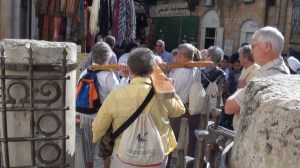
Pilgrims on the Vis Dolorosa
After the Christian church was established by Constantine in the 4th century, pilgrims from Mount of Olives, where many stayed, walked through St. Stephen’s Gate up to the Church of the Holy Sepulcher, stopping at certain places to recall incidents from the passion of Jesus. The present Via Dolorosa was formed from their devotions over the centuries. (cf. Murphy-O’Connor, p 37) Pilgrims, not archeologists, have given us the present Via Dolorosa.
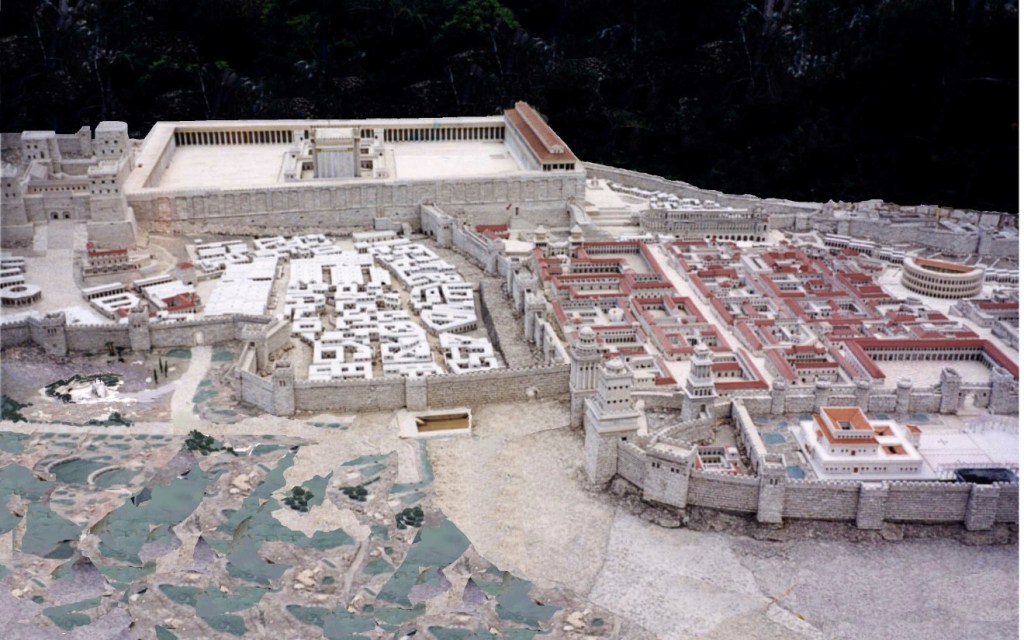
Jerusalem at the Time of Jesus
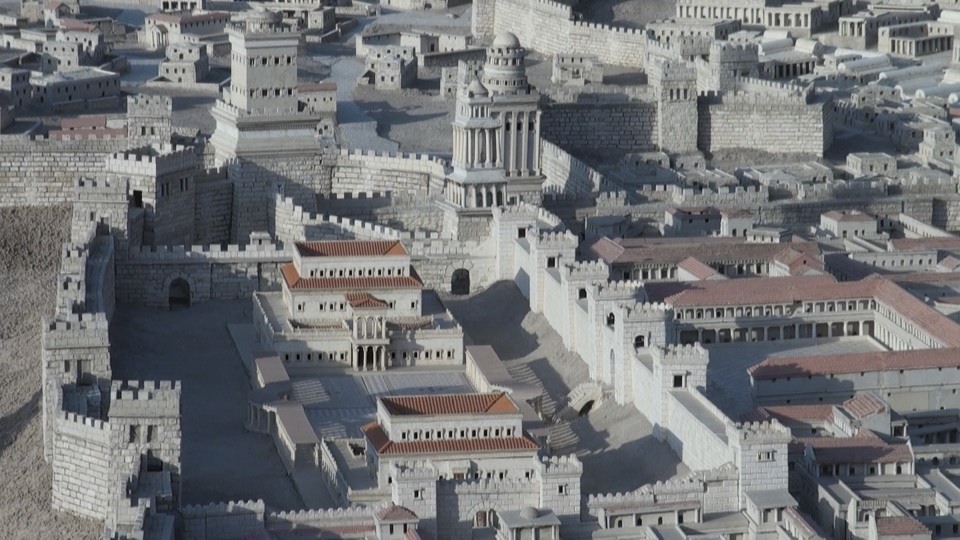
Is their a more reliable way? A reconstruction of Jerusalem (above) from the time of Jesus at the Israel Museum–somewhat altered here– suggests another way that Jesus was led to Calvary. At the bottom right is the luxurious palace complex built by Herod the Great. (below) When Pontius Pilate came from Caesaria Maritima for Passover he probably stayed there and judged Jesus in the courtyard outside the palace.
Herod’s Palace, the Citadel
After sentencing Jesus to death, Pilate handed him over to a detachment of soldiers quartered somewhere in the great towers to the left of the palace, who scourged him and crowned him with thorns.
They then led him away to Calvary, probably parading him through part of the upper city as a warning to others. In our map of Jerusalem above, the rock outcropping near to the city wall is the site of Calvary where Jesus was crucified. The gospels say he was buried in a tomb only a stone’s throw away.
In Jerusalem today the Citadel stands on the ruins of Herod’s palace, still dominating the western part of the Old City.
You can walk on the southern ramparts of the city wall where Herod’s palace once stood and view some few remains of Herod’s building; the towers have been rebuilt.
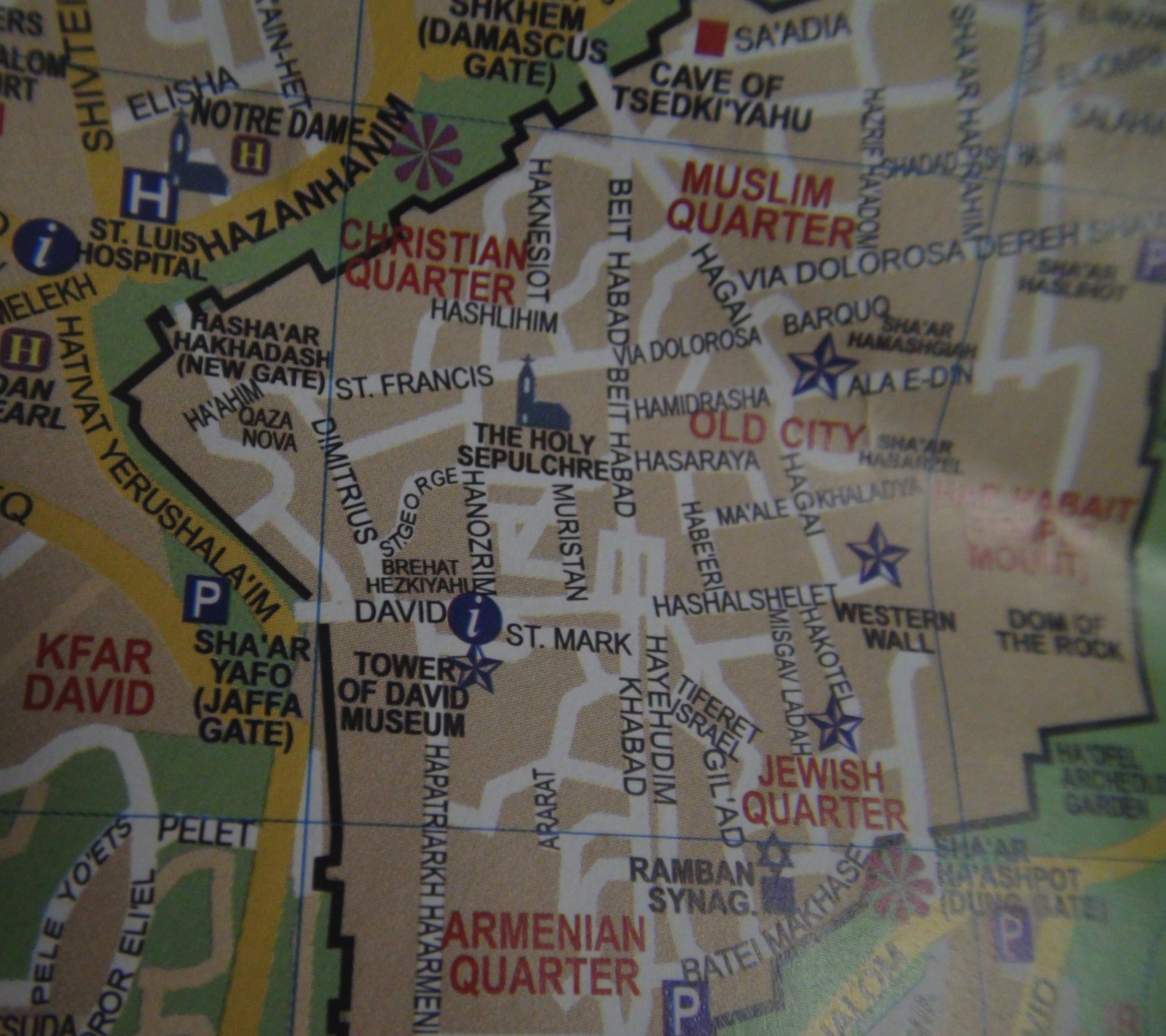
Murphy-O’Connor suggests a way Jesus was taken to Calvary from here. “If, as seems likely, Jesus was brought into the city on his way to execution, the approximate route would have been east on David Street, north on the Triple Suk, and then west to Golgotha.” (p.38)
I walked that way some years ago, down David Street, to the Triple Suk and then west to Golgotha and the Church of the Holy Sepulcher. My sense is Murphy-O’Connor is right, but I think we better not change the Via Dolorosa. For one thing, good piety has given us the present Via Dolorosa and it has a truth and beauty all its own. More importantly, it would start a war in Jerusalem, and the city has enough grief now.
For more information on the places of the Passion, see





 The Victor's Place