19th Week of the Year: Readings and Feasts

AUGUST 8 Mon Saint Dominic, Priest Memorial Ez 1:2-5, 24-28c/Mt 17:22-27 

9 Tue Weekday [St Teresa Benedicta of the Cross, Virgin and Martyr]

Ez 2:8—3:4/Mt 18:1-5, 10, 12-14 

10 Wed St Lawrence, Deacon and Martyr Feast 2 Cor 9:6-10/Jn 12:24-26 

11 Thu Saint Clare, Virgin Memorial Ez 12:1-12/Mt 18:21—19:1 

12 Fri Weekday [St Jane Frances de Chantal, Religious]

Ez 16:1-15, 60, 63 or 16:59-63/Mt 19:3-12 

13 Sat Weekday [Sts Pontian, Pope, and Hippolytus, Priest, Martyrs]

Ez 18:1-10, 13b, 30-32/Mt 19:13-15 

14 SUN TWENTIETH SUNDAY IN ORDINARY TIME

Jer 38:4-6, 8-10/Heb 12:1-4/Lk 12:49-53 

Our liturgical calendar this week takes us to distant times and places where we meet a variety of saints and situations.

August 8 we meet St. Dominic, founder of the Dominicans. August 9th to a German concentration camp to remember the heroic death of Edith Stein, Saint Teresa Benedicta of the Cross. August 10th we’re in 3rd century Rome for the martyrdom of Lawrence the Deacon; August 11th in 13th century Assisi with St. Clare; August 12th in 17th century France remembering St. Jane Francis de Chantal, August 13th to Rome for Pontian and Hippolytus, 3rd century martyrs, August 14th to a German concentration camp again, to remember Maximilian Kolbe.

 A wide variety. The saints teach us the many ways and how many situations God can be served. How are you going to serve God in your day, they ask us?

The liturgy itself is a school open day by day. We learn from it how to live. We also learn that God is with us too in life and death.

The weekday readings from Matthew’s gospel are from chapters 18-19 which describe the care the disciples of Jesus should have for each other’s faith and his departure with them from Galilee for Jerusalem.

Our first readings this week are from the Prophet Ezechiel who is the first prophet to speak from exile, after the Jews were taken captive by the Babylonians in 597 BC. He reminds us that unfavorable times can be hard, but necessary. A time that appears destructive can be transformative. A good message for now?

18th Week of the Year: Readings and Feasts

August 1 Mon Saint Alphonsus Liguori, Bishop and Doctor of the Church

Memorial Jer 28:1-17/Mt 14:13-21

2 Tue Weekday [Saint Eusebius of Vercelli, Bishop; Saint Peter Julian Eymard, Priest]

Jer 30:1-2, 12-15, 18-22/Mt 14:22-36 or Mt 15:1-2, 10-14 

3 Wed Weekday Jer 31:1-7/Mt 15:21-28 

4 Thu Saint John Vianney, Priest Memoria  Jer 31:31-34/Mt 16:13-23 

5 Fri Weekday [The Dedication of the Basilica of Saint Mary Major]

Na 2:1, 3; 3:1-3, 6-7/Mt 16:24-28 

6 Sat The Transfiguration of the Lord Feast Dn 7:9-10, 13-14/2 Pt 1:16-19/Lk 9:28b-36 

7 SUN NINETEENTH SUNDAY IN ORDINARY TIME

Wis 18:6-9/Heb 11:1-2, 8-19 or 11:1-2, 8-12/Lk 12:32-48 or 12:35-40 

Readings this week from Matthew’s gospel, chapters 14-17 offer the first of Matthew’s accounts of the miracle of the loaves and fish, the cure of the daughter of the Canaanite woman, the miracle of the storm at sea, and the confession of faith led by Peter. Matthew follows Mark’s narrative but softens Mark’s picture of the disciples and is less harsh on them for their unbelief.  

Most of the week we read from the Prophet Jeremiah and Nahum, from the time of the fall of Jerusalem by the Babylonians. Of all the prophets, Jeremiah appears closest to Jesus, the Suffering Servant.

August 6th is the Feast of the Transfiguration of Jesus, a feast originally celebrated by the eastern churches, then adopted by the western church. The feast is linked to the Feast of the Exaltation of the Cross, September 14th.

August 4th is the feast of John Vianney, patron of parish priests.

August 5 we celebrate The dedication of the Basilica of Saint Mary Major, the most important church in Rome dedicated to Mary, the Mother of God. Some of the first feasts of the Christmas celebration were celebrated here. Mary plays an important role in the mysteries of Jesus Christ.

18th Sunday c: God Stays with Us

For this week’s homily please watch the video below.

Catechesis, Yesterday and Today

Who is God? God is a pure spirit, infinitely perfect. Where is God? God is everywhere. Why did God make you? God made me to know him, to love him and to serve him in this world and to be happy with him forever in the next. I can still recite those questions and answers from the Baltimore Catechism of my youth. Most people my age learned their faith the same way, I would guess. We learned through a catechism-based catechesis.

What about catechesis today? A catechism-based catechesis seems to be the ordinary catechesis our schools, parishes and dioceses still follow, often in a classroom setting. But is it the only approach to take ?

Where do catechisms come from, anyway? Martin Luther was the first to compose a catechism in question and answers for ordinary people in the 15th century. In response, the Dutch Jesuit Peter Canisius composed the first Catholic catechism in 1555 followed by three others afterwards. The Council of Trent called for a catechism to be written as a resource for the clergy, and that catechism appeared in 1556. Robert Bellarmine later composed an influential catechism requested by Pope Clement VIII; after that, bishops from all over the world composed catechisms for their people.

As we might suspect, Catholic catechisms that followed the Protestant Reformation were composed to give a clear picture of the Catholic faith and were strongly influenced by apologetic aims.    

The Second Vatican Council in the 1960s had a different purpose. It was called to renew the church for its mission in the modern world. To bring its message to the worldwide church the council participants recognized the need for catechesis. It would not be a small task, because so many aspects of church life were being renewed.  Pope St. Paul VI, who presided over much of the council, considered the council itself the great catechism of modern times. It would be hard to encompass the council’s work in one book. Still, some catechisms appeared after the council was over.

 In 1997 Pope St. John Paul II, responding to the wishes of many of the world’s Catholic bishops, promulgated the Catechism of the Catholic Faith to foster the aims of the council. In 2006 the bishops of the USA published the United States Catholic Catechism for Adults, which interspersed stories of saints and others as examples of the faith expounded in the book. A number of other catechisms appeared after the council. “Periods of renewal are intense moments of catechesis,” the Catechism of the Catholic Faith acknowledged in an introductory paragraph. (CCC, 8)

Catechesis beyond Catechisms

In making its decisions and recommendations the Second Vatican Council looked into other times besides the Council of Trent. The history and traditions of the church’s earlier periods, especially patristic times, influenced much of the council’s work. In his catechetical sermons St. Cyril, the 4th century bishop of Jerusalem, instructs his catechumens to memorize the creed as a summary of the scriptures they learned.  There were no catechisms then. Books were rare; many people were illiterate.. A memorized creed was their primary book. Catechesis in patristic times used a range of ways to form Christians in their faith.

The Catechism of the Catholic Church recognizes this broader approach to catechesis in its introductory paragraphs. “Quite early on, the name catechesis was given to the totality of the Church’s efforts to make disciples, to help people believe that Jesus is the Son of God so that believing they might have life in his name, and to educate and instruct them in this life, thus building up the body of Christ.” (CCC 4) 

The Catechism identifies various ways the church’s catechesis occurs:  “while not being formally identified with them, they are: the initial proclamation of the Gospel or missionary preaching to arouse faith; examination of the reasons for belief; experience of Christian living; celebration of the sacraments; integration into the ecclesial community; and apostolic and missionary witness. (CCC 6) 

Preaching in all its forms has a catechetical dimension. Searching for reasons we believe is important to catechesis. Living with people who believe is important. Participating in the liturgy and the sacraments is important. Doing good works and taking part in the missionary activity of the Church are important. Catechesis, then, goes beyond knowing a book and its definitions. 

Catechesis isn’t just for children either, the Catechism of the Catholic Church states. Young people and adults need to grow into the fulness of the Christian life. “Catechesis is intimately bound up with the whole of the church’s life.”(CCC 7) It takes place through the whole of life.

Desiderio Desideravi

Pope Francis’ recent letter “Desiderio Desideravi, on the Liturgical Formation of the People of God,” (June 29, 2022) is an important contribution to catechesis today. “ I do not intend to treat the question in an exhaustive way,” the pope writes; he offers only “some cues for reflections,” but his letter is clearly a call for a liturgy-based catechesis to form the People of God, since liturgy is fundamental to the life of the church. 

“I have earnestly desired to eat this Passover with you before I suffer,” Jesus said before the Last Supper. His words, spoken in the context of a liturgy, reveal the depth of the love and desire of the Holy Trinity for us. (DD 2)

Peter and John and other disciples were not the only ones there at the table that night, Francis writes, but “ in actual fact, all of creation, all of history” were there when Jesus reveals “ his infinite desire to re-establish that communion with us that was and remains his original design, and it will not be satisfied until every man and woman, from every tribe, tongue, people and nation (Re 5:9), shall have eaten his Body and drunk his Blood. And for this reason that same Supper will be made present in the celebration of the Eucharist until he returns again.” (DD 4)

The Eucharist is the great sign of God’s universal love, revealed in the Word incarnate.  His body offered, his blood poured out gives meaning to his death and resurrection that followed the supper. The “breaking of the bread” became the sign Jesus offered his first disciples to heal them “from the blindness inflicted by the horror of the cross, and render them capable of “seeing” the Risen One, of believing in the Resurrection.” That same sign is given to the blind and unbelieving today. (DD7)

God’s love, revealed in the Word incarnate, is signified further in the sacraments and the rest of the liturgy as well. The liturgy is a privileged encounter with Jesus Christ. God first loved us, Pope Francis writes, and we in turn are called to love God.

Recognizing Its Beauty Today 

We need to recognize the beauty of the liturgy and its fundamental role in our faith today, but the pope in his letter speaks of some obstacles to a liturgy-based catechesis, warning of two tendencies, one he calls neo-Gnosticism, the other neo-Pelagianism:

 “The first, neo-Gnosticism, shrinks Christian faith into a subjectivism that ‘ultimately keeps us imprisoned in our own thoughts and feelings.’” (EG 94) Neo-Gnosticism might be described as shrinking the world into what I happen to be interested in now, what I’m doing, what’s going on in my life, what I think is good for me.  Nothing else matters. The early gnostics dismissed much of the world as evil, and so made the world too small.

Neo-Pelagianism cancels out the role of grace, the pope says. It leads us to believe we can do anything we set my minds to. I don’t need anything beyond what I can do with my own hands and my own mind. So why do I need God?  These two tendencies today endanger an encounter with Christ in the Eucharist and the liturgy. 

The liturgy provides a remedy for the two tendencies, Francis says. It “frees us from the prison of self-referencing nourished by our own reasoning and our own feeling.”  It frees us from small-mindedness. On the other hand,“It does not leave us alone to search out the mystery of God. Rather, it takes us by the hand, together, as an assembly, to lead us deep within the mystery that the Word and the sacramental signs reveal to us. And it does this, consistent with God’s action, following the way of the Incarnation…” (DD 18)

The Way of the Incarnation

The liturgy follows the way of Incarnation, the pope continues, which means it invites us to wonder at creation as a work of God. This a challenge today, the pope notes, a challenge “extremely demanding because modern people — not in all cultures to the same degree — have lost the capacity to engage with symbolic action, which is an essential trait of the liturgical act.”

In “Desiderio Desideravi” Pope Francis quotes extensively from Romano Guardini, a German liturgist and theologian who warned of symbolic illiteracy present in today’s modern world. “We must become once again capable of symbols,” Guardini wrote.  Symbolic illiteracy not only endangers liturgical life but, as Francis wrote previously in his letter “Laudato si’,  also endangers the way humanity relates to creation and the environment.

“Liturgy is done with things that are the exact opposite of spiritual abstractions: bread, wine, oil, water, fragrances, fire, ashes, rock, fabrics, colours, body, words, sounds, silences, gestures, space, movement, action, order, time, light. The whole of creation is a manifestation of the love of God, and from when that same love was manifested in its fullness in the cross of Jesus, all of creation was drawn toward it. It is the whole of creation that is assumed in order to be placed at the service of encounter with the Word: incarnate, crucified, dead, risen, ascended to the Father. It is as the prayer over the water at the baptismal font sings, but also the prayer over the oil for sacred chrism and the words for the presentation of the bread and wine — all fruit of the earth and work of human hands.” (DD 27) 

In his letter, Pope Francis makes his own the words of Pope St. Paul VI at the close of the second session of the Second Vatican Council: “God must hold first place; prayer to him is our first duty. The liturgy is the first source of divine communion in which God shares his own life with us. It is also the first school of the spiritual life. The liturgy is the first gift we must make to the Christian people united to us by faith and the fervour of their prayers. It is also a primary invitation to the human race, so that all may now lift their mute voices in blessed and genuine prayer and thus may experience that indescribable, regenerative power to be found when they join us in proclaiming the praises of God and the hopes of the human heart through Jesus Christ and in the Holy Spirit”. [7] (DD 30)

Conclusion

Though Pope Francis describes his letter as  “some cues for reflections,” Desiderio Desideravi certainly sees the liturgy as the “catechism” of the church today. It’s a school for the teachings of the Second Vatican Council and a path for the People of God on their journey in the modern world. The pope calls for the church’s ministers to bring this treasure to those for whom it may be “hidden in the field.” He asks everyone to discover the beauty of the liturgy each day. 

As the pope says in his letter’s opening paragraphs, the liturgy is not something separating us from others. With Peter and John who prepared the Supper “in actual fact, all of creation, all of history” were there. “The world still does not know it, but everyone is invited to the supper of the wedding of the Lamb (Re 19:9).

Following the lead of Vatican II, Pope Francis looks for a liturgy that invites the world to its table. “We must not allow ourselves even a moment of rest, knowing that still not everyone has received an invitation to this Supper or knowing that others have forgotten it or have got lost along the way in the twists and turns of human living. This is what I spoke of when I said, “I dream of a ‘missionary option’, that is, a missionary impulse capable of transforming everything, so that the Church’s customs, ways of doing things, times and schedules, language and structures can be suitably channelled for the evangelization of today’s world rather than for her self-preservation.” (Evangelii gaudium, n. 27).

Today’s blog is longer than others on this website because I see “Desiderio Desideravi” offering some context for what we’re doing here. Hardly a day goes by when there isn’t a reflection on the scriptures from the liturgy’s daily lectionary or the saint of the day or season of the year or one of the mysteries of faith on this blog. I find doing them, to use the word’s of St. Augustine, a way to discover “Beauty ever ancient, ever new.” I marvel I don’t get tired of doing this. (Well, I admit sometime I do, but it passes) I think the other contributors to this blog feel the same.

The pope’s letter inspires me. Don’t stop, it says.

Victor Hoagland, CP
My Mary Garden

We’re reading the Prophet Jeremiah these days, who scolded the people of his time, especially their rulers, for letting the garden lands God gave them go to waste. The same prophet then promises his people in exile that God will bring them back, “like watered gardens, never again shall they languish.”

We have a beautiful Mary Garden here in Queens, New York. Recently I noticed some tiny pebbles, their colors disguised in dirt until I washed them. Our garden is on a terminal moraine where the Laurentine Glacier stopped 20,000 years ago leaving tons of rocks and pebbles. A wind the other day shook the trees in our garden till they gave up seeds, scattering them on the ground.

I put some of those tiny pebbles in the small Mary Garden I have in my room. I also put pine cones and an acorn in it. They’re signs of hope and like hope they’re hidden. We have to wait for their treasures.

Today can we hear Jeremiah scolding us for wasting the creation, the “garden land”, God gave us? The God of Deep Time, the Creator of heaven and earth, gave us the humble soil, life-giving water, all the connected things of our universe, and we have wasted them.

But God does not turn away, the prophet says. I have a small picture of Mary and the Child in my Mary Garden, “Salus Populi Romani”, “Rescuer of the Roman People”. The original 6th century icon is in the church of Saint Mary Major in Rome. Popes and people through the centuries sought Mary’s intercession in plagues and other disasters, and so should we. 

Mary holds her Child, the Word through whom all things were made, Pray for us, O Holy Mother of God, that we may be made worthy of the promises of Christ.

Mary Garden, Passionists, Immaculate Conception Monastery

Visit: www.ourmarygarden.com

A Mother’s Plans for James and John

On today’s feast of St. James, the apostle,  Matthew’s gospel describes Salome, the mother of James and John, asking Jesus to give her sons privileged places in his kingdom. “Command that these two sons of mine sit, one at your right and the other at your left, in your kingdom.”

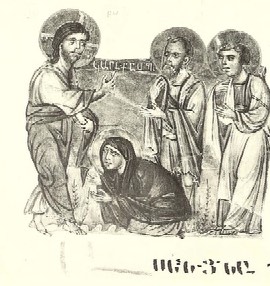
I’m not sure Salome would have fallen at Jesus’ feet as she’s pictured in the illustration above. They were related, after all, and she was a senior relative of his. She probably reminded Jesus that James and John were his cousins, and remember, I know your mother. Family ties always help people get ahead.

Jesus doesn’t dismiss her altogether, but he reminds her that his followers are to serve and not be served. It’s a service that will cost them, even their lives. Following him doesn’t mean that they and their family would gain. Like the Son of Man James and John will  have to give their lives “for many.”

They’re called by God to reach out, and reaching out can be hard, sometimes painful. It means going beyond those we call our own, our families and friends. It means reaching out to those we don’t know, even to those we don’t like. It means going beyond what we’re used to.

Later stories say that James and John went to places far beyond the Sea of Galilee where they fished with their father Zebedee and were cared for by a mother who had their interests at heart. Our church is a missionary church. It reaches out to the whole world. That’s what  Jesus last words in Matthew’s gospel says to do:  “Go out to the whole world, baptizing and teaching.”

That’s still his word today. Go out to the whole world, even if the world is changing and the future is uncertain. “I am with you all days,” Jesus says.

James, brother of John, is also known as  James the Greater, to distinguish him from James the Less, the other disciple mentioned in the New Testament. James was the first of the apostles to die for Christ; he was beheaded in Jerusalem by King Herod Agrippa in 42 AD.

Later Traditions About James

Some 4th century Christian writers say that one of the apostles went to Spain and a 6th century source identifies the apostle as James, who preached briefly in Spain and converted only a few before returning to Jerusalem and his death.

Modern scholars are divided about the truth of the tradition. Relics said to be of St. James were discovered in Compostela in Galicia in northwestern Spain in the 9th century, a major event in Spanish history. His shrine at Compostella became a major pilgrimage center for the people of Spain and Europe, rivaling even Rome and Jerusalem in its popularity.

From the 9th century onward, James was patron of the Spanish peoples and a rallying cry in their fight to free their land from the Moors. At four battles – Clavijo (9th c.), Simancas (10th c.), Coimbra (11th c.) and Las Navas de Tolosa (1212) – legends say he appeared as a warrior astride a great white horse with a sword in his hand. Throughout the Middle Ages, soldiers and knights  came as pilgrims to Compostela to seek the saint’s protection.

In 1492, when Spain was finally free of Moorish domination, King Ferdinand and Queen Isabella came to Compostela to give thanks to St.James in the name of the Spanish people.

How old are the relics of St.James? Pilgrims from Galicia were frequent visitors to the Holy Land as early as the 4th century and may have brought the relics back to their native land. Colorful legends from medieval times, however, brought the story back further to the time of the apostle himself, saying that disciples of James fled with his body after he was beheaded and, escaping by boat, drifted to the coast of Spain where, after many adventures they buried him. These legends about James appear frequently in medieval art and in numerous churches built in his honor in France, England, and later in the Spanish colonies of the New World. Cities such as Santiago, Chile, Santiago, Cuba,San Diego, California, are named after him. The feast of St.James is July 25.

17th Sunday c: God’s Near and Hears

For this week’s homily please watch the video below.

Parables: (Matthew 13:10-17)

by Orlando Hernandez

In this Thursday’s Gospel (Mt 13: 10-17) our Lord is asked by His disciples why He speaks to the crowds in parables. I used to think that in this passage Jesus sounds almost disdainful as He talks of those who “look, but do not see and hear but do not listen or understand.” They do not seem to deserve the healing that in Isaiah’s prophesy God refuses to give them. I think of the harsh sermons that I remember hearing fearfully when I was a child and went to church. We are so undeserving.

However, our Lord is all goodness and mercy. He cannot have bad feelings toward anyone. This is a vital “knowledge of the Kingdom of Heaven” that I feel He has granted me! I truly believe that He loved those “crowds” who mostly rejected what He taught. But, He could not help but point out that, for the most part, “Gross is the heart of this people” and they were unable to “understand within their hearts” that the Creator of the universe was giving them the very gift of Himself
.
My wife Berta always tells me that the Passion of our Lord was taking place within Him throughout all His ministry. Jesus must have felt great sorrow as He went about trying to reach the people. They seem to want the miracle and the spectacle, but the message of Salvation and eternal life was beyond them. The Sermon on the Mount was too much for them to understand or accept. Things have not changed. In our modern world what can we followers of Christ tell others that will open their eyes, their understanding, their hearts? Look at Jesus’ frustration in the Gospel. Can we do any better?

I used to think that in Thursday’s Gospel Jesus is saying that He talks to the unbelievers through parables in order to confuse, insult, and reject them. I can’t believe that anymore. In his book “Jesus, a Pilgrimage,” Fr. James Martin says that parables were ways to reach the people through the things they understood: farm life, fishing, home-building, the nature surrounding them, human relations. Jesus must have known that so much of His teaching was beyond their understanding. Perhaps the stories and similes were meant to catch their attention and stimulate their imaginations, like seeds planted hopefully in the soil of their hearts, whether rocky, compacted, weed-ridden, obstinate, or uninterested.

Were the chosen disciples so much better off than these crowds? Yes, Jesus gave them a good amount of healing and knowledge. For His own divine reasons He had also put into their hearts the supernatural gift of faith. But did they really comprehend the vast mystery of God’s Glory and Love? They certainly had a long painful road ahead in order to achieve enough joy and understanding of who Jesus really was in order to become truly committed to the demands of discipleship.

When I sit at Mass I feel like a member of both the undeserving crowd and the circle of disciples. When I hear the modern parables of the priests’ homilies, do I have ears to listen to what God is telling me? When I look around, do I have the eyes to see the presence of the living God in the people that surround me? When the broken, wounded Host is raised before me (“Behold the Lamb of God, Behold Him…”) is my heart pure enough that I might truly see Him, the Eternal God?

Lord, You are such a mystery to me. Sometimes my link to You seems so tenuous. And yet Your gift of faith has been planted in my heart. I do not want to let You go. Please don’t let me go. But, most importantly, I beg You, have mercy on those unbelieving “crowds.” Touch their hearts, show them who You are!

Orlando Hernández

Novena to St. Ann

Throughout the Catholic world novenas honoring St. Ann begin July 17.

You won’t find the names of Ann and Joachim in the bible, but they’re mentioned in one of the apocryphal books, the Protoevangelium of James, written shortly after our New Testament writings.

Interest in Jesus’ family came about because of claims that he was “Son of David,” the Messiah  expected to come from David’s line. Against those who said Jesus was only a carpenter from Nazareth, the infancy narratives in Matthew and Luke assert that  Jesus is the Messiah, descended from David.

The Protoevangelium of James also sees Joachim and Ann  in David’s line, and therefore Mary was too. It says they lived in Jerusalem. Did they accompany Mary to Nazareth after her marriage to Joseph? If so,  Jesus had grandparents taking care of him for a time.

If that’s true, it means Ann and Joachim gave Jesus something more besides proof of his bloodline.  Along with Mary and Joseph, they brought him up. As a young child he learned from them, the simplest and the most sublime things. Knowledge came to him, as it comes to us–through the senses, through mothers and fathers, grandmothers and grandfathers.

St. Ann is often pictured with her daughter Mary holding a small book in her hands. Written on the book in the statue here in this church are the words, “If today you hear God’s voice, harden not your heart,” a verse from the psalms.

Other statues of her have different words in the book. “I,2,3,4; A,B,C,D.” The basics of life. Or notice Giotto’s picture of the presentation of Mary in the temple. (above) Ann pushes her little daughter into the temple. Just like pushing kids to church today?

Parents and grandparents play a powerful role in the lives of their children and grandchildren. They teach kids their abc’s and the  sublime mysteries of faith. Maybe that’s why so many of them make this novena.  They know that’s true.