Lectionary and Saints

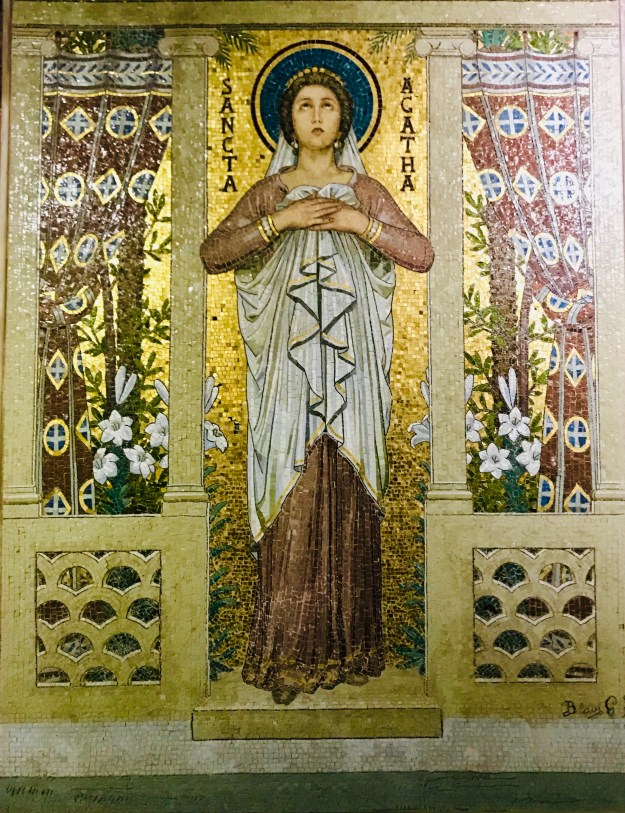
Our daily liturgy gives us scriptures to read and saints to celebrate. This week in our lectionary we continue to read from the Gospel of Mark and the 1st Book of Samuel. Today we remember Fabian, an early pope and  martyr, and Sebastian, a soldier saint and martyr.  Tomorrow we have Agnes, a young girl and early martyr. 

Our lectionary readings are not chosen haphazardly. After the feast of the Baptism we began reading each day from the Gospel of Mark, the first of the gospels to be written, an appropriate reading for following Jesus as he begins his ministry in Galilee. 

The saints point out how others have followed him. . The three martyrs we remember this week are examples of some who were put to death in persecutions that took place in the early church. Fabian was put to death at the beginning of the Decian persecution (250) because he was a church leader. The Roman strategy was to kill church leaders and their followers would scatter. 

Sebastian was a soldier saint martyred in the Diocletian persecution. From what we know, Christians were highly regard by the emperor when he first came to power, but then he turned against them,  especially the officer class. Like Sebastian, many of them holding influential positions in the empire were put to death for their supposed disloyalty. 

Agnes was not killed in a general persecution like Fabian and Sebastian.  She died because Christians were legally vulnerable in the centuries before Constantine. The Romans were suspicious of them. Agnes a victim of a powerful Roman man who used the Roman judicial system to punish a young Christian girl who  would not let him have his way with her. 


Praying for Christian Unity

We celebrate a Week of Prayer for Christian Unity every year from the 18th to the 25th of January.

Pope Francis, speaking about ecumenism, said that like the Magi, whom tradition represents as representatives of diverse cultures and peoples, Christians today are “challenged to take our brothers and sisters by the hand… and move forward together.”

Some of the journey together is easier than others, the pope noted, like works of charity together, for example. which draw us closer not only to the poor but to one another.

On the other hand, the journey toward full unity is sometimes more difficult, which “can lead to a certain weariness and temptation to discouragement.

Pope Leo has taken up the same cause dear to Pope Francis. He has called all the Christian churches to celebrate the anniversary of the foundation of Christianity in Jerusalem in the year 2033.

The restoration of unity among all Christians is one of the principal concerns of the Second Vatican Council.” (Decree on Ecumenism n.1). Ecumenism affects the mission of the church, because the division of Christians prevents the preaching of the gospel and deprives many people of access to the faith” (Ad Gentes, n. 6). Divisions among Christians cause a confusion that hinders people from accepting the gospel today.

Passionist Father Ignatius Spencer, an early pioneer in ecumenical activity, strongly urged more prayer together. Might be a good idea to consider . How can we do it? How can we prepare for the year 2033?

Why? : Mark 2:18-22

VATICANCRUC

Many flocked to Jesus as his ministry began, but a growing number found him hard to understand. That’s what Mark’s Gospel indicates in our lectionary readings this week.

Scribes from Jerusalem say he has a demon, the Pharisees begin to plot with the Herodians, the followers of Herod Antipas, about putting him to death. (Wednesday) When they hear about him in Nazareth, his relatives say, “No, he doesn’t have a demon. He may be out of his mind,” They come to bring him home. (Saturday. 2nd week)

Besides leaders and people from his hometown, ordinary people begin to distance themselves too. They may be people we hear in Mark’s Gospel, (Monday) who question him “Why do the disciples of John and the disciples of the Pharisees fast, but your disciples do not fast?” (Mark 2, 18-22) Jewish leaders, his own family and ordinary people of Galilee found his message, especially his message of the Cross, hard to understand.

They weren’t ready for new wine, they preferred the old. Nor were they ready for the death he would meet.

Commentators see Mark’s gospel as a Passion Narrative with a prelude. Mark’s early stories predict the Passion of Jesus who will die alone, forsaken by many who flocked to him at first. Forsaken even by his friends.

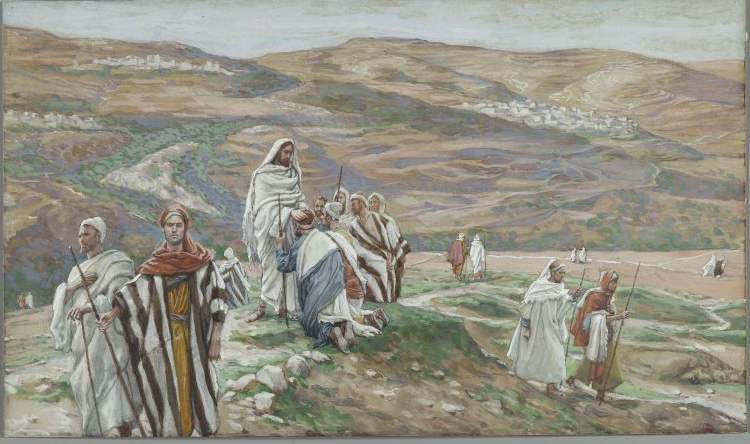
The Passion of Jesus is a mystery beyond human understanding, Mark’s gospel teaches. Mark wrote his gospel, commentators say, to help the Christians of Rome caught in an unexpected, brutal persecution by Nero in the mid 60s.. A senseless, arbitrary persecution left Rome’s Christians confused and wondering what it all meant. Many abandoned their faith or, like the three small figures in our illustration above, seem lost before the one hanging before them. They were shocked by the tragic suffering they did not see coming. Why? They couldn’t understand.

It was so before you, Mark teaches the Romans then. It was so before you, Mark teaches us today.

The Passion of Jesus in Mark

Mark’s account of the baptism and temptation of Jesus in the wilderness is the most succinct of the four gospels.  Only five sentences.  The heavens open at the Jordan, the Spirit, like a dove, descends on Jesus, the voice from heaven declares him “my beloved Son.” It’s  quickly over. “At once” the Spirit drives him out into the desert.  Jesus is tempted by Satan for forty days. 

Is that literally forty days, or more likely does it indicate a lifelong experience Jesus has, as some commentators say?

The heavens open at the baptism of Jesus, all the gospels say, but more than other gospels Mark indicates that baptism calls us to participate in the Passion of Christ. In baptism we enter the body of Christ and become children of God and heirs to God’s kingdom, but we are called also to suffer with him.

We should remember this as we begin reading Mark’s account of the triumphant victory of Jesus over Satan as he starts his ministry in the synagogue at Capernaum. It continues  that first day  with his cure of Peter’s mother-in-law and the crowds that come to his door with their sick till the end of the day. 

He wins the crowds over with his teaching and miracles, but it does not last. 

As chapter 8 of Mark ends, Jesus asks his disciples who do people says he is. “You are the Messiah” Peter answers, but when Jesus announces he is going to Jerusalem where he will be rejected and killed and raised up, Peter does not understand.

We face God’s thinking in Mark’s gospel,  which we often do not understand.  Mark’s gospel has been called “ A passion narrative with an extended introduction.” It is written for disciples who are slow to understand the mystery of the Cross.

Most commentators say that Mark’s gospel was written in Rome and meant for the Christians of that city who suffered in the first great persecution of the church by Nero after the fire that consumed the city in 64. Keep them in mind as we hear Mark’s gospel.

Our experience may often be somewhat like theirs.

2nd Sunday a: Listening

Hear I am, Lord, I come to do your Will

When I was a little boy, my mother would get letters from her cousin Rosanne,  in Ireland, and she would show the letters to me. I noticed sprinkled through the letters were the letters, “DV”.  What’s “DV”mean, I asked my mother?

That means “God willing”,  my mother said. “Deo volente” I learned later in Latin. 

And so when Rosanne wrote “Mary is looking for a job in Glasgow, DV “ she meant “Mary is looking for a job in Glasgow. God willing may she get it.” “ We hope the weather get’s warmer for Danny’s graduation, DV”  meant “We hope we have good day for Danny’s graduation, if it’s God’s will. The letters “DV” were a filter putting her life into another perspective, the filter of God’s will.

You don’t see much of that perspective today. We tend to see life through the filter of politics, or economics, or psychology  or just plain chance. We need to see God’s will at work in our lives and in the world today.

What’s God’s will?  We pray in the Our Father, “Your will be done.” We believe God wills our good. God wants the best us. God calls us his friends, his children. We are children of God. That’s what we are. We haven’t seen it yet, but that’s what we are.

Pope Leo is reflecting on the Second Vatican Council in his Wednesday audiences this year, and last Wednesday he began reflecting on divine revelation. God revealing himself. God calls us friends, the pope says, quoting the words of Jesus to his disciples. 

 “No longer do I call you servants…but I have called you friends, for all that I have heard from my Father I have made known to you” (Jn 15:15).

But we are so unequal, how can we be friends of God. Our knowledge is so limited, how can we be friends with Someone whose wisdom is unlimited.  “We are not equal to God, but God himself makes us similar to Him” be sending his Son to us. “Friendship is born between equals, or makes them so”. (Pope Leo )

We can hear God speaking to us as friends, as children of God, in the scriptures we hear in our liturgy today. God speaks to us as Father. Our prayers remind us who we are. 

We were servants called by God to be something more, our first reading from Isaiah tells us. God calls us to a destiny far beyond our imagination and a mission higher than we  can ever see ourselves. We’re formed as servants in the womb,  but “It is too little, the LORD says, for you to be my servant…I will make you a light to the nations, that my salvation may reach to the ends of the earth.”

In our gospel reading today, John the Baptist speaks of how he came to know Jesus in the baptism at the Jordan where the Holy Spirit made him known. And John was filled with joy.  (Jn 3:29).

Like John the Baptist, we are called to know Jesus as God’s Son through the waters and graces of baptism and the Holy Spirit given to us. We called to know him now in word and sacrament, and as we know him we rejoice. 

“Here am I, Lord, I come to do your will”  That prayer from the psalm in today’s liturgy, could we take it with us and say it this week? 

We need to pray to deepen our friendship with God. “Only when we speak with God can we speak about him”, Pope Leo said in Wednesday reflection. Only when we speak with God can we know ourselves and our dignity as God’s children..    

Anthony of Egypt: January 17

temptation anthony copy

January 17th is the memorial of Anthony of Egypt, one of the early saints of Egypt who is recognized as the father of monasticism. He influenced St. Athanasius and St. Augustine, as well as modern spiritual authors like Thomas Merton.

Anthony offered himself as a martyr during a 3rd century Roman persecution of Christians in Alexandria, his biographer St. Athanasius says, but they ignored him, and so he embraced the martyrdom of every day.

There’s a martyrdom every day, and temptations that have to be faced daily, Anthony realized. But don’t fear the trials that come. That was Anthony’s advice to those seeking his counsel. Artists like Martin Schongauer (above) portrayed Anthony surrounded by his temptations, but the saint is not afraid. Know your temptations, he said, and God will lead you from them.

Anthony abu

Anthony’s life helped many, among them St. Augustine, to steer through the challenges they faced. Here’s a simple version of Anthony’s battle with temptation as Athanasius described them:

“Those who follow Jesus should expect temptation and Anthony experienced a range of them over the hundred years of his life. The devil knocked regularly on the door of his heart, assuming different faces and making different suggestions, but this shy, gentle man was not conquered.

“In the early years Christ called him, he often thought: ‘Have I made a mistake?’ The days were so slow and monotonous, nothing important going on. ‘Am I doing anything with my life?’ he wondered.

“One day, weary of it all, he left his house and opening his arms wide he cried to heaven: “Lord, what should I do?” For awhile, nothing but silence. Then, Anthony heard someone moving behind him. Turning, he saw someone like himself, getting up from his bed, saying his prayers, eating his meals, doing his work, welcoming some visitors, and finally saying his prayers and going to sleep. Just as he did everyday.

“God’s angel was answering his prayer, Anthony realized. He was beginning to think ordinary life held no meaning. But that’s where treasure is; life is holy ground. Ask God to see it, and don’t give up. Anthony went back to his ordinary life again.

“Other temptations beset Anthony. Sometimes he worried about his health. If he got sick, who would care for him? He had chosen to live for God alone. Wouldn’t it be better to have a family to support you? He gave so much to others and kept so little for himself. Wouldn’t it be better to be a rich man? Lustful thoughts sometimes filled his mind.

“Temptations swept over his soul like dust storms, causing confusion and uncertainty. But in the storms, Anthony learned another lesson: Christ is always with you.

“One restless night, Anthony was almost pulled to pieces by violent temptations. Monsters and demons were everywhere, flying through his room shouting and screaming, ready to kill him. He was about to give up hope when a beautiful light shone through the roof of his house and the demons disappeared. In the peaceful light, he saw Christ.

“Lord, where were you when I was being tried?” Anthony said.
“I was right here all the time you struggled,” Jesus replied. “My hand was on you as your helper.”

“After that ordeal, Anthony experienced peace for a while. Then, one day he heard a knock at his door and, opening it, saw a little man grinning from ear to ear, bowing to the ground before him as if he were king.

“You are a saint, Anthony,” he said ingratiatingly. “Everyone says so. People say you’re wiser and better than anyone on earth. So, tell me everything you can and everything you know; you’re just perfect.”

“Anthony slammed the door in the little man’s face. “You’re more dangerous than any temptation I’ve had, because you want me to believe I’m God, and I’m not. You are the temptation of pride.”

“Gradually over the years, people discovered this man with so much hard earned wisdom. Soon , from everywhere people were seeking his advice and his prayers and his healing for themselves or someone they loved. Because he knew himself so well, Anthony knew their hearts too.

“One constant message he repeated again and again to those who came to him, ‘Don’t be afraid, live joyfully in God’s grace. Never give up. God delivers us from temptation.’”

Many came from the great Egyptian cities to live like Anthony. Communities of dedicated Christians sprang up in the Egyptian desert, and they inspired a similar movement over the Christian world. Benedict of Nursia and others like him would lead the monastic movement into Italy and Europe.

For Anthony’s influence on Monasticism, see Martin of Tours, Benedict of Nursia,

Listening to Prayers

DSC00500

“Speak, Lord, your servant is listening.” Those words of the Prophet Samuel remind us to listen. One way to pray is to listen to God in our prayers. Besides listening to the scriptures and the homilies we hear, we also need to listen to the prayers we say . This is especially true of the Eucharistic prayer and the prayers of our liturgy. We get used to prayers we say repeatedly; we need to listen to them.

I recorded an audio file of the 2nd Eucharistic Prayer for Various Needs and you can listen to it at the end of this blog, if you wish. Listen and reflect on the words. The Eucharistic prayers help us understand the mystery we celebrate.

Think about the words of the prayer and ask yourself what they mean. Take the dialogue that opens every Eucharistic prayer, for example:

“The Lord be with you.

And with your spirit.

Lift us your hearts.

We have lifted them up to the Lord.

Let us give thanks to the Lord, our God.

It is right and just.”

The Lord is with us as we pray and and lifts up our hearts to the divine presence. That presence expands our vision of life and broadens our awareness of who we are. We thank God.

What do we thank God for? Certainly for the blessings of our life, but we don’t stop there. In God’s presence we become aware of  the blessings of creation and redemption given to us by God, our Father, through Jesus Christ.

The Eucharist calls us into a large world, infinitely larger than our own time and place. If fact, it brings us into the context of eternity. We’re in touch with the beginnings of our universe and reach out to the end of time, when God’s kingdom will come. We belong to this great world as children of God. We have been blessed with a promise far beyond our imagination.

We receive this promise through Jesus Christ whose love we recall in the gifts of bread and wine and the other signs of our prayer. He is present; remember him.

Here’s an audio of a Eucharistic Prayer

Believing for Others: Mark 2:1-12

Readings for the Day https://www.vaticannews.va/en/word-of-the-day.html

The healing of the paralytic told in today’s gospel from Mark is a great story.(Mark 2: 1–12) Four friends bring him to the door of Peter’s house in Capernaum but the crowds are so dense that they can’t get in to see Jesus so they climb up on the roof, cut a hole in it and lower him down before Jesus. Was the paralyzed man conscious, or half conscious? We don’t know.

What ingenuity! What nerve! What determination on the part of his friends! Think of the logistics involved in it all.

The picture above show the ruins of Peter’s house in Capernaum, now enclosed in a shrine. From a chapel above you can look down into Peter’s house below –possibly just where the man was lowered down. The picture at the beginning of our blog is also from that chapel.

We know Jesus forgave the man’s sins and then healed him completely, so he left the house carrying the mat that once bore him. The gospel story tells us that Jesus the healer is Jesus who forgives sins. Some who heard his words of forgiveness that day were shocked by this action which they rightly judged was divine.

But I’m led back to the four friends who had a part in this miracle. Let’s not forget them. They believe and their belief makes them go to extraordinary lengths to help someone .  Faith reaches out; it doesn’t remain within. We believe for others as well as for ourselves.  Believing prompts us to do daring things for others.

Back to Peter’s house. Did Peter look up that day and say, “Who’s going to pay for that hole in the roof?” The story of the paralyzed man is a wonderful story. But it also has an ominous part to it. Scribes, sitting in judgment, call Jesus a blasphemer for pronouncing sins are forgiven. Opposition to Jesus begins to build and it leads to his death.

The Land Where Jesus Lived: The Political Landscape

Rembrandt, Saul and David, Mauritshuis

The New Testament writings recall the wonders, signs and miracles that Jesus worked in the few years of his ministry,  but still, at least externally, the political landscape Jesus knew seemed little changed by his coming. 

The political power structure Luke describes at Jesus’ birth remained. The Romans still held the land tightly in their hands; their allies, the Herodians, were still the local rulers. 

“We were hoping,” two disciples tell Jesus after his resurrection, but no political revolution happened in Jerusalem. The political structures hardly changed. A few tax-collectors became his followers, but the tax system was not reformed. Prostitution was not abolished. The world looked the same after Jesus died and rose again – even if it wasn’t. The Light had come, but the people still seemed to sit in darkness.

The Old Testament readings at Mass these days from the Book of Samuel offer a similar picture as they describe the times of Saul and David when the Jews, a scattered tribal people, became a united nation with Jerusalem as their center. It was a world of wars and political intrigues, one after the other. Hardly a glorious picture revealing the coming of the kingdom of God. 

Rembrandt (above) paints Saul and David sitting in the dark, maybe a picture of their time. Saul, the powerful warrior leader in fine clothes, is tormented by dark thoughts. He finds soothing the music from the harp, played by young David, but soon David will be his bitter political rival and replace him as king.

Saul wipes the tears from his eyes with a curtain nearby. In his hand he holds a spear he will use later to try to take David’s life.(1 Samuel 16;23)

As we look at our own world with its wars, revolutions and increasing disunity we might remember the world we see in the Book of Samuel. It’s a disturbing picture. Where is God in this, we ask. But God was there; God is here.

Our Faith is meant, not only to see the presence of God in bread and wine, but God’s presence in the signs of the times.

The Land Where Jesus Lived

photo
Bethany, outside Jerusalem

“To what shall we compare the Kingdom of God,
or what parable can we use for it?”  ( Mark 4, 30)  Jesus turned to the land where he lived and the life around him to answer that question.

So what was the land where he lived like? It was a land of olive trees near Bethany outside Jerusalem, but if you went eastward to Jericho and the Dead Sea, it was mostly a barren desert. Then, from Jericho to Galilee the land turns from desert to lush farmland. A changing land.

IMG_0467
Jordan Valley

Jesus experienced a changing land from Nazareth to the Jordan River and then the Sea of Galilee. Like us, he was influenced by the place and life around him.

In a book written in the 1930s Gustaf Dalman, an expert on the geography and environment of Palestine, observed that when Jesus went from the  highlands of Nazareth, 1,100 feet above sea level to the fishing towns along the Sea of Galilee, 680 feet below sea level, he entered a different world.

For one thing, he ate better – more fish and nuts and fruits were available than in the hill town where he grew up. He looked out at the Sea of Galilee from the towns he visited. Instead of the hills and valleys around the mountain village of Nazareth, he saw a great variety of birds, like the white pelicans and black cormorants challenging the fishermen on the lake. He saw trees and plants and flowers that grew abundantly around the lake, but not around Nazareth.

Instead of the chalky limestone of Nazareth, Jesus walked on hard black basalt, which provided building material for houses and synagogues in the lake region. They were sturdy structures, but they were dark and drab inside. They needed light. Light on a lampstand became one of his parables. (Mark 4,21)

Basalt also made for a rich soil where everything could grow. “… here plants shoot up more exuberantly than in the limestone district. Where there are fields, they yield a produce greater than anyone has any notion of in the highlands.” (Dalman, p123)

DSC00027
Farmland in Galilee

The volcanic soil on the land around the lake produced a rich harvest. The Jewish historian, Josephus, praised that part of Galilee for its fruitfulness, its palm trees, fruit trees, walnut trees, vines, wheat. But thistles, wild mustard, wild fennel grew quickly too and could choke anything else that was sown. The land around the Sea of Galilee was fertile then; even today it has some of the best farmland in Palestine.

fields
Soil near the Sea of Galilee

The weather in the Lake District was not the same as in the mountains, warmer in winter, much hotter and humid in summer, which begins in May. “It is difficult for anyone used to living in the mountains to work by day and sleep by night…Out of doors one misses the refreshing breeze, which the mountains along the lake cut off…one is tempted to think that Jesus, who had settled there, must often have made occasion to escape from this pitiless climate to his beloved mountains.” (Dalman, p. 124)

You won’t find these observations  in the gospels, of course, but they help us appreciate the world in which Jesus lived and the parables he drew from it.  He was influenced by where he lived, as we are.

And what about us? What wisdom do we draw from the world we live in? What do we see day by day? What’s life like around us? We’re experiencing climate change now, aren’t we? It’s going to influence our spirituality, how we see, how we live, how we react to life.

May we gain wisdom from our time and place.