3RD Week in Ordinary Time: Readings and Feasts

JANUARY 23 Mon USA: Day of Prayer for the Legal Protection of Unborn Children

[USA: Saint Vincent, Deacon and Martyr; USA: Saint Marianne Cope, Virgin]

5 Heb 9:15, 24-28/Mk 3:22-30 

24 Tue St Francis de Sales, Bishop Doctor Heb 10:1-10/Mk 3:31-35 

25 Wed Conversion of St Paul Apostle Feast Acts 22:3-16 or Acts 9:1-22/Mk 16:15-18 

26 Thu Sts Timothy and Titus, Bishops Memorial 2 Tm 1:1-8 or Tit 1:1-5 /Mk 4:21-25 

27 Fri Weekday [Saint Angela Merici, Virgin] Heb 10:32-39/Mk 4:26-34 

28 Sat St Thomas Aquinas, Priest Doctor Memorial Heb 11:1-2, 8-19/Mk 4:35-41 

29 SUN 4TH SUNDAY IN ORDINARY TIME Zep 2:3; 3:12-13/1 Cor 1:26-31/Mt 5:1-12A

The Conversion of St. Paul (January 25) and his two disciples, Timothy and Titus (January 26). What would our church be without them? During the Octave for Church Unity we pray that God give a converting grace to all the Christian churches that they become the one church Jesus prayed for.

St. Francis de Sales ( Jan 24) was a great communicator when a fractured Europe needed communication. He the patron of publishers; would he be interested in the internet today? St. Thomas Aquinas (Jan 27) is one of the great teachers of the Church.

Two women saints this week are reminders of what women have done in the church. St. Angela Merici (Jan 27)began a community to teach children. Big need today. St Maryanne Cope (Jan 23) was a American nun who, after founding two hospitals in upstate New York, served lepers in Hawaii.

January 23 is also a day of prayer in the United States for the legal protection of unborn children. A major issue in society today.
Sustainable Goals: 2022

Faith breaks boundaries, our previous blog announced. Lest we leave that in a synagogue in Capernaum, let’s think about how that applies to the world we live in this year 2023. What are the boundaries our world faces today? For some the sustainable goals set by the United Nations in 2015 may seem unreachable. Can followers of Jesus say they are?

Readings and Feasts: January 16-22

JANUARY 16 Mon Weekday Heb 5:1-10/Mk 2:18-22 

17 Tue Saint Anthony, Abbot Memorial Heb 6:10-20/Mk 2:23-28 

18 Wed Weekday Heb 7:1-3, 15-17/Mk 3:1-6 

19 Thu Weekday Heb 7:25—8:6/Mk 3:7-12 

20 Fri Weekday [St Fabian, Pope Martyr; St Sebastian, Martyr] Heb 8:6-13/Mk 3:13-19 

21 Sat St Agnes, Virgin and Martyr Memorial Heb 9:2-3, 11-14/Mk 3:20-21 

22 SUN 3RD SUNDAY ORDINARY TIME Is 8:23—9:3/1 Cor 1:10-13, 17/Mt 4:12-23 

In the Gospel of Mark this week Jesus confronts opposition, and we also remember a young girl, Agnes, and a soldier, Sebastian, who made him known to early Christians by following him into the mystery of his death and resurrection. They tell us to witness to him in our time.

Mark’s Gospel this week says the scribes, Pharisees and Herodians saw Jesus as a danger to their society and brought him to his death. Roman judges and leaders saw Agnes challenging the norms of their world, and Sebastian betraying their military code. They must die. Their stories correspond well with Mark’s account of Jesus’ ministry in Galilee and his eventual death and resurrection in Jerusalem.They were treated unjustly.

The two Roman martyrs must also have faced rejection by their own families and friends, as Jesus faced rejection in Nazareth. Jesus is not the only one who bears the mystery of the Cross; his followers bear it too. In fact, it’s part of everyone’s life.

Yet Mark’s Gospel sees Jesus going forward, still drawing crowds, still casting out demons, forging ahead to new ground in spite of opposition. The mystery of the Cross leads to Resurrection and the coming of God’s kingdom. It does not end in death.

Nor do the stories of martyrs end in death; they share in the resurrection of Jesus Christ.“ If you can have some share in the sufferings of Christ, be glad, because you will enjoy a much greater gladness when his glory is revealed.” (1 Peter 4:13-14) The martyrs follow the Suffering Christ–as one sees already in the story of first martyr, Stephen, so carefully crafted to show Stephen following Jesus.

Waiting for an executioner’s sword in the arena, Agnes also sees the heavens open and with arms outstretched says: “ I pray to you, holy Father; behold, I am coming to you, whom I have loved, whom I have sought, whom I have always desired.”

Read the scriptures. Also remember the saints, young girls and soldiers, men and women from every time and place, who heard the same Word we do and believed in that Word. They say : “Follow him.”

Keeping Heroes in Mind

We’re reading the Letter to the Hebrews at length these days in our liturgy at Mass. Why was this written? When and to whom was it written? Interpreters of the Letter to the Hebrews ask these questions to understand this writing better.

Obviously Hebrews is written to Jewish-Christians, some think in Rome which had a substantial Jewish-Christian population in the 1st century. It was written after a time of persecution, perhaps when the Emperor Claudius banished Jewish Christians from the city in 49 AD because they were causing riots in Rome’s synagogues in disputes over Jesus Christ. Or maybe a later persecution.

Did that  cause the followers of Jesus there to tamper down their efforts and embrace their faith less fully? Perhaps. The writer of Hebrews warns his hearers against “drawing back” and “losing confidence” in the faith they profess. Were they losing their enthusiasm? That sounds like something that happens to us too.

Keep before you the heroes of faith, beginning with Jesus, the author of Hebrews says as he draws up for them a lengthy list of inspiring believers.

“For, after just a brief moment, he who is to come shall come; he shall not delay. But my just one shall live by faith, and if he draws back I take no pleasure in him.”

 To that list of Old Testament heroes we can add the saints of the New Testament and saints of our times. They can inspire us too.

Jesus in Caphernaum

img_0065

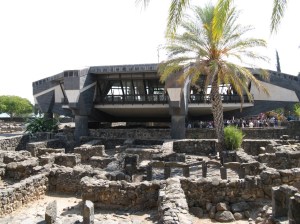
  Near the shore of the Sea of Galilee, in Israel, one can visit the excavations of the ancient town of Capernaum. There the Franciscans have built a lovely hexagonal church over the restored ruins of a circular stone house, with the opening for its front door clearly visible. We pilgrims believe in our hearts of faith that this is the house mentioned in today’s Gospel.

      ” On leaving the synagogue Jesus entered the house of Simon and Andrew with James and John. Simon’s mother-in-law lay sick with a fever. They immediately told Him about her. He approached, grasped her hand, and helped her up. Then the fever left and she waited on them.

     ” When it was evening, after sunset, they brought to Him all who were ill or possessed by demons. The whole town was gathered at the door.” (Mk 1; 29-33).

     We believe that right at that door Jesus healed dozens, if not hundreds, of people (including the paralytic, who was lowered with ropes through the ceiling). He might also have preached the Good News of the Kingdom in front of that humble threshold.

     I cannot help but imagine my Lord residing in my own private room within my heart. I know that there, through the Eucharist or prayer, planned or unexpectedly, He continuously “grasps my hand and helps me up”. He stands at the door of my heart and encourages me to serve, to invite all those around me, in my family and community, who might need some of the hope and healing that He compels me to share. This is what I live for.

     And He asks for more: ” Let us go on to the nearby villages that I may preach there also. For this purpose have I come.” (Mk 1; 38). With His holy companionship I am asked to reach out to those beyond the locust of my comfort zone: to the stranger, the different, the unpleasant one,the hopeless one, the one whose political ideas or interests are so different from mine.

     May He give me the strength and faith, and courage, to try and “grasp” the hand that might reject mine. He has given me so much undeserved grace and love. He has given me the eyes to “see Him”. For what “purpose” has He come to me, if not so that I may be an instrument of His peace and love?   

                                      Orlando Hernandez

1ST WEEK IN ORDINARY TIME: READINGS AND FEASTS

JANUARY 9 Mon  Baptism Feast Is 42:1-4, 6-7 or Acts 10:34-38/Mt 3:13-17 

10 Tue Weekday (First Week in Ordinary Time) Heb 2:5-12/Mk 1:21-28 

or Heb 1:1-6  and 2:5-12 /Mk 1:14-20 and 1:21-28 

11 Wed Weekday Heb 2:14-18/Mk 1:29-39

12 Thu Weekday Heb 3:7-14/Mk 1:40-45 

13 Fri Weekday [St Hilary, Bishop Doctor] Heb 4:1-5, 11/Mk 2:1-12 

14 Sat Weekday [BVM] Heb 4:12-16/Mk 2:13-17 

15 SUN  2ND SUNDAY IN ORDINARY TIME Is 49:3, 5-6/1 Cor 1:1-3/Jn 1:29-34 

The feasts of the Epiphany and the Baptism of Jesus are joined together this year. I explain the importance of their connection in my blog for tomorrow. 

From the Mass on Tuesday which begins Ordinary Time, we will be reading from the first 8 chapters of the Gospel of Mark until Ash Wednesday. 

This year we’re reading from the Letter to the Hebrews for the next three weeks. I usually follow the readings on the website of the US Bishops, http://www.usccb.org, mainly because I can find the scriptural commentary on the New American Bible easily there. One thing I notice, looking over the readings from Hebrews in the Masses this week, is how well the responsorial psalm summarizes the first readings. 

On Friday, we’re celebrating the Feast of St. Hilary of Potiers. I find him an interesting saint because he came from a background that didn’t seem to prepare someone for the faith very well.

JANUARY 2-8: READINGS AND FEASTS

JANUARY 2 Mon Sts Basil the Great and Gregory Nazianzen, Bishops Doctors 

Memorial 1 Jn 2:22-28/Jn 1:19-28 

3 Tue Christmas Weekday [ Most Holy Name of Jesus] 1 Jn 2:29—3:6/Jn 1:29-34 

4 Wed USA: St Elizabeth Ann Seton, Religious Memorial 1 Jn 3:7-10/Jn 1:35-42 

5 Thu USA: St John Neumann, Bishop Memorial 1 Jn 3:11-21/Jn 1:43-51 

(St. Charles Houben, Passionist)

6 Fri Christmas Weekday [USA: St André Bessette, Religious]

1 Jn 5:5-13/Mk 1:7-11 or Lk 3:23-28 or 3:23, 31-34, 36, 38 

7 St Christmas Weekday [St Raymond of Penyafort, Priest]

1 Jn 5:14-21/Jn 2:1-11 

8 SUN USA:  EPIPHANY OF THE LORD SolemnityIs 60:1-6/Eph 3:2-3a, 5-6/Mt 2:1-12 

The First Letter of John, read this week at the end of the Christmas season,  responds to the claim of some early Christians that the Word did not become flesh; Jesus was not human like us. It would be unworthy of God to assume our lowly humanity, they thought.

The dissidents were either Docetists, who said Jesus only seemed to be human, or Gnostics who believed that a greater Power would succeed him. They did not believe “the Word was made flesh.” 

Speaking for the Apostle John, who saw Jesus and believed, the letter condemns that opinion and those who express it. Keep away from them, it says. The Word became flesh and we see his glory reflected in his humanity.

We may see these questions as old and settled and no longer of interest to us today, but believers of every age face the questions posed in John’s letter. Believing is inseparable from reason and doubt,  Pope Benedict once wrote. “Just as the believer knows himself to be constantly threatened by unbelief, which he must experience as a continual temptation, so for the unbeliever faith remains a temptation and a threat to his apparently permanently closed world.… In short, there is no escape from the dilemma of being a man.” 

In the gospel readings from John this week, John the Baptist points Jesus out to his disciples as the One who is to come.

“Beloved, we are God’s children now; what we shall be has not yet been revealed. We do know that when it is revealed we shall be like him, for we shall see him as he is.”

Two of the great saints of the eastern church, St.Basil and St. Gregory Nazianzen are remembered January 2. Two important American saints, St. Elizabeth Seton and St. John Neumann are remembered January 4 and January 5.

On January 5, the Passionists remember St. Charles Houben, CP, a saintly healer.

Mary, the Mother of God

Virgin and Child

The Feast of Mary, the Mother of God (January 1) is celebrated by the Roman Catholic Church as the Christmas celebrations end and a new year begins. This feast begins a month named for the Roman god Janus, the two faced god who looks ahead and looks back. Mary connects us to the world ahead as well as the world of the past, and so we pray to her “that we may be made worthy of the promises of Christ.”

Christian churches of the east have a similar feast at this time honoring the Virgin Mary as the Mother of God. .

“Marvelous is the mystery proclaimed today
Our nature is made new as God becomes man;
He remains what he was and becomes what he was not,
Yet each nature stays distinct and undivided.” Canticle, Morning Prayer

Mary’s Son who came “in the fullness of time” blesses all time:
“The LORD bless you and keep you!
The LORD let his face shine upon you,
and be gracious to you!
The LORD look upon you kindly and give you peace!” (Numbers 6, 22-27)

On this feast of Mary, the Mother of God, I think of a PBS special “What Darwin Never Knew” produced awhile ago on Nova. I don’t remember or understand a lot of the program’s scientific material, but its description of DNAs and embryos caught my attention.

According to scientists, embryos from different living beings–humans, animals, birds, fish– appear remarkably alike at an early stage of development, as if they were from the same source. Then, something triggers a different development in each species. Humans sprout arms and legs and begin human development. The other species develop in their own way.

A few years ago, I visited an exhibit called “Deep Time” at the Smithsonian Museum in Washington which described the development of the earth through 4.5 billion years. One section described our development as human beings from 4.5 billion years ago. Our human species developed over time in an evolving world.

In Mary’s womb, the Word became flesh, connected with the world of the past and the world of the future. Early theologians, like St. Irenaeus, say the Word became truly human, and therefore went through the same process of development as we do. They also say the Word had to assume all that he would redeem. Can we say that in his early embryonic journey in Mary’s womb the Word assumed the creation he would renew? The embryonic journey is a sacred journey that needs to be cared for and recognized.

“Blessed is the fruit of your womb,” Elizabeth says to Mary before Jesus’ birth. (Luke 1,42) At that moment, the Word of God gave the promise of redemption to another infant– Elizabeth’s son John. Was that promise also communicated to the rest of creation in Mary’s womb, by the Word made flesh, who dwelt among us– Jesus Christ, maker and Savior of all?