Category Archives: Travel

No Nest, No Den

RUN08875
We’re reading from the 9th chapter of Luke’s gospel this Sunday. (Luke 8,51-62) Jesus has completed his mission in Galilee, in the small towns around the lake, and sets out for Jerusalem. That’s how today’s gospel begins:

“When the days for Jesus’ being taken up were fulfilled,
he resolutely determined to journey to Jerusalem.”

Luke doesn’t describe a journey from place to place. Rather, Jesus gathers disciples on the way. He’s not making this journey alone, or just with the twelve. He’s calling many others to experience with him the mystery of his death and resurrection.

It’s a hard call. You have to go through tough places, Jesus says, like the Samaritan town that he and his disciples passed through, where you’re not accepted. You may not feel powerful or secure. If you follow me, Jesus says, you won’t have nests like the birds or dens like the fox. You’ll meet circumstances and difficult situations that may seem unreasonable.

But don’t worry, by following Jesus you’ll made the journey.

Last week I had some visitors from Australia and I took them on a tour of downtown New York, to visit a saint who once lived on Wall Street. She’s St. Elizabeth Seton, Mother Seton; she lived with her family on Wall Street and a number of other places downtown in colonial times. One of the last places she lived in New York City is on State Street, right across from the Staten Island Ferry. A church honoring her is built over that house.
Setonshrine - Version 2

She’s a good example of what it means to follow Jesus, according to today’s gospel.
1.Elizabeth Seton 1797

I took my visitors on the Staten Island Ferry to show them where the quarantine stations were in the harbor. Mother Seton’s father, Doctor Richard Bayley, was New York City’s first health officer and his job was to isolate and care for people with diseases like yellow fever who were coming into the country on ships from overseas.
Quarantine 1833

In the summer of 1801, his daughter described the conditions at the quarantine station at Tomkinsville, Staten Island, where she was staying with her father. A boatload of Irish immigrants with yellow fever had just been taken off a ship:
“I cannot sleep–the dying and the dead possess my mind. Babies perishing at the empty breast of the expiring mother…Father says such was never known before: twelve children must die for want of sustenance…parents deprived of it as they have lain for many days ill in a ship without food or air or changing…There are tents pitched over the yard of the convalescent house and a large one at the death house.” (Letter July 28, 1801) Her father contacted yellow fever himself then and died shortly afterwards.

Through her life, Mother Seton experienced hard things like that. She was four years old when her mother died, and her father quickly remarried. Her stepmother never had much time for her, but neither did her father, a good man absorbed in his work as a doctor and away a lot.

She describes how lonely she was as a child. What kept her going was looking up into the clouds and believing that God was her father and he loved her.

Her fortunes changed dramatically when as a young woman Elizabeth Bayley met William Seton, one of the wealthiest young men in New York. They got married and had children and became part of New York’s high society. Alexander Hamilton was a neighbor, George Washington lived down the street. They were on top of the world and blissfully happy.
Wall St. 1825 copy

William Seton was one of the venture capitalists of his day. He was into banking and shipping. But as we know venture capitalists can go bankrupt as well as make millions. That’s what happened to the Setons. They went bankrupt, he died of sickness and his wife became a widow with five kids.

Elizabeth Seton went through a spiritual crisis. She was attracted to the Catholic faith, but the Catholic Church then was looked down on by New Yorkers. She lost most of her friends when she decided to become a Catholic. She had to leave New York and go to Maryland where she began a school and a religious community of women, the Sisters of Charity.
IMG_3158

Her school was the beginning of Catholic Parochial School system in the United States and she’s honored as our first native born American saint. In the new United States Catholic Catechism for Adults she’s presented as an example of how our search for God takes place. Sometimes we’re on top of the world, other times we’re like birds without nests and foxes without dens.

Sometimes we may think that the gospel is an old book about things from long ago. But if you look at it with yourself in mind you can see how it applies. There are times when our lives are transfigured, as the lives of the disciples were when Jesus took them up the mountain. At other times we are not sure where we are. Sometimes we can feel like we’re going through a Samaritan town where nothing makes sense. To follow Jesus is like that.

Saints like Elizabeth Seton are good guides too. Take a look at them. They’re better guides to life than movie celebrities, and more real.

Palm Sunday Procession

The gospels of Mark, Matthew and Luke report that Jesus began his entry to Jerusalem on Palm Sunday at Bethphage and Bethany on the Mount of Olives. From here he went into the city of Jerusalem seated on a donkey and those who followed him threw olive branches before him, crying, “Hosanna to the Son of David, blessed is he who comes in the name of the Lord, hosanna in the highest.”

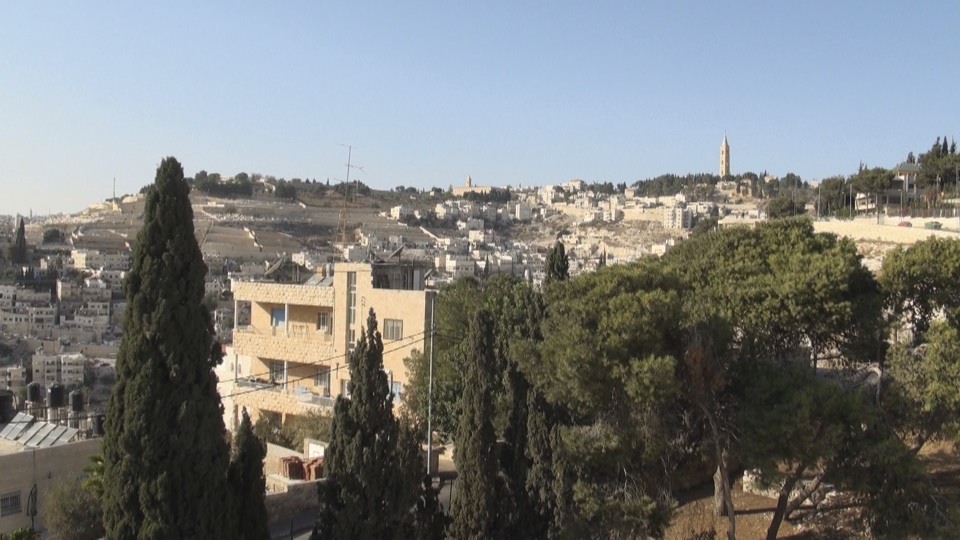
From the roof of the Passionist house in Bethany you can see the eastern slopes of the Mount of Olives looming ahead; the road winds over the crest of the mount down the other side past the Garden of Gethsemani and into Jerusalem. We walked part of the road last week.

The area around  Bethany was probably sparsely populated at the time of Jesus and into the Christian era. During great feasts, the poorer pilgrims would stay in the area, probably pitching tents up in the olive groves, and walk to the city. Here are two pictures from the 1940‘s when the area was less populated, today it is Muslim.

After Constantine established the church in Jerusalem and built churches like the Church of the Holy Sepulcher in the 4th century, vast crowds came here on Palm Sunday to reenact the gospel. They probably began near here to go their way into the city to the empty tomb .

Fr. Roberto tells me the procession today for the Latin church goes through St. Stephen’s Gate and ends in the Church of St. Ann.

Our Palm Sunday celebration today in the Roman rite imitates the ancient practice of the Church of Jerusalem, as well as many other of its Holy Week rites as well. We follow our ancestors in faith in sign. Before our Palm Sunday procession we hear these words:

“Let us remember with devotion this entry which began his saving work and follow him with  lively faith. United with him in his suffering on the cross, may we share his resurrection and new life.”

Don’t forget, however, that the little procession we have in our churches today once stretched over some tough hills and went for a distance.

In the garden behind the Passionist house are some first century ruins of a few Jewish houses from the time of  Jesus. Outside one is  a mikvah for purifications. Not far away is the Franciscan church next to the traditional site of the tomb of Lazarus. Who knows? Could they have lived here? It looks like its part of the ancient village of Bethany.

In back of the site is the famous security wall which runs through the Passionist property. More about that later.

Palm Sunday Procession

The gospels of Mark, Matthew and Luke report that Jesus began his entry to Jerusalem on Palm Sunday at Bethphage and Bethany on the Mount of Olives. From here he went into the city of Jerusalem seated on a donkey and those who followed him threw olive branches before him, crying, “Hosanna to the Son of David, blessed is he who comes in the name of the Lord, hosanna in the highest.”

From the roof of the Passionist house in Bethany you can see the eastern slopes of the Mount of Olives looming ahead; the road winds over the crest of the mount down the other side past the Garden of Gethsemani and into Jerusalem. We walked part of the road last week.

The area around  Bethany was probably sparsely populated at the time of Jesus and into the Christian era. During great feasts, the poorer pilgrims would stay in the area, probably pitching tents up in the olive groves, and walk to the city. Here are two pictures from the 1940‘s when the area was less populated, today it is Muslim.

After Constantine established the church in Jerusalem and built churches like the Church of the Holy Sepulcher in the 4th century, vast crowds came here on Palm Sunday to reenact the gospel. They probably began near here to go their way into the city to the empty tomb .

Fr. Roberto tells me the procession today for the Latin church goes through St. Stephen’s Gate and ends in the Church of St. Ann.

Our Palm Sunday celebration today in the Roman rite imitates the ancient practice of the Church of Jerusalem, as well as many other of its Holy Week rites as well. We follow our ancestors in faith in sign. Before our Palm Sunday procession we hear these words:

“Let us remember with devotion this entry which began his saving work and follow him with  lively faith. United with him in his suffering on the cross, may we share his resurrection and new life.”

Don’t forget, however, that the little procession we have in our churches today once stretched over some tough hills and went for a distance.

In the garden behind the Passionist house are some first century ruins of a few Jewish houses from the time of  Jesus. Outside one is  a mikvah for purifications. Not far away is the Franciscan church next to the traditional site of the tomb of Lazarus. Who knows? Could they have lived here? It looks like its part of the ancient village of Bethany.

In back of the site is the famous security wall which runs through the Passionist property. More about that later.

The Days of Noah

I preached today at St.Margaret’s, Madison, Ct. and told the people they could follow me at Victor’s Place. From the stats it looks like a lot did. Here’s a summary of my sermon today.

I just got back from a pilgrimage to the Holy Land earlier this week.  I led 42 people from  St. Mary’s Parish in Colts Neck, NJ, to visit the holy places. After they returned, I spent over a week at Bethany, where my community, the Passionists, have a house and church, appropriately called St. Martha, built over 1st century Bethany, where Jesus stopped to visit Martha, Mary and her brother Lazarus.

The Holy Land was crowded with pilgrims when we were there. Strange as it may seem,  in spite of the political troubles, they’re having a record breaking year for visitors. The majority were from eastern Europe– Russia, Poland, Lithuania, the Ukraine– as far as I could tell.

That part of the world is often called by historians “ The Bloodlands, ” because over 14 million people were killed there in the 2nd World War, either by Stalin or by Hitler. More people died there than anywhere else in that terrible war. Certainly, most of these people I saw lost family members then. So they came here, I believe, not just as tourists, but as believers who had come to the holy places that gave them a faith for hard times.

Many of the Americans who were there were Protestants, and a good number were Fundamentalist Protestants who strongly support the State of Israel.

I think you see things a little differently when you go to the Holy Land. You read the scriptures a little differently. I’m looking at the scriptures today and two things strike me.

On this 1st Sunday of Advent, listen to those beautiful words of Isaiah: “Come, let us climb the LORD’s mountain,

to the house of the God of Jacob,

that he may instruct us in his ways,

and we may walk in his paths.”

When you go to the Holy Land  you’re doing that all the time: climbing mountains. It’s a land of hills and mountains, and even if you get around by bus, you still have to get out and climb. The Mount of Olives, the temple mount, Mount Tabor, the Mount of the Beatitudes, Mount Carmel. Even when you want to go up to Mount of Calvary in the Church of the Holy Sepulcher, you have to climb a steep staircase.

The people of Jesus’ day climbed these mountains to see where they were going, first of all. In those days people didn’t have Google Maps, so they went up  high places to see where they were going. On the mountains they got a sense of direction and perspective.

The people of Jesus’ day also climbed mountains so that they could experience God.  God was in the high places, they believed. God refreshed you when you went up to the high places.

Could I suggest that our Advent mission we begin today might be a good way to climb the mountain of the Lord and get the direction and perspective we need. We easily lose our way.

In  the  gospel, Jesus uses an interesting phrase, “the Days of Noah.” He uses it to  describe an experience to beware of. You remember how he describes the days of Noah. In those days,  he says, “people are eating and drinking, marrying and giving in marriage.” Nothing wrong with that, you say.

But even good things can become routine, causing life to become dead.  The days of Noah are “same old, same old” days, nothing’s happening, nothing’s going on, as far as we can see. Might as well “Turn on the Television,” “Have a beer,” The days of Noah are days of blinding routine. We end up sleep-walking, missing out on what life brings.

So what’s my life and your life like? Are we living  in the days of Noah?  In the days of Noah we need to be lifted up:   “When you’re down and out, lift up your head and shout, there’s gonna be a great day!”

Today the season of Advent begins. It’s a time that brings hope. It saves us from being trapped by routine. Stay awake.  Advent is a time that proclaims a Great Day?

Our church today needs an awakening. Archbishop Dolan from New York was interviewed the other day in The New York Times about the church and he offered a sobering appraisal of what it’s experiencing today. Almost half of our young Catholics getting married are not getting married in the church. Participation at Mass is down to 35%. There’s a big slippage going on in our church. We need an awakening.

What should we do? Certainly church leaders have to do something? But what about ordinary Catholics? The church has always depended on them. Like the small Advent candle we light today, the church shines one by one.

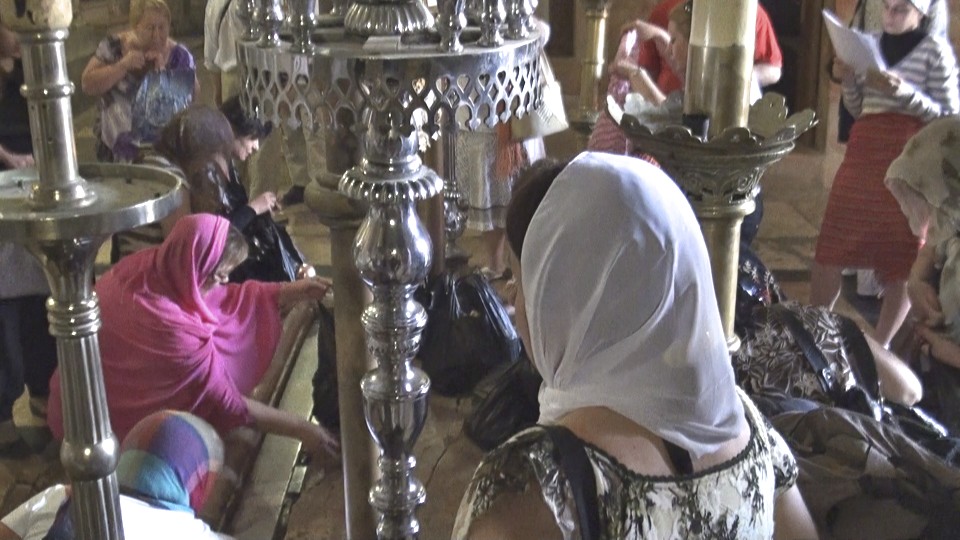
I don’t think I’ll ever forget one memorable event from my pilgrimage to the Holy Land. That was my visit to Lazarus’ tomb. As I finally got there, after traveling around the Israeli Security Wall, a large group of Russian pilgrims were entering the tomb. These were people from the “Bloodlands.” They crowded into that tight space of death and began to sing their powerful Russian songs of faith. The tomb was transformed by their singing.

Faith does that. It defies death. It transforms life. It gives hope.

Praying is like breathing

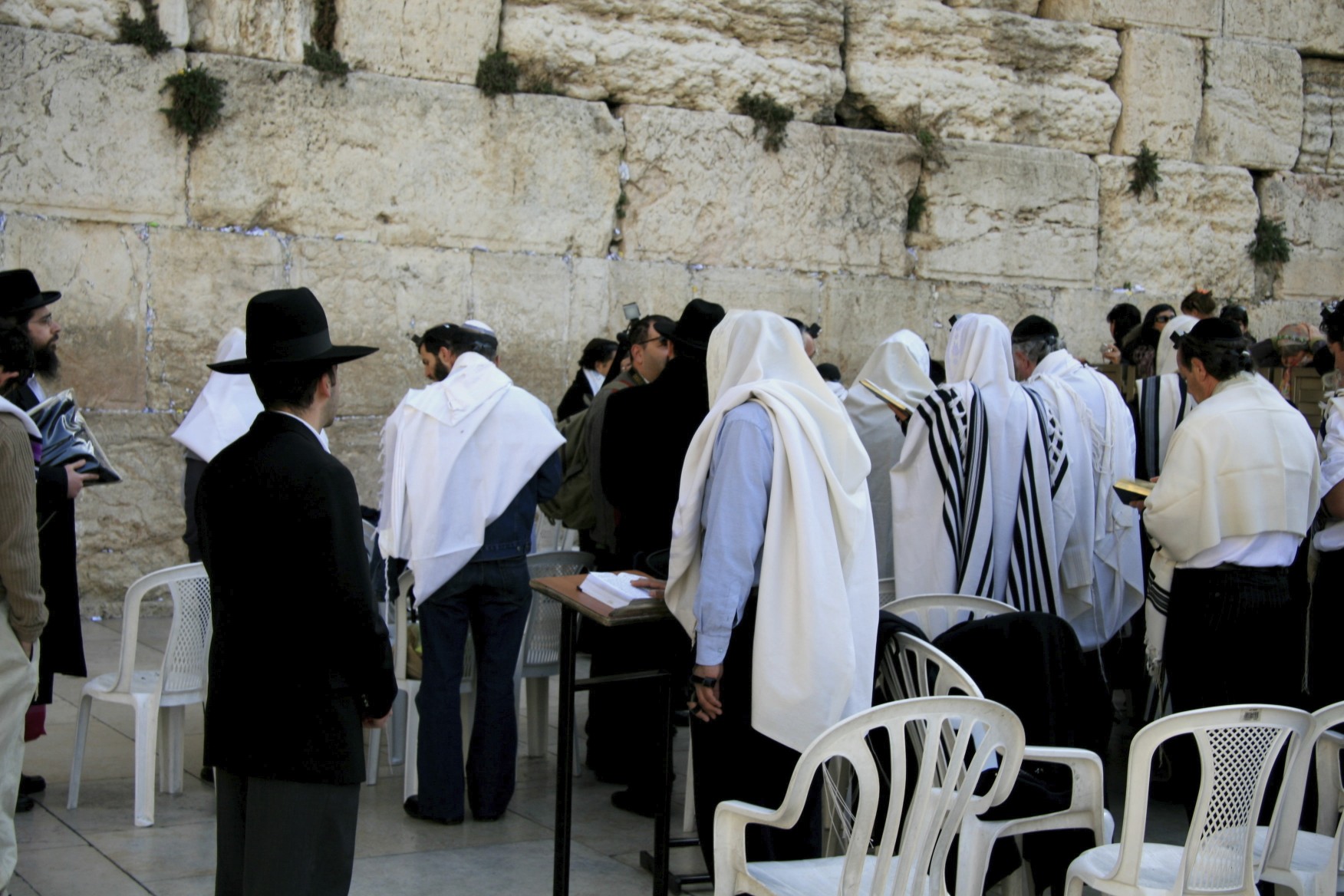
Last Sunday morning a Jewish man sitting next to me on the plane from Tel Aviv to Newark asked me, “Do you mind if I pray?” I replied, “Certainly not, I would be be happy if your prayed.”

He stood up and got something out of the overhead compartment and readied himself for prayer. I’m not quite sure all he did, but I noticed he put leather straps around his arms. Then he sat down and read from a small prayerbook he had for about 15 minutes. The drone of the engine blocked out any words he might have said that I could understand.

Praying is like breathing. We all need to do it. I used to bring out my small prayerbook on flights like that, but it got so cumbersome that I use a small rosary I keep in my pocket to pray.

Years ago, I remember on a flight from St. Louis to New York City a young Afro-American girl sat next to me. I opened my prayerbook to say my prayers, and I heard a  soft southern voice saying to me, “Sir, could I read a psalm?”

“Sure,” I replied, “Why don’t we read a psalm together.” I turned to Psalm 22 “The Lord is my Shepherd” and we read it aloud as we took off.

Afterwards, she told me that was her favorite psalm. She looked like a young teen-ager, but she told me she was married and on her way to Germany to return to her husband who was in the military. She had just lost a baby and had gone home to her mother to look for some comfort.

“I’m looking at these beautiful clouds in the sky,” she said, “and I remember one day after I lost my baby I had a dream and I saw the Lord like a Shepherd in clouds like these, holding my little baby.”

When we landed in Kennedy, I noticed she was struggling to pull out a big package from the overhead compartment and tried to  help her. ”It’s very heavy,” I said.

“It’s a computer, “ she answered, “I’m going to learn how to use it.” And she went off to the International departures.

Praying is like breathing; if we do it, we live.

A Church of the Hebrews?

Fr. Pol took me to the airport this morning early for the flight home. He celebrated Mass the evening before at Tel Aviv for about 700 Filipinos and other Catholics who work in that area as care-givers and domestics. There are over 80,000 Filipinos alone in Israel.

In the Gulf area there are about 2 million Catholics, many from the Philippines, India, Sri Lanka and Africa.

Pol was enthusiastic about the lively, ingenious faith of these immigrants, who send much of their earnings home, yet contribute so much to the efforts of their church here in Israel. They meet regularly at St. Peter’s Church in Joppa  and are planning another Christian center between Tel Aviv and Haifa. Some vital new movements are inspiring them.

The Israeli who hire them appreciate these workers for their ability to care for the sick and the elderly, and their honest values. Often they will arrange for them to get to Church on Sunday. Fr. Pol wonders if they will bring some of them to the faith.

Relations of immigrants to the government can be difficult, however. As in America, some are here illegally. Their children often are schooled in Hebrew and they want a more permanent relationship to the country but the political situation is not favorable now. Some are thinking that these immigrants may be the beginning of a new Christian presence, not just a pilgrim presence, in the Holy Land. One priest who is a Jewish convert is speaking of a Church of the Hebrews.

Fr. Pol and Fr. Marito and the Camboni Sisters next to them minister to this immigrant community regularly, driving all over Israel to wherever they can meet them.

Today is the Feast of Christ the King. Usually great things are done, according to Christian thinking, not by political or military or economic power, but by the power of the weak and the small. Weren’t lowly immigrants largely responsible for the original growth of the church?

Yesterday I missed an  opportunity for going with Fr. Pol to Tel Aviv because I wanted to get to Lazarus’ tomb and the Comboni Sisters offered to take me because they were going shopping. 17 Kilometers later we landed at the tomb and the sister said, “Look across the wall, that’s where we live, just a few yards away.”

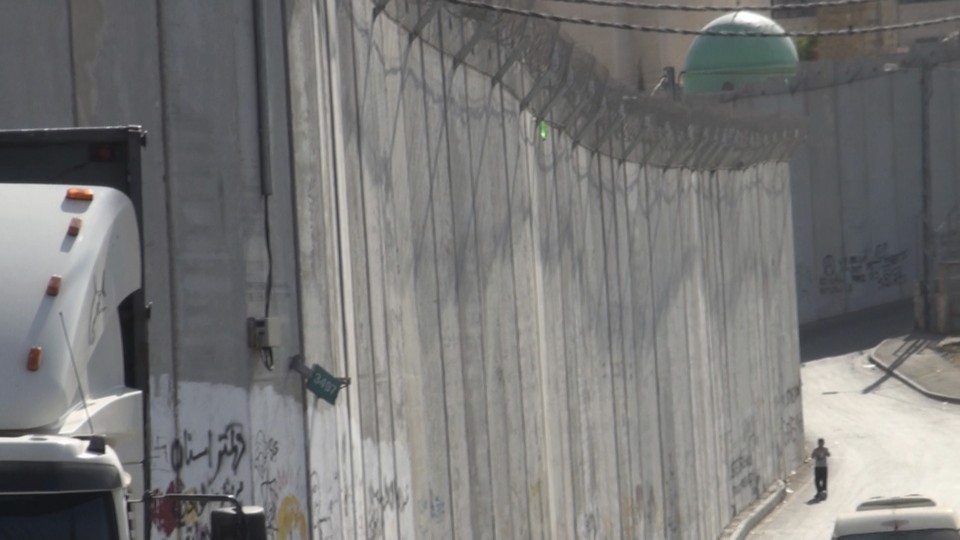
The ugly security wall.

It didn’t stop a group of Russians from descending into the tomb. For about 15 minutes they sang glorious Russian chants and then came up into the sunlight. The tomb became radiant with their faith.

Living by the Wall

The tomb of Lazarus is only down the road from here, but unfortunately I’m blocked from getting there by the Israeli security wall at the end of our street. Instead of a few minutes walk, I can get there only by traveling a good distance around the Mount of Olives.

The security wall winds through our property and the property of the Camboni sisters, an Italian order who have a school and a hostel next to us. As they look out their back  window, it looms over them, about twenty feet away, and it goes on as far as the eye can see.

I have been celebrating morning Mass these days for the sisters–in Italian– and they told me the wall has stopped many children, all Muslim, from coming to their school.  Relations between Christians and Muslims in this neighborhood have always been good, thanks to the good works of these religious women.

If the Israelis want peace, it would be better to tear down the wall and sponsor some schools and clinics like those run by the sisters. A high barbed wire wall, patrolled by armed soldiers, blocking streets people have been using for centuries, running through the backyards of ordinary peoples’ homes, stopping the flow of business, doesn’t win you friends.

It makes enemies.

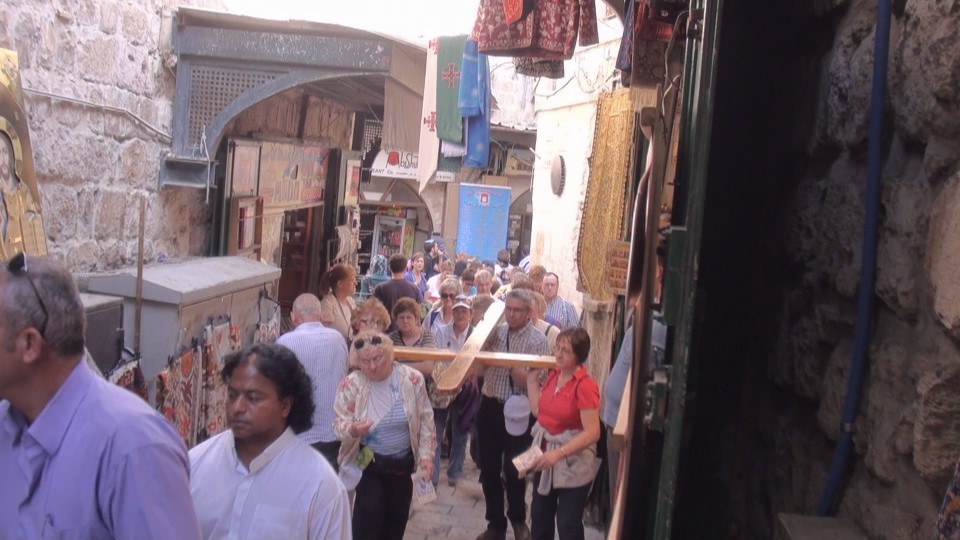
This afternoon Fr. Roberto drove me to the city where I made my way to the Via Dolorosa again, which was more crowded than ever with groups praying and groups shopping and gawking.

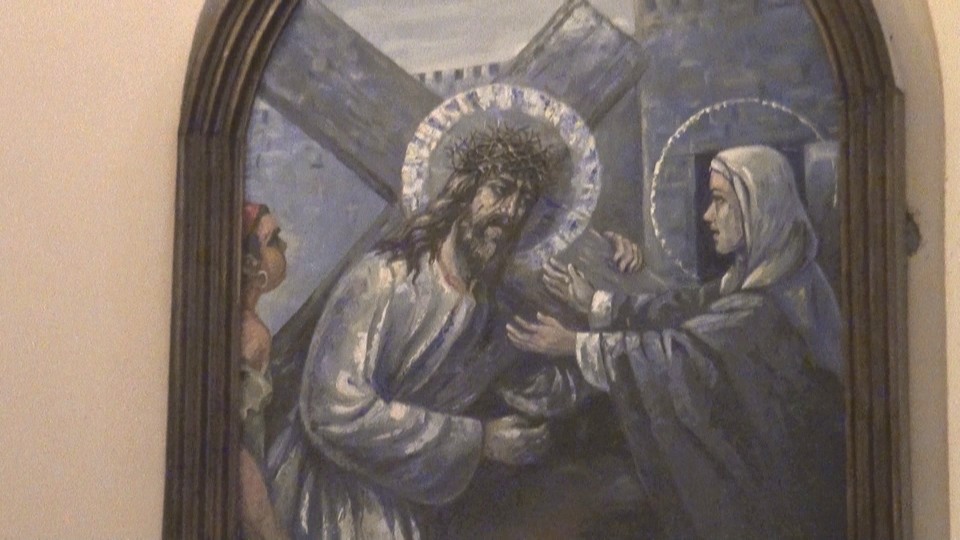
I did discover an Armenian church at the 4th Station that was an oasis in Babel. The church has some paintings of the 3rd and 4th stations. Jesus meets his mother at the 4th station. In the quiet courtyard before the church a mother was nursing her infant. In the church was a picture over the altar of Mary nursing her child.

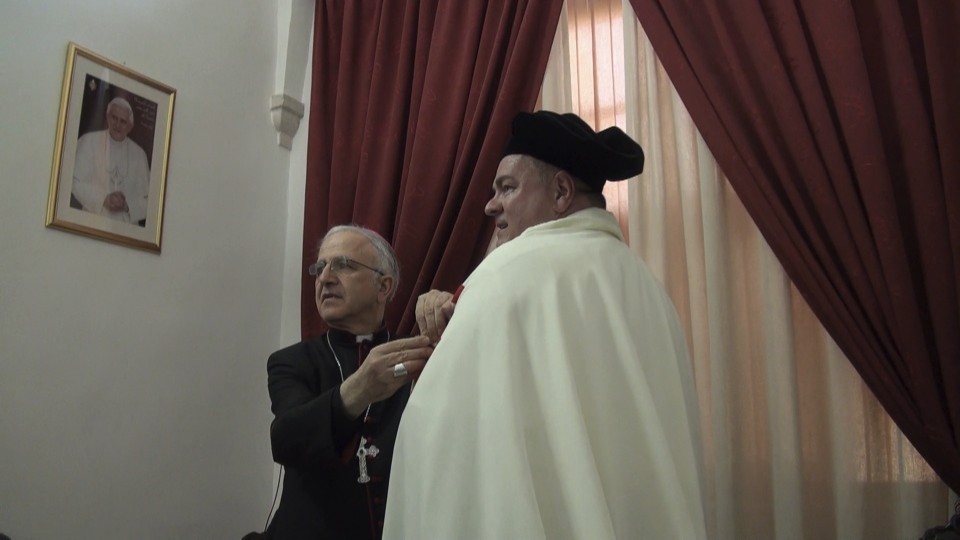
The day ended at the Latin Patriarchate where Sir Patrick Allen, Knight of the Holy Sepulcher from  Union City, NJ, met Bishop Shomali, who was born in Bethlehem, to receive an award for bringing over 100 people to the Holy Land on pilgrimage. I was a photographer and guest, and the bishop even said some nice things about the Passionists.

The Second Tomb

Right down the street from where I’m staying these days–in Bethany–is the traditional tomb of Lazarus. Jesus raised Lazarus from the dead, you remember, and stories of that famous incident and other events from Bethany figure large in the New Testament.

I went over to the Franciscan bookstore near the Joppa Gate this morning and got a small book on Bethany which goes into the history of this tomb and what archeologists have found as they dig and dig. Actually, they have stopped digging–for the present.

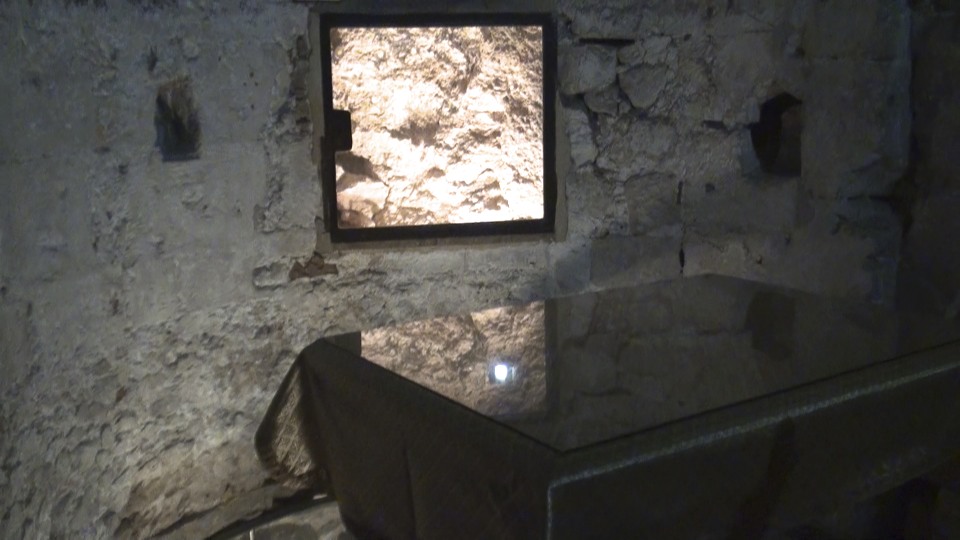
Surely, like the tomb of Jesus, the tomb of Lazarus would be remembered. Egeria, the 4th century nun, who was to all these places, says that there were so many people at Lazarus’ tomb  when she was there that they packed the whole church and all the fields around. For Christian pilgrims Lazarus played a vital part in the story of Jesus.

Right now, the Franciscans, the Greek Orthodox and the Muslims (who venerate Lazarus, by the way) are all around his tomb together. It looks like the same war over turf that goes on at the Church of the Holy Sepulcher.

Raising Lazarus from the dead was the final sign God gave before raising Jesus from the dead, John’s gospel says. It’s a miracle telling us we shall share in his resurrection.

Political reasons weren’t the only thing that brought Jesus to his death, it was his claim to be the way, the truth and life. The miracle brought people from Jerusalem to see a man who came from the dead and the one who raised him. The authorities reckoned that Lazarus would have to be taken care of too.

The believers were here in Bethany; not many in the temple, according to John’s gospel. Like Martha, carrying her pots and pans, they believed he was the Messiah, the Son of the Living God, who  brings life to the whole world. That’s why Bethany, and Lazarus, are important.

I spent today at the Church of the Holy Sepulcher, watching the crowds pile into the dark church and sat for some time in “Adam’s Cave” next to Calvary on a bench looking at the exposed rock where the crucifixion took place.  A stuffy guide came in with two Englishmen and said, “Look at that fellow over there, he’s sitting on the tomb of Baldwin 1, one of the first Crusader rulers of Jerusalem and doesn’t even know it.” I went back and looked up Jerome Murphy O’Connor who says the Greeks removed that tomb in 1809.

So much for experts.

Up to Jerusalem. November 10

Joseph said in the time of Jesus it would take a group of men about 7 days to get to Jerusalem from Tiberias; a family about 10 days. By bus we made it today in about 9 hours with stops at Mount Tabor, where we decided the wait was too long, so we just took some pictures of the mountain from a distance.

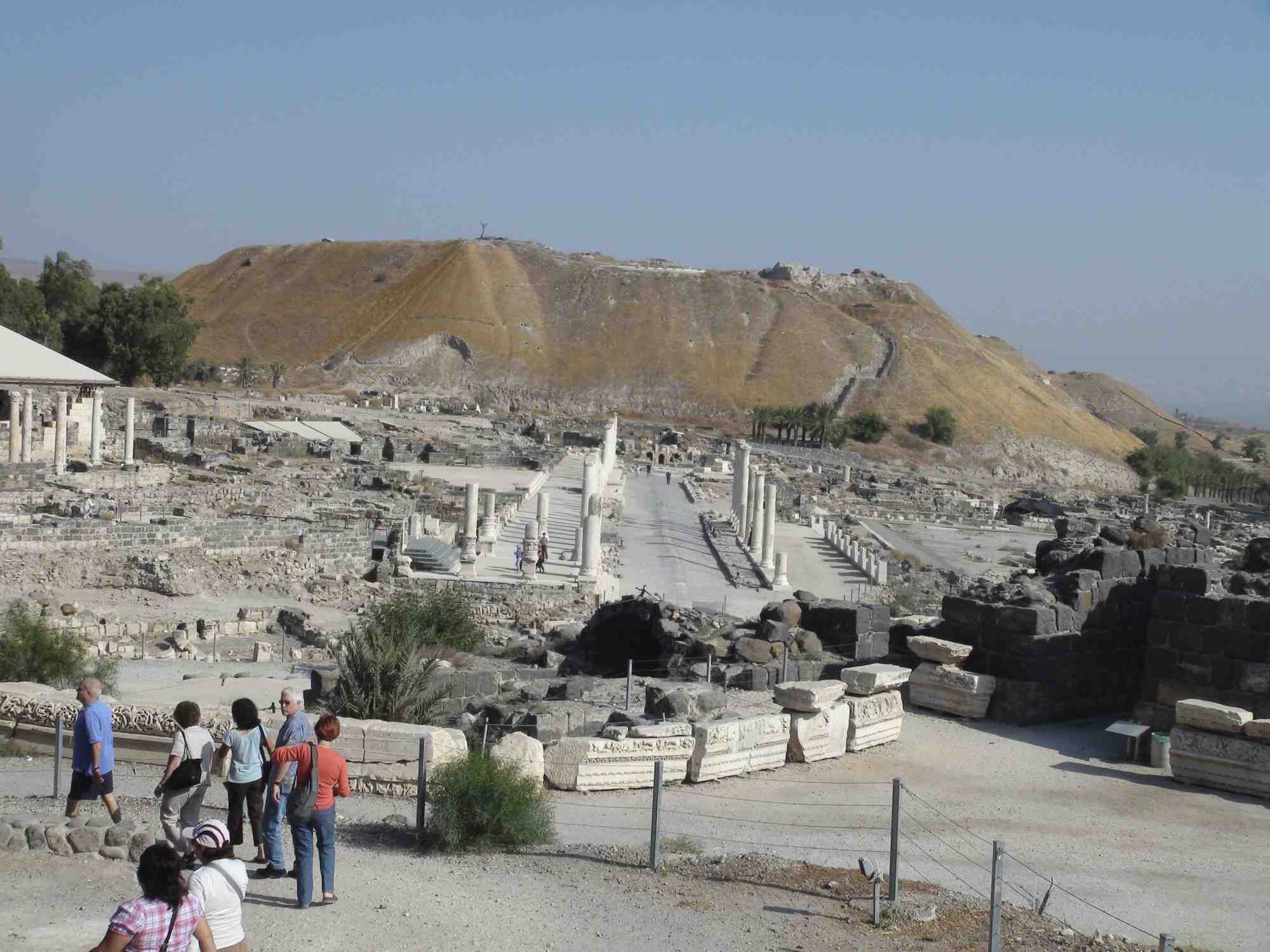
We made for Bet Shean, a Roman city built during the time of Jesus on the site of an older city. Our route was along the Jordan River, with barbed wire fences east of us.

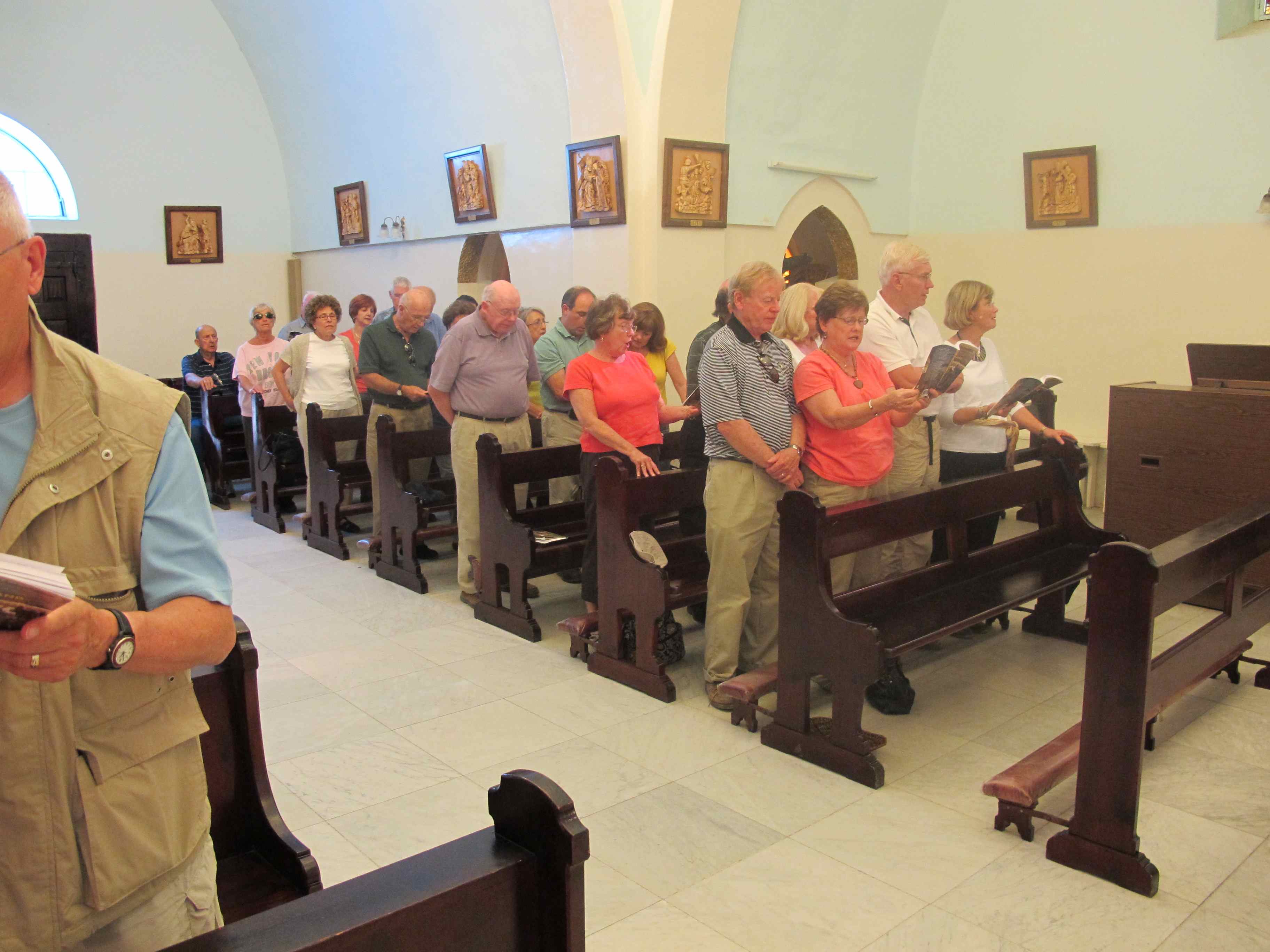
We had Mass around 12;30  at Jericho, Zacchaeus, the tax-collector’s town, in a little Catholic Church, Good Shepherd,  staffed by Franciscans. It’s also Joseph’s parish. There’s a Catholic school there with over 400 kids, the majority Muslims. Our group sang like angels, auditioning for the angelic choir tomorrow at Bethlehem.

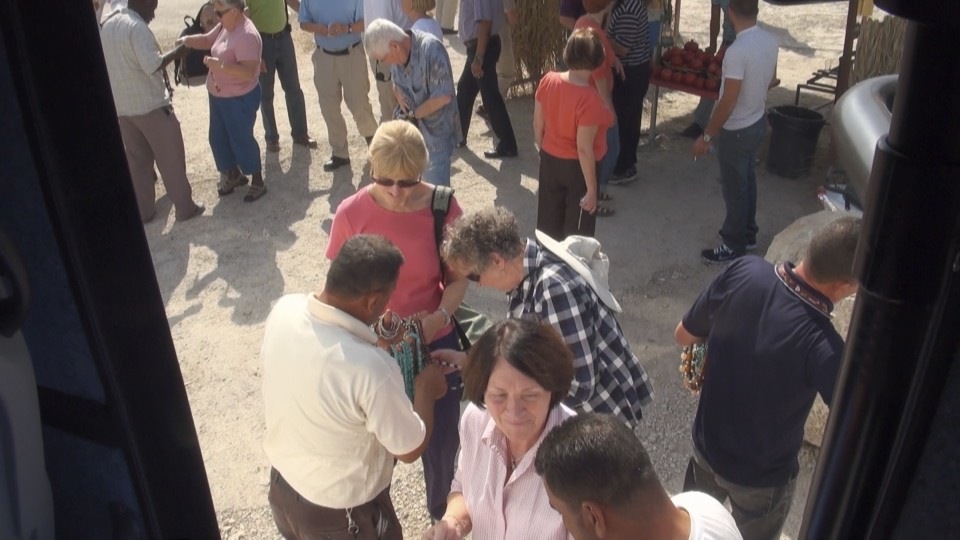
On the way to Jericho we had a lively experience of group haggling with some Jericho peddlars. I think the peddlars met some real competition from some New Jersey experts.

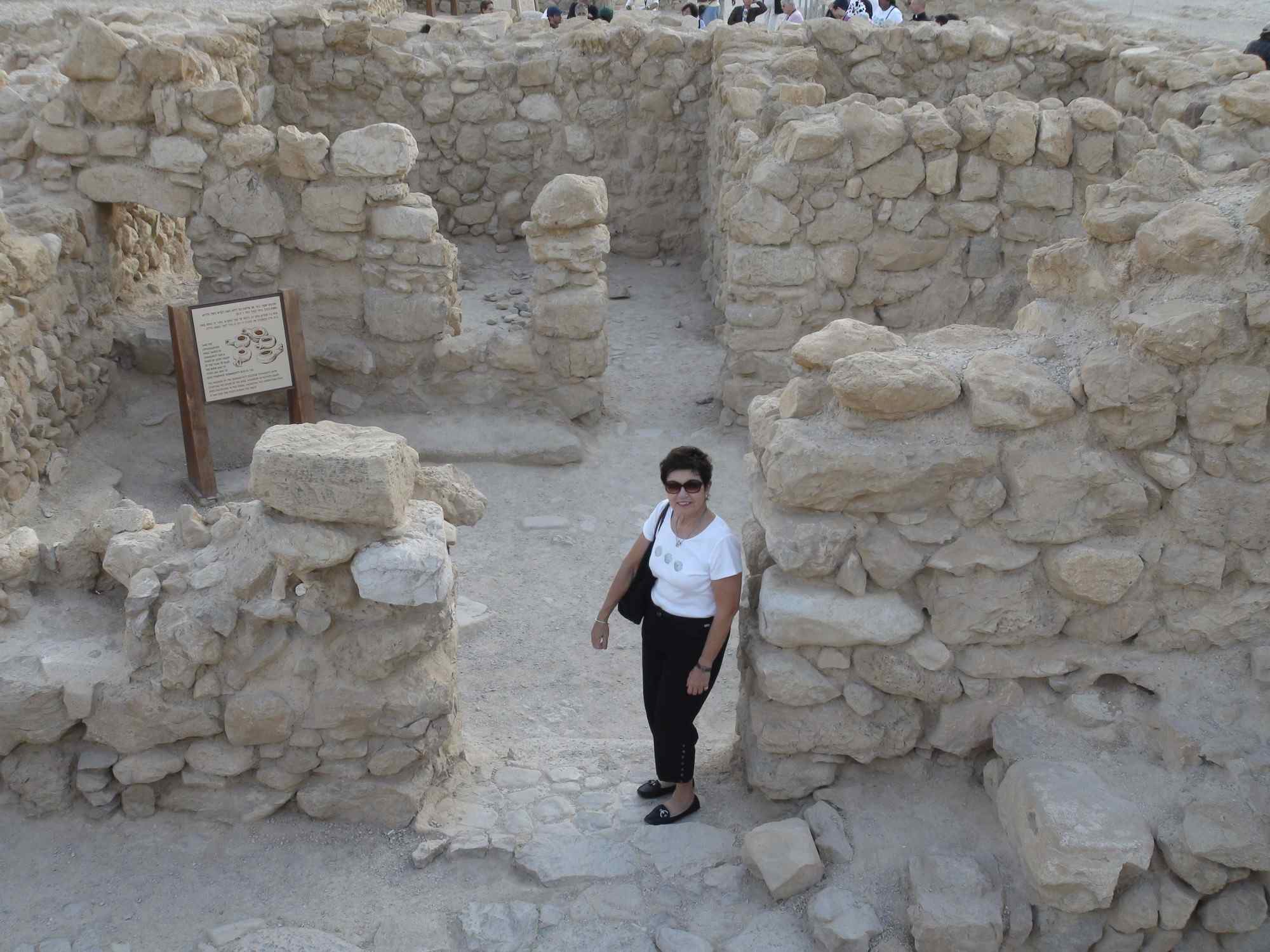
Then we went to the Qumran site along the Dead Sea where the Dead Sea Scrolls were found.

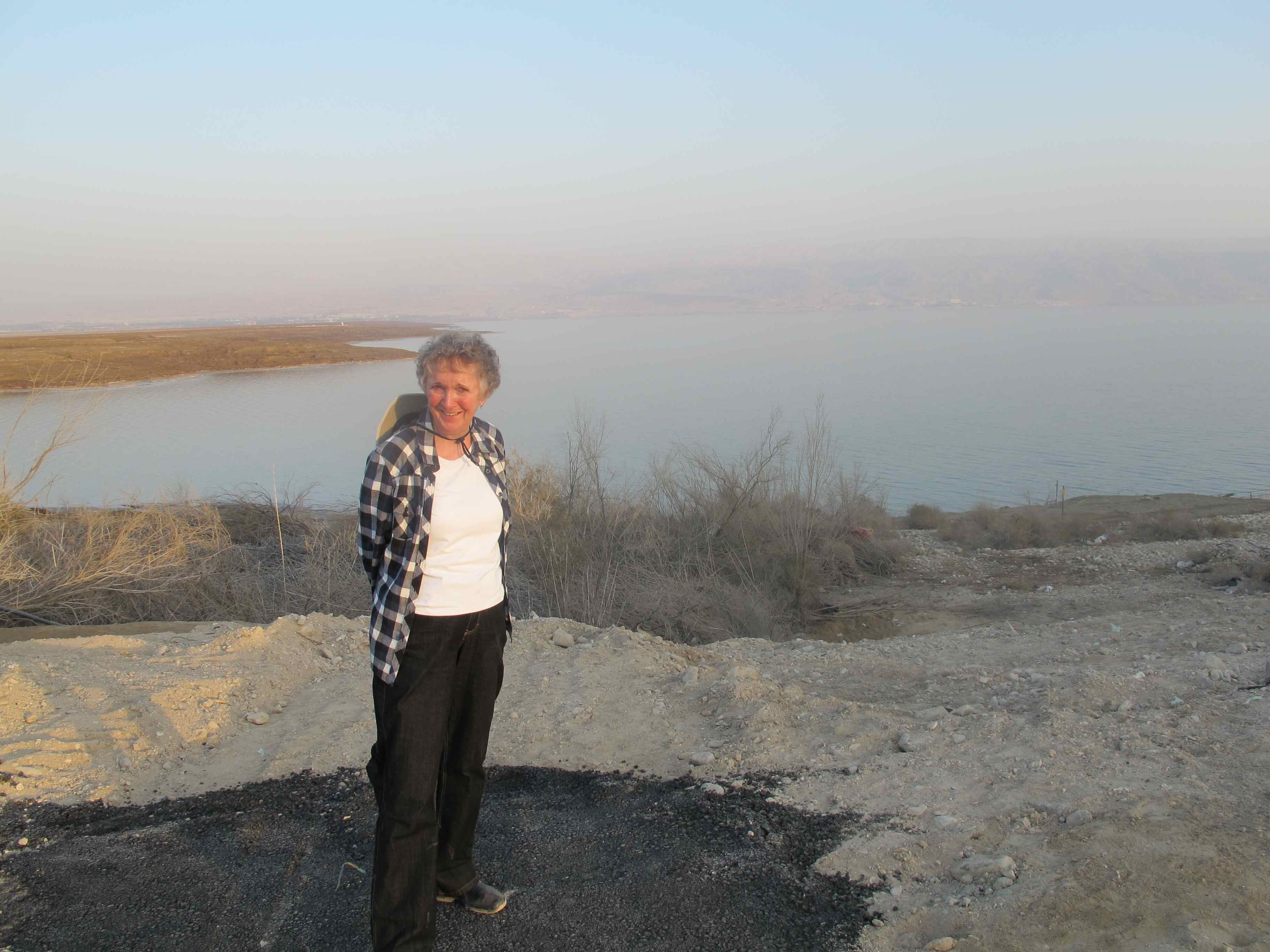
Afterwards, we made for the Dead Sea to see if it was really dead. It was. Some of us dipped our feet into it, some plunged in and lived to tell the tale.

Tonight we are in Jerusalem, not far from the Old City. Just finished a meal,

Capernaum, Tabgha, the Jordan

Today we went to a number of place closely connected with the ministry of Jesus: Capernaum, called “the Town of Jesus” because so many incidents recorded in the gospels took place here, and Tabgha where tradition says he fed the crowd with bread and met his disciples after his resurrection. We ended the day at the Jordan River where we renewed our baptismal vows and visited the church of the Beatitudes.

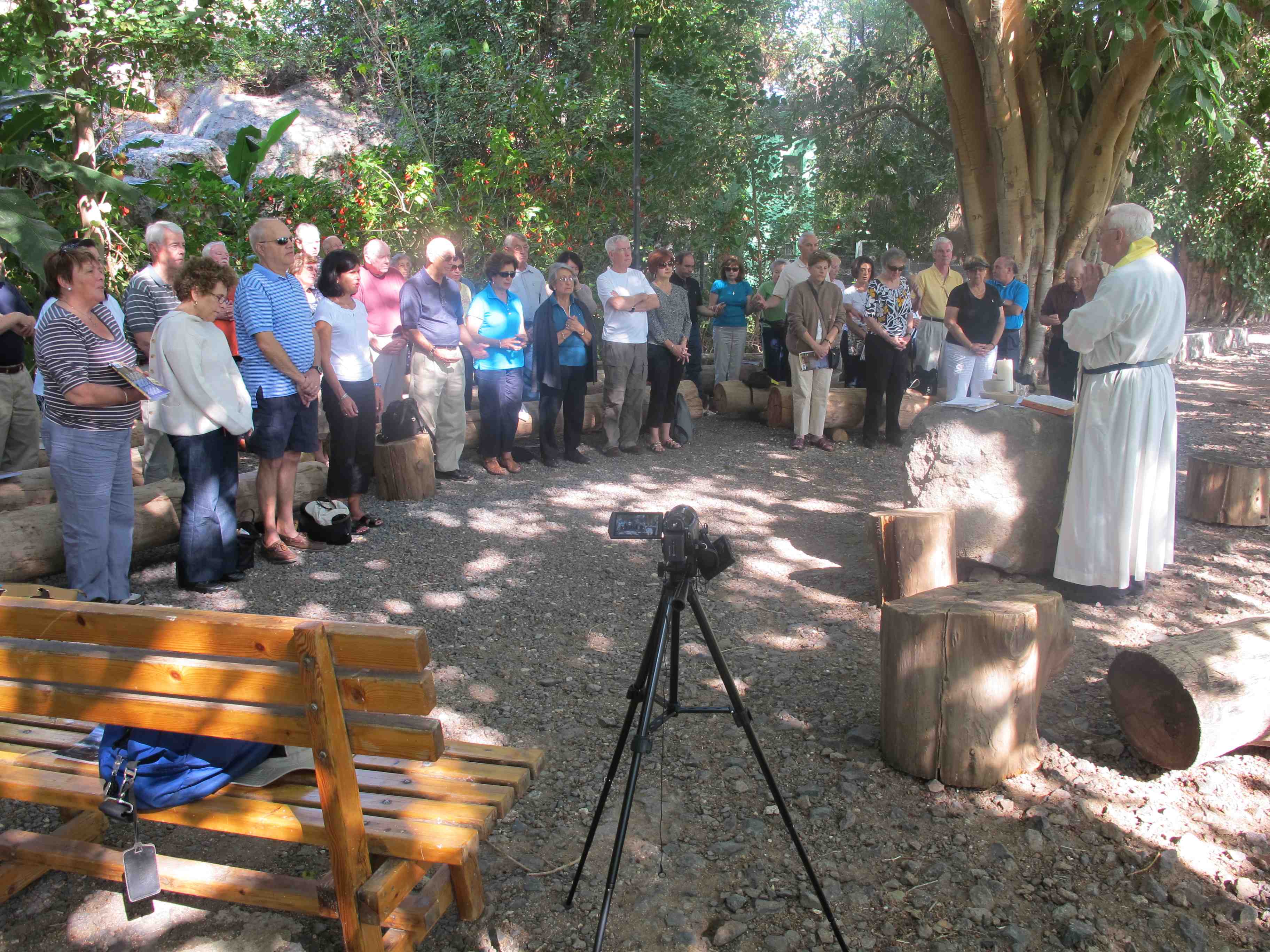
We began at Tabgha with morning Mass celebrated at a small wooded site along the Lake of Galilee and our reading was from John’s gospel which tells the story of Jesus meeting his disciples there after his resurrection. He provides them with a miraculous catch of fish, then Jesus questions Peter, “Do you love me?”

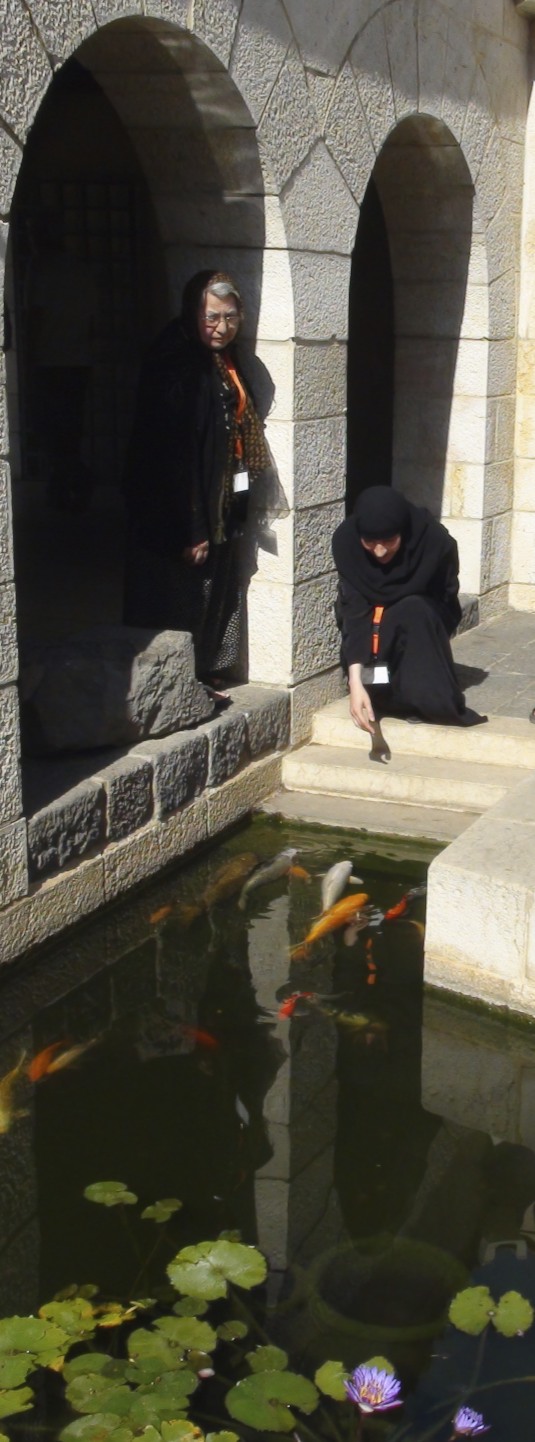
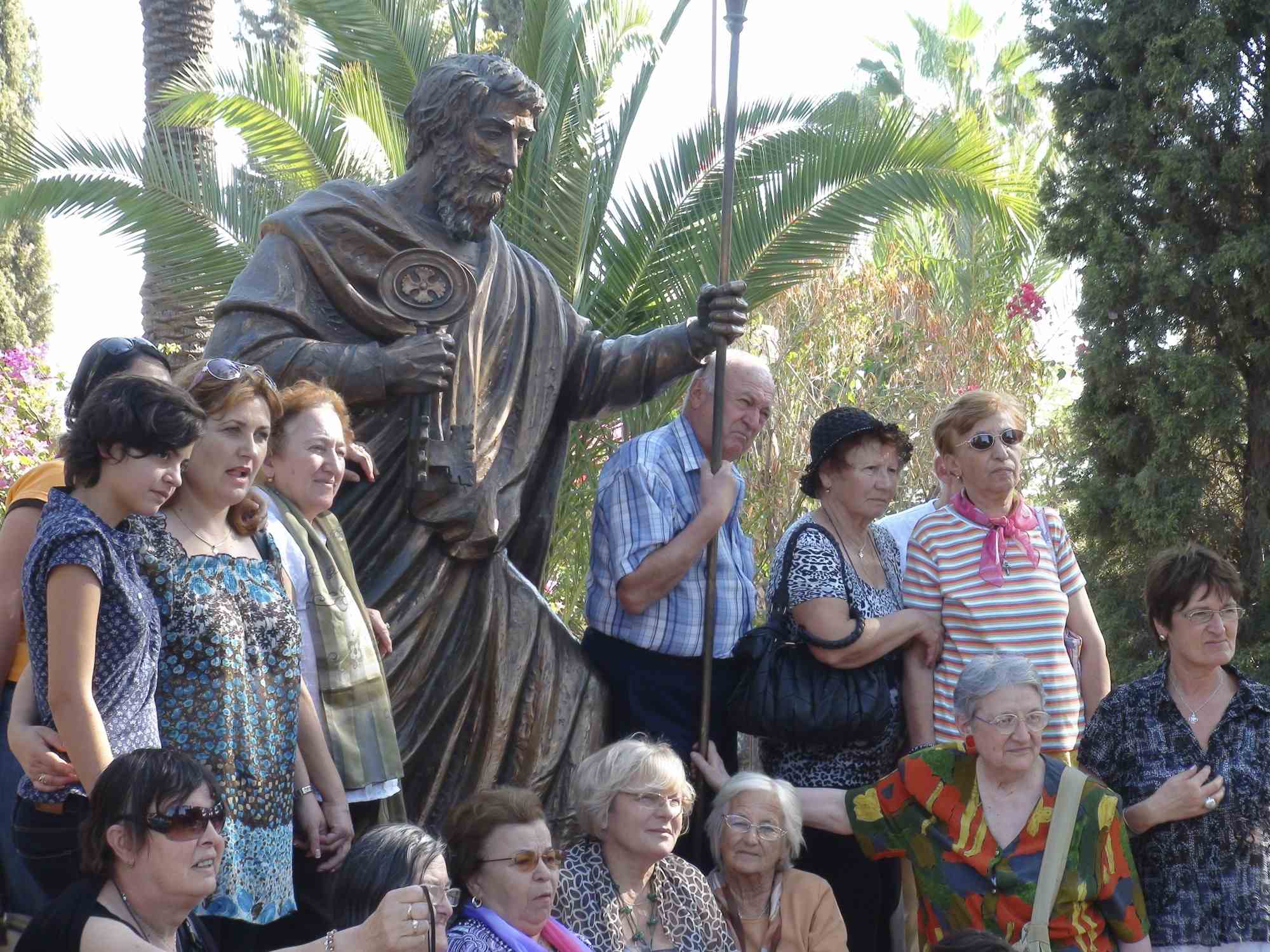
Then, we went to the Church of the Primacy, a short distance away and the Church that recalls the miracle of the loaves and fish. There are crowds of pilgrims in the Holy Land today. A large number seem to come from Russia, as well as from Goa, Korea, Houston, California. Here’s a Russian nun feeding fish at the Church of the Loaves and Fish. Also some friends of Peter holding on to his statue at Capternaum.

Capernaum is truly extraordinary. The ancient ruins from the time of Jesus present a striking indication of the place where he spent some of his most important years.

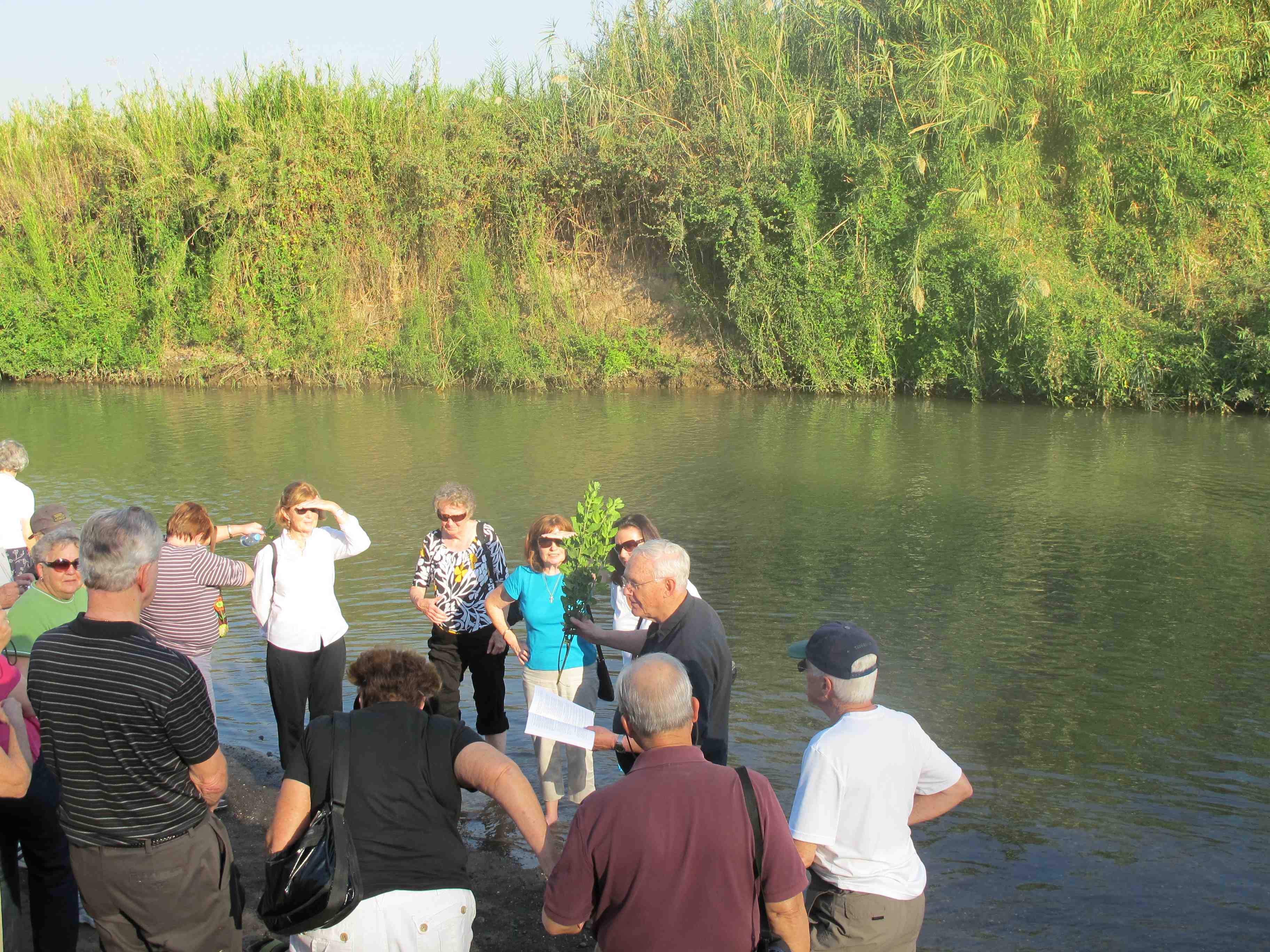
We went to the Jordan River to renew our baptismal vows, not at the spot that’s favored for baptisms these days at the southern end of the Lake of Galilee, but at a stretch of the river that feeds into the northern part of the lake.

Here we are at the Jordan getting sprinkled.


Tomorrow we pull up our tents and head to Mount Tabor, then south along the Jordan River, to Jericho and Qumran, then up to Jerusalem.  Joseph is taking us there.