When you’re reading the gospels it’s good to notice where Jesus travels, because it usually offers an insight into what he does. Mark’s Gospel today (Mark 7,31-37) says Jesus leaves the district of Tyre “and went by way of Sidon to the Sea of Galilee into the district of the Decapolis.” The cities of the Decapolis, east of the Sea of Galilee, were not Jewish areas; they were where pagans lived. That means that the deaf man Jesus cures is most likely a pagan, not a Jew. In a simple way, through these place names, Mark’s Gospel indicates that Jesus brings life to others, besides the Jews; he comes for all people.
Our story also sees an interesting connection between hearing and speech. The deaf man not only can’t hear, he can’t speak either. His deafness affects his understanding; it impedes his connection with the world and reality around him; he can’t say what he has to say.
The miracles of Jesus are about more than physical cures, of course. The deaf man who can’t hear or speak points to the spiritual deafness that can affect the way we hear God and consequently impedes our ability to speak God’s truth.
Pope Francis will be visiting us in a few weeks. He’ll be visiting three different places. In Washington he will be addressing our government, in Philadelphia he will be speaking about family life, in New York he will be speaking to the whole human family at the United Nations. He has important things to say and we should listen to him.
I think we already know some of the things he’s going to say. His recent encyclical “Laudato Si” was about the care of creation. It wont be a surprise if he speaks about that in all those places. But if recent surveys are right, it seems that American Catholics aren’t hearing the message of that encyclical very well. We don’t seem to hear what’s being said, it’s not entering into our ordinary discourse. Certainly we don’t hear too much about it in our present political discourse.
There’s an ecological crisis, the pope said in his letter. It’s a major issue endangering the whole world, all of its creatures, our human family. It’s especially affecting the poor. We have to do something about it.
Some may deny the crisis exists; some may claim it’s exaggerated; some may just throw up their hands thinking it’s too big to deal with. Some may think it can taken care of gradually by the play of “market forces.”
The pope and many others see the ecological crisis as real, it’s endangering the world and it has to be dealt with now. Recently, Francis asked Catholics and people everywhere to come together on September 1st for a day of prayer about the care of creation. We need an “ecological conversion,” he said. An “ecological conversion.” I must confess I don’t understand all he means by that, but my instincts say he’s right. I need to “hear” what that means– an “ecological conversion.”
I don’t think ecological conversion means that we have to immerse ourselves completely in science, although the pope obviously respects scientific conclusions. We should too. I don’t think ecological conversion means that a few quick moves will fix the crisis, like changing a couple of light bulbs in the house–although again, suggestions like that are important. The pope says that as Catholics we need to “rediscover in our own rich spiritual patrimony the deepest motivations for our concern for the care of creation.”
Pope Francis does that in his encyclical. He sees what the scriptures say about creation, from the Book of Genesis to the writings of the New Testament. He sees the respect we have for creation in our sacraments. The water we use in baptism, the bread and wine we take in our Eucharist, the oil we use for anointing the sick. Our spiritual patrimony has a reverence for creation. In the pope’s words, our spiritual tradition reminds us that we’re called “to be protectors of God’s handiwork.” That call “is essential to a life of virtue; it is not an optional or a secondary aspect of our Christian experience” (Laudato Si, 217). We must love God and our neighbor and creation itself.
Caring for creation and an “ecological conversion” are not going to be easy. It means great changes in the way we look at life and live life. We can’t understand all it means. We have trouble hearing and speaking about it, like the deaf man in the gospel. That’s why we need the grace of God. We need to pray for it. And while we’re at it, let’s pray for the pope.
Paul the Apostle is buried in the Church of St. Paul Outside the Walls in Rome. His sarcophagus lies under the church’s main altar. Until 2008, when archeologists uncovered it, it was concealed underground in the same spot.
After their execution in the mid 60s, Peter was buried on the Vatican Hill and Paul was buried along the Via Ostia. Churches honoring the two apostles were built in the 4th century by the Emperor Constantine over their graves. Constantine didn’t initiate devotion to the apostles, though. Christians from Rome and elsewhere came in great numbers from earliest times to these places to honor these great heroes.
A statue of St. Paul welcomes us outside the church’s entrance. He’s an old man, clothed in a heavy traveler’s cloak, bent and tired from years on the road. Yet, the apostle holds a sword firmly in hand, not a military sword, but a symbol of a faith that won hearts and banished the powers of darkness. He has “fought the good fight” and “kept the faith,” and here in Rome his earthly journey ended. Pictures on the church doors recall Paul’s final hours, when he died decapitated by an executioner’s sword not far from this spot.
Lifting our eyes to the façade of the church, we see his dramatic journey in outline, from Jerusalem to Rome, as Paul carried the gospel of Jesus Christ announced beforehand by prophets of the Old Testament. A more detailed description of his mission appears in the paintings around the church walls inside, from his conversion on the way to Damascus, to his death here in the capitol of the Roman world.
If we look higher before we go in, Paul appears on the church’s façade in the light of glory, his traveling days done. With Peter, a fellow disciple, he sits at the feet of Jesus Christ, the Risen Lord who taught him so well. “Who are you, Lord?” Paul once cried, thrown to the ground. Now he sees Jesus face to face.
This same scene of glory is repeated within the church itself where columns in procession lead our eyes to a triumphal arch defining the apostle’s grave below and the altar above it. On the dome of the apse, Jesus sits in triumph, surrounded by Paul and his companion apostles and evangelists. “Come, blessed of my father, receive the kingdom prepared for you,” Jesus proclaims in the book of life he holds up to them.
Today, we can see the apostle’s tomb, recently uncovered by archeologists, under the main altar.
Outside the Walls
The description “Outside the Walls” is a reminder that this church, now in a crowded city suburb, was once outside Rome’s city walls on a desolate stretch of the Via Ostia, part of a little cemetery where the apostle was first buried. As they did over St.Peter’s grave, early Christians built a modest memorial immediately after Paul’s death to mark his grave; then in the early 4th century the Emperor Constantine erected a small church facing the Via Ostia honoring the apostle.
It did not end there, however. Later that same century, a larger church replaced the small church, as large as that of St.Peter on the Vatican. Why build an immense building like this in an out-of-the-way place, we may ask? Was it devotion or Christian pride?
Perhaps. Yet, some speculate other reasons were behind it. In the late 4th century, hordes of “barbarians” were pouring through the frontiers of the empire, and the Romans–most likely Christians among them– saw the newcomers as pesky strangers: violent, crude and uncultured. The latin word they used for them, “barbari,” dismisses them as little less than savages, unwelcome intruders to an orderly Roman world.
St. Paul once scolded the proud Corinthians for looking down on others and forgetting how God raised them up from nothing by his grace. “The door to faith has opened to the nations,” he said; God welcomes all, no matter who they are. Wouldn’t God welcome these new immigrants?
Did the new church call Roman Christians to open their hearts to these new gentiles as the apostles Peter and Paul had done before? Early popes like Leo the Great and Gregory the Great promoted this new church. Gregory not only welcomed newcomers to the Italian peninsula but inspired by Paul reached out to peoples beyond the borders of the empire, to the misty shores of England and the dark forests of Northern Europe.
To be catholic the church had to reach out to the world.
Peter and Paul complement each other. Paul, a complex intellectual, forged beyond the boundaries of Judaism to address the whole world. Peter, the Galilean fisherman, was a cautious captain for the ship of the church. Their gifts are different, but we gain from both of them. Paul’s sword points to an unknown future and tells us not to be afraid to embrace it. Peter, holding firmly the keys given him by Jesus, calls us to stay close to the Good Shepherd, whose wisdom and love supports us.
Church and Monastery of Saints John and Paul, Rome
The 5th century church of Saints John and Paul stands on the western spur of the Coelian Hill near the center of imperial Rome, across from the ruins of the emperors’ palaces on the Palatine Hill, the Roman forum and the Colosseum.
The Coelian Hill was an important area in early Christian Rome. In imperial times, wealthy senatorial families lived in quiet walled mansions on the hill. The Emperor Marcus Aurelius (160-180 AD) was raised on the Coelian Hill. Apartment houses (insulae) for the middle class and the poor stretched along the roads crossing it. A garrison of imperial troops was stationed there. Some Christians were among these various groups on the hill early on.
Constantine (312-337 AD) built a baptistery, a residence for the pope and the impressive Lateran Basilica on the eastern spur of the Coelian on land he confiscated from his enemies after conquering the city in 311 AD. The bishops of Rome resided on the Coelian from the 4th to the 14th century, then they moved across the city to the Vatican.
Other prominent Christians were assocated with the Coelian Hilly by the 5th century, when the Church of Saints John and Paul was built. The area was a lively spiritual and intellectual center attracting figures like St. Jerome, St. Augustine and spiritual teachers from the Egyptian desert who frequented the homes and churches on the Coelian.
St. Melania the Younger (+439), from one of Rome’s richest families, lived near Saints John and Paul. Shortly before Alaric’s army invaded the city in 410 she sold her home and lands and left for Africa with her husband to be near Augustine and his community at Hippo. Eventually, Melania began an important monastery for women on the Mount of Olives in Jerusalem.
The lands next to Saints John and Paul belonged to the wealthy Christian family of St. Gregory the Great (590-604 ) which gave the church two popes before Gregory: Pope St. Felix III (483-492) and Pope St. Agapitus (535-536), Gordian, the father of Agapitus, was a priest of the Church of Saints John and Paul. A splendid Christian library–its ruins visible today across the Clivus Scauri from the church– may go back further than its patron, Agapitus. The Church of St. Gregory the Great stands opposite to the Church of Saints John and Paul.
After Constantine freed Christianity in 312 AD, Christians from the Coelian must have taken part in an effort to win over to Christianity the powerful Roman majority that remained distant and sometimes resentful of the new faith. The Church of Saints John and Paul must have been part of an effort of Christian evangelization.
Before 312 AD, Christians promoted their faith cautiously; now they presented it boldly, using the Christian scriptures freshly translated by St. Jerome, along with his learned commentaries. The new faith, St. Augustine argued in his City of God, far from causing the empire to fall, offered it a powerful new wisdom it needed. Roman Christians confidently believed they had something to say to their city and made their appeal from splendid new churches, rivaling Rome’s temples and shrines.
Was the church of Saints John and Paul – the first to be built in the “show area” of the imperial city, next to the Roman temple of Claudius, close to the Roman forum, the heart of Rome – an example of this new Christian assertiveness? Until then, so as not to offend the Roman majority, new Christian buildings were confined to the city’s edge (the Lateran Basilica is an example). Was the church a visual statement that Christianity had arrived?
The builder of Saints John and Paul was a one-time leader of the Roman senate, Pammachius (340-410 AD). His wife was Paolina, daughter of the influential noblewoman St.Paula, who accompanied St. Jerome to the Holy Land. They had no children, and when Paolina died in 360 Pammachius dedicated himself to the spiritual life, promoting scripture study and caring generously for the poor. St. Jerome, a long-time friend and regular correspondent, admired the Roman nobleman’s deep faith and keen mind. Another friend, St. Paulinus of Nola, called Pammachius the “most generous patron the church could have.”
Pammachius built his 5th century church using as its foundations three existing buildings, two of them 3rd century apartment houses facing the Clivus Scauri. Most likely, the Roman senator, saw the church as a spiritual and intellectual beacon in the heart of the city.
Pammachius died in 410 AD, the year Alaric and the Goths invaded Rome, creating panic and uncertainty in the city. Many of the inhabitants on the Coelian Hill fled to safety beyond Rome or to other parts of the city. Almost a century later the great Christian scholar Cassiodorus speaks regretfully of abandoning a joint project to promote Christian learning which he planned to undertake with Agapitus, whose great library stood across the street from Pammachius’ church.
As we have already said, the present 5th century church is built on the structures of some houses that can still be seen beneath it. There’s evidence that Christians met in one of these houses, a “house church,” bearing Pammachius’ name. It’s listed among the twenty five early Christian house-churches that existed in the city.
Pammachius’ house-church had another distinction. Bodies of Christian martyrs were buried and honored there, even before the upper basilica was built. Two soldier martyrs, John and Paul, said to have been put to death by the Emperor Julian the Apostate in 362, are the most prominent of the group. By the time of the church synod in Rome in 595, the church of Pammachius was also known as the Church of Saints John and Paul.
Scholars are still puzzled by the stories of the martyrs, John and Paul. Different versions have appeared, the earliest from the 6th century. According to the earliest “Passion” (an account of martyrdom), John and Paul were two Christian officers of the Emperor Constantine, who made them guardians of his daughter, Constantia. Thanks to his generosity, the two brothers bought a house on the Coelian Hill and retired there.
When Julian the Apostate, became emperor, he called the two brothers back into imperial service as his aides. But they refused, because the emperor had betrayed the Christian faith into which he was baptized. Julian, incensed at their refusal, gave them ten days to reconsider; unless they complied with his request, he would charge them with impiety, which was punishable by death. During the next ten days, the brothers prepared for their martyrdom by giving away their possessions to the poor.
Fearful that open persecution would antagonize the Christians, Julian chose to deal with the two soldiers privately. So he sent one of his captains, Terentianus, to their home to command obedience from them and to sacrifice to the gods. When they remained firm, they were beheaded and secretly buried in their home. To cover up their death, officials started the rumor that they were sent into exile. Three other Christians, the priest Crispus, the cleric Crispinianus and the woman Benedicta were martyred along with the brothers.
Shortly afterwards, the truth came out, and John and Paul, as well as the others, were honored at a shrine built over their graves in the apartments along the Clivus Scauri, which may have been their home. Later, a stairway connected the shrine to the church built above.
The cult of the two soldier saints grew as miracles were reported through their intercession. By the 6th century, their names were listed in the ancient Roman Canon; their feast was celebrated in Rome, Milan and Ravenna on June 23rd, which may be the day of their martyrdom.
The two martyred soldiers would have been favorites of the soldiers stationed on the Coelian Hill, who passed their shrine on the Clivus Scauri regularly. They also reminded Christians of Pammachius’ day – who were becoming increasingly more comfortable in Roman society after the years of persecution – that those who follow Jesus must be ready to bear their cross.
Churches share the fate of the places where they are built. The church of Saints John and Paul’s fortune changed following the invasion of the Visigoths in 410. Other barbarian invaders swept through the empire after them, and Rome’s population dwindled from about 800,000 in 400 AD to perhaps 100,000 by 500 AD. Most of the wealthy families from the Coelian fled to the safety of Constantinople or Ravenna. The remaining population either moved from the city or relocated in its westward section, leaving the hill largely abandoned and depopulated. It remained that way until the end of the 19th century.
After a brief shining mement as a center for early Coelian Christians, the Church of Saints John and Paul came under the papal court located at the Lateran area nearby, and depended upon the fluctuating resources of the popes of the time. An annotation from the Liber Pontificalis in the 8th century says that Pope Hadrian I (772-795) “began to renovate the titulus Pammachii, of Saints John and Paul, which had become run down over the years.” Through the dark ages, to medieval times, until today, the church was kept standing by popes, cardinal protectors, religious communities and benefactors who mended, altered or restored its fabric.
By the 6th century, Saints John and Paul was no longer a thriving parish church, but an isolated martyrs’ shrine in an abandoned area of the city. Yet, as Rome under the popes of the 7th century became a magnet for pilgrims flocking to the city’s shrines (especially the shrines of St. Peter and St. Paul), the church of the soldier martyrs on the Coelian Hill also attracted visitors.
Church of Saints John and Paul, c.16 century
From the 11th to the 13th centuries, cardinal protectors provided the popular church with a beautiful bell tower, solid walls and enlarged monastic buildings. Pilgrim guidebooks of the time give the church a place of honor because, uniquely, it contained martyrs’ tombs within the city walls. The 12th century historian and guide, William of Malmesbury, writes: “Inside the city, on the Coelian hill, John and Paul, martyrs, lay in their own house, which was made into a church after their death.”
From the 8th century onward, monastic and religious communities took up residence next to the shrine. The latest religious community making a home there is the Passionists whose founder, St. Paul of the Cross, was a zealous Italian preacher and mystic of the 18th century. Pope Clement XIV, because of his friendship and admiration for the saint, asked him in 1773 to take over the ancient monastery and church. With seventeen Passionist religious, Paul moved into the monastery of Saints John and Paul, and it has been the seat of administration for his worldwide congregation ever since. Paul spent his last years and died there on October 18, 1775.
Paul of the Cross was proclaimed a saint on June 29, 1867. On April 25, 1880 his remains were brought to the beautiful classical chapel built in his honor on the right hand side of the basilica of Saints John and Paul. The rooms where he lived and died, overlooking the piazza, are carefully preserved in the old monastery. Besides the saintly founder, other Passionists honored by the church are associated with the place. Among them are: Saint Vincent Strambi (1745-1824), former superior of Saints John and Paul, who was named Bishop of Macerata and suffered during the Napoleonic occupation; Blessed Dominic Barberi (1792-1849), who received John Henry Newman into the Catholic Church; Blessed Bernard Mary Silvestrelli (1831-1911), a superior general of the Passionists who prepared for their worldwide expansion in the 20th century; and Blessed Eugene Bossilkov, a Passionist Bishop martyred by the communists in Bulgaria in 1950.
Today the monastery is a residence for Passionist students from many countries and also the site of the community’s administration. In the late 19th century, a Passionist religious, Father Germano Ruoppolo (1850-1909) conducted extensive excavations under the church. He uncovered the remains of the early 2nd and 3rd century apartments and homes that were the foundations of the later basilica, as well as the streets of the ancient site and the confession where the martyrs were honored. Father Germano was also the spiritual director of St. Gemma, an Italian mystic who, from her childhood, was devoted to the mystery of the Passion of Jesus. Today, she is buried in a shrine named in her honor in Lucca. Not far from her rests the body of her saintly guide, Father Germano, Passionist; his own cause for canonization is in process. Father Germano’s successor in the excavations at Saints John and Paul was Passionist Brother Lambert Budde, who worked there from 1909-1911.
Further explorations were conducted from 1956-1958 through the generosity of Francis Cardinal Spellman of New York and Joseph P. Kennedy, father of President John Kennedy. Cardinal Terence Cooke and Cardinal John O’Connor, successors to Cardinal Francis Spellman as archbishops of New York, also had title to this important Roman church..
Visiting Saints John and Paul The bell tower was built in the 12-13th century over the travertine foundations of the 1st century Temple of Claudius and the Claudianum. The large sunken door to the left of the bell tower on the piazza leads to an ancient street before the Claudianum. The buildings to the left of the bell tower belong to the 11-12 century Monastery of Saints John and Paul, built by Cardinal Theobald. Its original entrance, now enclosed, is seen to the right of the narthex (or porch at the entrance to the basilica) on the piazza. The double-arched windows above the door to the Claudianum mark the room where St.Paul of the Cross died. (October 18,1775) The narthex was constructed by Cardinal di Sutri in the middle of the 12th century to protect pilgrims from the weather. Above it is the 13th century gallery, built by Cardinal Savelli, who became Pope Honorius III. The five large pillars above columns on the upper facade of the basilica are from the original 5th century basilica.The large round dome to the right of façade was constructed in the 19th century as part of the shrine to St.Paul of the Cross. On the left hand side of the basilica is the ancient street, Clivus Scauri, connecting the Coelian Hill to the Palatine Hill. Spanned by seven brick arches that buttress the 5th century church, the road runs past the 3rd century apartment houses on which the church is built, parts of which can be seen in the church’s foundations. The excavations under the church can be visited from an entrance on the Clivus Scauri. Inside the church, the story of Saints John and Paul is told in the paintings in the apse. There is a painting of Pammachius above an altar to the upper right of the church.
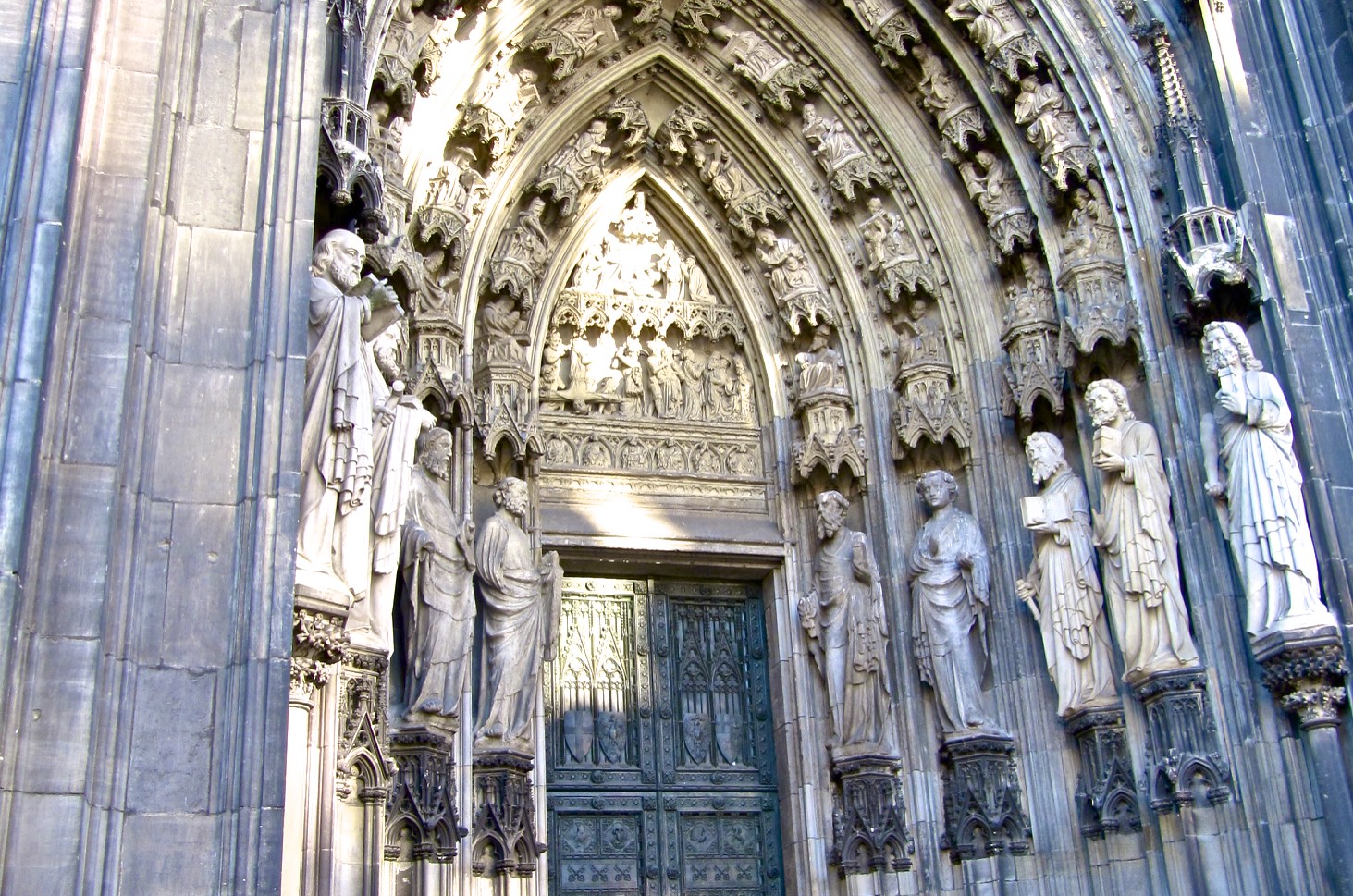
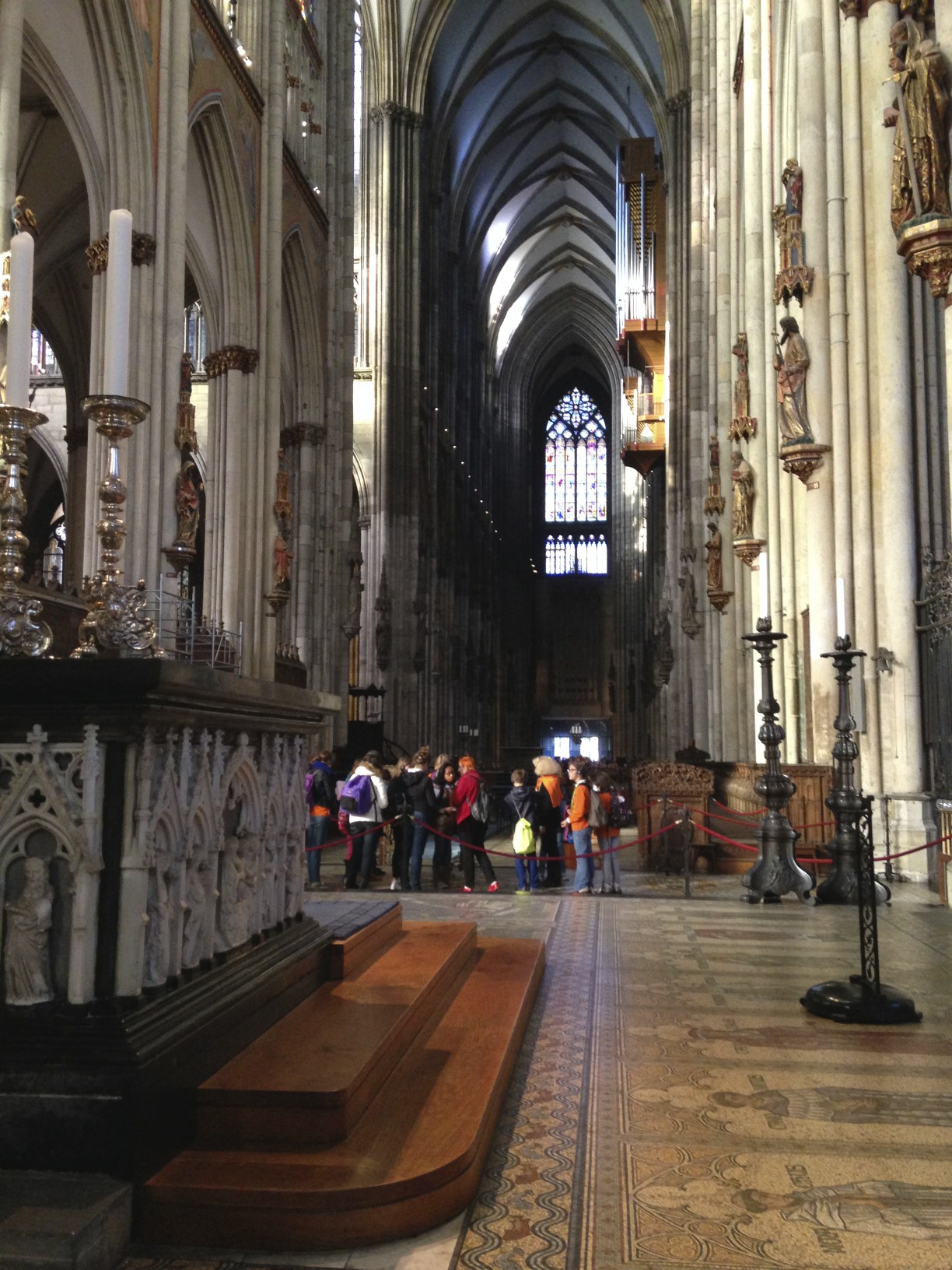
We hurry through doors, because we want to get inside. But cathedral doors are not ordinary doors; they try to slow you down and get you ready for what’s inside.
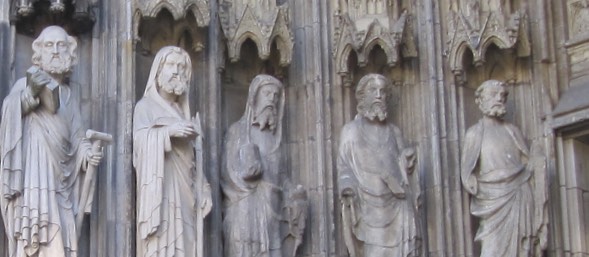
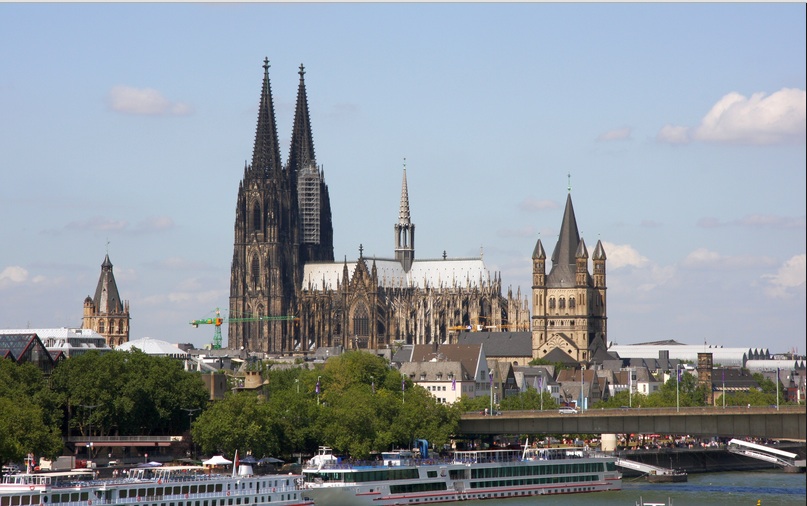
The apostles stand at the western door of the Cologne Cathedral. Peter and Paul are nearest the door itself. Above them is the scene of their martyrdom under Nero. They’ve given their lives to the truth that’s told here, that Jesus Christ, the Son of God, was sent from above, and by his death and resurrection he calls us to follow him to glory. They’re teachers of faith who invite us to believe. You might call this door a version of the Apostles’ Creed.
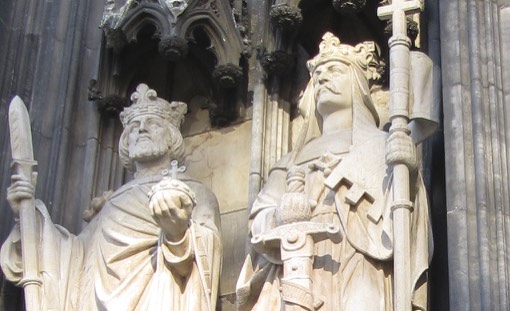
Earthly rulers, like Charlemagne, stand at the door too, witnesses of another authority. The faith is to be lived on earth as well as heaven.
The images of prophets, teachers, martyrs and saints on the outside and within the cathedral echo the same promise. The Cologne Cathedral was an important church that welcomed pilgrims from other parts of northern Europe and so, besides the Three Kings, images of the popular saints honored at other shrines along the pilgrim routes of Europe, like St. James of Compestelo, are found there. It encouraged a common vision of life that made the various peoples one.
In days when people couldn’t read, they read the cathedral’s stained glass, paintings and sculpture. With them can we see the building’s reach into the heavens pointing to a world above, a world where the promises of God will be fulfilled?
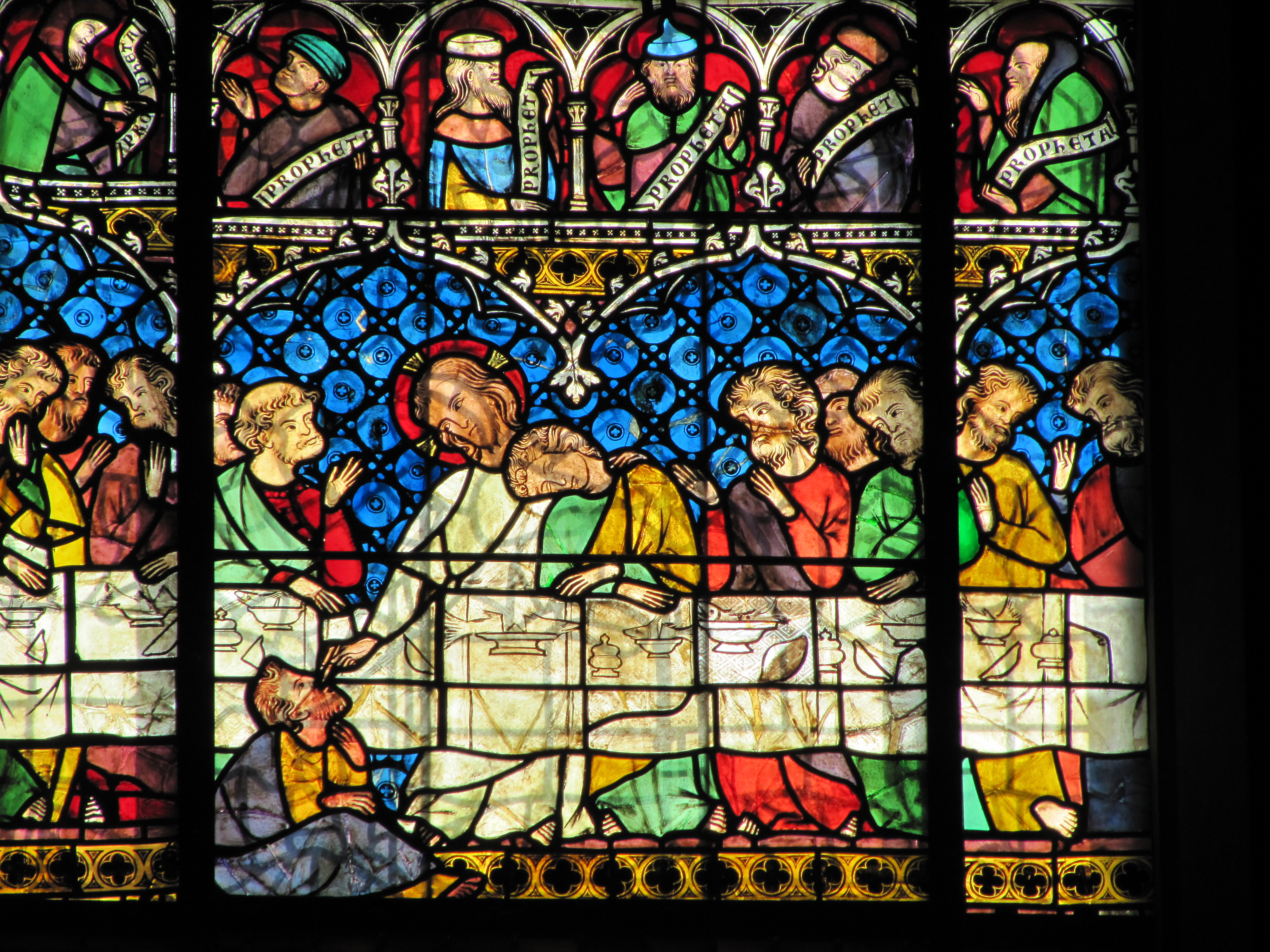
I took a picture of a stained glass window of the Last Supper in the Strasbourg Cathedral. Jesus hands a morsel to Judas, who then goes out into the night. How beautifully the artist captures the sadness of the Lord.
The Three Kings who visited the Infant Jesus are honored at a shrine in Germany’s Cologne Cathedral, where their relics were placed after being brought there in the 12th century from Italy. Images of the kings appear everywhere in this part of Germany; the rich gold reliquary holding their remains is one of the cathedral’s treasures.
“The purported relics,” our guide told us a few weeks ago, as if settling the matter.
But suppose we ask : “ Why were relics of the Three Kings brought there in the first place?” That invites some speculation.
The earliest Christian churches often traced their faith to those who brought it to them. Rome, for example, looked to the apostles Peter and Paul. Greece honors Peter’s brother Andrew for bringing the faith to their land. Other parts of the Christian world claimed other apostles, like Simon and Jude.
I wonder if Cologne, the Roman colony along the Rhine, at the “limes,” the end of the world, saw the Three Kings as appropriate patrons for their church so far from the land of Jesus as well as from the early churches first blessed by his gospel. Late in receiving the faith, did this land see the Three Kings as the bearers of the faith to them? They were not left out.
“Go out to the whole world,” Jesus told his disciples.
The cathedral reliquary (above) portrays Jesus in glory as Teacher and Lord. On the bottom left is a scene of the Three Kings paying homage to the Child on Mary’s lap. They come from the ends of the earth. On the bottom right, Jesus is baptized in the River Jordan, sanctifying not only the waters of that river but the waters of the Rhine as well. A simple portrayal saying everything: All nations are called to the promise of his life.
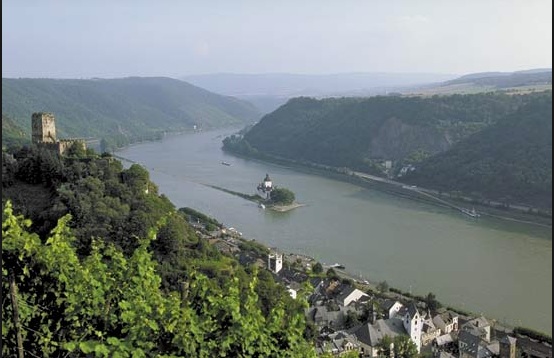
I’m going with a group on a cruise of the Rhine River leaving Wednesday. Here are a few notes about the trip for those on the cruise and those who may wish to follow us.
The Rhine River is a living history book as it winds its way 820 miles from the Swiss Alps to the North Sea.
Look for signs of Roman forts along the way. The ancient Romans tried to make the Rhine a kind of “Iron Curtain” to contain the barbarian tribes that wanted to enter the empire. They also found the fertile lands near the river good for growing grapes and other crops, so some of the forts became centers of trade, like Mainz.
After the Peace of Constantine (312 AD), Christianity brought the gospel to the lands along the Rhine. St. Boniface is an important figure. (c. 675 – 5 June 754 AD) A missionary from England he preached to the various Germanic tribes, became bishop of Mainz, and established monastic settlements along the river to fulfill his mission.
Should he be our patron for the trip? “In her voyage across the ocean of this world the church is like a ship pounded by the waves of life’s different stresses. Our duty is not to abandon ship, but to keep her on course…Let us stand fast for what is right and prepare our souls for trial…Let us be neither like dogs that do not bark nor silent onlookers nor servants who run away before the wolf.”
In the 12th century with the growth of cities majestic cathedrals, like those in Strasbourg and Cologne, were built. Castles and buildings of local rulers line the river’s banks as defenses against invaders and symbols of power.
In the 14th century, the shrines and churches of the Franciscans and the mendicant orders appear. The 16th century brought the Reformation. We hope to sample some cathedrals and churches along the river.
The Rhine was a battleground through the centuries; the last two world wars have left their mark on the lands along the river.
We land in Basel, where John Calvin wrote his “Institutes” in 1536, a defense of Protestantism which he sent to Francis 1 of France. Francis kept France Catholic, however, and Calvin fled to Geneva and made it into a key Protestant center that had influence worldwide.
I hope to reflect particularly during our trip on the Reformation and the relationship of Protestants and Catholics today. Much has changed since the stormy beginnings in the 16th century. Pope Francis recently remarked to a group of European bishops that “Speaking about God has become more and more marginal” in Europe. The pope, a strong advocate of ecumenism, hopes all Christians will come together to face the challenge.
We will see many churches and signs of its Christian past on our trip down the Rhine from Basel to Amsterdam, but I don’t think we’ll hear much about God or see many signs of Christian practice. Europe is increasingly secularized.
Some books that I’ll bring along on the trip.
“A Brief History of Spirituality” by Philip Sheldrake, Blackwell Publishing, 2007. Sheldrake has a wonderful gift for summarizing spiritual movements like monasticism and relating them to the world in which they take place.
“The World of Catholic Renewal 1540-1770” by R. Po-Chia Hsia, Cambridge University Press. The Catholic Church responds to the Reformation. A good study in social history.
“Concise Dictionary of the Christian Church” E.A. Livingstone, Oxford 1977 Just what it says: a lot of concise information about the Christian Church.
I’m going in October with a group from St. Mary’s, Colts Neck, NJ, on a river cruise on the Rhine. This river was a path Christian missionaries took to bring the gospel to all nations. We’ll visit cities like Strasbourg and Geneva, places connected to the Protestant Reformation in the 16th century.
In his book “Trent and All That: Renaming Catholicism in the Early Modern Era”, Harvard University Press, 2000, John W. O’ Malley, S.J. says that historians today are wary of using the words Reformation and Counter-Reformation to describe these historical periods. Recent historical research indicates the names don’t altogether fit the reality of the two movements.
“Reformation” means reform, the reform of something broken or in need of new life. In the case of the Catholic Church, it implies it was in shambles because of superstition and abuses of power. But recent social research indicates that the Catholic experience at the time was still quite vital, for the most part. True, the papacy was in need of reform, other abuses were present as they always are, but ordinary Catholic life was far from lifeless.
“Counter-Reformation,” or “Catholic Reform” usually mean that reform of the Catholic Church took place mainly through the efforts of the Council of Trent and a renewed papacy. But recent research questions the determining part played by the council and the popes in the life of the church at the time.
Historians in the past tended to see the Catholic Church then only in terms of the papacy and council bodies like Trent. They didn’t see its complexity exemplified by its confraternities, religious orders, saintly mystics and patterns of devotion. Social historians today are aware of the vitality in the Catholic Church that existed in its ordinary fabric. Its renewal didn’t just come from above, but from below.
The medieval cathedrals at Strasbourg and Cologne, which we’re going to visit, are examples of the profound faith of the medieval church. They weren’t built to satisfy the vision of a powerful bishop or ruler; they expressed the faith of a dedicated people. We can read what they believed and how they thought about life in those great cathedrals.
One of the O’Malley’s insights I liked was his comment on the lecture on the Counter Reformation by H. Outram Evennett, an English historian, some years ago at Trinity College. Rejecting the thesis that the Reformation was solely a reaction to a decayed medieval church, Evennett opined that both the Reformation and Counter Reformation “were two different outcomes of the same general aspiration towards ‘religious regeneration’ that pervaded the 14th and 15th centuries.”
Does this indicate that both Catholicism and Protestantism are moving in sync towards a place together in the modern world? I hope so.
This Sunday we listen to one of the parables of the kingdom, the Workers in the Vineyard, from Matthew’s gospel. Like the workers, squabbling among themselves, we’re often blind to the larger patterns of God’s plan unfolding in history. In a post-modern society of questioning and doubt it’s also difficult to believe in a plan for the world. There’s a harvest on its way and it’s an abundant one. My homily’s on that.
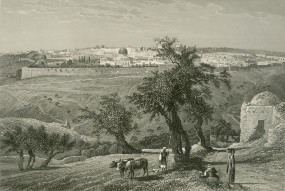
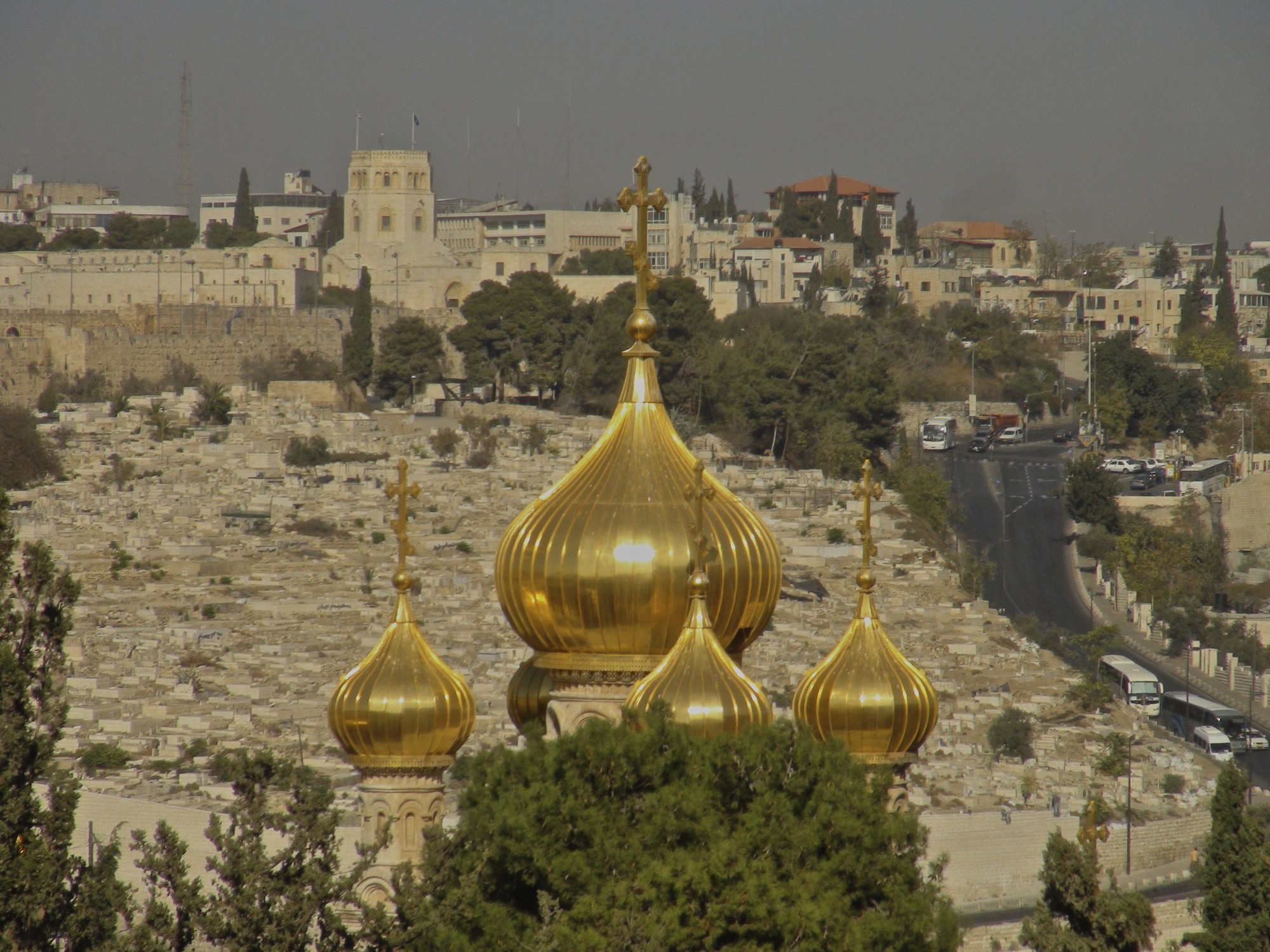
Mountains last for the centuries. The Mount of Olives, the two mile mountain ridge facing the Old City of Jerusalem goes back well beyond the time of Jesus Christ, over two centuries ago. On its slopes, olive trees that gave it its name still grow.
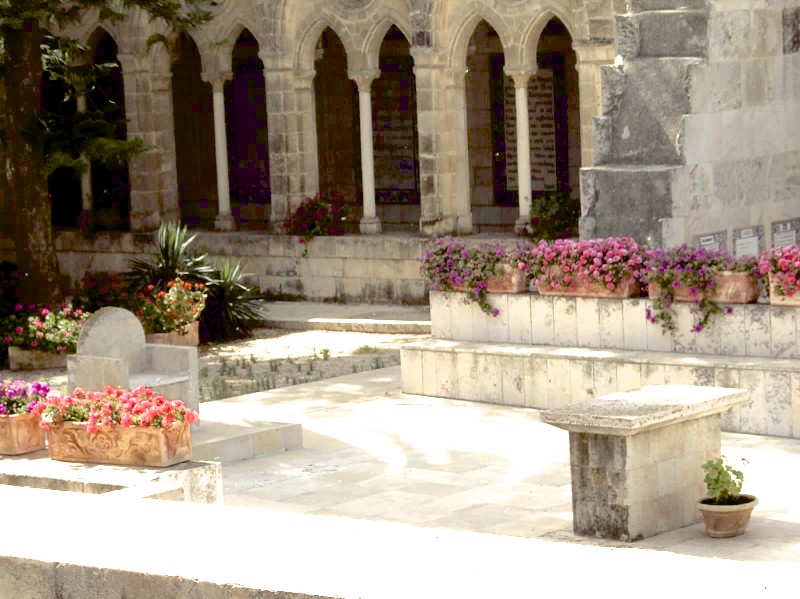
Ancient tombs along the mountain and into the Kidron Valley below tell us this place is holy. One day “God’s feet will stand on the Mount of Olives,” calling the dead to be raised, the Prophet Zechariah said. (Zechariah 14,4) The tombs are mostly Jewish, though some ancient Jewish-Christian tombs are there. Mary’s tomb is near the garden of Gethsemane. Facing the ruins of the temple and the holy city, the tombs signify humanity waiting for the promise of resurrection on the last day.
Jesus knew this mountain as a boy when he came to Jerusalem to celebrate the Jewish feasts. Most likely he stayed on this mountain at Bethany, a village on its eastern slope. Galilean pilgrims to Jerusalem stayed there. (Luke 21,37-38)
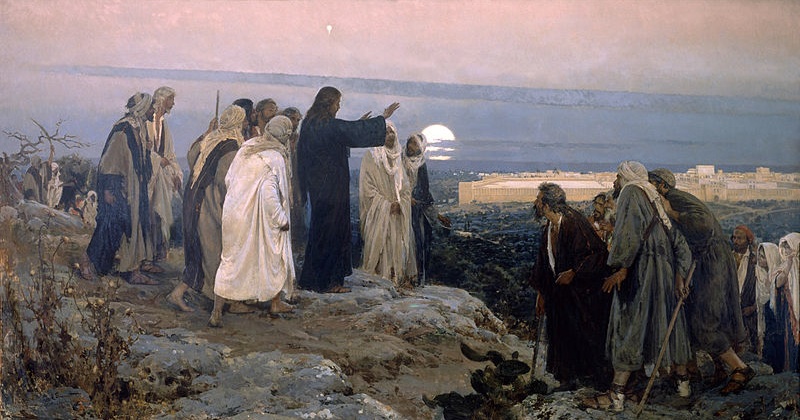
As many do today, he must have stopped on top of the mountain to gaze at the ancient city across the way. The gospels say he spoke here to his disciples about the days to come. (Mark 13,3-27; Matthew 24,3-25,46) He wept over the city here: “Jerusalem, Jerusalem, you who kill the prophets and stone those sent to you, how many times I yearned to gather your children together, as a hen gathers her young under her wings, but you were unwilling! Behold, your house will be abandoned, desolate.” (Luke 19,29-44)
Roman legions under Titus fulfilled that prophecy in 70 AD, when they destroyed Jerusalem and its temple. Some of the stones thrown down from the temple can still be seen at the base of the old walls.
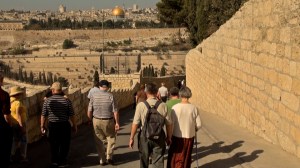
Days before he was crucified, Jesus rode down this mountain to the city on a donkey from Bethphage, surrounded by followers and admirers who sang and danced and cast palm branches before him. (Mark 11,1,11; Matthew 21,1-11; Luke 19, 28-40; John 12,12-19) The ancient path down the mountain to the city may well be the one he took.
On the night before he died, Jesus came with his disciples to pray here in a garden at the foot of the mountain. He fell into an agony as he prayed. Judas, a disciple, knew the place and led soldiers here to arrest him and lead him away to be tried and humiliated and crucified. (Mark 14, 32 ff; Matthew 26,36 ff; Luke 22,39ff;John 18,1ff)
When Jesus died, Matthew’s gospel says “The earth quaked, rocks were split, tombs were opened, and the bodies of many saints who had fallen asleep were raised. And coming forth from their tombs after his resurrection, they entered the holy city and appeared to many.”(Matthew 24, 51-54) The tombs around the Mount of Olives, all the dead, Matthew indicates, received the promise of Jesus’ resurrection. “He descended into hell.” Like the tomb of Jesus, every grave opens to the promise of risen life.
According to Saint Luke, Jesus taught his disciples for 40 days and then ascended into heaven from the Mount of Olives. (Luke 24,50; Acts 1,1 ff) No wonder, then, that Christians early on were attracted to this holy place with so many associations to Jesus.
By the 5th century, the Emperor Constantine built a large church on the top of this mountain over the spot where tradition said Jesus taught and prayed with his disciples and ascended into heaven. It was called Eleona, after the emperor’s mother, Helena, an early pilgrim devoted to the Holy Land. (See picture below) Luke’s unique view of the ascension, which inspired the building of this church, also inspired our celebrations of the Feast of the Ascension and Pentecost and the easter season.
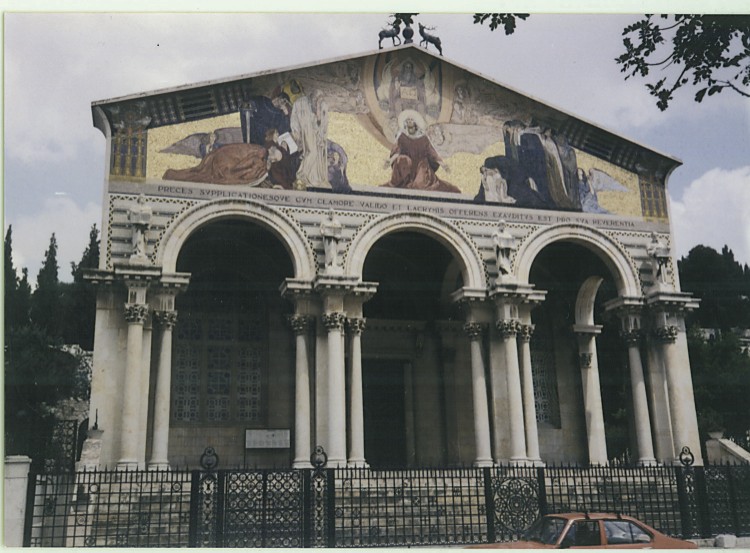
In the Byzantine era, great numbers of Christians flocked to the three major shrines built by Constantine: the church over the tomb of Jesus in Jerusalem; the church over the cave in Bethlehem and the church on the Mount of Olives where he ascended into heaven. Soon other churches were built to mark events in Jesus’ life. On the Mount of Olives, a church marked the place where Jesus wept over Jerusalem, “Dominus Flevit,” another where he prayed in agony. Over the centuries they were destroyed and rebuilt.
Over time, the Mount of Olives has been a Christian sanctuary where monks and nuns built large monasteries and pilgrims came, as once Jewish pilgrims from Galilee did. As once Jesus did.
Holy places help us see holy mysteries in concrete ways. They give us insight into the scriptures and the mysteries of faith.
Today, is the feast of the Dedication of Church of St. John Lateran in Rome. It seems to me you can see much of the history of the Roman Catholic Church here in this building, one of the great pilgrim churches of Rome.I wrote about this ancient 4th century church, the “mother of all churches” elsewhere.
In a homily for this feast, St. Caesarius of Arles says that this church, like all churches, reminds us we’re temples of God. “And if we think more carefully about the meaning of our salvation, we shall realize that we are indeed living and true temples of God. God does not dwell only in things made by human hands, nor in homes of wood and stone, but rather he dwells principally in the soul made according to his own image and fashioned by his own hand. Therefore, the apostle Paul says: The temple of God is holy, and you are that temple.”
The ancient baptistery at the Lateran church, pictured above, is an entrance to this church. Through baptism we belong to the great church whose Lord, Jesus Christ, shares his life with us.
The beauty of a church reminds us of the beauty of our souls, Caesarius says: “Whenever we come to church, we must prepare our hearts to be as beautiful as we expect this church to be… Just as you enter this church building, so God wishes to enter into your soul, for he promised: I shall live in them, I shall walk through their hearts.”












 The Victor's Place
