Pooe Leo began an important conference in Rome October1 on the environment with that question posed by Pope Francis ten years ago in his letter Laudao si’.Looks like many of the countries of the world, especially the USA, are turning away from that question. We are absorbed in our wars and political fights.
“ Our Sister Earth cries out, pleading that we take another course. Never have we so hurt and mistreated our common home as we have in the last two hundred years. Yet we are called to be instruments of God our Father, so that our planet might be what he desired when he created it and correspond with his plan for peace, beauty and fullness.
The problem is that we still lack the culture needed to confront this crisis. We lack leadership capable of striking out on new paths and meeting the needs of the present with concern for all and without prejudice towards coming generations. The establishment of a legal framework which can set clear boundaries and ensure the protection of ecosystems has become indispensable; otherwise, the new power structures based on the techno-economic paradigm may overwhelm not only our politics but also freedom and justice.
It is remarkable how weak international political responses have been. The failure of global summits on the environment make it plain that our politics are subject to technology and finance. There are too many special interests, and economic interests easily end up trumping the common good and manipulating information so that their own plans will not be affected. Any genuine attempt by groups within society to introduce change is viewed as a nuisance based on romantic illusions or an obstacle to be circumvented.”
Pope Francis, Laudato SI 54-55
Today at the Vatican Gardens outside Rome evironmental leaders of the world gathered to answer that question: Are we caring for our common home?
One thing to notice about this conference, which involved artists,scientists, politicians, business people, ordinary people. Pope Leo sat among them, not before them, as if to signify their equal task in the care of the environment. They bring an equal wisdom to the challenge of caring for the earth. It’s not just the task of religious people, or a pope. It’s a common task for a common good.
Today the church celebrates two early saints and martyrs, Cornelius, a pope who died in 253, and Cyprian, a bishop who was martyred in Roman Africa shortly after in 258.
At the time barbarian tribes in the west and the Persians in the east were invading Roman territory; the Roman emperors Decius and Valerian called for absolute loyalty from their people. The empire was imperiled.
To prove their loyalty, Roman citizens lined to offer sacrifice in honor of the emperor. Christians refused, and so at first church leaders were executed or imprisoned, wealthy, influential Christians lost their property, their positions and possibly their lives. Finally, all Christians could expect punishment for not performing the rites of sacrifice.
Not every Christian remained loyal to the faith at the time. Many offered sacrifice, betraying their faith, then afterwards sought to return to the church. Hard liners called for them to be banned for life for their lack of loyalty. Let God judge them when they die, they said. Others, like Cornelius and Cyprian, called to reconcile them after a time of penance, since God is all merciful.
Mercy and justice are always hard to reconcile. The gospels come down on the side of mercy. So should we.
In the persecution, Cornelius, bishop of Rome, was executed first, Cyprian, bishop of Carthage in Africa, was executed a few years later. The two men were from different social backgrounds and not always on good terms, historians say, but they found support in their common faith, as this letter of Cyprian to Cornelius, written shortly before Cornelius’ death, reveals:
“Cyprian to my brother Cornelius,
Dearest brother, bright and shining is the faith which the blessed Apostle praised in your community. He foresaw in spirit the praise your courage deserves and the strength that can not be broken; he was heralding the future when he testified to your achievements; his praise of the fathers was a challenge to the sons.
Your unity, your strength have become shining examples of these virtues to the rest of us. Divine providence has now prepared us. God’s merciful design has warned us that the day of our own struggle, our own contest, is at hand. By that shared love which binds us close together, we are doing all we can to exhort our congregation, to give ourselves unceasingly to fastings, vigils and prayers in common. These are the heavenly weapons which give us the strength to stand firm and endure; they are the spiritual defences, the God-given armaments that protect us.
Let us then remember one another, united in mind and heart. Let us pray without ceasing, you for us, we for you; by the love we share we shall thus relieve the strain of these great trials.”
Pilgims enteing the Church of the Holy Sepulcher, Jerusalem
This ancient ecumenical feast, celebrated by Christian churches throughout the world, commemorates the dedication of a great church in Jerusalem at the place where Jesus died and rose again. Called the Anastasis ( Resurrection) or the Church of the Holy Sepulcher, it was built by the Emperor Constantine and dedicated on September 13, 325. It’s one of Christianity’s holiest places.
Liturgies celebrated in this church, especially its Holy Week liturgy, influenced churches throughout the world. Devotional practices like the Stations of the Cross grew up around this church. Christian pilgrims brought relics and memories from here to every part of the world. Christian mystics were drawn to this church and this feast.
Tomb of Jesus
Calvary
Pilgrims still visit the church and the tomb of Jesus, recently renovated after sixteen centuries of wars, earthquakes, fires and natural disasters. They venerate the rock of Calvary where Jesus died on a cross. The building today is smaller and shabbier than the resplendent church Constantine built, because the original structure was largely destroyed in the 1009 by the mad Moslem caliph al-Hakim. Half of the church was hastily rebuilt by the Crusaders; the present building still bears the scars of time.
Scars of a divided Christendom can also be seen here. Various Christian groups, representing churches of the east and the west, claim age-old rights and warily guard their separate domains. One understands here why Jesus prayed that ” All may be one.”
Egyptian Coptic Christians
Seventeenth century Enlightenment scholars expressed doubts about the authenticity of Jesus’ tomb and the place where he died, Calvary. Is this really it? Alternative spots were proposed, but scientific opinion today favors this site as the place where Jesus suffered, died and was buried.
A number of martyrs are remembered in our liturgy in mid-August. August 9, we remembered Teresa Benedicta of the Cross, Edith Stein, who died in the concentration camp at Auschwitz August 9, 1942.
August 10th, we remembered Lawrence the Deacon, one of the most important martyrs of the early church. August 13 Pontian and Hippolytus.
August 14 we remember Maximillian Kolbe, a Polish Franciscan priest, who died in Auschwitz about a year before Edith Stein, August 14, 1941.
Peter Brown, an historian of early Christianity, says it wasn’t the bravery of Christian martyrs that impressed the Romans. The Romans, a macho people, had war in their blood. They prided themselves on dying bravely.
Rather, the Romans marveled at how Christian martyrs approached death. They saw something beyond death. They considered themselves citizens of another world, who followed Jesus Christ in how they lived and believed in his promise of everlasting life.
Lawrence the deacon, for example, could have escaped Roman persecution, but he wouldn’t abandon the poor of Rome in his care. Jesus said take care of the poor.
Centuries later, Maximillian Kolbe was a priest who wouldn’t abandon the vocation God gave him.
Before World War II, Kolbe was active as a Franciscan priest, promoting devotion to Mary, the Mother of Jesus. He ran a large, successful Franciscan printing enterprise in Warsaw.
In 1939, after invading Poland, the Nazi arrested him and a number of other Franciscans and imprisoned them for some months. They ransacked their printing place, probably hoping to intimidate them. Then, they left them go.
Instead of being intimidated, Kolbe began to house refugees from the Nazis, some of them Jews. That got him into trouble, so he was arrested again, on February 14th, 1941, and sent to Auschwitz to do hard labor.
Concentration camps like Auschwitz where Maximillian Kolbe and Sr.Teresa Benedicta died are the nearest thing to Calvary in modern times. More than 1500 of them were spread mostly through German occupied territories in Europe. Twenty million people died in the camps in the Second World War, 6 million were Jews. 1.3 million people went to Auschwitz; 1,1 million died there.
Five months after Kolbe entered Auschwitz, in July 1941, a prisoner from his barracks escaped. In reprisal, the Nazis took 10 men from the barracks to put them to death by starvation. One of them cried out that he had a wife and children who would never see him again. Father Kolbe stepped forward and offered to take the man’s place.
He was the last of the ten men to die of starvation and an injection of carbolic acid two weeks later, on August 14, 1941.
Many stories of Kolbe’s ministry among the prisoners in Auschwitz were told after his death when Auschwitz was liberated. He was canonized by Pope John Paul II on October 19, 1983, who called him “Patron Saint of Our Difficult Age.”
He was a sign of God’s love in a place where God seemed absent.
Maximillian Kolbe’s death on the vigil of Mary’s Assumption into Heaven has been seen as a further sign. God’s hand reached into the dark horror of Calvary to save his Son. God reached out to Mary to bring her, body and soul, to heaven. God reached into Auschwitz and other camps of horror to bring suffering human beings to glory and peace.
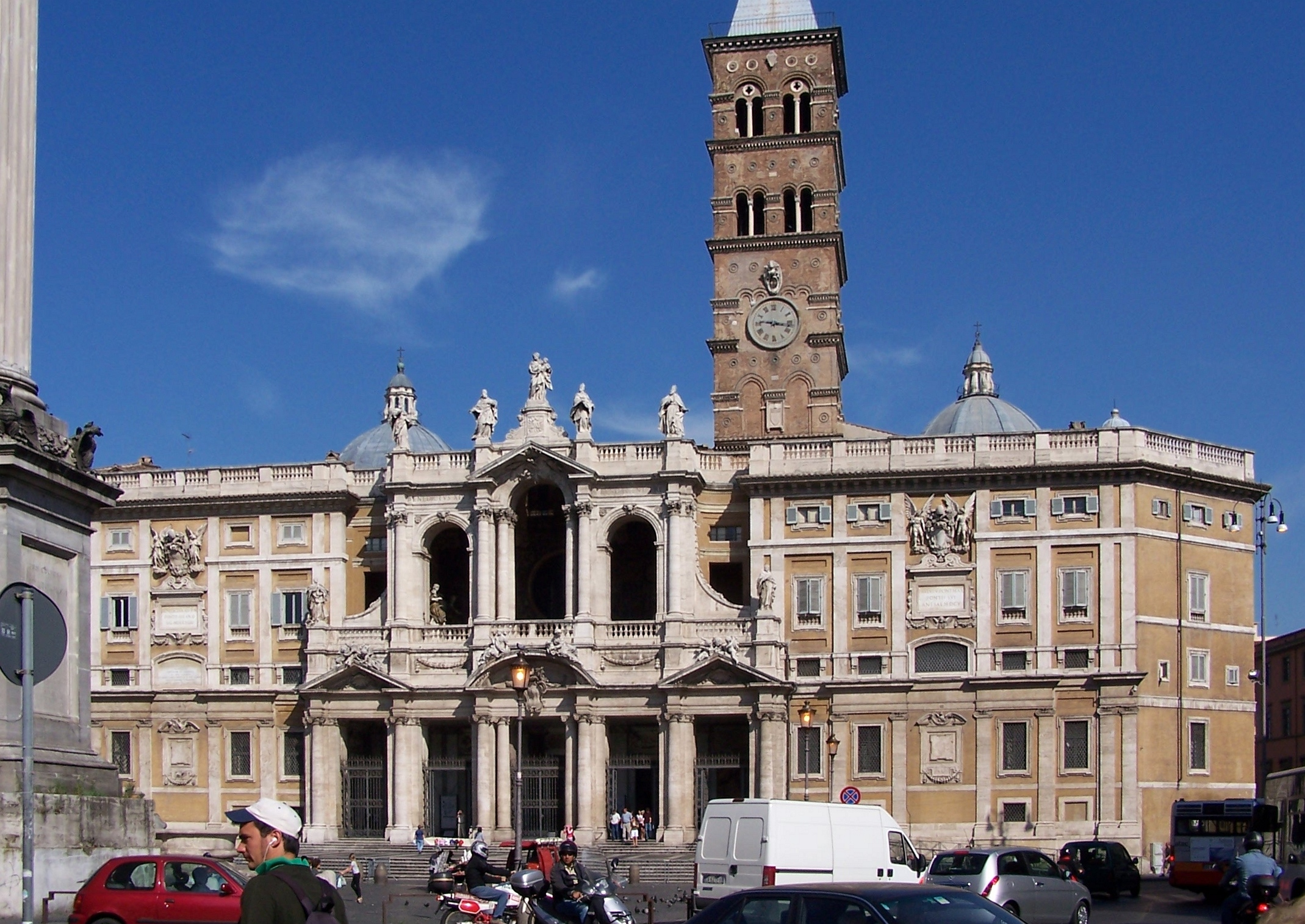
On the summit of the Esquiline Hill, a short distance from the Lateran Basilica, is the church of St. Mary Major, begun in the early 5th century and completed by Pope Sixtus III (432-440.)
Salus Populi Romani, c 5th century
Mary, the mother of Jesus, is honored here as the Mother of God. . In 431, the Council of Ephesus repudiated Nestorius, the patriarch of Constantinople, for refusing to call her “Mother of God.”
The title is important because it safeguards Christian belief in the mystery of the Incarnation: Jesus is God and man, the council said. For the Christian world Mary is the defender of Jesus, her son, who was both human and divine.
Devotion to Mary ran high in the Christian world after the Ephesus council, and churches dedicated to Mary arose everywhere. In the city of Constantinople alone, 250 churches and shrines in her honor were built before the 8th century. Pictures, icons of Mary holding her divine child multiplied, especially in churches of the East, where they became objects of special devotion.
Mary’s title, Mother of God, does not make her a goddess, otherwise how could she have given birth to Christ who is truly human? Yet, she can be called Mother of God, because Jesus who is truly her human son is truly Son of God from all eternity as well.
The 5th century, however, was hardly a good time to build a church in Rome. In 410, Alaric and his Goths shocked the Roman world by sacking a city all thought invincible. In 455 the Vandals under Genseric vandalized Rome. Twice more in the century other barbarian tribes invaded.
In far off Palestine St. Jerome cried out in disbelief at Rome’s misfortunes, which he saw heralding the end of the world. In Africa St. Augustine wrote “The City of God” in response to the followers of Rome’s traditional religions, who said Christian weakness caused the city’s devastation. Christians were not the cause of the city’s misfortunes, St. Augustine wrote; two loves are at work in the world building two cities. One love builds an evil city; Christianity builds the City of God, promoting love and justice.
The English historian Edward Gibbon called this period a time of decline and fall, the end of the Roman Empire. God’s plan does not lead to decline and fall, they say, but to triumph in Christ. God’s plan does not lead to decline and fall, they say, but to triumph in Christ. God’s plan does not lead to decline and fall, this church says. On the walls of St. Mary Major has stories from the Old and New Testaments calling for courage and hope.
In the church of St. Mary Major, Mary appears as Jesus’ mother and closest disciple. To use a phrase of St. Pope John Paul II, this church is “a school of Mary” who teaches mysteries she has learned. A noticeable number of women from the Old and New Testaments surround her: she represents those who seem powerless, but are empowered by God.
The great 13th century mosaic in the church’s apse of Mary crowned by Jesus Christ as heaven’s queen proclaims God’s triumph in her, but also his triumph in the church as well. She is taken up to heaven “to be the beginning and pattern of the church in its perfection, and a sign of hope and comfort for your people on their pilgrim way.” (Preface of the Assumption)
It shouldn’t surprise us that many of the mysteries in which Mary had a special role were first celebrated here as liturgical feasts. The Christmas liturgy, especially the midnight Mass on December 25th , began in this church in the 5th century and spread to other churches of the west.
A replica of the cave under the church of the Nativity at Bethlehem, the traditional site of Jesus’ birth, was constructed here early on.. After the Muslim conquest of the Holy Land in the 7th century, Christian refugees placed relics here purported to be from the crib that bore the Christ Child and relics of St.Matthew, an evangelist who told the story of Jesus birth.
Relics of the Crib from Bethlehem
Besides the Christmas liturgy, other great Marian feasts, such as her Immaculate Conception and Assumption, developed their liturgical forms in this church.
Built on a hill where all could see it, near Rome’s eastern walls so often threatened by barbarian armies, St. Mary Major affirms Christianity’s ultimate answer to its enemies. It is not military might, but the power of faith and love that triumphs in the end.
Visiting St.Mary Major
The church’s 18th century façade was built to enhance the appearance of this important church at a time when many visitors, especially from England and Germany, were traveling to Rome on the Grand Tour to visit its classical and religious sites.
The church’s interior, with its splendid 5th century mosaics along the upper part of the nave, retains its original form better than any other of the major basilicas of Rome.
The Sistine Chapel at the right hand side of the nave was built to house a silver reliquary with relics of the crib brought from the Holy Land in the 8th century. Two popes, Sixtus V and Pius V are buried there.
The Borghese Chapel at the left hand side of the nave honors the ancient icon of the Virgin and Child,”Salus populist Romani”, that Roman Christians have reverenced for centuries. A reproduction of the icon is a nice remembrance to bring home. Pope Francis has requested to be buried here.
The magnificent 13th century mosaic in the apse of the basilica presents the Coronation of Mary in heaven. It’s surrounded by 5th century mosaics depicting scenes from the birth of Jesus and the life of Mary.
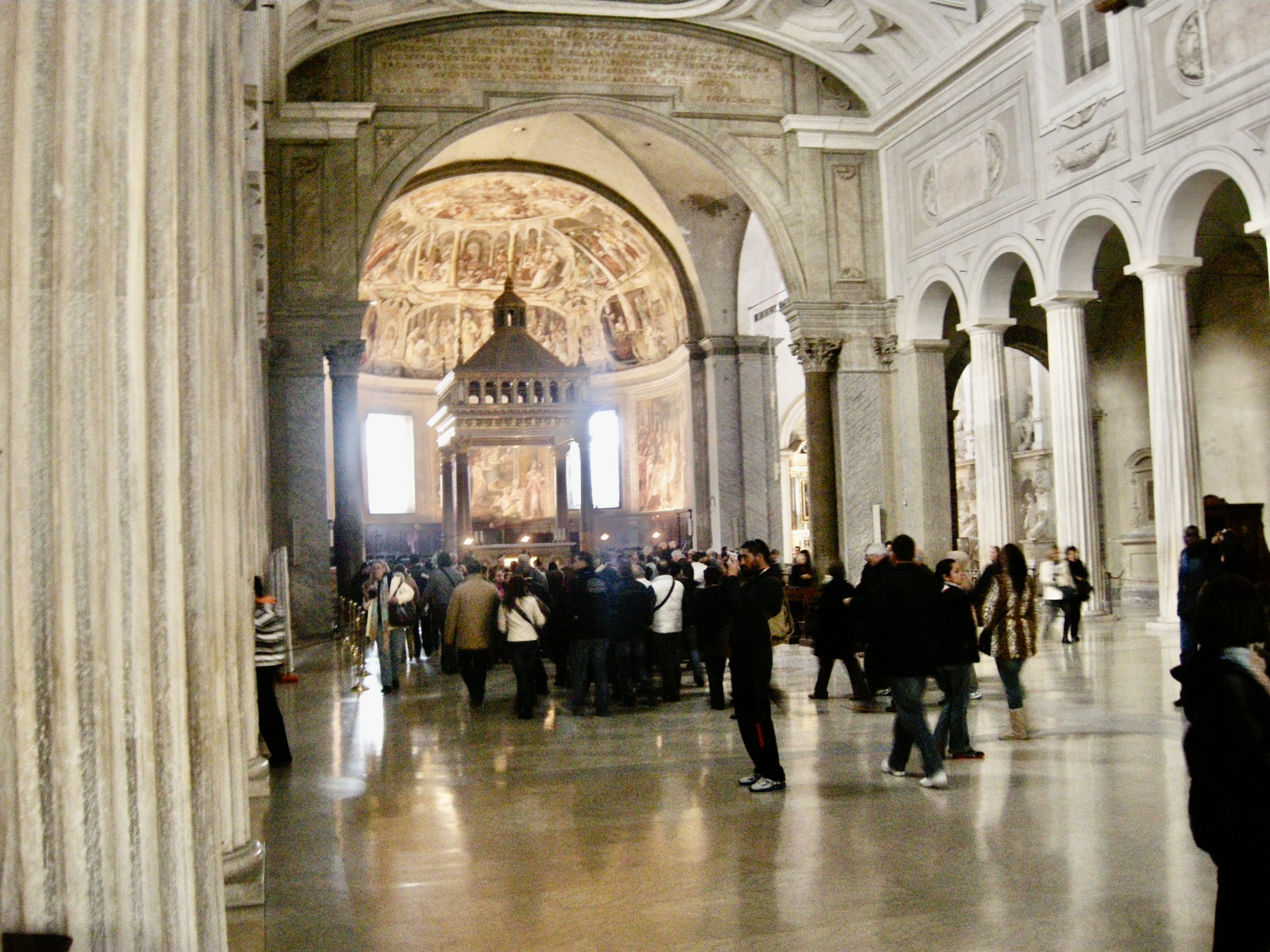
The Vatican Basilica where Peter the Apostle is buried is a prime destination for pilgrims to Rome today, but another important place dedicated to the memory of the apostle is the Church of St. Peter in Chains. It was built in the 5th century by the Empress Eudoxia on the western slope of the Esquiline Hill, next to the site of the early Roman Prefecture, not far from the Colosseum and the Roman Forum.
Justice was still being dispensed at the Roman Prefecture in Eudoxia’s day. Rome’s main prison was also nearby, where suspected criminals were tortured, questioned and judged. Not far away, just outside the city, those condemned were beheaded or strangled.
I would guess that Eudoxia was inspired to build this church next to the Roman Prefecture by the dramatic story we read today from the Acts of the Apostles of Peter being freed from his chains from a Jerusalem prison. (Acts 12:1-11) I imagine she saw the Prefecture as the place where judgment was carried out for so many Christians, even Peter and Paul.
Eudoxia gathered chains from the prisons in Jerusalem and Rome and placed them under the altar of this church she built, according to reports. Modern visitors usually turn to Michelangelo’s famous statue of Moses, located in the same church, but they should keep the chains in mind. They represent the imprisonment of Christian martyrs like Peter and Paul, and so many others.
A strong tradition among early Christian communities — affirmed today by many historians and archeologists — says that Peter met his death at Nero’s circus on the Vatican and Paul was beheaded along the Via Ostia near the place where Constantine later built a church in his honor. The apostles Peter and Paul, were martyred late in the persecution. Many details of their martyrdom are unknown, but like others they must have been arrested, put in chains, questioned, and sentenced before being executed.
Were Peter and Paul and many of the Christian martyrs who died in Nero’s persecution arrested, enchained and sentenced here?
There are later legends, of course. One says Peter and Paul were imprisoned in the Mamertime Prison, near the Capitoline Hill, where they converted and baptized their jailers. Peter, freed from his chains, escaped and fled along the Via Appia until he reached the place where the chapel, Domine, Quo Vadis? now stands. There he met Jesus coming into the city. “Where are you going, Lord?” Peter asked. When Jesus told him he was going to join those suffering, the apostle turned to embrace the same fate.
In the apse of the church of St Peter in Chains there’s a 16th century painting of Eudoxia presenting the chains to the pope. According to some 8th century homilies, one is from a Jerusalem prison. The other is from a Roman prison, possibly the one nearby? Eudoxia was a woman who listened to the scriptures with her imagination and saw connections. Good example for us who listen to the scriptures today.
Basilica di s.pietro in vincoli, A.P.Frutaz, Rome ?
The Roman Catacombs and Their Martyrs, l. Hertling SJ and E.Kirschbaum,SJ, Milwaukee, USA 1956
June 24, three months after the angel announces to Mary that Elizabeth is six months pregnant (March 25) John the Baptist is born.
From his birth John the Baptist was destined by God, not to follow Zachariah his father as a priest in the temple, but to go into the desert to welcome the Messiah, Jesus Christ. John is the last of the Jewish prophets, the first to recognize Jesus. His birth and death are celebrated in our church calendar.
It may have changed, but there’s an interesting Sunday walk in Rome I’d recommend. Go out the city gate at the Porta di San Sebastiano and walk south along one of the oldest roads in the world, the Via Appia, to the catacombs and church of San Sebastiano. Outside the city gates, you’re in what the ancient Romans called the “limes,” the limits, the world beyond the city, a different world altogether.
To the ancient Romans the “limes” was the end of civilized, reasonable life. No place to live, they thought. Get where you’re going as soon as you can. “Speed limit” comes from the word. Go beyond the limit and you can lose your life.
Few people today are usually on that road, deserted fields all around. The only sound you can hear is the sound of your own breathing and your footsteps.
The last line of St. Luke’s gospel for today’s feast says of John:
“The child grew and become strong in spirit, and he was in the desert until the day of his manifestation to Israel.”
How did John become strong in a desert? Centuries before, God told Abraham to go into a land he would show him. He led Jews from Egypt into the desert, and with no map or provisions, to a world unknown. They were in the hands of God, their strength.
Most of us stay within our limits; we don’t go to live in physical deserts. Yet, try as we may, we face them anyway in things we didn’t expect, like sickness or death or separation or divorce or the loss of a job or lost friends or lost places we know and love. The desert’s never far from any of us.
The Via Appia brings you to the catacombs, the great underground tunnels where early Christians buried their dead. They buried them there, I think, not to hide them, but because this place was an image of a new unknown world. The “limes,” marked the end of this life and foreshadowed a new life. The dead no longer belonged in the city; they were going to a new city.
Life holds its doubts, fears, uncertainty. But we don’t face limits alone. In the “limes” God alone has you in his hands. God gives you strength and brings you where you’re meant to be. God is there. God is there.
Like other ancient church feasts, the Nativity of John the Baptist, June 24, is tied to cosmology. Three months after the angel announces to Mary that Elizabeth is six months pregnant (March 25) John the Baptist is born.John’s birth coincides with the summer solstice. He begins to decrease to make way for the one who will increase. Jesus will be born December 25. The Feast of the Nativity of John the Baptist is celebrated by all the ancient Christian churches. The Orthodox Church celebrates it June 24.
Birth of John the Baptist. Orthodox Church of America.
We might call our first readings at Mass this week the Jewish part of the Book of Genesis. (Gen 11–50) The origins of the world and the beginnings of the human race are described in first 10 chapters of Genesis. Chapter 11 begins with the call of Abram and recounts the beginnings of the Jewish people.
For Jews living in exile, when the Jewish scriptures were finally assembled, Abraham was someone to look to as they made their way in uncertain times, when the road ahead was unclear.
The road ahead doesn’t seem clear for us either, does it?
The Commentary from the New American Bible describes these chapters from Genesis as a book exiles can learn from:
“Genesis 11–50. One Jewish tradition suggests that God, having been rebuffed in the attempt to forge a relationship with the nations, decided to concentrate on one nation in the hope that it would eventually bring in all the nations. The migration of Abraham’s family (11:26–31) is part of the general movement of the human race to take possession of their lands (see 10:32–11:9). Abraham, however, must come into possession of his land in a manner different from the nations, for he will not immediately possess it nor will he have descendants in the manner of the nations, for he is old and his wife is childless (12:1–9). Abraham and Sarah have to live with their God in trust and obedience until at last Isaac is born to them and they manage to buy a sliver of the land (the burial cave at Machpelah, chap. 23). Abraham’s humanity and faith offer a wonderful example to the exilic generation.”
I like Jesssica Power’s poem on the great patriarch:
“I love Abraham, that old weather-beaten
unwavering nomad; when God called to him
no tender hand wedged time into his stay.
His faith erupted him into a way
far-off and strange. How many miles are there
from Ur to Haran? Where does Canaan lie,
or slow mysterious Egypt sit and wait?
How could he think his ancient thigh would bear
nations, or how consent that Isaac die,
with never an outcry nor an anguished prayer?
We need Christians today like St. Justin, the 2nd century philosopher we remember June 1. “We need to make our teaching known,” he said. Still true today.
In Justin’s time, philosophers were the mentors, teachers, influencers of Roman society and were welcomed in the forum and private homes of the Roman world. St. Paul addressed them in Athens with limited success. Justin was an Christian philosopher in Rome.
Born in Nablus in Palestine of Greek parents, Justin studied all the philosophers of his time in Alexandria, Athens and Ephesus. It may have been in Ephesus around the year 130 that he encountered Christianity when, walking along the seashore, he met an old man who told him the human heart could never be satisfied by Plato for “the prophets alone announced the truth.”
“After telling me these and other things…he went away and I never saw him again, but a flame kindled in my soul, filling me with love for the prophets and the friends of Christ. I thought about his words and became a philosopher..” (Dialogue 8)
Justin was influenced, not only by Christian teaching, but also by the example of Christians he met:
“I liked Plato’s teaching at first and enjoyed hearing evil spoken about Christians, but then I saw they had no fear of death or other things that horrify, and I realized they were not vicious or pleasure-loving at all.” (Apology 2,12)
Ruins of the Roman Forum
Justin championed the cause of Christians who were increasingly attacked by society. Donning a philosopher’s cloak he taught and wrote in Rome about the year 150 AD. He was a new kind of Christian, a Christian philosopher engaging Roman society on its own terms. He gave Christianity a Roman face and voice.
Justin defended Christians against the charge they were atheists and enemies of the Roman state. Christians were good citizens, he wrote, who pray for Rome, though they don’t worship in temples, who had no statues of gods or who did not participate in the religious rites of the state. Justin’s writings give us a unique picture of 2nd century Christianity and early Christian worship.
In his “Dialogue with Trypho, the Jew” Justin offered the traditional Christian defense of Christianity to a Jewish antagonist. The Jewish prophets predicted the coming, the death and resurrection of Jesus, Justin argues.
In the documents of Vatican ii, Justin is recognized as an early example of Christian ecumenism. (Evangelium Nuntiandi 53) Through the Word of God all things came to be, he said. The Word became flesh in Jesus Christ, but Justin linked the biblical Word to the Logos of the philosophers. “Seeds of the Word” were scattered throughout the world, Justin claimed. Every human being possesses in his mind a seed of the Word, and so besides the prophets of the Old Testament, pagan philosophers like Heraclitus, Socrates and Musonius lead us to Jesus Christ, Justin said. (Apology 1,46)
A prolific writer and teacher, Justin was an early Christian intellectual using his talents to promote his faith, Unfortunately only three of his writings come down to us. Other Christian intellectuals followed him, using the tools of philosophy to dialogue with the Greco-Roman world.
Finally, rivals in Rome pressed charges against Justin as an enemy of the state and he was brought before a Roman judge along with six companions. Sentenced to death, they were beheaded probably in the year 165 AD. The official court record of their trial still survives.
Readings
Rembrandt’s biblical subjects are always interesting. As a child he used to sit with his mother while she prayed and look at the illustrations in her prayerbook. All his life the painter was attracted to the bible. Even without a commission, he’d sketch a biblical story that caught his eye.
Here’s the Ethiopian eunuch–our reading from Acts for today– kneeling and looking intently at the stream of water, waiting to be baptized by Philip the deacon. He’s been profoundly moved by the story he’s been told.
His servant stands behind him holding his rich outer garments. He’s the queen’s treasurer, don’t forget, but something greater awaits him now. An imposing guard on horseback, armed to the teeth, maybe an Ethiopian security agent, looks on. The rest of his retinue stand back, maybe puzzled by it all and anxious to get on their way on the long trip home from Jerusalem.
Like Zacchaeus — another rich man Luke recalls — the Ethiopian sees something greater than riches in Jesus and the water promising life.
Though visibly absent, the Holy Spirit who orchestrated this scene is here too. .
How does it all turn out, we wonder? When they get home, does the eunuch get sacked because the security agent turns him in for foolish behavior? Does the servant who watched the baptism become a follower of Jesus too? Did the eunuch tell the Queen the story of Jesus? Did he ever get back to Jerusalem again?
Luke is a wonderful story-teller. In his day Ethiopia was the end of the world, and so the gospel reaches there. In this account, he invites us to think about another path taken in the spread of the gospel. Luke is a wonderful story-teller, and Rembrandt is too.






 The Victor's Place