Category Archives: Travel

Visiting Elizabeth Seton’s New York

Visiting Elizabeth Seton’s New York? Start with a ride on the Staten Island Ferry. It’s free and offers a view of New York City that takes you back to the city’s beginning.

Early European explorers sailed into this harbor. In 1524 Giovanni Verranzano reached New York harbor and thought it was a lake. The Verranzano Bridge stands at the entrance to the harbor today. He thought the Hudson River might be a passage to the Pacific, but never went further than the harbor.

In 1609 Henry Hudson, exploring for the Dutch, sailed up the river that bears his name as far as Albany. The Dutch realized how valuable the place was and started a trading post on Manhattan Island. They called it New Amsterdam and traded with Indian tribes here and along the Hudson River.

Before the Europeans came, the harbor was a favorite place where the native tribes fished, hunted and traded.

The English had their eyes on the place too and in 1642 took it over. New Amsterdam became New York, and remained under English control till the American Revolution in 1776.

Millions of immigrants have come through New York harbor since then. The harbor was their gateway to the new world.  The Statue of Liberty stands on the harbor’s western side along with Ellis Island, a major center for processing immigrants.

New York harbor became the place where early New York City traded with the rest of the world. Elizabeth Seton and her family were closely connected to the harbor. Her husband, William Seton, invested in the ships that made the city one of the richest ports in the world.  But ships were a risky investment; they brought handsome profits yet could also bring bankruptcy if they didn’t come in. The Setons experienced both the riches and the risk.

I suppose you could call William Seton one of Wall Street’s first venture capitalists. In 1801 the Seton’s went bankrupt after the loss of a ship at sea and the family moved to the rented house on State Street, our first stop off the ferry.

Elizabeth Seton’s father, Doctor Richard Bayley, was the first Health Officer for the Port of New York (1796), caring for many of the first immigrants and travellers arriving here.

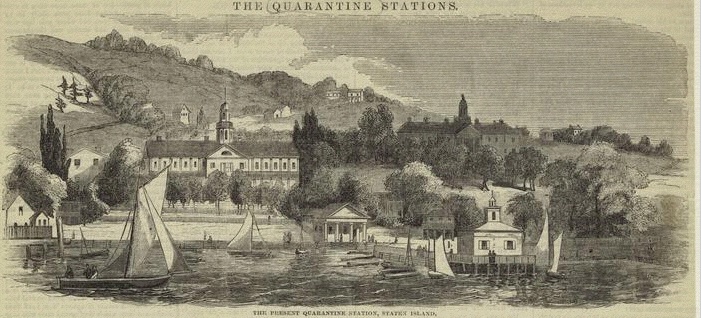
His job was to keep New York City safe from disease and keep travellers who were dangerous health threats isolated. So, quarantine stations were set up in the harbor for immigrants with yellow fever, cholera and small pox.

Within the harbor are some of the city’s early quarantine stations. Bedloe’s Island (1758-1796), Governor’s Island (1796-1799), Thomkinsville in Staten Island (1799-1858), just south of the St. George ferry station.

In the summer of 1801, Elizabeth was staying with her father at the Thomkinsville quarantine station when a boatload of sick Irish immigrants were brought in. She describes the dreadful conditions in a letter:

“I cannot sleep–the dying and the dead possess my mind. Babies perishing at the empty breast of the expiring mother…Father says such was never known before: twelve children  must die for want of sustenance…parents deprived of it as they have lain for many days ill in a ship without food or air or changing…There are tents pitched over the yard of the convalescent house and a large one at the death house.” (Letter July 28, 1801)

That same year, Richard Bayley himself died from yellow fever contacted from the Irish immigrants off Thomkinsville. He’s buried in the family plot next to the Episcopal Church of St. Andrew in Richmond, Staten Island.

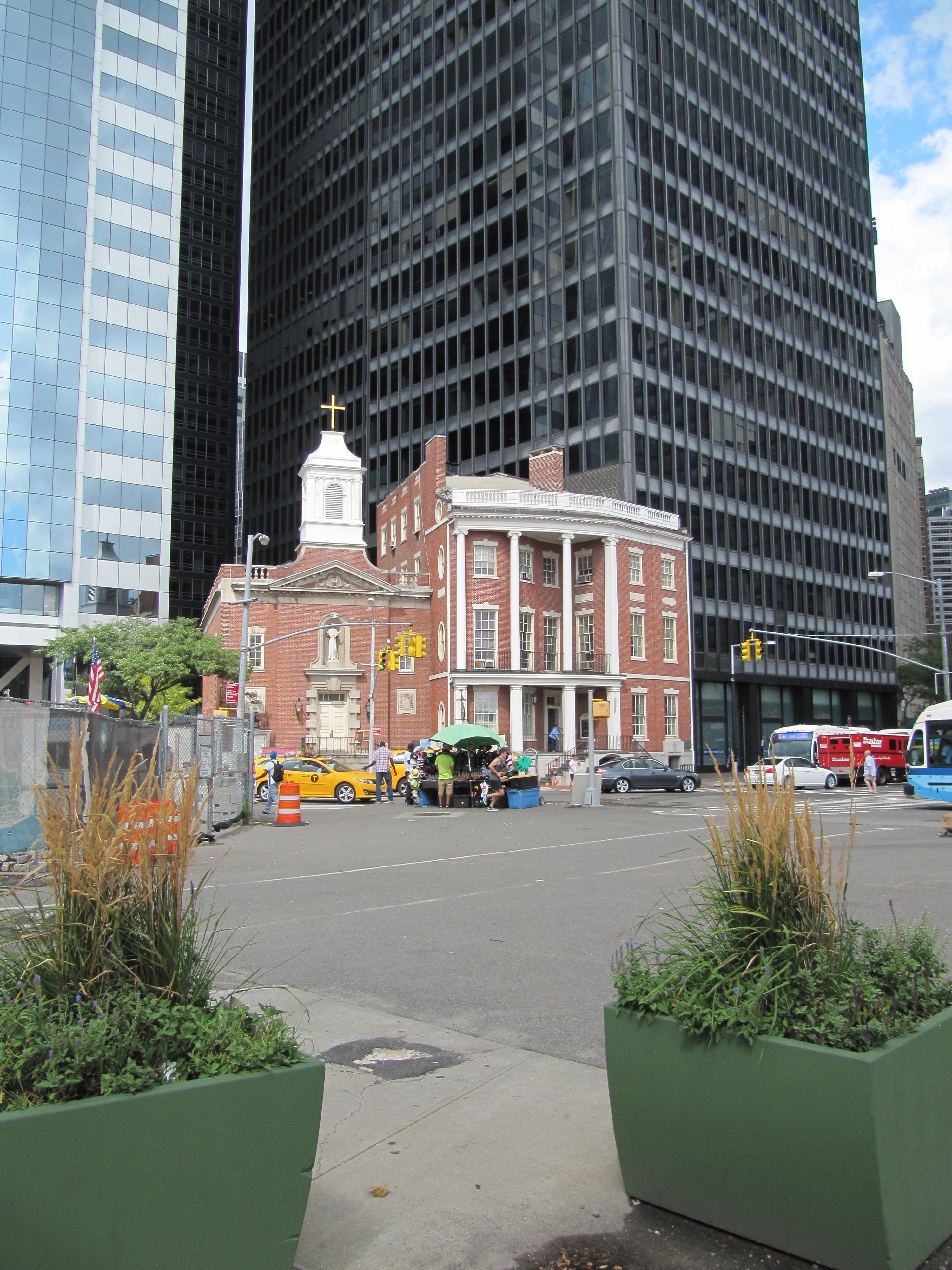
Seton Shrine, State Street, South Ferry

Arriving back in the city you can see the Seton house and a shrine near the ferry terminal at the end of Manhattan Island where Elizabeth Seton and her family lived for a short time. Stop in for a visit; many mementoes of her are found there. Most of Elizabeth Seton’s New York years were lived in this early section of the city.

From Mother Seton’s shrine and house on State Street walk up Broadway to Trinity Church and then St. Paul’s Chapel, the Anglican parish she belonged to until her conversion to Catholicism in 1805. She lived her early years as a happily married woman with five children on Wall Street and Stone Street, close by these colonial churches.

St. Paul’s Chapel

As a devout Anglican, Elizabeth devoted herself to her family and to the poor. In 1797 she and other public-spirited church women began an aid society for destitute women and their children. “The poor increase fast: immigrants from all quarters come to us. And when they come to us they must not be allowed to die.” (Description of the Society for the Relief of Poor Widows and Small Children.)

Looking eastward down Wall Street from Trinity Church on Broadway , you can see many of the institutions the fueled America’s economy: the docks and slave market (newly marked) on the East River,  the New York Stock Exchange and the Federal building, a short walk from Broadway, and finally Trinity Church and King’s College on the western side of Manhattan. King’s College built on lands belonging to Trinity Church became Columbia University after the Revolutionary War, and later relocated in northern Manhattan.

St. Peter’s Catholic Church

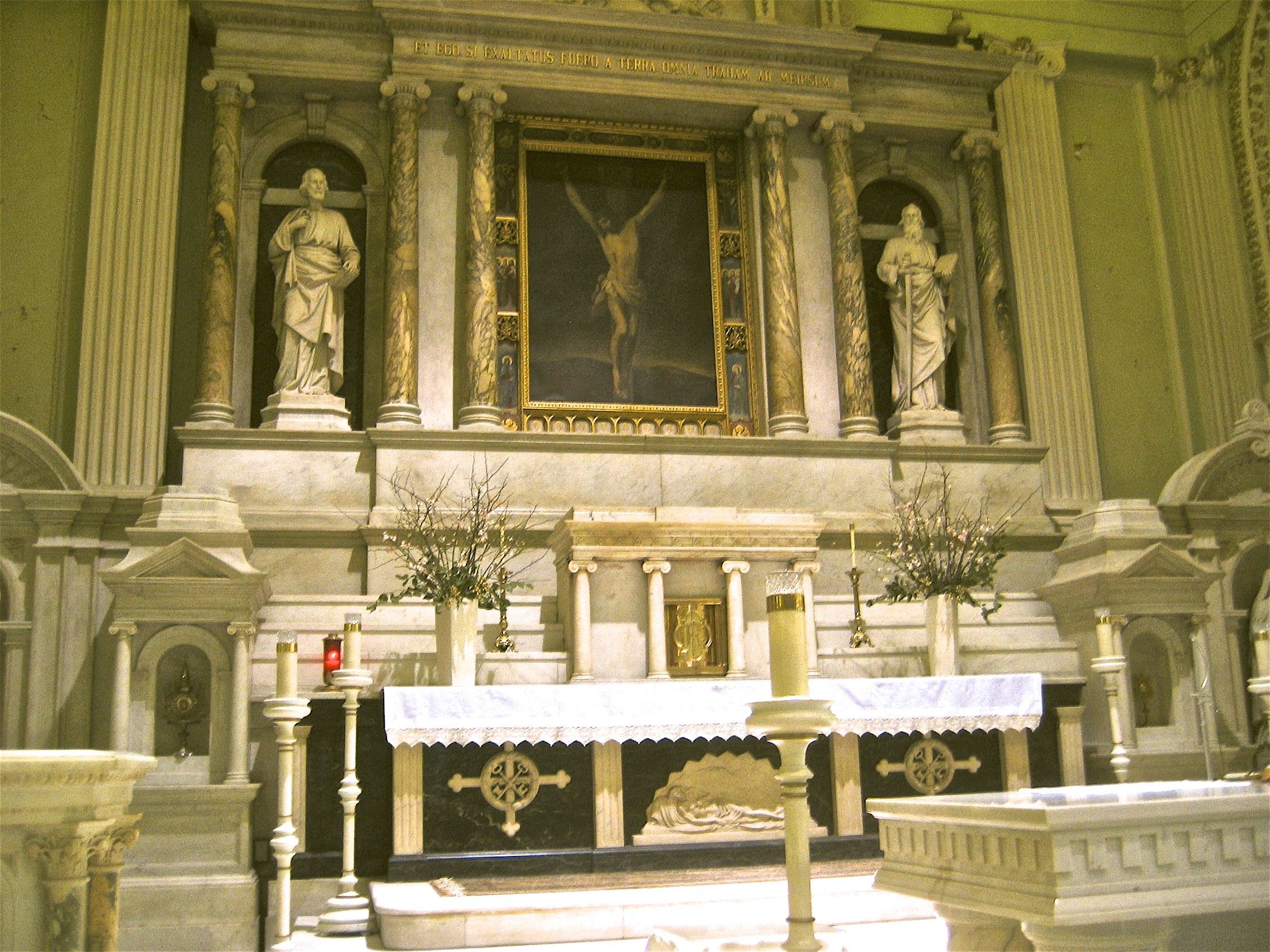
Our final stop visiting Elizabeth Seton’s New York is St. Peter’s Catholic Church on Barclay Street, near to World Trade Center. Here she was received into the Catholic Church. Notice the beautiful painting of the crucifixion above the altar. Elizabeth Seton mentioned how moved she was as she prayed before that painting after becoming a Catholic. 

In June 1808, she left New York City with her family for Baltimore, where she founded a school on Paca Street, the beginning of the Catholic parochial schools system in the United States. Shortly after, Mother Seton moved to Emmitsburg, Maryland, where other women gathered around her and took vows as the Sisters of Charity. Her religious followers continued her work through schools, orphanages and hospitals found throughout the United States.

Mother Seton died at the age of 46 in 1821. She was canonized on September 14,1975. There’s a good biography of Mother Seton written by Catherine O’Donnell, Elizabeth Seton: American Saint, Blackstone, 2018

Saving Santa Claus

Santa came to town for Macy’s annual Thanksgiving Parade. From the parade he went into the store for Black Friday and he will be there for the rest of the days till Christmas.

More than a salesman, Santa’s a saint– Saint Nicholas– and he reminds us Christmas is for giving rather than getting. His quiet giving mirrors God’s love shown in Jesus Christ.

Telling his story is one of the ways we can save Santa Claus from being captured by Macys and Walmart and all the rest. First, take a look at our version for little children, which has over 200,000 views on YouTube. How about telling that story to a real little kid you know? Wouldn’t you rather they know someone like him than the guy in the store in a red suit?

Then, you might want to go on to our  modest contribution for bigger children– like us:

Dedication of the Churches of Sts. Peter and Paul

IMG_1302

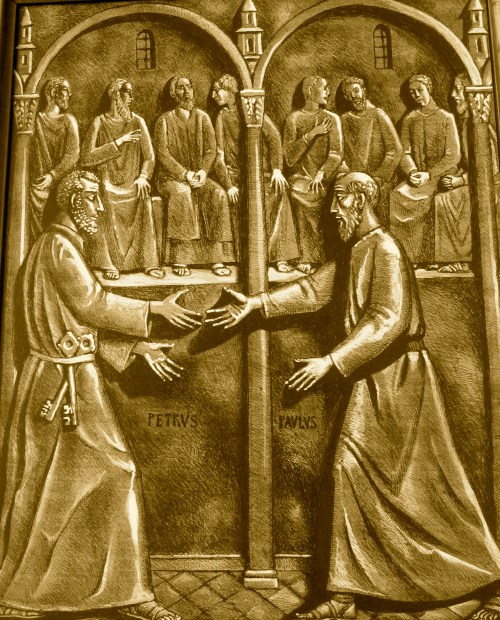
On November 18th, we honor the great apostles, Peter and Paul, remembering the dedication of the two ancient churches built over their graves. Peter is honored in the Vatican Basilica of St. Peter; Paul is honored in the Basilica of St. Paul, outside the Aurelian Walls along the Via Ostiense. The two apostles are founders and teachers of the Roman church.

Constantine built churches over the apostles’ graves in the middle of the 4th century. Besides honoring the apostles Peter and Paul, the churches were part of a wider plan of prayer, instruction and pilgrimage still seen in the Holy Year pilgrimages to Rome today. An early example of evangelization and catechesis.

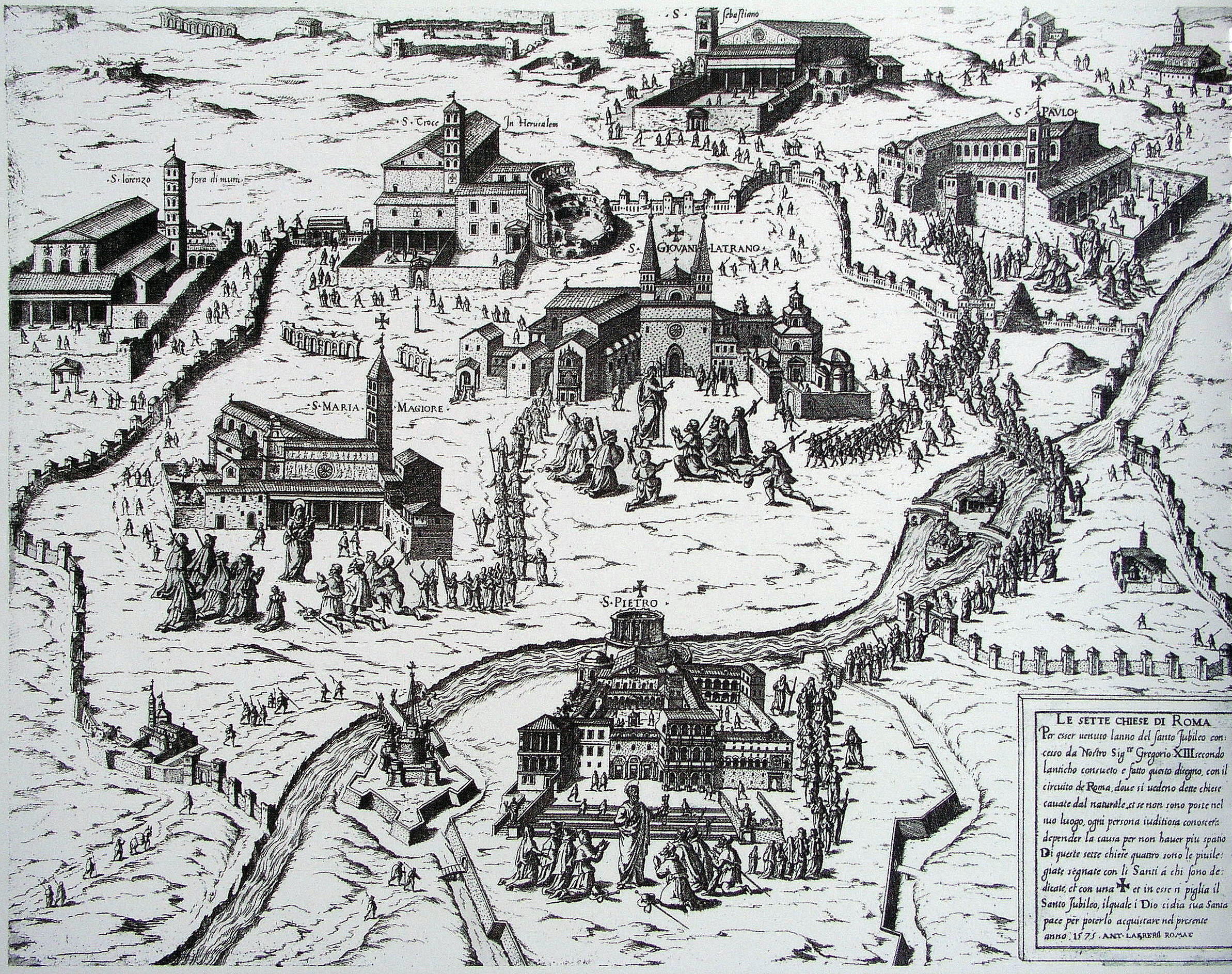
From earliest times pilgrims followed a path from one church to the other, visiting a number of other Christian shrines – St. Agnes and St. Lawrence, for example–on their way. A later pilgrim map based on that ancient pilgrimage journey offers an example.

Pilgrim Map, 17th century, Wikipedia Commons

Peter was crucified on the Vatican Hill in 64 near the obelisk not far from the circus of the emperors Caligula and Nero and was butried nearby.  Constantine erected a basilica over his burial site in 326, while Sylvester was pope. Later in 1626 the present basilica replaced Constantine’s church. It’s in the process of reconstruction in the illustration above. Recent excavations have confirmed Peter’s burial place under the papal altar of this church.

Paul, tradition says, was beheaded on the Ostian Way, outside the ancient city walls, in 67. Constantine built a shrine church over the gave in 325; it was enlarged by Theodosius I in386. The church was rebuilt after a fire in 1823, according to its original measurements. The apostle’s grave lies before the main altar of the church.

Defend your Church, O Lord, by the protection of the holy Apostles, that, as she received from them. the beginnings of her knowledge of things divine, so through them she may receive, even to the end of the world, an increase in heavenly grace. Through our Lord Jesus Christ, your Son. (Collect for the feast)

St. Peter’s Basilica, Rome
St.Paul outside the wall, Rome

Mother Cabrini: November 13

Mulberry Street, New York City, ca.1900

From 1880 to 1920 more than 4 million Italian immigrants came to the United States, mostly from rural southern Italy. Many were poor peasants escaping the chaotic political situation and widespread poverty of a recently united Italian peninsula.

Almost all the new immigrants came through Ellis Island; many settled in the crowded tenements of the New York region, where men found work in the subways, canals and buildings of the growing city. The women often worked in the sweatshops that multiplied in New York at the time. Almost half of the 146 workers killed as fire consumed the Triangle Shirtwaist Factory in 1911, were Italian women.

Over time, the immigrants moved elsewhere and became prominent in  American society, but at first large numbers suffered from the over-crowding, harsh conditions, discrimination and cultural shock they met in cities like New York. Many returned to Italy with stories of the contradictions and injustices lurking in “the American dream.”

Mother Maria Francesca Cabrini

Mother Maria Francesca Cabrini (1850-19170), founder of the Missionaries of the Sacred Heart, an order of women missionaries , came to America in 1889 at the urging of Pope Leo XIII to serve the underserved poor. Her work is succinctly described on the website of the Cabrini Mission Foundation. and in the movie Cabrini.

She proceeded to found schools, orphanages, hospitals and social services institutions to serve the needs of immigrants in the United States and other parts of the world. Despite poor health and frailty, Mother Cabrini crossed the ocean 25 times during 29 years of missionary work, and with her sisters founded 67 institutions in nine countries on three continents – one for each year of her life.

Mother Cabrini was a collaborator from the start of her missionary activity. She was a woman of her time, yet beyond her time. Her message – “all things are possible with God” – is as alive today as it was 110 years ago. Mother Cabrini lived and worked among the people, poor and rich alike, using whatever means were provided to support her works. She was a progressive, strategic visionary, willing to take risks, adaptable to change, and responsive to every opportunity that arose to help others. In recognition of her extraordinary service to immigrants, Mother Cabrini was canonized in 1946 as the “first American saint,” and was officially declared the Universal Patroness of Immigrants by the Vatican in 1950.”

Be good to have leaders like her today in the church, as well as in society, wouldn’t it? “… a progressive, strategic visionary, willing to take risks, adaptable to change, and responsive to every opportunity that arose to help others.”

Her feastday is November 13th. “Mother Cabrini, pray for us.”

Are We Caring for Our Common Home?


Pooe Leo began an important conference in Rome October1 on the environment with that question posed by Pope Francis ten years ago in his letter Laudao si’.Looks like many of the countries of the world, especially the USA, are turning away from that question. We are absorbed in our wars and political fights.

“ Our Sister Earth cries out, pleading that we take another course. Never have we so hurt and mistreated our common home as we have in the last two hundred years. Yet we are called to be instruments of God our Father, so that our planet might be what he desired when he created it and correspond with his plan for peace, beauty and fullness.

The problem is that we still lack the culture needed to confront this crisis. We lack leadership capable of striking out on new paths and meeting the needs of the present with concern for all and without prejudice towards coming generations. The establishment of a legal framework which can set clear boundaries and ensure the protection of ecosystems has become indispensable; otherwise, the new power structures based on the techno-economic paradigm may overwhelm not only our politics but also freedom and justice.

It is remarkable how weak international political responses have been. The failure of global summits on the environment make it plain that our politics are subject to technology and finance. There are too many special interests, and economic interests easily end up trumping the common good and manipulating information so that their own plans will not be affected. Any genuine attempt by groups within society to introduce change is viewed as a nuisance based on romantic illusions or an obstacle to be circumvented.”

Pope Francis, Laudato SI 54-55

Today at the Vatican Gardens outside Rome evironmental leaders of the world gathered to answer that question: Are we caring for our common home?

One thing to notice about this conference, which involved artists,scientists, politicians, business people, ordinary people. Pope Leo sat among them, not before them, as if to signify their equal task in the care of the environment. They bring an equal wisdom to the challenge of caring for the earth. It’s not just the task of religious people, or a pope. It’s a common task for a common good.

Saints Cornelius and Cyprian

Cornelius

Today the church celebrates two early saints and martyrs, Cornelius, a pope who died in 253, and Cyprian, a bishop who was martyred in Roman Africa shortly after in 258.

At the time barbarian tribes in the west and the Persians in the east were invading Roman territory; the Roman emperors Decius and Valerian called for absolute loyalty from their people. The empire was imperiled.

To prove their loyalty, Roman citizens lined to offer sacrifice in honor of the emperor. Christians refused, and so at first church leaders were executed or imprisoned, wealthy, influential Christians lost their property, their positions and possibly their lives. Finally, all Christians could expect punishment for not performing the rites of sacrifice.

Not every Christian remained loyal to the faith at the time. Many offered sacrifice, betraying their faith, then afterwards sought to return to the church. Hard liners called for them to be banned for life for their lack of loyalty. Let God judge them when they die, they said. Others, like Cornelius and Cyprian, called to reconcile them after a time of penance, since God is all merciful.

Mercy and justice are always hard to reconcile. The gospels come down on the side of mercy. So should we.

In the persecution, Cornelius, bishop of Rome, was executed first, Cyprian, bishop of Carthage in Africa, was executed a few years later. The two men were from different social backgrounds and not always on good terms, historians say, but they found support in their common faith, as this letter of Cyprian to Cornelius, written shortly before Cornelius’ death, reveals:

“Cyprian to my brother Cornelius,

Dearest brother, bright and shining is the faith which the blessed Apostle praised in your community. He foresaw in spirit the praise your courage deserves and the strength that can not be broken; he was heralding the future when he testified to your achievements; his praise of the fathers was a challenge to the sons.

Your unity, your strength have become shining examples of these virtues to the rest of us. Divine providence has now prepared us. God’s merciful design has warned us that the day of our own struggle, our own contest, is at hand. By that shared love which binds us close together, we are doing all we can to exhort our congregation, to give ourselves unceasingly to fastings, vigils and prayers in common. These are the heavenly weapons which give us the strength to stand firm and endure; they are the spiritual defences, the God-given armaments that protect us.  

Let us then remember one another, united in mind and heart. Let us pray without ceasing, you for us, we for you; by the love we share we shall thus relieve the strain of these great trials.”

Love shared relieves the strain of trials.

The Exaltation of the Cross: September 14

Holy sepul

Pilgims enteing the Church of the Holy Sepulcher, Jerusalem

This ancient ecumenical feast,  celebrated by Christian churches throughout the world, commemorates the dedication of a great church in Jerusalem at the place where Jesus died and rose again. Called the Anastasis ( Resurrection) or the Church of the Holy Sepulcher, it was built by the Emperor Constantine and dedicated on September 13, 325. It’s  one of Christianity’s holiest places.

Liturgies celebrated in this church, especially its Holy Week liturgy, influenced churches throughout the world. Devotional practices like the Stations of the Cross grew up around this church. Christian pilgrims brought relics and memories from here to every part of the world. Christian mystics were drawn to this church and this feast.

Holy Sepulcher - 28

Tomb of Jesus

Calvary

Calvary

Pilgrims still visit the church and the tomb of Jesus, recently renovated  after sixteen centuries of wars, earthquakes, fires and natural disasters. They venerate the rock of Calvary where Jesus died on a cross. The building today is smaller and shabbier than the resplendent church Constantine built, because the original structure was largely destroyed in the 1009 by the mad Moslem caliph al-Hakim. Half of the church was hastily rebuilt by the Crusaders; the present building still bears the scars of time.

Scars of a divided Christendom can also be seen here. Various Christian groups, representing churches of the east and the west, claim age-old rights and warily guard their separate domains. One understands here why Jesus prayed that ” All may be one.”

Holy Sepulcher - 04

Egyptian Coptic Christians

Seventeenth century Enlightenment scholars  expressed doubts about the authenticity of Jesus’ tomb and the place where he died, Calvary. Is this really it? Alternative spots were proposed, but scientific opinion today favors this site as the place where Jesus suffered, died and was buried.

For more on its history, see here.

And a video here.

Readings for the Triumph of the Cross

DSC00234
Via Dolorosa - 17

“Do not forget the works of the Lord!” (Psalm 78, Responsorial Psalm) We remember his great works here. How can we forget them.

St. Maximilian Kolbe

A number of martyrs are remembered in our liturgy in mid-August. August 9, we remembered Teresa Benedicta of the Cross, Edith Stein, who died in the concentration camp at Auschwitz August 9, 1942.

August 10th, we remembered Lawrence the Deacon, one of the most important martyrs of the early church. August 13 Pontian and Hippolytus.

August 14 we remember Maximillian Kolbe, a Polish Franciscan priest, who died in Auschwitz about a year before Edith Stein, August 14, 1941.

Peter Brown, an historian of early Christianity, says it wasn’t the bravery of Christian martyrs that impressed the Romans. The Romans, a macho people, had war in their blood. They prided themselves on dying bravely.

Rather, the Romans marveled at how Christian martyrs approached death. They saw something beyond death. They considered themselves citizens of another world, who followed Jesus Christ in how they lived and believed in his promise of everlasting life.

Lawrence the deacon, for example, could have escaped Roman persecution, but he wouldn’t abandon the poor of Rome in his care. Jesus said take care of the poor.

Centuries later, Maximillian Kolbe was a priest who wouldn’t abandon the vocation God gave him.

Before World War II, Kolbe was active as a Franciscan priest, promoting devotion to Mary, the Mother of Jesus. He ran a large, successful Franciscan printing enterprise in Warsaw.

In 1939, after invading Poland, the Nazi arrested him and a number of other Franciscans and imprisoned them for some months. They ransacked their printing place, probably hoping to intimidate them. Then, they left them go.

Instead of being intimidated, Kolbe began to house refugees from the Nazis, some of them Jews. That got him into trouble, so he was arrested again, on February 14th, 1941, and sent to Auschwitz to do hard labor.

Concentration camps like Auschwitz where Maximillian Kolbe and Sr.Teresa Benedicta died are the nearest thing to Calvary in modern times. More than 1500 of them were spread mostly through German occupied territories in Europe. Twenty million people died in the camps in the Second World War, 6 million were Jews. 1.3 million people went to Auschwitz; 1,1 million died there.

Five months after Kolbe entered Auschwitz, in July 1941, a prisoner from his barracks escaped. In reprisal, the Nazis took 10 men from the barracks to put them to death by starvation. One of them cried out that he had a wife and children who would never see him again. Father Kolbe stepped forward and offered to take the man’s place.

He was the last of the ten men to die of starvation and an injection of carbolic acid two weeks later, on August 14, 1941.

Many stories of Kolbe’s ministry among the prisoners in Auschwitz were told after his death when Auschwitz was liberated. He was canonized by Pope John Paul II on October 19, 1983, who called him “Patron Saint of Our Difficult Age.”

He was a sign of God’s love in a place where God seemed absent.

Maximillian Kolbe’s death on the vigil of Mary’s Assumption into Heaven has been seen as a further sign. God’s hand reached into the dark horror of Calvary to save his Son. God reached out to Mary to bring her, body and soul, to heaven. God reached into Auschwitz and other camps of horror to bring suffering human beings to glory and peace.

St.Mary Major: August 5

Basilica of St. Mary Major

On the summit of the Esquiline Hill, a short distance from the Lateran Basilica, is the church of St. Mary Major, begun in the early 5th century and completed by Pope Sixtus III (432-440.)

Salus Populi Romani, c 5th century

Mary, the mother of Jesus, is honored here as the Mother of God. .  In 431, the Council  of Ephesus repudiated Nestorius, the patriarch of Constantinople, for refusing to call her “Mother of God.”

The title is important because it safeguards Christian belief in the mystery of the Incarnation: Jesus is God and man, the council said. For the Christian world Mary is the defender of Jesus, her son, who was both human and divine.

Devotion to Mary ran high in the Christian world after the Ephesus council, and churches dedicated to Mary arose everywhere. In the city of Constantinople alone, 250 churches and shrines in her honor were built before the 8th century. Pictures, icons of Mary holding her divine child multiplied, especially in churches of the East, where they became objects of special devotion.

Mary’s title, Mother of God, does not make her a goddess, otherwise how could she have given birth to Christ who is truly human? Yet, she can be called Mother of God, because Jesus who is truly her human son is truly Son of God from all eternity as well.

The 5th century, however, was hardly a good time to build a church in Rome. In 410, Alaric and his Goths shocked the Roman world by sacking a city all thought invincible. In 455 the Vandals under Genseric vandalized Rome. Twice more in the century other barbarian tribes invaded.

In far off Palestine St. Jerome cried out in disbelief at Rome’s misfortunes, which he saw heralding the end of the world. In Africa St. Augustine wrote “The City of God” in response to the followers of Rome’s traditional religions, who said Christian weakness caused the city’s devastation. Christians were not the cause of the city’s misfortunes, St. Augustine wrote; two loves are at work in the world building two cities. One love builds an evil city; Christianity builds the City of God, promoting love and justice.

The English historian Edward Gibbon called this period a time of decline and fall, the end of the Roman Empire. God’s plan does not lead to decline and fall, they say, but to triumph in Christ. God’s plan does not lead to decline and fall, they say, but to triumph in Christ. God’s plan does not lead to decline and fall, this church says. On the walls of St. Mary Major has stories from the Old and New Testaments calling for courage and hope.

In the church of St. Mary Major, Mary appears as Jesus’ mother and closest disciple. To use a phrase of St. Pope John Paul II, this church is “a school of Mary” who teaches mysteries she has learned. A noticeable number of women from the Old and New Testaments surround her: she represents those who seem powerless, but are empowered by God.

The great 13th century mosaic in the church’s apse of Mary crowned by Jesus Christ as heaven’s queen proclaims God’s triumph in her, but also his triumph in the church as well. She is taken up to heaven “to be the beginning and pattern of the church in its perfection, and a sign of hope and comfort for your people on their pilgrim way.” (Preface of the Assumption)

It shouldn’t surprise us that many of the mysteries in which Mary had a special role were first celebrated  here as liturgical feasts. The Christmas liturgy, especially the midnight Mass on December 25th ,  began in this church  in the 5th century and spread to other churches of the west.

A replica of the cave under the church of the Nativity at Bethlehem, the traditional site of Jesus’ birth, was constructed here early on.. After the Muslim conquest of the Holy Land in the 7th century,  Christian refugees placed relics here purported to be from the crib that bore the Christ Child and relics of St.Matthew, an evangelist who told the story of Jesus birth.

Relics of the Crib from Bethlehem

Besides the Christmas liturgy, other great Marian feasts, such as her Immaculate Conception and Assumption, developed their liturgical forms in this church.

Built on a hill where all could see it, near Rome’s eastern walls so often threatened by barbarian armies, St. Mary Major affirms Christianity’s ultimate answer to its enemies. It is not military might, but the power of faith and love that triumphs in the end.

Visiting St.Mary Major

The church’s 18th century façade was built to enhance the appearance of this important church at a time when many visitors, especially  from England and Germany, were traveling to Rome on the Grand Tour to visit its classical and religious sites.

The church’s interior, with its splendid 5th century mosaics along the upper part of the nave, retains its original form better than any other of the major basilicas of Rome.

The Sistine Chapel at the right hand side of the nave was built to house a silver reliquary with relics of the crib brought from the Holy Land in the 8th century. Two popes, Sixtus V and Pius V are buried there.

The Borghese Chapel at the left hand side of the nave honors the ancient icon of the Virgin and Child,”Salus populist Romani”, that Roman Christians have reverenced for centuries. A reproduction of the icon is a nice remembrance to bring home. Pope Francis has requested to be buried here.

The magnificent 13th century mosaic in the apse of the basilica presents the Coronation of Mary in heaven. It’s surrounded by 5th century mosaics depicting scenes from the birth of Jesus and the life of Mary.

Website:

http://www.vatican.va/various/sm_maggiore/index_en.html

St. Peter in Chains

The Vatican Basilica where Peter the Apostle is buried is a prime destination for pilgrims to Rome today, but another important place dedicated to the memory of the apostle is the Church of St. Peter in Chains. It was built in the 5th century by the Empress Eudoxia on the western slope of the Esquiline Hill, next to the site of the early Roman Prefecture, not far from the Colosseum and the Roman Forum.

Justice was still being dispensed at the Roman Prefecture in Eudoxia’s day. Rome’s main prison was also nearby, where suspected criminals were tortured, questioned and judged. Not far away, just outside the city, those condemned were beheaded or strangled.

I would guess that Eudoxia was inspired to build this church next to the Roman Prefecture by the dramatic story we read today from the Acts of the Apostles of Peter being freed from his chains from a Jerusalem prison. (Acts 12:1-11) I imagine she saw the Prefecture as the place where judgment was carried out for so many Christians, even Peter and Paul.

Eudoxia gathered chains from the prisons in Jerusalem and Rome and placed them under the altar of this church she built, according to reports. Modern visitors usually turn to Michelangelo’s famous statue of Moses, located in the same church, but they should keep the chains in mind. They represent the imprisonment of Christian martyrs like Peter and Paul, and so many others.

A strong tradition among early Christian communities — affirmed today by many historians and archeologists — says that Peter met his death at Nero’s circus on the Vatican and Paul was beheaded along the Via Ostia near the place where Constantine later built a church in his honor. The apostles Peter and Paul, were martyred late in the persecution. Many details of their martyrdom are unknown, but like others they must have been arrested, put in chains, questioned, and sentenced before being executed.

Were Peter and Paul and many of the Christian martyrs who died in Nero’s persecution arrested, enchained and sentenced here?

There are later legends, of course. One says Peter and Paul were imprisoned in the Mamertime Prison, near the Capitoline Hill, where they converted and baptized their jailers. Peter, freed from his chains, escaped and fled along the Via Appia until he reached the place where the chapel, Domine, Quo Vadis? now stands. There he met Jesus coming into the city. “Where are you going, Lord?” Peter asked. When Jesus told him he was going to join those suffering, the apostle turned to embrace the same fate.

In the apse of the church of St Peter in Chains there’s a 16th century painting of Eudoxia presenting the chains to the pope. According to some 8th century homilies, one is from a Jerusalem prison. The other is from a Roman prison, possibly the one nearby? Eudoxia was a woman who listened to the scriptures with her imagination and saw connections. Good example for us who listen to the scriptures today.

Basilica di s.pietro in vincoli, A.P.Frutaz, Rome ?

The Roman Catacombs and Their Martyrs, l. Hertling SJ and E.Kirschbaum,SJ, Milwaukee, USA 1956