Category Archives: spirituality

Tenebrae: Holy Saturday

Today’s Tenebrae psalms (Psalms 15, 4, 24) speak of Jesus’ burial in the earth. He is the seed that falls to the ground, but he will rise and bring life:

“My heart rejoices, my soul is glad,                                                                                        Even my body shall rest in safety,                                                                                             For you will not leave my soul among the dead                                                                       Or let your beloved know decay.” Psalm 15

Jesus gives the gift of risen life, not only to humanity, but to the earth itself. “Cry out with joy to the Lord, all the earth. Serve the Lord with gladness.”“

It’s a gift we doubt is ours:

O men, how long will your hearts be closed
will you love what is futile and seek what is false"
It is the Lord who grants favors to those whom he loves.
Psalm 4

The gates of heaven open to Christ, risen from the dead, they are lifted high for all he loves:

O gates lift high your heads, grow higher ancient doors,
let him enter the King of Glory.
Who is the King of Glory, the Lord the mighty and valiant,
the Lord the valiant in war! Psalm 24

Tenebrae for Holy Saturday ends with an ancient homily: “Something strange is happening—there is a great silence on earth today, a great silence and stillness. The whole earth keeps silence because the King is asleep. The earth trembled and is still because God has fallen asleep in the flesh and he has raised up all who have slept ever since the world began. God has died in the flesh and hell trembles with fear.”

“The earth trembled and is still…” 

The Passion of Jesus is not only a human story; creation has part in it too. At his death “the earth quaked, rocks were split” Matthew’s gospel says. (Matthew 27,51) “From noon onwards darkness came over the whole land till three in the afternoon,” Matthew, Mark and Luke all say..

 The sun that rules the day, the moon that rules the night respond as Jesus cries out in a loud voice and gives up his spirit. Artists through the centuries place sun and moon at the cross of Jesus.

Remember too blood and water, those great elemental realities blood that John’s gospel says flowed from the side of Christ when a soldier pierced his side. Water refreshed with contact with the Word of God; blood source of life for living creatures come from the side of Jesus. They also share in the mystery of redemption.

The homily for today says that Jesus at his death goes “to search for our first parent…to free from sorrow the captives Adam and Eve…I am your God, who for your sake have become your son. Out of love for you and for your descendants I now by my own authority command all who are held in bondage to come forth, all who are in darkness to be enlightened, all who are sleeping to arise. Rise up, work of my hands, you who were created in my image. Rise, let us leave this place, for you are in me and I am in you; together we form only one person and we cannot be separated.”

Artists from the eastern Christian traditon see the Passion of Jesus leading to a great redemption. Jesus does not rise alone, but humanity and creation itself  will follow him.

Feasts for Tired Believers

Central Italy, 1800s

The Passionists celebrate two feasts immediately before Ash Wednesday. The Solemn Commemoration of the Passion of Jesus Christ on the Friday before Ash Wednesday. The Prayer of Jesus in the Garden on Tuesday before that day.

Both feasts are inspired by our missionary founder, St. Paul of the Cross, (1694-1775). He spent many years announcing the graces of lent in the villages and towns of the Tuscan Maremma in Italy..

It was a challenging task. The Tuscan Maremma was then a place where graces seemed gone. It was the poorest, most troubled part of Italy in Paul’s day, an area in Central Italy facing the Mediterranean Sea, almost 2,000 square miles– roughly the size of Long Island and New York City together. Only gradually, towards the end of the 1700s, after his death, did it begin inching towards recovery.

St.PaulCross.017

Now Tuscanny is a popular tourist destination. Then it was an unhealthily mix of hills and swamplands. Malaria was widespread, roads often impassible, dangerous because of bandits. Farmlands were abandoned; beggars everywhere. The people in isolated villages and hill towns suspected outsiders.

Paul and his companions preached there for many years. Every year it was the same; it never seemed to change. You need other eyes and another kind of heart to work in a world like that and not get tired.

And so as they packed their bags for their lenten journey into the Tuscan Maremma they had to remind themselves what was there before them: the mystery of the Passion of Christ. They needed to pray so they wouldn’t forget. That’s what Jesus did before the mystery of his Passion.

It’s still so today, isn’t it? These two feasts are for all kinds of tired believers, who face the world where things don’t seem to change. We need another way of seeing things and another kind of heart to journey on..

If you want to pray these feasts with the Passionists, go here.

Following Jesus Christ

I like Rembrandt’s drawing of Jesus preaching to a crowd representing all ages, shapes and sizes of ordinary humanity. Jesus’ disciples, like Peter, James and John are there, but they don’t stand out.Some of his enemies are there, but they don’t stand out either. They’re all there listening, except maybe the little child on the ground playing with something he’s found. Jesus sheds his light on them, even on the little child.

Did Rembrandt find these faces in the people of his neighborhood, ordinary people? If so, this crowd could be us.

All the gospels recall Jesus journey from Galilee to Jerusalem, which we recall in Mark’s gospel. . Some women from Galilee follow him. He calls Zachaeus, the tax collector, down from a tree to join him. Follow me, he says to a blind man begging in the same place for years. He called people of every shape and form, sinners, tax-collectors, everyone.

They follow him, not just to see him die, but to go with him to glory. “Come with me this day to paradise, “ Jesus says to the thief on the cross. Our creed says he descends into hell, to those waiting for centuries for the redemption he brings. He calls all generations to follow him.

Following Jesus to glory means taking up our cross each day.“Then he said to all, ‘If anyone wishes to come after me, he must deny himself and take up his cross daily *and follow me. For whoever wishes to save his life will lose it, but whoever loses his life for my sake will save it.’” ( Luke 9, 23-24 )

Jesus speaks to “all”. Everyone in this world has a challenge to take up and a burden to bear. “Take up your cross.” It’s a cross that’s distinctly ours, not the physical cross Jesus bore; it’s the cross we bear. “Do you want to see the cross? Hold out your arms; there it is.” (Wisdom of the Desert)

He blesses those who share his cross. He gives them strength to bear what they have to bear and to carry out the mission they have been given.

Even the little child in Rembrandt’s painting is blessed with his grace, even though he’s in his own world, playing with some little thing, not hearing a word. Even the child is blessed.

Noah and the Ark: Genesis 6-7

Where did the story come from?

A few years ago Nova on PBS featured a program called“The Secrets of Noah’s Ark.” In early times, floods were common in the “Fertile Crescent,” the area in Mesopotamia {modern Iraq} where the Tigris and Euphrates Rivers and the ancient city of Babylon were located. Floods, sometimes great floods, occurred, so the people had to be ready. You had to keep your boats handy, and a big boat also– you never knew..

But people then, as now, had short memories. “As it was in the days of Noah, so it will be at the coming of the Son of Man. In those days before the flood, they were eating and drinking, marrying and giving in marriage, up to the day that Noah entered the ark. They did not know until the flood came and carried them all away.” (Matthew 24, 37-38)

I suspect some Babylonian priests then– meteorologists and story tellers of the age– came up with a flood story thousands of years before the Noah story in Genesis, to keep people on their toes – and maybe challenge some early climate change deniers too. It reinforced important advice: “ Keep your boats in shape and make sure a big boat’s around for ‘the big one.’”

Jewish priests and scribes in 6th century Babylon saw the story a perfect fit for the story of human origins they were telling their people. For them the take-away from the story was not to keep a big boat handy, but to be faithful to God like Noah and Abraham and their families. If they were faithful, God would save them from the flood and bring them  to the Promised Land.

The Nova program showed evidence from today of those big boats there “just in case.”

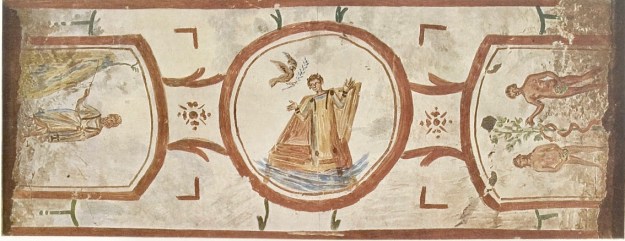
The story gave hope to the Jews driven from Jerusalem to exile in Babylon where, “By the rivers of Bablyon, we sat ad wept, remembering Zion.” (Psalm 137)  Christians– the pictures in the catacombs remind us (above)– saw Noah as a sign that the waters of baptism saved them from death and brought them the promise of paradise lost by Adam and Eve.

So the story of Noah and the ark is more than a myth.

Building a City: Genesis 11: 1-9

babel
Tower of Babel. Pieter Bruegel the Elder. 16th century

After the deluge, God renews a covenant with creation, and the descendants of Noah begin to fulfill God’s command “to increase and multiply and fill the earth.”

But then something else happens: human beings want to be together, so they build a city. A common origin and language draws them together, not just as families or clans, but in a larger society. They look for human flourishing in a city. (Genesis 11,1-9)

Unfortunately, they overreach. They want to get their heads into the heavens and so they plan a tower into the sky. Like Adam and Eve reaching for the Tree of the Knowledge of Good and Evil, they want to be like gods, “presuming to do whatever they want,” Their tower becomes a Tower of Babel. It collapses and they’re scattered over the world, leaving their city unfinished.

It’s important to recognize that the Genesis story does not claim God’s against human beings building a city. The bible, in fact, often sees the city as a place favoring human flourishing. In the Book of Jonah, God values the great city of Nineveh. Jesus sees Jerusalem, the Holy City, cherished by the Lord, the place where he dwells. The Spirit descends on his church in the city. The Genesis story sees the city as good, but it can be destroyed by sin and human pride..

The picture at the beginning of this blog is a painting of the Tower of Babel by the 16th century Dutch artist, Pieter Bruegel the Elder. It’s situates Babel in Antwerp, one of the key seaports of the time. Its shaky structure suggests it’s too ambitiously built. Still incomplete, it may not last. So the painter offers a warning against ambition and not caring for people, especially the needy.

It’s interesting to note that Pope Francis encourages mayors from cities to plan well. Commentators say the pope, conscious of a rising isolationism that’s affecting nations and international bodies today, sees cities to be agents for unifying peoples. They’re important places for humans to flourish. The United Nations also sees cities as key resources in the challenge that comes with climate change.

The picture at the end? You don’t have to be told. A great city. Still, its greatness will be judged, not by its big buildings or businesses, but how it encourages human flourishing.

img_1960

“A Vision Thing”


Here’s a favorite picture of mine from the Staten Island Ferry. You say it’s a picture of the New York skyline? I say it’s a picture of water that gave birth to the city. True, isn’t it? The water was here first. The city came to be because water brought the world here, making the city a capitol of world trade and drawing millions of human beings to this place

Now look at it. The man who built the new World Trade Center claims it’s the tallest building in the country, challenging the heavens–like Babel.

Be careful, though, about challenging the heavens and forgetting about the earth. Be careful about the waters that brought you where you are. No fish or oysters here to eat now. Little space for the waters to go when they rise. And they will.

Don’t forget– the water was here first. It’s a “vision thing.” That’s what Pope Francis says in “Laudato si”.

This week’s readings from Genesis are good readings for improving our vision. In the weeks before we read from the Letter to the Hebrews, so you might say that from the heavens we’re now reflecting on the earth.  

It’s good to reflect on creation, Genesis reminds us. God looks on what has been made and finds it good. Our account from Genesis today describes the creation of man (“man” here is a term for man and woman). Man is not immediately placed on the bare earth. No, he is placed in a garden where “various trees grow that were delightful to look at and good for food, with the tree of life in the middle of the garden and the tree of the knowledge of good and evil. “

Human beings, created by God, are called like God to find creation good. iThe Genesis account singles our the various trees that are delightful to look at and good for food, but all creation, from the sun and the stars to the simplest organisms, is to be looked at with delight.  

We’ll read for two weeks in our lectionary from the Book of Genesis and then we’ll be reading from the Book of Sirach which continues the Genesis message. Learn the Lord’s wisdom from the sands on the seashore, from heaven’s heights and earth’s depths, Sirach teaches.  Like the Book of Genesis, it tells us to learn from the world we live in. 

The scriptures in our lectionary are not assigned arbitrarily. The compilers of our lectionary after Vatican II carefully planned the way our lectionary unfolds.

What’s Inside? Mark 7:14-23


In Wednesday’s Gospel reading (Mk 7: 14-23), Jesus says: ” Nothing that enters one from outside can defile that person; but the things that come out from within are what defile.”

    Later on, He tells His disciples: ” Do you not realize that everything that goes into a person from outside cannot defile, since it enters not the heart but the stomach and passes out into the latrine (thus He declared all foods clean). But what comes out of the man, is what defiles him. From within the man, from his heart, come evil thoughts, unchastity, theft, murder, adultery, greed, malice, deceit, licentiousness, envy, blasphemy, arrogance, folly. All these evils come from within and they defile.”

    Our Lord is once again talking about the pettiness and superficiality of so many of the rules and regulations that the scribes and Pharisees were always harping on. He asks us to focus rather on that “beam” in our eyes, the sinful, destructive tendencies that exist within us, and that we try to cover up.

    But this passage leads me to ask so many questions. In many of the Psychology courses that I took, the issue of ” nature vs. nurture” would come up, and makes me think of this Gospel. So many disturbing, horrible things can ” enter from the outside ” and damage or ” defile ” a child so that he or she grows up and displays many of these sinful behaviors listed by the Lord. Do we learn these evils, or did they already come within us at birth? How extensive is the power of our “original sin?”  Why do some people turn out ” nicer” than others?

    No matter what the answers to these questions, our Lord certainly wants people to be cleansed of ” all their evils” . Can we do it by following a set of rules and prescribed behaviors that our Church so lovingly provides? ….. Follow the Commandments, participate in the Eucharist, celebrate the Sacrament of Reconciliation,  fast, avoid the sinful influence of the media for us and our children, control our “dirty language” and “dirty pictures” in our minds, practice tolerance and forgiveness, and so on?

    Many, many people, like me, who received Catholic upbringing and instruction when young, failed to follow these rules. Others, by the Grace of God, gave these rules a good try and are still trying. Why? Was it God’s arbitrary choice?

    I really cannot answer these questions either. All I know is that after 43 years in the wilderness, after hurting God, myself, and others so many times, my Lord Jesus Christ came my way and struck me with his Love and Mercy. The gift of His Light helped me to see His Light in me, along with the many dark, dirty spots that would cloud my vision of Him.

    So I no longer try to analyze what harmful events in my life led me to so much sin, nor how my “inside”  got filled with so much darkness (although I try to spot those bad influences when they threaten my grandchildren, and carefully talk about it with their parents!). All I know is that God loves me so much, that I can’t help but try to be”better”, because I love Him. There is this beautiful sentence that I read in the magazine THE WORD AMONG US: ” It’s the relationship, not the formula that matters.”

    In his book, FALLING UPWARD, Fr Richard Rohr, talks about the importance of “shadow work” in the spiritual journey. It is a matter of careful ” seeing through ” our self-deception, as well as through all of those inner things that “defile” us: ” You come to expect various forms of halfheartedness, deceit, vanity, or illusions from yourself. But now you see through them, which destroys most of their game and power.” What are you looking at as you see through them? Rohr believes that you are looking into your innermost self at  the One who loves you.

   ” This self cannot die and always lives, and is your True Self.”

Orlando Hernandez   

Learning from Genesis

tree-of-life-2


Pope Francis, in his encyclical Laudato Si, , invites Christians to turn to the Book of Genesis to understand how they’re related to the earth.

Genesis makes clear in its first chapter that the earth, “our common home,” is God’s work. God works for 5 days to create the world; only on the 6th day does God create man, whom he gives dominion over creation– but not absolute dominion. God made this world, not us, and every created thing enjoys a distinct relationship to its creator.

The dominion we have from God is a gift and is not absolute. We’re to help, respect, understand, tend, care for creation: creation isn’t ours to do what we want with it.

eden-2

The 2nd chapter of Genesis describes the creation of man. The earth is dry dust, but water wells up making a soft wet clay from the dust. God, like a potter, fashions man from the clay, breathing the breath of life into him and making him a living being.

We’re creatures of the earth, the story says.  As we’re reminded on Ash Wednesday, “You are dust and to dust you shall return.”

After creating man, God places him in a garden filled with all kinds of plants and trees. Two trees are singled out, the tree of life, and the tree of the knowledge of good and evil. Man is forbidden to eat from that tree.

What’s the tree of the knowledge of good and evil? Why is it forbidden to eat its fruit?  There are different interpretations. Some interpret eating from the tree as a decision of moral autonomy. By eating its fruit, I claim a knowledge of good and evil; I say what’s right or wrong.

Not unusual to hear that today, is it? Some believe they’re in absolute control of their lives. They choose what’s right or wrong, good and evil, rejecting the limits of the human condition and the finite freedom God gives human beings.

Another interpretation sees eating from the tree as a decision to trust only in human experience and human knowledge that we gain as we grow and progress individually and as a people. Like children distancing themselves from their parents, we must be self sufficient, gaining a wisdom on our own. The danger is that human experience and human wisdom become absolute.  We distance ourselves from God.

Can we see both these approaches harmful to our environment? The first leads to a possessiveness of created things;  they belong to us alone and we can do anything we want with them.

The second way also leads to harming our environment. Pope Francis speaks of the danger of “anthropocentrism,” putting human beings at the center of everything, a trend he traces back to the beginnings of the Enlightenment in the 16th century. Trusting human knowledge and human creativity, some are convinced that science and technology alone can bring about a perfect world.

Technology isn’t enough to meet our present environmental crisis, the pope says, we humans need to change. We need to humbly accept our place in creation, as God meant it to be.

What about the tree of life in the Genesis narrative? In the garden the tree was a promise of continuing life. Once banished from the garden,  human beings face death.

tree-of-life

When Christ came in the fullness of time, he brought life to the world, Christians believe. In his death on the cross, the sign of death was replaced by a sign of life. His cross is a tree of life.

Here’s Pope Francis from Laudato si:

“The creation accounts in the book of Genesis contain, in their own symbolic and narrative language, profound teachings about human existence and its historical reality. They suggest that human life is grounded in three fundamental and closely intertwined relationships: with God, with our neighbour and with the earth itself. According to the Bible, these three vital relationships have been broken, both outwardly and within us. This rupture is sin. The harmony between the Creator, humanity and creation as a whole was disrupted by our presuming to take the place of God and refusing to acknowledge our creaturely limitations. This in turn distorted our mandate to “have dominion” over the earth (cf. Gen 1:28), to “till it and keep it” (Gen 2:15). As a result, the originally harmonious relationship between human beings and nature became conflictual (cf. Gen 3:17-19).

It is significant that the harmony which Saint Francis of Assisi experienced with all creatures was seen as a healing of that rupture. Saint Bonaventure held that, through universal reconciliation with every creature, Saint Francis in some way returned to the state of original innocence.[40] This is a far cry from our situation today, where sin is manifest in all its destructive power in wars, the various forms of violence and abuse, the abandonment of the most vulnerable, and attacks on nature.”

Pope Francis, Laudato SI  66

St. Josephine Bakhita: February 8

An heroic African woman from the Sudan, Josephine Bakhita was kidnapped by slave traders when she was 9 years old and forced into slavery for almost 12 years. Pope Benedict XVI wrote of her in his encyclical letter “On Hope” as an example of God’s gift of hope. “To come to know God—the true God—means to receive hope.”

“I am thinking of the African Josephine Bakhita, canonized by Pope John Paul II. She was born around 1869—she herself did not know the precise date—in Darfur in Sudan. At the age of nine, she was kidnapped by slave-traders, beaten till she bled, and sold five times in the slave-markets of Sudan. Eventually she found herself working as a slave for the mother and the wife of a general, and there she was flogged every day till she bled; as a result of this she bore 144 scars throughout her life.

Finally, in 1882, she was bought by an Italian merchant for the Italian consul Callisto Legnani, who returned to Italy as the Mahdists advanced. Here, after the terrifying “masters” who had owned her up to that point, Bakhita came to know a totally different kind of “master”—in Venetian dialect, which she was now learning, she used the name “paron” for the living God, the God of Jesus Christ.

Up to that time she had known only masters who despised and maltreated her, or at best considered her a useful slave. Now, however, she heard that there is a “paron” above all masters, the Lord of all lords, and that this Lord is good, goodness in person.

She came to know that this Lord even knew her, that he had created her—that he actually loved her. She too was loved, and by none other than the supreme “Paron”, before whom all other masters are themselves no more than lowly servants. She was known and loved and she was awaited.
What is more, this master had himself accepted the destiny of being flogged and now he was waiting for her “at the Father’s right hand”. Now she had “hope” —no longer simply the modest hope of finding masters who would be less cruel, but the great hope: “I am definitively loved and whatever happens to me—I am awaited by this Love. And so my life is good.” Through the knowledge of this hope she was “redeemed”, no longer a slave, but a free child of God.

She understood what Paul meant when he reminded the Ephesians that previously they were without hope and without God in the world—without hope because without God. Hence, when she was about to be taken back to Sudan, Bakhita refused; she did not wish to be separated again from her “Paron”.

On 9 January 1890, she was baptized and confirmed and received her first Holy Communion from the hands of the Patriarch of Venice. On 8 December 1896, in Verona, she took her vows in the Congregation of the Canossian Sisters and from that time onwards, besides her work in the sacristy and in the porter’s lodge at the convent, she made several journeys round Italy in order to promote the missions: the liberation that she had received through her encounter with the God of Jesus Christ, she felt she had to extend, it had to be handed on to others, to the greatest possible number of people.

The hope born in her which had “redeemed” her she could not keep to herself; this hope had to reach many, to reach everybody.” Benedict XVI “Spes salvi” 2007

Josephine Bakhita died February 8, 1947 and was declared a saint in 2000. She is the patron saint of the Sudan and victims of human trafficking. For more on her, see here.

The Numbers are Down:Mark 4:24-34

The Sower. Jame Tissot

Numbers seem to indicate power and popularity. We think that way; Jesus’ disciples must have thought that way too. In Mark’s gospel Jesus begins his ministry in Capernaum before an enthusiastic crowd. At the end of his first day, the whole town gathers at the door of Peter’s house and word reaches out to other towns and places that a prophet has come. The numbers go up. (Mark 1, 21-34)

But then enthusiasm dies down as Jesus’ authority is questioned. Religious leaders from Jerusalem and the followers of Herod Antipas cast doubts about him. His own hometown, Nazareth, takes a dim view of him.. Gradually, Capernaum and the other towns that welcomed Jesus enthusiastically turn against him. His numbers go down.

Why are the number going down, his disciples must have wondered? It didn’t make sense. Jesus’ answer comes in Mark’s gospel today. God’s kingdom is coming; God is at work in the world, but human beings are mostly unaware of it:


“This is how it is with the Kingdom of God;
it is as if a man were to scatter seed on the land
and would sleep and rise night and day
and the seed would sprout and grow,
he knows not how.
Of its own accord the land yields fruit,
first the blade, then the ear, then the full grain in the ear.
And when the grain is ripe, he wields the sickle at once,
for the harvest has come.” (Mark 4, 28-34)

Great power is at work in the scattered seed, but we know little how it grows. The seed takes time, with its own law of growth; a great harvest will come, but still there’s mystery we don’t see. We sleep.

Meanwhile, we worry about numbers. Why are growing numbers giving up going to church or synagogue? Why are there so few vocations to our religious communities? So many of the good things in this world seem to be diminishing.

What can we do? Look into the signs of the time. Treasure the seed we have. Scatter it as we can. Be patient as we sleep. The Kingdom of God comes.