Category Archives: Passionists

St. Thèrése and the Passion of Jesus

therese-child-face-a

St. Thèrése put two titles to her name after she became a Carmelite nun. She holds those two titles in this photo. One was Thèrése of the Child Jesus, the other was Thèrése of the Holy Face of Jesus. She wished to be known by these two titles: Thèrése of the Child Jesus and the Holy Face.

The titles came from religious experiences she had. The first occurred on Christmas day, 1886, when she was 13 years old. Shorlty afterwards, she had an experience of the Passion of Jesus, which took place one Sunday of the next year, when she was 14. She describes the two experiences  in chapter 5 of her autobiography. Her experience of the Passion of Jesus involved a murderer.

“One Sunday, looking at a picture of Our Lord on the Cross, I was struck by the blood flowing from one of the divine hands. I felt great sorrow when thinking this blood was falling to the ground unnoticed. I was resolved to remain in spirit at the foot of the Cross and to receive the divine dew. I understood I was then to pour it out upon souls.

The cry of Jesus on the Cross sounded continually in my heart: “I thirst!” These words ignited within me an unknown and very living fire. I wanted to give my Beloved to drink and I felt myself consumed with a thirst for souls. As yet, it was not the souls of priests that attracted me, but those of great sinners; I burned with the desire to snatch them from the eternal flames.”

At the time a notorious murderer, Pranzini had been condemned to death and refused to see a priest. Thèrése was deeply affected by the sensational story and   asked Jesus, “feeling that I myself could do nothing,” to be merciful to him. She had Mass offered for him, she begged God’s mercy.

Afterwards the newspaper reported a priest offered Pranzini a crucifix as he went to his death and he kissed it fervently three times. Thèrése believed her prayers were answered “Then his soul went to receive the merciful sentence of him who declares that in heaven there will be more joy over one sinner who does penance than over ninety-nine just who have no need of repentance!”

For Thèrése the Passion of Jesus was a sign of God’s mercy. His words “I thirst,” were more than an expression of physical thirst, they expressed his desire to show a merciful love to the world.

The teen age girl’s experience reminds us that God’s graces can come to anyone, at any time. The experience left her with a lasting conviction, “I myself can do nothing.” One of her prayerbooks carries a remembrance of her experience.

therese-holy-card

Feast of St. Thérèse of Lisieux

fullsizerender

The proper prayers of the Mass for the feast of a saint often tell us about the saint and the graces we find in them. The prayers for the Feast of St. Therese do just that:

“The Lord led her and taught her

and kept her as the apple of his eye.

Like an eagle spreading its wings

he took her up and bore her on his shoulders.

The Lord alone was her guide.” (Entrance antiphon)

Therese saw herself as loved by God, she was the apple of God’s eye. Jesus alone was her guide. No matter how close she was to her family or her religious community, Jesus was her teacher and guide. In her autobiography she speaks of herself as a little bird hardly able to fly, but she has the desires, the heart of an eagle, and she prays that God give her wings. God gave her what she sought. “Like an eagle spreading its wings, he took her up and bore her on his shoulders.”

In the Collect, the opening prayer of the Mass for her feast, we ask God to “lead us to follow trustingly in the little way of Saint Therese, because God invites those who are humble, little ones, into his kingdom:

“O God, who open your Kingdom

to those who are humble and to little ones,

lead us to follow trustingly in the little way of Saint Thérèse,

so that through her intercession

we may see your eternal glory revealed.

Through our Lord Jesus Christ, your Son,

who lives and reigns with you in the unity of the Holy Spirit,

one God, for ever and ever.”

In the prayer over the offerings we say:

“As we proclaim your wonders in Saint Thérèse, O Lord,

we humbly implore your majesty,

that, as her merits were pleasing to you,

so, too, our dutiful service may find favor in your sight.

Through Christ our Lord.”

Therese insisted as she began writing her autobiography that her life, not her accomplishments,  proclaimed the wonders of God. As we bring ourselves to God in the bread and the wine, we proclaim God’s goodness to us in Jesus Christ. We give thanks to the Lord, our God.

After communion we remember what Jesus taught, so that he accomplish his teaching in us:

“Thus says the Lord:

Unless you turn and become like children,

you will not enter the Kingdom of Heaven.”

In the prayer after Communion we pray:

“May the Sacrament we have received, O Lord,

kindle in us the force of that love

with which Saint Thérèse dedicated herself to you

and longed to obtain your mercy for all.”

We know how much this saint loved God. She also reached out in love to the whole world as God’s merciful love does. We ask the Lord to “kindle in us the force of that love”, to love him and love others with his merciful love.

A biography of St. Therese here.

On her missio today.

Saints of Korea

The founders of churches throughout the world have an important place in our church calendar, because they did what Jesus commanded: “Go out to the whole world and preach the gospel, baptizing them in the name of the Father and of the Son and of the Holy Spirit.” (Matthew 25 ) 

Church founders are apostles like Peter and Paul, founders of the church in Rome, (June 29), or monk-bishops like Boniface, founder of the church of the Germanic peoples, (June 5), Patrick, founder of the church in Ireland, (March 17) Ansgar, founder of the church in Scandanavia, (February 3),  Cyril and Methodius, founders of the church in the Slavic nations (February14).

The church in Korea, whose founding we celebrate today, can be traced back to the 17th century. Its foundation is special, as Pope John Paul II noted at the canonization of the Korean Martyrs, May 6, 1984:

“The Korean Church is unique because it was founded entirely by laypeople. This fledgling Church, so young and yet so strong in faith, withstood wave after wave of fierce persecution. Thus, in less than a century, it could boast of 10,000 martyrs. The death of these many martyrs became the leaven of the Church and led to today’s splendid flowering of the Church in Korea. Even today their undying spirit sustains the Christians of the Church of Silence in the north of this tragically divided land.” – Pope John Paul II at the canonization of the Korean Martyrs, May 6, 1984.

A priest, Andrew Kim Taegon and a layman Paul Chong Hasang, head the list of 103 martyrs canonized in 1984, but the early Korean church was from the first a church of laypeople. Decades before those celebrated today, it was without priests or bishops. All lay people, they kept faith alive at great cost and offered it to others. 

 By its nature, the Catholic Church draws from its member churches the gifts God has given them. The church is the body of Christ. May our churches today, old and new, be blessed with lay people like those who founded the church in Korea.

The Second Vatican Council, 60 years or so ago,  called for increasing the role of the laity in the Catholic Church. It seems to me that goal has still to be met, at least in my country. 

“Once again, Jesus sends lay people into every town and place where he will come (cf.Luke 10:1) so that they may show that they are co-workers in the various forms and modes of the one apostolate of the Church, which must be constantly adapted to the new needs of our times. Ever productive as they should be in the work of the Lord, they know that their labor in him is not in vain (cf.  1 Cor.15:58).”  (Decree on Laity, 33)

O God, who have been pleased to increase your adopted children in all the world, and who made the blood of the Martyrs Saint Andrew Kim Tae-gǒn and his companions a most fruitful seed of Christians, grant that we may be defended by their help and profit always from their example.Through our Lord Jesus Christ, your Son, who lives and reigns with you in the unity of the Holy Spirit, God, for ever and ever.Amen.

Saints Cornelius and Cyprian

Cornelius

Today the church celebrates two early saints and martyrs, Cornelius, a pope who died in 253, and Cyprian, a bishop who was martyred in Roman Africa shortly after in 258.

At the time barbarian tribes in the west and the Persians in the east were invading Roman territory; the Roman emperors Decius and Valerian called for absolute loyalty from their people. The empire was imperiled.

To prove their loyalty, Roman citizens lined to offer sacrifice in honor of the emperor. Christians refused, and so at first church leaders were executed or imprisoned, wealthy, influential Christians lost their property, their positions and possibly their lives. Finally, all Christians could expect punishment for not performing the rites of sacrifice.

Not every Christian remained loyal to the faith at the time. Many offered sacrifice, betraying their faith, then afterwards sought to return to the church. Hard liners called for them to be banned for life for their lack of loyalty. Let God judge them when they die, they said. Others, like Cornelius and Cyprian, called to reconcile them after a time of penance, since God is all merciful.

Mercy and justice are always hard to reconcile. The gospels come down on the side of mercy. So should we.

In the persecution, Cornelius, bishop of Rome, was executed first, Cyprian, bishop of Carthage in Africa, was executed a few years later. The two men were from different social backgrounds and not always on good terms, historians say, but they found support in their common faith, as this letter of Cyprian to Cornelius, written shortly before Cornelius’ death, reveals:

“Cyprian to my brother Cornelius,

Dearest brother, bright and shining is the faith which the blessed Apostle praised in your community. He foresaw in spirit the praise your courage deserves and the strength that can not be broken; he was heralding the future when he testified to your achievements; his praise of the fathers was a challenge to the sons.

Your unity, your strength have become shining examples of these virtues to the rest of us. Divine providence has now prepared us. God’s merciful design has warned us that the day of our own struggle, our own contest, is at hand. By that shared love which binds us close together, we are doing all we can to exhort our congregation, to give ourselves unceasingly to fastings, vigils and prayers in common. These are the heavenly weapons which give us the strength to stand firm and endure; they are the spiritual defences, the God-given armaments that protect us.  

Let us then remember one another, united in mind and heart. Let us pray without ceasing, you for us, we for you; by the love we share we shall thus relieve the strain of these great trials.”

Love shared relieves the strain of trials.

Our Lady of Sorrows: September 15

DSCN0299

The Memorial of Our Lady of Sorrows is celebrated the day after the Feast of the Exaltation of the Cross (September 14). Eight days after Mary’s birth (September 7) her sorrows are recalled, her lifelong sorrows. 

The old man Simeon spoke of her lifelong sorrows when he  told Mary a sword would pierce her heart when Jesus was born. Her greatest sorrow, of course, came when she stood beneath the Cross of her Son.

What, then, were her lifelong sorrows? The gospels indicate some of them, but perhaps more important was Mary’s experience of the sorrow every human being experiences. An infant cries as it enters this world. “Our life is over like a sigh. Our span is seventy years, or eighty for those who are strong. And most of these are emptiness and pain.” (Psalm 90) Everyone experiences the human sorrow the psalms describes. Mary experienced that human sorrow.

The sword of sorrow struck Mary most deeply at the death of her Son. Some of Jesus followers stood at a distance when he was crucified. But John’s gospel describes Mary as the first of those standing close by, beneath the cross itself. “Standing by the cross of Jesus were his mother and his mother’s sister, Mary the wife of Clopas, and Mary Magdalene.”

Mary stands by the Cross of Jesus, close by, not at a distance. She’s not absorbed in her own suffering, not afraid to see. Her closeness to the Cross is significant. She enters the mystery of her Son’s suffering through compassion. 

She stood by him. Compassion doesn’t experience another’s suffering exactly, and it may not take another’s suffering away. Compassion enters suffering to break the isolation suffering causes. It helps someone bear their burden.  The sword, the spear, the sorrow, pierces both hearts, in different ways.

Our prayer for today’s feast says that when her Son “was lifted high on the Cross” his mother stood by and shared his suffering. “Grant that your Church, participating with the Virgin Mary in the Passion of Christ, may merit a share in his Resurrection.

For a commentary on John’s Gospel see here.

For a study on Mary on Calvary see here.

For readings for the feast and the Stabat Mater see here.

The Exaltation of the Cross: September 14

Holy sepul

Pilgims enteing the Church of the Holy Sepulcher, Jerusalem

This ancient ecumenical feast,  celebrated by Christian churches throughout the world, commemorates the dedication of a great church in Jerusalem at the place where Jesus died and rose again. Called the Anastasis ( Resurrection) or the Church of the Holy Sepulcher, it was built by the Emperor Constantine and dedicated on September 13, 325. It’s  one of Christianity’s holiest places.

Liturgies celebrated in this church, especially its Holy Week liturgy, influenced churches throughout the world. Devotional practices like the Stations of the Cross grew up around this church. Christian pilgrims brought relics and memories from here to every part of the world. Christian mystics were drawn to this church and this feast.

Holy Sepulcher - 28

Tomb of Jesus

Calvary

Calvary

Pilgrims still visit the church and the tomb of Jesus, recently renovated  after sixteen centuries of wars, earthquakes, fires and natural disasters. They venerate the rock of Calvary where Jesus died on a cross. The building today is smaller and shabbier than the resplendent church Constantine built, because the original structure was largely destroyed in the 1009 by the mad Moslem caliph al-Hakim. Half of the church was hastily rebuilt by the Crusaders; the present building still bears the scars of time.

Scars of a divided Christendom can also be seen here. Various Christian groups, representing churches of the east and the west, claim age-old rights and warily guard their separate domains. One understands here why Jesus prayed that ” All may be one.”

Holy Sepulcher - 04

Egyptian Coptic Christians

Seventeenth century Enlightenment scholars  expressed doubts about the authenticity of Jesus’ tomb and the place where he died, Calvary. Is this really it? Alternative spots were proposed, but scientific opinion today favors this site as the place where Jesus suffered, died and was buried.

For more on its history, see here.

And a video here.

Readings for the Triumph of the Cross

DSC00234
Via Dolorosa - 17

“Do not forget the works of the Lord!” (Psalm 78, Responsorial Psalm) We remember his great works here. How can we forget them.

Saint John Chrysostom: September 13

John Chrysostom

Saint John Chrysostom was born around 340 into a military family in Antioch, in modern Turkey. He studied under Libanius, the great rhetorician of the day and afterwards lived with monks in Syria for a few years, but poor health made him return to Antioch, where he served the church for five years as a deacon, taking care of the poor.

Ordained a priest in 386, John became a bishop of Constantinople, then the seat of Roman power. John was an outstanding preacher: his “golden mouth” (Chrysostom) delighted ordinary hearers with sermons on the gospels and the letters of Paul, but they got him into trouble with the city’s rulers and churchmen whom he attacked for their wealth and high living. The Empress Eudoxia exiled him briefly from the city in 402 AD.

John returned and resumed his fearless preaching against the city’s powerful political and church elite.  Eudoxia finally sent him into exile on the Black Sea after John gave a sermon that began “Again Herodias is raging, again she is perturbed,  again she wants to receive the head of John on a dish.” Not a way to win friends in high places.

“ Glory be to God for everything. Amen” John said as he made his way to exile and death. “If Christ is with me, whom shall I fear. Though the waves and the sea and the anger of princes are against me, they’re as weak as a spider’s web.”

He died on September 14, 407, the Feast of the Triumph of the Holy Cross, which we celebrate tomorrow.

Like other bishops of the time– Athanasius, Basil, Gregory Nazianzen– John faced a Roman government no longer intent on destroying the church but rather having it under its thumb. Like them, John suffered exile, yet still spoke out to power. In our prayer for his feast, we thank God for a bishop made “illustrious by his wonderful eloquence and his example of suffering.” We ask for brave church leaders like John. We need them now to lead a church that speaks to power.

Notice too that John spent some years as a deacon, taking care of the poor. His preaching was nourished by that experience. Here’s an example:

The waters are up; storms are on us, but we’re not afraid of drowning; we’re standing on a rock. The raging sea won’t break the rock. The rising waves won’t sink the boat of Jesus. What are we afraid of? Death? Life to me means Christ, and death is gain. Exile? The earth and its fullness belong to the Lord. Goods taken away? We brought nothing into this world, and we shall surely take nothing from it. I have only contempt for the world’s threats, I find its blessings laughable. I have no fear of poverty, no desire for wealth. I am not afraid of death nor do I long to live, except for your good.

I concentrate therefore on the present situation, and I urge you, my friends, to have confidence.  Do you not hear the Lord saying: Where two or three are gathered in my name, there am I in their midst? Will he be absent, then, when so many people united in love are gathered together? I have his promise; I am surely not going to rely on my own strength! I have what he has written; that is my staff, my security, my peaceful harbour. Let the world be in upheaval. I hold to his promise and read his message; that is my protecting wall and garrison. What message? Know that I am with you always, until the end of the world!  If Christ is with me, whom shall I fear?

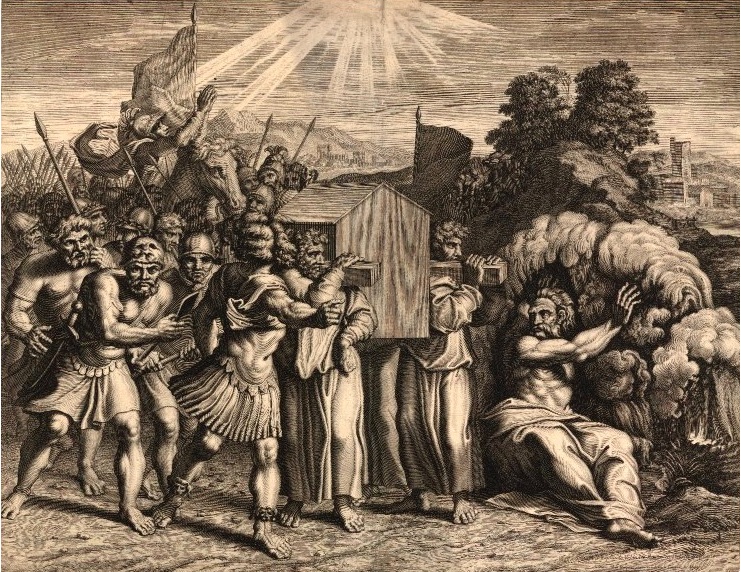
Joshua

Robert Hecquet, Israelites Crossing the Jordan River, c. 1720-1775

Our Old Testament readings for the next few days are from the Book of Joshua, the successor of Moses. He was a man of battles and wars, who led the Israelites in their conquest of Canaan and their possession of the Promised Land. “Joshua fit the battle of Jericho, and the walls came tumbling down.”

As a warrior he was concerned with preparing troops for battle, getting weapons ready, strategizing for the battle, but Joshua begins his campaign by first reminding the people what’s more important than all that: “Remember who you are.”

Gathering the Israelites before the Jordan River, Joshua orders the priests to bring before them the ark of the covenant, God’s pledge that they are his people. They bring the jar of manna reminding them that God sustains them. They are God’s people, not insignificant slaves. They’re God’s children, cared for, with rights and privileges and promises.

Only by remembering who they are will they be able to cross the Jordan and break down the walls of Jericho and take possession of the land.

Remember who you are.

St. James, Son of Zebedee. July 25

James the greater

The mother of the sons of Zebedee approached Jesus with her sons
and did him homage, wishing to ask him for something.
He said to her,
“What do you wish?”
She answered him,
“Command that these two sons of mine sit,
one at your right and the other at your left, in your Kingdom.”
Jesus said in reply,
“You do not know what you are asking.
Can you drink the chalice that I am going to drink?”
They said to him, “We can.”
He replied,
“My chalice you will indeed drink,
but to sit at my right and at my left, this is not mine to give
but is for those for whom it has been prepared by my Father.”
When the ten heard this,
they became indignant at the two brothers.
But Jesus summoned them and said,
“You know that the rulers of the Gentiles lord it over them,
and the great ones make their authority over them felt.
But it shall not be so among you.
Rather, whoever wishes to be great among you shall be your servant;
whoever wishes to be first among you shall be your slave.
Just so, the Son of Man did not come to be served
but to serve and to give his life as a ransom for many.” (Matthew 20:20-28)

James and John were sons of Salome and Zebedee, the gospels say, and at the Sea of Galilee Jesus called them to follow him. They were fishermen, relatives of Jesus. The gospels mention James first; he may have been the oldest.

The two brothers are described as quick-tempered and ambitious about restoring Jewish independence. They became part of the innermost circle of Jesus’ companions. They heard him teach, saw him transfigured in glory, then shaking with fear in the garden of Gethsemane before his death.

Our first reading at Mass for the Feast of St. James is a good description of James and John. “We hold this treasure in earthen vessels, that the surpassing power may be of God and not from us.” (2 Corinthians, 4,7) James and John were earthen vessels indeed, as our gospel describes them, using their mother Salome as their intermediary, looking for a big place in the kingdom they hope Jesus will bring. Earthen vessels break easily.

Jesus asks them if they can drink from the chalice that he will drink from, the chalice of serving others, no matter what the cost. “We can,” they say.

His brother John and his mother Salome stood near the cross of Jesus, but James must have fled immediately when Jesus was seized in the garden. Yet, God’s “surpassing power” filled him with treasures of faith, and James drank from the cup he asked to drink.

According to the Acts of the Apostles, James spoke bravely about Jesus risen from the dead to the people of Jerusalem and to the Jews visiting the Holy City from all parts of the world at Pentecost. He became a leader of the Jerusalem church but probably still clung to dreams of Jewish independence. Long held dreams don’t easily disappear.

In the year 41, Herod Agrippa, the grandson of Herod the Great, became king of Judea and ruled in Jerusalem. Educated in Rome, he knew how to favor the emperors of his time and he also knew how to please the powerful Jewish ruling class that had a key role in his kingdom. Were they also concerned about James’ continued political hopes for a Jewish kingdom?

When the Jewish Sanhedrin accused Christians of threatening the peace of Jerusalem, Herod sent his soldiers to seize James, the son of Salome and Zebedee, and had him executed by the sword. Strike the shepherd, Herod reasoned, and the sheep will scatter.

James, son of Zebedee, was the first of the apostles to die a martyr’s death. “My cup indeed you will drink,” Jesus promised, and his promise came true.

On the list of apostles there is another James, son of Alphaeus, commonly called James the Less. He is thought to be the son of Mary of Clopas, a sister of Mary, the mother of Jesus, who stood beneath the cross of Jesus with Mary Magdalen. (John 19: 25) His feast, along with the Apostle Philip is May 3. He was head of the church in Jerusalem and was martyred there in 62.  

The Martyrs of Daimiel

Damiel

Civil wars are hard to understand. The American Civil War, the war in Rwanda in the 1990s, the war in Bosnia. That’s true also of the Spanish Civil War, which took place from 1936-1939 between forces of the left and the right. Great numbers of innocent people lost their lives. Outsiders from Germany, Russia and Italy made the war a testing ground for their own war machines. The scars are still there.

Many Catholic clergy were killed, especially in the early months of the war, including 13 bishops, 4,172 diocesan priests and seminarians, 2,364 men religious and 283 nuns in a period referred to as Spain’s “Red Terror.” Today the Passionists remember their Martyrs of Daimiel, Spain.

Between July 22nd and October 24th, 1936, twenty-six religious from the Passionist house of studies, Christ, the Light, outside the city of Daimiel, about eighty miles south of Madrid, died at the hands of anti-religious militiamen at the outbreak of the Spanish Civil War

They were: Niceforo Diez Tejerina, 43, provincial superior, who previously served as a missionary in Mexico and Cuba after being ordained in Chicago, Illinois.; Ildefonso García Nozal, 38; Pedro Largo Redondo, 29; Justiniano Cuestra Redondo, 26; Eufrasio de Celis Santos, 21; Maurilio Macho Rodríguez, 21; Jose EstalayoGarcia, 21; Julio Mediavilla Concejero, 21; Fulgencio Calv Sánchez, 19; Honorino Carraced Ramos, 19; Laurino Proáno Cuestra, 20; Epifanio Sierra Conde, 20; Abilio Ramos Ramos, 19; Anacario Benito Nozal, 30; Felipe Ruiz Fraile, 21; Jose Osés Sainz, 21; Felix Ugalde Irurzun, 21; Jose Maria Ruiz Martinez, 20; Zacarias Fernández Crespo, 19; Pablo Maria Lopez Portillo, 54; Benito Solano Ruiz, 38; Tomas Cuartero Gascón, 21; Jose Maria Cuartero Gascón, 18; German Perez Jiménez, 38; Juan Pedro Bengoa Aranguren, 46; Felipe Valcobado Granado, 62.

Most of those killed were young religious studying for ordination and destined for missionary work in Mexico and Cuba. Others were priests who taught them and brothers who served in the community. Father Niceforo, the provincial, was visiting the community at the time.

Militiamen entered the Passionist house on the night of July 21st and ordered the thirty-one religious to leave in one hour. Father Niceforo gathered them in the chapel, gave them absolution, opened the tabernacle and said:

“We face our Gethsemane. . . all of us are weak and frightened, , ,but Jesus is with us; he is the strength of the weak. In Gethsemane an angel comforted Jesus; now he himself comforts and strengthens us. . .Very soon we will be with him. . .To die for him is really to live. . . Have courage and help me by your example.”

He then distributed the sacramental hosts to them.

The militiamen ordered the group to the cemetery and told them to flee. At the same time, they alerted companions in the surrounding areas to shoot the religious on sight.

The Passionists split into five groups. The first group of nine was captured and shot outside the train station of Carabanchel in Madrid on July 22, 1936 at 11pm.

The second group of twelve, Father Niceforo among them, was taken at the station at Manzanares and shot by a firing squad. Father Niceforo and four others died immediately. Seven were taken to a hospital where one later died. Six of them recovered, only to be shot to death later on October 23, 1936

Three other religious, traveling together, were executed at the train station of Urda (Toledo) on July 25th. Two gave their lives at Carrion de Calatrave on September 25th. Only five of the thirty-one religious were spared.

Numerous eye-witnesses testified afterwards to the brave faith and courage shown by the Daimiel Community in their final moments, especially the signs of forgiveness they gave their executioners.

They were beatified by Pope John Paul II on October 1, 1989, who said of them: “None of the religious of the community of Daimiel was involved in political matters. Nonetheless, within the climate of the historical period in which they lived, they were arrested because of the tempest of religious persecution, generously shedding their blood, faithful to their religious way of life, and emulating, in the twentieth century, the heroism of the Church’s first martyrs.” (Homily: October 1, 1989)

Today their bodies are interred in the Passionist house at Daimiel, Spain.

Their feastday is July  24th.