Category Archives: Passionists

21st Sunday B: A Journey of Compassion


Who am I? Who are we?

Our first reading this Sunday from the Book of Joshua is all about those two questions. “Who am I?” and “Who are we?” It’s a reading worth reflecting on.

Joshua, you may remember from your bible history, succeeded Moses as the leader of Jewish people when they came out of Egypt. He’s generally remembered as a soldier who led the Israelites across the Jordan River into the Promised Land, a land disputed then and a land disputed now. The Book of Joshua is a litany of the battles he fought, beginning with the famous battle for Jericho. “Joshua fit the battle of Jericho and the walls came tumblin down.”

Our reading today is from the end of the Book of Joshua. Joshua is over a 100 years old, and the old soldier calls together the different tribes and families of Israel to Shechem to speak to them for the last time.

Your work isn’t finished, your journey isn’t over, he reminds them. But he’s not an old soldier interested in recalling old battles or strategizing military planning for the future. You have been called by God, he tells them. Are you going to listen to that call or not, he asks them? You can drift away and follow other voices, other gods. Make your choice.

“As for me and my household, we will serve the Lord,” Joshua says.

And the people respond:
“Far be it from us to forsake the Lord for the service of other gods. For it was the Lord who brought us and our ancestors out of the land of Egypt, out of a state of slavery. He performed those great miracles before our eyes and protected us along our entire journey and among the peoples through whom we passed. Therefore we also will serve the Lord, for he is our God.”

For Joshua the most important thing is remembering who you are. It’s remembering who you are as an individual and remembering who we are as a people. Everything depends on how we choose to answer those questions.

There’s the personal call: “Who am I?” Where did I come from, who gave me life? Why am I here, what am I to do? Where am I going? What’s my future going to be? God is there in those questions. How do I answer him?

My personal call is not for me alone, though, I’m part of a call to others. We go to God together. We make this journey together.

Joshua and the people see God’s call not just as a personal call When God called them from Egypt, he called them all, the old and the young, the strong and the weak, the rich and the poor, to journey together and they did. That’s the way the bible describes it and that’s the way it should be, even today. No matter how sophisticated our society gets, how difficult our circumstances are, God calls us to make the journey together.

A French geophysicist and philosopher, Xavier Le Pichon, says that the world evolves the way it should when we respect the fragility of the earth and the fragility of our human community. We advance as a people when we take care of our weakest members; our earth community advances when we respect its fragile nature.

One important way we differ from the animals,Le Pichon says, is the care we take of our weakest members. It’s a trait he finds in our earliest ancestors, the Neanderthals, over one hundred thousand years ago. One study of a Neanderthal burial ground in Iraq revealed the skeleton of a 40 year old severely malformed male, who evidently had been carried from place to place by this group of hunters and then buried with them. He would have been a burden to them, he must have slowed them down, but they carried him with them just the same. He meant something to them.

Unlike animals who cast aside their weak to die on the way, humans have developed a feeling for the weak, Le Pichon says. Like animals, they nourish and care for their young, but they reach further to the weakest. This sense of compassion separates humans from animals. It makes us humane.

Le Pichon disputes Darwin’s all embracing principle of the “survival of the fittest.” That principle, when applied to human evolution, does not take into account the spirit of compassion, he says.

Jesus, of course, taught the importance of the spirit of compassion when he told us that what we did for “one of these, the least, you did it to me.” You grow in love through your care of the least. We are truly human, made in God’s image, when we take care of the weak. We make the journey together.
Praying for Politicians

Maybe the Book of Judges, our Old Testament reading at today’s Mass, can offer some perspective on the election process going on in our country now.

The Book of Judges describes the period in Jewish history from the death of Joshua, who led the Israelites in their conquest of the promised land of Canaan, till the installation of Saul as Israel’s first king by the prophet Samuel. During that time, the Israelites were spread out in various parts of Canaan and were led by local leaders, “judges”, a Hebrew word that doesn’t mean people who preside in courts, but ordinary leaders like mayors or city managers or local chiefs.

Without an overall leader, the Israelites were prey to stronger enemies. Eventually, they realized they needed a king, like Saul and David and Solomon, but in this period they were small vulnerable pockets of people living throughout the land.

Gideon and his frightened community are described in today’s reading. They’re taking to the hills to escape marauding bands of Midianites. God calls Gideon to lead his people against them, but he shrinks from the call; he’s a poor farmer who can hardly take care of his own vineyard. He has no talent, no experience or strength, he says.

“Go with the strength you have,” was God’s message to him.

We’re certainly a divided people today; we may wonder is there’s anyone who can unite us and lead us? Is there anyone adequate to govern us?

The Book of Judges says that the “Spirit of the Lord” can come upon the weakest and transform them into leaders, as it did Gideon. A leader’s not made from human qualities alone, or political contributions or a powerful media that promotes one’s cause.The political world is not off-limits to the spiritual. The Spirit can move in the world of politics as in other areas of life, enhancing the strength one has, giving eyes to see and a mind to understand.

We may not pray for politicians enough.

20th Sunday B: Taste and See

I stopped for something to eat the other day along the seashore at Montauk, Long Island, a place I stopped by chance. “We have a nice fish chowder, everything fresh from near here,” the waitress said, so I ordered the fish chowder. Couldn’t have been better, better than anything I expected.

Our first reading today for Sunday Mass is about a meal that’s even better, better than we could expect or plan for. Someone wise provides it. It’s not a meal for just one or two; we’re all invited to the table. Amazingly, it’s free; we don’t have to pay for it.

Listen again to the Book of Wisdom: “Whoever is simple turn in here; to the one who lacks understanding, she says, Come eat my food and drink of the wine I have mixed.”

“Whoever is simple turn in here.” I suppose that means whoever is hungry, whoever is weary, whoever is burdened, come and eat. Aren’t those the ones Jesus felt compassion for. “Come to me, and I will refresh you,” he said. Don’t we qualify for an invitation like this? His refreshment is beyond what earthy food or drink can bring.

Where can we find this meal, except in the Eucharist, where “we taste and see the goodness of the Lord.” A goodness beyond our expectations.

“Take and eat, this is my body.” “Take and eat, this is my blood.” The people in today’s gospel (John 6,51-58) are repulsed by Jesus when he says “unless you eat the flesh of the Son of Man and drink of his blood you cannot have life in you. Whoever eats my flesh and drinks my blood has eternal life and I will raise him on the last day.”

“How can he give us his flesh to eat and his blood to drink?” They take his words in too narrow a way. Who tells us to do this? Who’s the One who offers us his body and blood? The Lord of all, who made all things. He contains all the treasures of wisdom and knowledge. He’s the Lord of life who gives life. He promises resurrection, while knowing the reality of our death.

No other meal can compare to this. No other food can satisfy us; no other drink can quench our thirst .

Moses and the Quest for God

Moses

120 years old. That’s how old Moses was when he died, according to the Book of Deuteronomy, which we’re reading today at Mass.

Biblical exaggeration we wonder? Maybe. Yet scientists said recently life expectation in our society might be heading to 120 in the future, so perhaps we need to look at Moses a little more closely. Our society is aging.

The 4th century Cappadocian mystic, Gregory of Nyssa, in his classic study “The Life of Moses” considers Moses, not mainly as a leader of the Israelites, but rather as a example of the way God calls all of us. His life shows us our way to God.

Gregory divides the life of Moses’ 120 years into 3 parts. The first part of his life (Exodus 2, 1-15) is marked by dangers. Pharaoh has decreed that all Jewish new born boys be killed, but Moses is taken by his mother after his birth and placed in the river in a little boat ( the word for Moses’ boat in Exodus is the same word used in Genesis for Noah’s ark) In the river of life, Moses is protected by God and has a mission to fulfill. We too have been placed in the river of life, in God’s boat as it were, and have a mission to fulfill.

Adopted and brought up by Pharaoh’s daughter, Moses enjoys the gifts of Egypt. Like him, we’ve been given many gifts in life. We have to use them well, wherever they come from. Gregory writes. That’s a way to make the journey.

Moses’ first forty years end with the killing of the Egyptian and his subsequent flight to the desert of Midian. Choosing to stand with his own people Moses chooses to stand with God. In life we’re constantly called to make this same crucial choice. If we wish to see the face of God, we must choose it.

The next forty years Moses spends in solitude in the mountains of Midian where he lives a simple virtuous life, which prepares him to meet God in the burning bush. Then, at eighty years, he’s sent on to the next stage of his life: leading his people through the desert to the promised land.

Eighty years old– hardly a good time to begin such a momentous task. But Gregory of Nyssa sees Moses’ life as an inward journey, rather than an outward one. This is more than an historical journey. It’s a journey that doesn’t stop, defying age and the circumstances of life. One is never too old, or too young, for this inner journey. Gregory describes it beautifully in “The Life of Moses.”

“…the great Moses, becoming ever greater, never stopped his ascent, never set a limit to his upward course. Once setting his foot on the ladder that God set up (as Jacob says) he continually climbed to the step above and never ceased to rise higher, because there was always a step higher than the one he attained…though lifted up through such lofty experiences, he’s still unsatisfied in his desire for more. He still thirsts for what seems beyond his capacity… beseeching God to appear to him, not according to his capacity, but according to God’s true being.

“Such an experience seems to me to belong to the soul who loves the beautiful. Hope always draws the soul from the beauty that’s seen to what ‘s beyond; it always kindles the desire for what’s hidden from what’s now known. Boldly requesting to go up the mountain of desires the soul asks to enjoy Beauty, not in mirrors, or reflections, but face to face. “ (Gregory of Nyssa)

In his final instructions to his people before his death, Moses does not offer words of human advice gathered from his years. He leaves no memoirs, no recollections. God will be with his people as God was with him. Beyond land or treasures of human conquest, they will see the face of God.

19th Sunday in Ordinary Time: B Elijah, Prophet on the Run


For the past few weeks the Old Testament readings at Mass on Sunday from the Book of Exodus have focused on the journey the whole Israelite community made through the desert after being freed by God from enslavement in Egypt. Today, the Old Testament reading at Mass from the Book of Kings recalls the journey of one man, the Prophet Elijah, who fled from the wicked King Ahab and his notorious wife Jezebel.

The Book of Exodus reminds us that God is with us as a people making our way to the Kingdom. The Book of Kings, as it tells the story of Elijah, reminds us that God’s with us individually as we make our personal journey through life.

Elijah is one of the greatest and most powerful of the prophets. He raises people from the dead and brings fire down from heaven on his enemies. He causes the rain to stop in punishment for unbelief. At the time of Jesus people wondered if Jesus weren’t Elijah appearing again. When Jesus is transfigured on the mountain, Moses and Elijah, two great figures from the Old Testament, appear at his side.

Yet, Elijah leaves no writings, as most of the prophets do, which means we know him mainly from the life he leads.

According to the Book of Kings, Elijah spends most of his life fleeing from Ahab and his wife Jezebel, his mortal enemies. They follow him from water hole to water hole as he flees south from northern Israel. He has to hide in mountain caves and isolated wadis in the desert, with scarcely enough to eat. Elijah may be a powerful prophet, but most of time he’s a prophet on the run.

It’s a difficult, humbling flight. A popular icon of Elijah pictures him hand to his head, wondering if he will make it, as a raven hovers behind him bringing bread for the day. He’s living through a desperate drought; the king and his all his followers are after him. He scrounges for food, even relying on a poor widow with almost nothing of her own. He wishes God would end it all.

The powerful prophet is helpless. He’s living through a drought that God alone can lift. He needs food that God alone can give. He has to wait for God alone to act.

Yet Elijah learns from this experience. It trains him to see. From experience, the prophet learns to see what others may not see, and so he sees God’s redeeming presence in the far-off tiny cloud that promises rain and the whisper of a wind that says God is here, or in a poor widow whom most would say is useless.

In Jesus’ time, people were hoping for a Messiah. Elijah was one type of Messiah some hoped for. He’s closest to the kind of Messiah Jesus was.

Isn’t that true? Isn’t Elijah on the run like Jesus in the mystery of his Incarnation and Passion? “He humbled himself, taking on the form of a slave.” That humbling led to death on a cross. He ended his life a rejected, helpless prophet, yet God raised him up in power.

Elijah invites us to learn from the journey we make, particularly from our experiences of weakness and death. We learn to see through the mystery of the cross. We gain the greatest wisdom through this mystery. What wisdom is better than the wisdom that sees God’s power in a tiny cloud, the slight whisper of a breeze, the helplessness of the poor? That’s a wisdom our times can use.

17th Sunday of the Year: B – The Bread of Life


Audio homily below:

The next five Sundays at Mass we’ll read from the 6th chapter of St. John’s gospel, which centers around the miracle of the loaves and the fish. All four gospels recall this miracle of Jesus; Mark and Matthew recall it twice. It’s one of Jesus’ most important miracles. It’s a miracle that will define him more than others miracles do.

John’s gospel expands on the miracle more than the other gospels. John’s gospel likes to point out signs. This miracle as an important
sign of Jesus’ mission in this world. He’s “the Bread of Life,” who answers the hunger that’s in our world.

John’s gospel notes the time and place the miracle occurs. It’s the time of Passover, on a mountain near the Sea of Galilee. When we hear it’s the Feast of Passover, we know that was when God led the Israelites out of Egypt. It was a mighty action of God. Now God will do a further act of saving his people through Jesus, his Son.

Jesus goes up a mountain. That’s an important detail too: Moses spoke to the people from a mountain on the desert journey. Now we’ll hear a greater voice from the mountain by the Sea of Galilee.

Look at the picture we have in John’s gospel: Jesus on the mountain sees a multitude of people coming toward him. In the other gospel accounts of this miracle, the disciples notice the crowds coming and nervously tells Jesus to send them away. In John’s gospel, though, Jesus sees the crowds approaching and, as if to remind his disciples of the inability of human resources to deal with them, he asks his disciple Philip, “Where could we buy enough food for them to eat?” Of course, there are no places to buy food and even if there were they wouldn’t have enough money. There are only 5 loaves and two fish.

Then, look how the miracle takes place in John’s gospel. Jesus doesn’t have the people line up, as if in a breadline for a piece of bread to tide them over on their way home. No, he settles them all on the green grass as if he were seating them at a banquet table. Then, taking the loaves and giving thanks, “he distributed them to those who were reclining , and also as much of the fish as they wanted.”

And it’s not only enough for them to eat; there’s a lot left over, which they collect in baskets. “More than they could eat.”

What does the miracle say to us? Let’s go back to the beginning. Jesus seeing the crowd is God seeing us all, the whole human family in fact. He sees the hunger of the crowd that can’t be met by human resources alone. The miracle isn’t an answer to a temporary crisis; it’s a sign that points to something deeper, something lasting. God will be with us on our human journey. God will always be with us; God will give us what we need, and even more than we expect.

You see the promise we have in this miracle. It’s not something done long ago and then over. It’s a sign that goes on and on.

This miracle says there’s a hunger in human beings that only God can satisfy. We may hardly be aware of it; just as the crowds who came to Jesus that day may not have been aware of it. But he was.

It’s not just a hunger for food either; it’s a hunger for wisdom and knowledge that only God can give. “You have made us for yourself, O Lord, and our hearts are restless until they rest in you.”( Augustine) There’s something unsatisfied, something restless in us that can only be met by God. Our human hunger wont be satisfied by money, by success, by popularity, by things, by a healthy, perfect body. We can have all of these, but the question rises, “What then?” “What then?”

The miracle of the loaves and fish also points to the mystery of the Holy Eucharist, that beautiful sign so small and insignificant. Yet we sat it’s a banquet, God’s banquet. It’s the place where Jesus looks at us and see our hunger and offers food. He is our Bread of Life.

15th Sunday B: Go With What You Have

To listen to today’s homily, please select the audio file below:


We read last Sunday from the Gospel of Mark about the rejection of Jesus in his own hometown of Nazareth. After performing two great miracles, he went home and found himself dismissed and belittled by people he has known all his life, not only townspeople but members of his own family.
“A prophet is not without honor except in his native place and among his own kin and in his own house.” (Mark)

The rejection didn’t stop him, of course. Leaving Nazareth Jesus turns to the twelve he has chosen previously and sends them out to announce the coming of the Kingdom of God. He gives them a commission; he empowers them. But listening to his words in the gospel ,we might wonder if he’s really giving them all they need.

“He instructed them to take nothing for the journey but a walking stick—no food, no sack, no money in their belts. They were, however, to wear sandals but not a second tunic. “

No food, no begging bag, no money? Not even a change of clothes? Doesn’t seem adequate, does it?

A Haitian priest, Father Joseph, is staying with us for a few months trying to learn English and last Friday he celebrated our community Mass for the first time in English. The gospel, appropriately, was from St. Matthew, where Jesus said to his apostles, “Behold, I am sending you like sheep in the midst of wolves… do not worry about how you are to speak or what you are to say. You will be given at that moment what you are to say. For it will not be you who speak but the Spirit of your Father speaking through you.”

We can be a tough audience, of course, but we clapped for him when he finished. No, we couldn’t understand him all the time, but his sincerity, his zeal, the faith of the man stood out. The Spirit was speaking through him.

I think that’s what Jesus tells us in today’s gospel. He’s not talking to his apostles alone; he’s talking to us too. Don’t be afraid to embrace your faith, to live it as well as you can and to offer it to others as well as you can. The Spirit uses us. Even if you think your faith is small, don’t be afraid to use it, even if you don’t have all the answers or can’t put it in the words you would like, say it. Jesus gives us his Spirit; we need to depend on the Spirit, not on our own abilities.

These days the pope is visiting three countries in South America: Ecuador, Bolivia and Paraguay. These are countries that are among the poorest in the world. They don’t have much clout; they’re not among the super-powers. I suppose some would say the pope should manage his time better. Instead of going to places like that why not go to Harvard or Princeton and talk to the intelligentsia. Why not go to Hollywood and talk to the celebrities, they’re the people with power. But pope seems to prefer going to the poor.

And what does he say to them? To a congress in Bolivia of representatives of labor and many marginalized groups he said:”The future of humanity does not lie solely in the hands of great leaders, the great powers and the elites,” he said. “It is fundamentally in the hands of peoples and in their ability to organize. It is in their hands, which can guide with humility and conviction this process of change. I am with you. Let us together say from the heart: no family without lodging, no rural worker without land, no laborer without rights, no people without sovereignty, no individual without dignity, no child without childhood, no young person without a future, no elderly person without a venerable old age. Keep up your struggle and, please, take great care of Mother Earth.” Sounds like something Jesus would say.

14th Sunday B: A Rejected Church


To listen to today’s homily, please select the audio file below:

If you remember, last Sunday in Mark’s gospel there were two stories about Jesus. He raised the synagogue official’s daughter to life and he healed the poor woman who touched his cloak in the crowd. You would think miracles like that would enhance his reputation and convince people that he should be listened to.

Yet, after recounting those stories, Mark’s gospel continues today with a surprising rejection that took place when Jesus returned to his own hometown, Nazareth. News traveled fast even in those days, and the people there would have heard of the marvels he had done elsewhere in Galilee.

The gospel doesn’t say why Jesus returned to Nazareth on this occasion. Someone sick? A funeral maybe? We forget Jesus had obligatory ties like that to his own family. Whatever the reason he was there, when Jesus went into the synagogue to pray and to teach, he was rejected by the people of his own hometown. “His family is here, we know them.” “He’s a carpenter, the son of a carpenter.” “We know his mother Mary.” They dismiss him.

This wasn’t an isolated incident, for sure. Jesus was rejected at other times by other people, but you have to think his rejection in his own hometown was hard on him. Yet, he didn’t turn away from them, for sure.

If Jesus experienced rejection, I suppose churches have to experience rejection too, and recent statistics seem to indicate that’s happening in our country now. Last month the Pew Research Center published a report on America’s Changing Religious Landscape, which noted a sharp decline in church membership, particular in Catholic and mainline Protestant churches. About 28% of Americans, mainly among the young, say they are “ religiously unaffiliated – describing themselves as atheist, agnostic or ‘nothing in particular.’ A good number of that 28% were likely members of our churches once.

A recent survey by the Gallup Poll has a similar message. It’s a study of how Americans view moral issues, and notes a shift to the left on key moral issues over the last 12 years. What moral issues? A majority of Americans now believe that sex between an unmarried man and woman is ok; divorce is ok, doctor assisted suicide is ok, gay or lesbian relations are ok, having a baby outside marriage is ok.

The authors of the study say that “the public is now more accepting of sexual relations outside of marriage in general than at any point in the history of tracking these measures, including a 15-point increase in the acceptability of sex between an unmarried man and woman…acceptance of divorce and human embryo research is up 12 points.

Are differences over moral issues like these responsible for some people leaving our churches? I’m sure they are. What should our church do about it? Turn its back on those who disagree with its moral teaching? I like what Cardinal Wuerl of Washington wrote after the recent supreme court decision on marriage equality:

“Are people who share our faith but struggle with the Church’s understanding about marriage still welcome at Church? Because Jesus came to save all people, all are invited to be a part of God’s family – his Church. Faithful to her Lord and Founder, the Church welcomes everyone. It is the home for all who seek to follow Jesus as his disciple. This welcome is extended to everyone: married couples with children, unwed mothers and fathers, the single unmarried, couples who struggle with infertility, men and women with same-sex attraction, individuals facing gender issues, those whose marriages have broken down and suffered the trauma of divorce, people with special needs, immigrants, children born and unborn, the young, seniors, and the terminally ill, sinners and saints alike. If the Church were to welcome only those without sin, it would be empty. Catholic teaching exhorts every believer to treat all people with respect, compassion, sensitivity, and love. All are called to walk with Jesus and so all who try to do so have a place in the Church.”

The cardinal offers a number of suggestions for meeting this situation, but I like one particularly. “All Christians have the responsibility to learn and to grow in their faith in order to share it with others. We should be able to explain what we believe and why we hold it. This means taking up the challenge to be better informed on Church teaching and why such belief is part of the vision rooted in Gospel values. This is all the more important when we find the teaching difficult.”

Our church is over two thousand years old. It has a lot of experience in human nature and in the wisdom that comes from Jesus Christ. Our duty is to engage those who disagree with us, not to turn them away. To meet them respectfully, sensitively and with love. That’s the way Jesus himself would do it.

The Daughters of Jesus


To listen to today’s homily, please select the audio file below:

In this Sunday’s gospel, the evangelist Mark runs two stories together. A synagogue official, Jairus is his name, goes to Jesus pleading that he come and cure his little daughter who’ s dying. Jairus is obviously an important figure in that area; people know him and immediately a crowd gathers to follow the synagogue official and Jesus to the house.

That story is interrupted by the story of a woman– we don’t know her name– who has had hemorrhages for twelve years and spent all her money on doctors. Obviously she’s poor, broke and stressed out. She pushes through the crowd on the way to Jairus’ house and touches Jesus cloak and is cured. Jesus recognizes her and calls her. “In fear and trembling” she approaches him. “Daughter,” Jesus says to her, “ your faith has saved you. Go in peace and be cured of your affliction.” To Jesus the woman is his “daughter,” like the daughter of Jairus, someone who is dear to him.

Then the gospel returns to the first story. Jesus reaches Jairus’ house, the little girl is dead. They’re all mourning loudly. He raises the little girl up to life and tells them to give her something to eat.

It’s easy to say which of those two stories would make the 6 o’clock news tonight or the Daily News headlines tomorrow. Daughter of Synagogue Official Saved from Death.

You wonder why Mark’s Gospel runs those stories together the way it does? The unknown woman’s story seems to interrupt the far more dramatic story about the synagogue official’s little girl who dies and is brought back to life. Yet, Mark’s gospel puts the two stories together, seemingly to indicate that both them must be told and are somehow interconnected.

I’m thinking of these stories in the light of Pope Francis’ new encyclical, Laudato Si, on the environment, which was published last week. That encyclical has a lot of interconnected stories too. You can concentrate on one of its dramatic highlights, like it’s urgent call to do something about climate change and either agree or disagree with the pope and pass over all the rest. But the pope’s encyclical is many sided. There’s a great deal in it. It’s about more than climate change or carbon credits or the impact it may have on our American political scene.

The pope is asking us to examine the way we look at things, the way we look at life, the way we look at nature, our common home. He wants us to examine ourselves in the light of our faith, but also in the view of the realities of life today. The encyclical is addressed primarily to Catholics, but he’s asking all people to look at what it means to live together on this planet now.

Encyclicals are long letters, densely constructed, and this one is too, 184 pages. But if you take your time and go through it slowly, and that’s hard because so many of us like our news in sound bites, you will find it’s stimulating and challenging. I’m sure we are going to be exposed to the “stories” in this encyclical in the months and years to come. I don’t think it’s going to go away.

The encyclical is on the internet. You can get it on the Vatican website, and I’m sure you’ll find it in print very shortly.

The pope’s language is strong, but remember the pope’s a preacher, and they say a preacher is supposed to “Comfort the afflicted and afflict the comfortable.”

It’s not just governments, or corporations and communities and systems he’s challenging. It’s all of us. We “have grown up in a milieu of extreme consumerism that makes it difficult to see the world as it is, particularly the world of the poor.” He’s asking us to see the world as it’s interconnected.

For the pope, the environment is not just nature, but nature and human society together. He’s calling, not just for awareness, but an awareness that translates into new habits. (209) He’s asking for an “ecological conversion. It’s not enough to think about these things; we need to change our ways.

And changing our ways and our lives is always hard. We get used to the way we live, the ways we think and the way we are.

On final thing to remember about this encyclical: the pope wants us to look at things with an eye on the poor, the poor that are close by and the global poor who live in places we never see or hear about. In his letter, the pope sometimes refers to poor as the “excluded,” they don’t enter into our world or our planning or our thinking. But they should.

And maybe that’s why this Sunday’s gospel is so pertinent. The two stories in it are about two worlds. Jairus the synagogue official is someone people know. He has a name, and Jesus goes to his house and raises his daughter to life. The poor woman who comes up to Jesus in the crowd has no name. She lives in fear and trembling. But Jesus calls her “daughter,” she’s his daughter too, and she will not be turned away.

Laudato Si

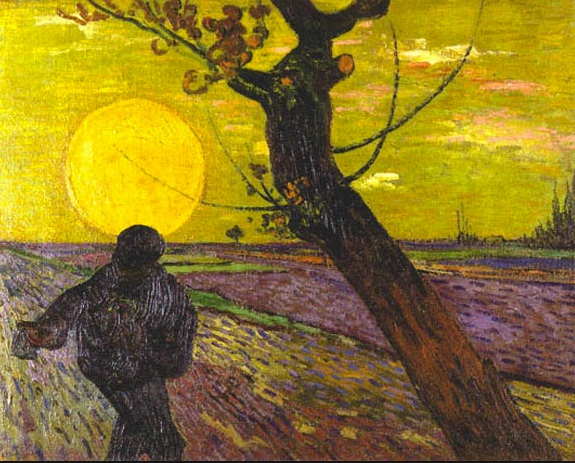
Sower

Be awhile before I get through Pope Francis’ encyclical, Laudato Si, filled as it is with thought provoking words. He says in this encyclical that we need to slow down, our world is too fast paced. This is a work to go through slowly.

He quotes from many sources, religious and secular. I found a little gem in a quotation Francis takes from a Sufi mystic: We need to regain and develop a mystical appreciation of the earth”

[159] The spiritual writer Ali al-Khawas stresses from his own experience the need not to put too much distance between the creatures of the world and the interior experience of God. As he puts it: “Prejudice should not have us criticize those who seek ecstasy in music or poetry. There is a subtle mystery in each of the movements and sounds of this world. The initiate will capture what is being said when the wind blows, the trees sway, water flows, flies buzz, doors creak, birds sing, or in the sound of strings or flutes, the sighs of the sick, the groans of the afflicted…” (EVA DE VITRAY-MEYEROVITCH [ed.], Anthologie du soufisme, Paris 1978, 200).

Francis urges us to feel the pain of our earth and those society ignores, like the unseen immigrants searching for a home somewhere. The Passion of the earth is a theme the Passionists have been addressing recently, influenced by the work of Fr. Thomas Berry, CP, who must be smiling from above at the pope’s efforts.

There’s something for everyone here.