Category Archives: Passionists

December 19: Zechariah in the Temple

Zachariah in Temple, William Blake Wiki Commons

The priest Zachariah goes into the temple bearing incense to worship the Lord , “In the days of King Herod”, our Advent readings says today. An angel appears next to the altar of incense and says to him. “Your prayer has been heard,..Your wife will bear you a son.”

Surely, the old priest was no longer praying for a son. Childbearing was over for his wife and himself. The promise of new life was long gone; there’s no hope for a child.

But the angel promises a child “great in the eyes of the Lord” to be called John, who will more than fulfill their hopes, turning “many of the children of Israel to their God.”

The old priest doubts and is punished with silence. He won’t speak until after the child is born. Then he speaks again,  as he announces to those at his birth that “his name is John.”

You lose your voice when you lose hope in God’s promises. You get it back when you believe. When John is born, Zechariah sings a song of praise at God’s unexpected  gift.

The Communion Prayer for today’s Mass says: “As we give thanks, almighty God, for these gifts you have bestowed, graciously arouse in us, we pray, the desire for those yet to come.”

Never doubt the gifts God wants to give, Zechariah tells us. Doubt silences us. God’s gifts give us a voice.

O Root of Jesse’s stem,
sign of God’s love for all his people:
come to save us without delay!

Readings here.

December 18: Joseph, Son of David

Nativity

In the gospel of Matthew  Joseph, the husband of Mary, has an important role in Jesus’ birth and early years. Mary points to him to tell the story of the birth of Jesus in the illustration above.

Matthew’s gospel calls Joseph  a just man, someone who listens to God rather than to himself. He does God’s will. He’s a carpenter, the gospels say, certainly not someone privileged – but he’s a “son of David” from the royal family who gives the world a Messiah.

During their betrothal, which in Jewish tradition was more than the modern engagement we know, Joseph finds that Mary is pregnant. A just man, he struggles to find a way to divorce her quietly when, in a dream, an angel of God tells him not to be afraid to take Mary as his wife.

Here is the key part of the angel’s message: “For it is through the Holy Spirit 
that this child has been conceived in her. She will bear a son and you are to name him Jesus, because he will save his people from their sins.”

Like Mary, Joseph believes God’s message. Like Mary, he sees more than human eyes and a human mind sees. “When Joseph awoke, he did as the angel of the Lord had commanded him and took his wife into his home.” He believed what we say in our creed: “(Jesus) was conceived by the Holy Spirit, born of the virgin Mary.” Jesus became one of us, God was with us.

Artists early on pictured Joseph with his head in his hands, listening in sleep to the angel’s message. In a dream later he heard the angel telling him to take the child and his mother to Egypt to escape Herod, the king. He was a man of great faith.

The medieval artist who painted the picture above has Mary pointing to Joseph as a witness to whose Child this is who’s’ born in a stable. They are the first to believe and they will care for Jesus with all the love and care they can give him.

Joseph has his hand on his head.. The angel spoke to him in dreams. Faith is like a dream where God speaks to us in another way.

O Leader of the House of Israel,
giver of the Law to Moses on Sinai:
come to rescue us with your mighty power!

The gospels for the remaining days until Christmas are from St. Luke, recalling the angel’s visit to Mary and her relative Zechariah. Matthew’s gospel will be read again after the birth of the Child, when Joseph will be warned of danger and takes the Child and Mary to Egypt and then to Nazareth..

Our Lady of Guadalupe

December 12th is the feast of Our Lady Guadalupe, which recalls the appearance of Mary on a hilltop near Mexico City to Juan Diego, a humble Mexican laborer, in 1591, ten years after the Aztec Empire was crushed by the colonial armies of Spain. Mary appeared dark skinned, with native features and in native dress, not at all like someone from the colonial powers. In appearing like them, Mary helped many of the native peoples accept Christianity.

Keep this story in mind when the next discussion on immigration comes up.It’s a strong reminder of Isaiah’s ancient call in our Advent readings: God wishes all to be his children.

Pope John Paul II said this about St. Juan Diego Cuauhtlatoatzin, whose feast is celebrated December 9th:

“He has lifted up the humble. God the Father looked down onto Juan Diego, a simple Mexican Indian and enriched him not just with the gift of rebirth in Christ but also with the sight of the face of the Blessed Virgin Mary and a role in the task of evangelizing the entire continent of America. From this we can see the truth of the words of St Paul: those whom the world thinks common and contemptible are the ones that God has chosen – those who are nothing at all to show up those who are everything.

“This fortunate man, whose name, Cuauhtlatoatzin, means “the eagle that speaks,” was born around 1474 in Cuauhtitlan, part of the kingdom of Texcoco. When he was an adult and already married, he embraced the Gospel and was purified by the waters of baptism along with his wife, setting out to live in the light of faith and in accordance with the promises he had made before God and the Church.

“In December 1531, as he was travelling to the place called Tlaltelolco, he saw a vision of the Mother of God herself, who commanded him to ask the Bishop of Mexico to build a church on the site of the vision. The bishop asked him for some proof of this amazing event.

“On 12 December the Blessed Virgin Mary appeared to Juan Diego once more and told him to climb to the top of the hill called Tepeyac and pick flowers there and take them away with him. It was impossible that any flowers should grow there, because of the winter frosts and because the place was dry and rocky. Nevertheless Juan Diego found flowers of great beauty, which he picked, collected together in his cape, and carried to the Virgin. She told him to bring the flowers to the bishop as a proof of the truth of his vision. In the bishop’s presence Juan Diego unfolded his cape and poured out the flowers; and there appeared, miraculously imprinted on the fabric, the image of the Virgin of Guadalupe, which from that moment onwards became the spiritual centre of the nation.

“The church was built in honor of the Queen of Heaven. Juan Diego, moved by piety, left everything and dedicated his life to looking after this tiny hermitage and to welcoming pilgrims. He trod the way to sanctity through love and prayer, drawing strength from the eucharistic banquet of our Redeemer, from devotion to his most holy Mother, from communion with the holy Church and obedience to her pastors. Everyone who met him was overwhelmed by his virtues, especially his faith, love, humility, and other-worldliness.

“Juan Diego followed the Gospel faithfully in the simplicity of his daily life, always aware that God makes no distinction of race or culture but invites all to become his children. Thus it was that he enabled all the indigenous peoples of Mexico and the New World to become part of Christ and the Church.”

Pope John Paul II

Feast of The Immaculate Conception

Why does Mary, the Mother of Jesus, have such a big place in our church? The words of the angel in Luke’s gospel, words we often repeat in prayer, are an answer: “Hail, full of grace, the Lord is with you.”

Mary is filled with God’s grace, gifted with unique spiritual gifts from her conception, because she was to be the mother of Jesus Christ, God’s only Son.

She would be the “resting place of the Trinity,” and would give birth to, nourish, guide and accompany Jesus in his life and mission in this world. To fulfill that unique role she needed a unique gift. She would be free from original sin that clouds human understanding and slows the way we believe God and his plan for us.

“How slow you are to believe” Jesus said to the two disciples on the way to Emmaus. Jesus made that complaint repeatedly as he preached the coming of God’s kingdom. “How slow you are to believe!” “What little faith you have!” “Do you still not understand!” Human slowness to believe didn’t end in gospel times. We have it too.

Mary was freed from that slowness to believe. “Be it done to me according to your word,” she immediately says to the angel. Yet, her acceptance of God’s will does not mean she understood everything that happened to her. “How can this be?” she asks the angel about the conception of the child. “The Holy Spirit will come upon you.”  But the angel’s answer seems so incomplete, so mysterious.

Surely, Mary would have liked to know more, but the angel leaves, never to return. There’s no daily message, no new briefing or renewed assurance by heavenly messengers. The years go by in Nazareth as the Child grows in wisdom and age and grace, but they’re years of silence. Like the rest of us, Mary waits and wonders and keeps these things in her heart.

That’s why we welcome her as a believer walking with us. She is an assuring presence who calls us to believe as she did, without knowing all. She does not pretend to be an expert with all the answers. She has no special secrets she alone knows. “Do whatever he tells you,” is her likely advice as we ponder the mysteries of her Son.

The feast of the Immaculate Conception is celebrated 9 months before the feast of the Birth of Mary (September 8). The feast  was extended to the universal Church by Pope Clement XI in 1708.

 Pope Pius IX solemnly proclaimed the Dogma of the Immaculate Conception in 1854: “We declare, pronounce, and define that the doctrine which holds that the most Blessed Virgin Mary, in the first instance of her conception, by a singular grace and privilege granted by Almighty God, in view of the merits of Jesus Christ, the Savior of the human race, was preserved free from all stain of original sin” (Ineffabilis Deus, 1854)

Do Whatever He Tells you

Thursday: 1st Week of Advent

OLYMPUS DIGITAL CAMERA

Readings:

Isaiah 26:1-6:  On the day of the Lord those who depend on God will enter God’s city.

Matthew 7: 21-24-27:  Build your house on rock.

Ancient peoples built their cities on rocky heights because they promised safety. With water, food and strong defenses they were less likely to be invaded. That’s why the Jews chose Jerusalem. Built high on a rocky mountain, it was safe.

There’s a city on God’s holy mountain, Isaiah says in today’s reading, where all peoples will dwell. Yet even now, our cities and places where we live are meant to be an image of the Holy City. Don’t depend on natural resources or human skills or human planning alone to build your earthly cities, the prophets warn. Don’t rely on them; they can’t save you. The strongest city becomes “a city of chaos” without God.

God builds the strong city, the prophet says; he is our Rock, our strong city: he admits through its gates “ a nation that is just; one that keeps faith.”

Build your lives on rock, Jesus says in the gospel. Don’t rely on a token faith (Lord, Lord) or be like fools who build on sand .

“Everyone who listens to these words of mine and acts on them will be like a wise person who built a house on rock.”

That’s true for our homes and the cities and places where we live.

A secular society like ours often sees religion as a destructive force or a brake on progress or something to be dispensed of. It turns to  “human reason” alone.

So how do we see our cities and countries today? Should be turn away from them and wait for the City on the Mountain? Time to wait for the right politician or a better economy, and take care of yourself?

I don’t think that’s the answer we get in this Season of Advent which proclaims the coming of Jesus Christ in the flesh to an earthly city.

“It is better to take refuge in the LORD, than to trust in man.                                                          It is better to take refuge in the LORD than to trust in princes.” 
(Psalm 118)

Saint Francis Xavier (1506-1552)

“All nations will come to climb the mountain of the Lord,” the Prophet Isaiah says in our Advent readings. Joining Portuguese merchants, Saint Francis Xavier went to far-off Asia, not for its exotic spices and goods, but to call all nations to follow Jesus Christ.

For 10 years, Francis Xavier labored in India, Japan and southeast Asia to bring the gospel to the native peoples of these lands. In a letter to St. Ignatius Loyola, the founder of the Jesuits, he explains that he’s so busy teaching and baptizing he has hardly a minute to himself. “Send help,” he says.

“Many, many people hereabouts are not becoming Christians for one reason only: there is nobody to make them Christians. Again and again I have thought of going round the universities of Europe, especially Paris, and everywhere crying out like a madman, riveting the attention of those with more learning than charity: ‘What a tragedy: how many souls are being shut out of heaven and falling into hell, thanks to you!’”

He’s driven by missionary zeal. Today, unfortunately, we’re becoming more like those university people in Paris– concerned about ourselves and ready to let the rest of the world go by.

The statue of Saint Francis Xavier above is  in the beautiful church of the Sacred Heart in Springfield, MA, where Father Theodore Foley went as a boy. Was it put there after a Novena of Grace preached by some Jesuit missionaries, I wonder? How many  people, like Theodore Foley, heard the story of the fiery missionary and saw themselves called to be missionaries ?

The Prophet Isaiah’s call to the nations is not confined to his time. God’s mission to the nations is for our time too.

https://vhoagland.wordpress.com/2014/02/08/father-theodore-foley-cp/

Advent: Tuesday, 1st Week


Edward Hicks, Peaceable Kingdom

“The calf and the young lion shall browse together, with a little child to guide them. A shoot shall sprout from the stump of Jesse, and from his roots a bud shall blossom.” (Isaiah 11,1)

A child stands atop Isaiah’s peaceable kingdom in Tuesday’s first reading at Mass. Edward Hicks, the Quaker painter, made over 100 copies of this scene from Isaiah, carefully indicating in the far left the peace treaty between William Penn and the native peoples of Pennsylvania in colonial America.

It takes a child to believe the astounding promises Isaiah makes. Adults, hardened by the experience of life, struggle with the prophet’s words. That’s why Advent invites us to become children, not physically, of course, but spiritually.

Become like little children. That’s what Jesus told his followers,  and he praised the childlike:

“I give you praise, Father, Lord of heaven and earth, for although you have hidden these things from the wise and the learned, you have revealed them to the childlike.” Luke 10

Only the childlike believe in great promises.

What does being “childlike” mean? Here’s what St. Leo the Great said about Jesus’s teaching on spiritual childhood: To be a child means to be “free from crippling anxiety, to be forgetful of injuries, to be sociable and to keep wondering at all things.”

A little child in its mother’s arms has no worries. It’s a good place to be, free from anxieties and a mother’s voice promising all will be well. Advent brings that grace back  to us; a grace we can lose so easily.

Jesus experienced that grace in Mary’s arms. Herod’s soldiers, like Isaiah’s Assyrian armies, were on their way. It’s a poor place where he’s born, no room in the inn, but the Child in his mother’s arms has no fear. All will be well.

Injuries come. The world can turn hostile. The promises may seem far away, but from infancy to his death, Jesus knew he was a child of God, his Father, in God’s caring hands and destined for God’s kingdom.

Help us, Lord to become like children

Saint Andrew, brother of Peter

Duccio_di_Buoninsegna_036

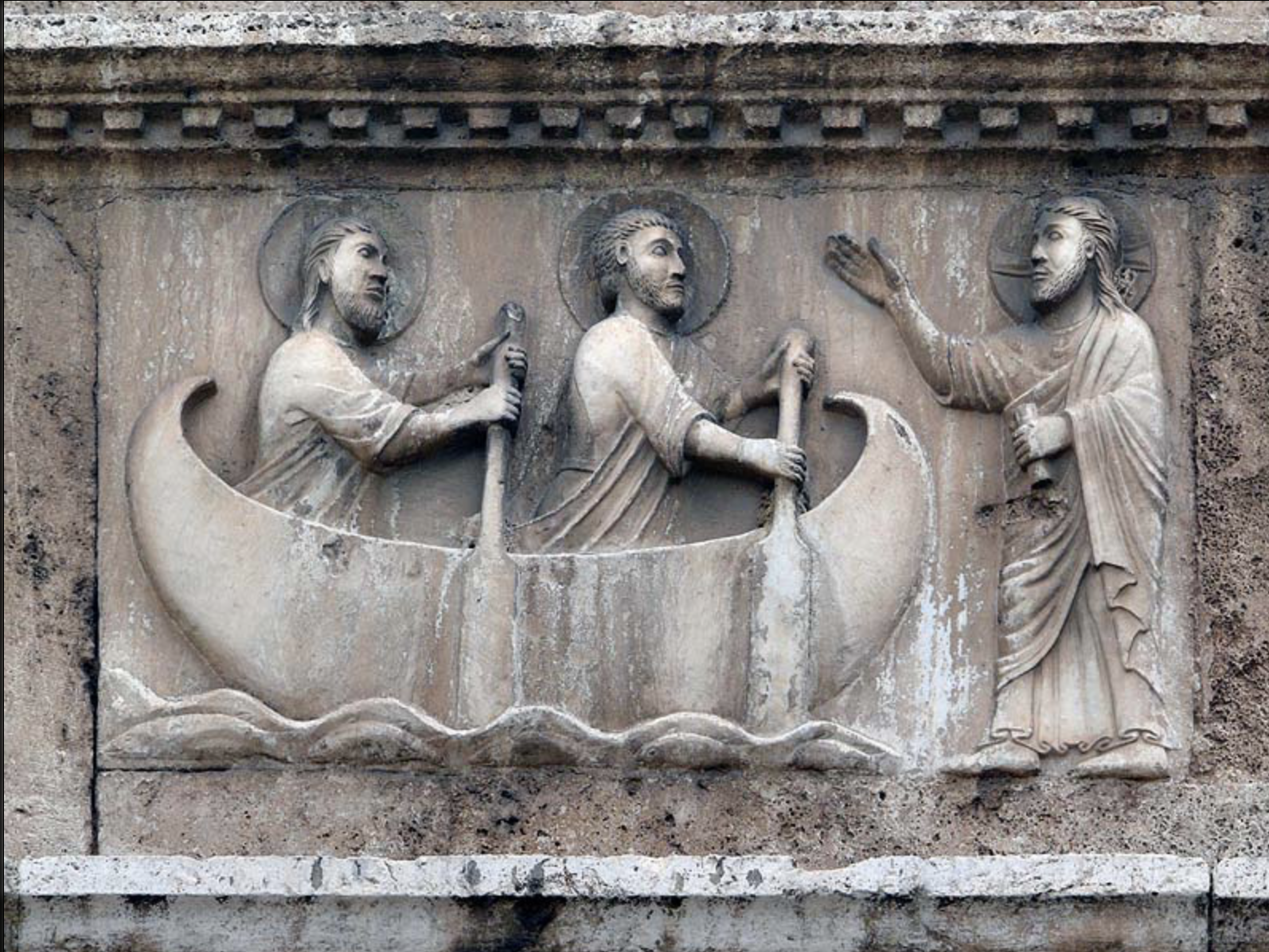
November 30th is the Feast of St. Andrew. On the lakeshore in Galilee Jesus called him and his brother Simon Peter to follow him. We only know a few details about Andrew. What are they?

He’s a fisherman, of course. Andrew is a Greek name. Why would a Jew have a Greek name? The area around the Sea of Galilee was then multi-cultural, and Andrew’s family were originally from Bethsaida, a trading town in the upper part of the Sea of Galilee with a substantial Greek population. Would that explain why they may have spoken some Greek?  Afterwards they located in Capernaum, another trading town close by.

Could that explain why later in John’s gospel, Andrew and Philip bring some Greek pilgrims to Jesus before his death in Jerusalem. Jesus rejoices, seeing them as signs that his passion and glorification will draw all nations to him. One sees why the Greek church has Andrew as its chief patron: he introduced them to Jesus.

Bethsaida, on the northern shore of the Seas of Galilee, has been recently excavated.

Bethsaida 393
Bethsaida: Winegrowers house
IMG_0632
Bethsaida: Ruins
IMG_0624
Bethsaida: Ruins

 Andrew seems to have an interest  in religious questions. He’s described as a disciple of John the Baptist, who points Jesus out to him. Jesus then invites Andrew and another disciple to stay for a day with him. “Come and see.” Afterwards, Andrew “found his brother Simon and said to him ‘We have found the Messiah.’” (John 1,35-41)

I notice too that Andrew bring the little boy with the bread and fish to the attention of Jesus.

The Greek Church sees  Andrew as the first of the apostles because he’s the first to follow Jesus; then he calls his brother. Western and eastern Christian churches together celebrate his feast on November 30th.

The letter to the Romans, the first reading for his feast in the Roman Catholic liturgy, stresses there is no distinction between Jew and Greek, and praises messengers who bring God’s word to others. Tradition says Andrews brought the gospel to the Greeks, and also claims that Andrew was crucified on the beach at Patras in Greece. Besides Greece, Andrew’s also the patron of Russia and Scotland.

We ask you, O Lord,
that, just as the blessed Apostle Andrew
was for your Church a preacher and pastor,
so he may be for us a constant intercessor before you.

Troparion (Tone 4) (Greek Orthodox)

Andrew, first-called of the Apostles
and brother of the foremost disciple,
entreat the Master of all
to grant peace to the world
and to our souls great mercy.
Kontakion (Tone 2)

Let us praise Andrew, the herald of God,
the namesake of courage,
the first-called of the Savior’s disciples
and the brother of Peter.
As he once called to his brother, he now cries out to us:

“Come, for we have found the One whom the world desires!”

Finally, from John Chrysostom in our Office of Reaadings today, we learn how to read the scriptures:

After Andrew had stayed with Jesus and had learned much from him, he did not keep this treasure to himself, but hastened to share it with his brother. Notice what Andrew said to him: We have found the Messiah, that is to say, the Christ. Notice how his words reveal what he has learned in so short a time. They show the power of the master who has convinced them of this truth. They reveal the zeal and concern of men preoccupied with this question from the very beginning. Andrew’s words reveal a soul waiting with the utmost longing for the coming of the Messiah, looking forward to his appearing from heaven, rejoicing when he does appear, and hastening to announce so great an event to others. To support one another in the things of the spirit is the true sign of good will between brothers, of loving kinship and sincere affection. 

  Notice, too, how, even from the beginning, Peter is docile and receptive in spirit. He hastens to Jesus without delay. He brought him to Jesus, says the evangelist. But Peter must not be condemned for his readiness to accept Andrew’s word without much weighing of it. It is probable that his brother had given him, and many others, a careful account of the event; the evangelists, in the interest of brevity, regularly summarise a lengthy narrative. Saint John does not say that Peter believed immediately, but that he brought him to Jesus. Andrew was to hand him over to Jesus, to learn everything for himself. There was also another disciple present, and he hastened with them for the same purpose. 

  When John the Baptist said: This is the Lamb, and he baptizes in the Spirit, he left the deeper understanding of these things to be received from Christ. All the more so would Andrew act in the same way, since he did not think himself able to give a complete explanation. He brought his brother to the very source of light, and Peter was so joyful and eager that he would not delay even for a moment.

Saving Santa Claus

Santa came to town for Macy’s annual Thanksgiving Parade. From the parade he went into the store for Black Friday and he will be there for the rest of the days till Christmas.

More than a salesman, Santa’s a saint– Saint Nicholas– and he reminds us Christmas is for giving rather than getting. His quiet giving mirrors God’s love shown in Jesus Christ.

Telling his story is one of the ways we can save Santa Claus from being captured by Macys and Walmart and all the rest. First, take a look at our version for little children, which has over 200,000 views on YouTube. How about telling that story to a real little kid you know? Wouldn’t you rather they know someone like him than the guy in the store in a red suit?

Then, you might want to go on to our  modest contribution for bigger children– like us:

A Thanksgiving Prayer

Noah

Thanksgiving is a good time to remember our blessings, starting with Creation itself .  I’m sure that was Noah’s prayer when God delivered him.

All-powerful God,
you are present in the whole universe
and in the smallest of your creatures.
You embrace with your tenderness all that is.
Pour out upon us the power of your love,
that we may protect life and beauty.
Fill us with peace, that we may live
as brothers and sisters, harming no one.
O God of the poor,
rescue the abandoned
and forgotten of this earth,
so precious in your eyes.
Bring healing to our lives,
that we may protect the world and not prey on it,
that we may sow beauty,
not pollution and destruction.
Touch the hearts
of those who look only for gain
at the expense of the poor and the earth.
Teach us to discover the worth of each thing,
We thank you for being with us each day.
Encourage us, we pray, as we struggle
for justice, love and peace.

Happy Thanksgiving.