Crucifix: St. Michael’s Monastery, Union City, New Jersey
St. Thomas Aquinas
St. Bernard of Clairvaux
St. Paul of the Cross
St. Gabriel of the Sorrowful Mother
Artist: Mother Mary of the Compassion, Dominican Chapel, Union City, NJ
Four saints face the great crucifix that was once above the altar in the monastery chapel of St. Michael’s Passionist Monastery, Union City, New Jersey. St. Paul of the Cross, St. Gabriel of Our Lady of Sorrows, St. Thomas Aquinas and St. Bernard of Clairvaux. Mother Mary of the Compassion, a renowned artist from the Dominican Convent in Union City, painted the saints.
Thomas and Bernard represent the guides the Passionists follow in their search into the mystery of Christ. Bernard represents their search through devotional prayer and preaching. Aquinas represents those who guide them into the mystery of the Cross through theological study and the search for truth.
St. Michael’s Monastery in Union City was formerly the headquarters of the Passionists in the United States and a place for formation of their young religious. The Passionists left Union City on June 1, 2012.
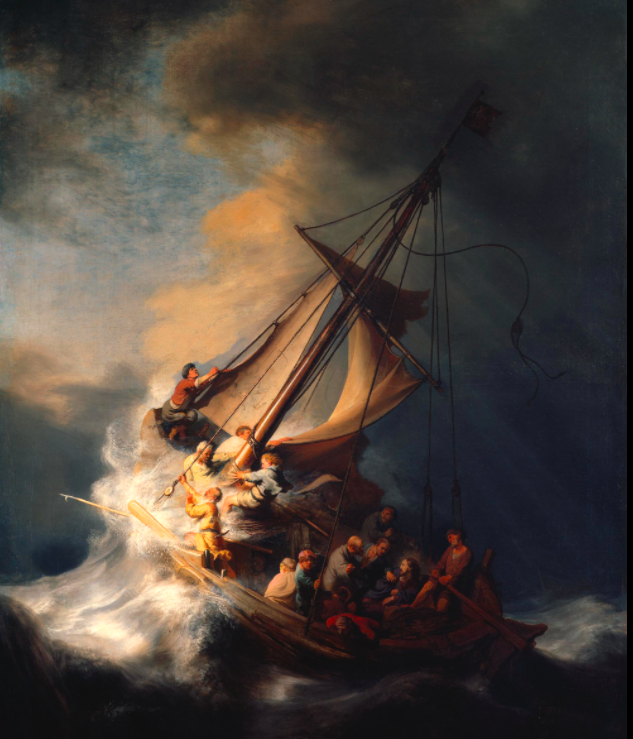
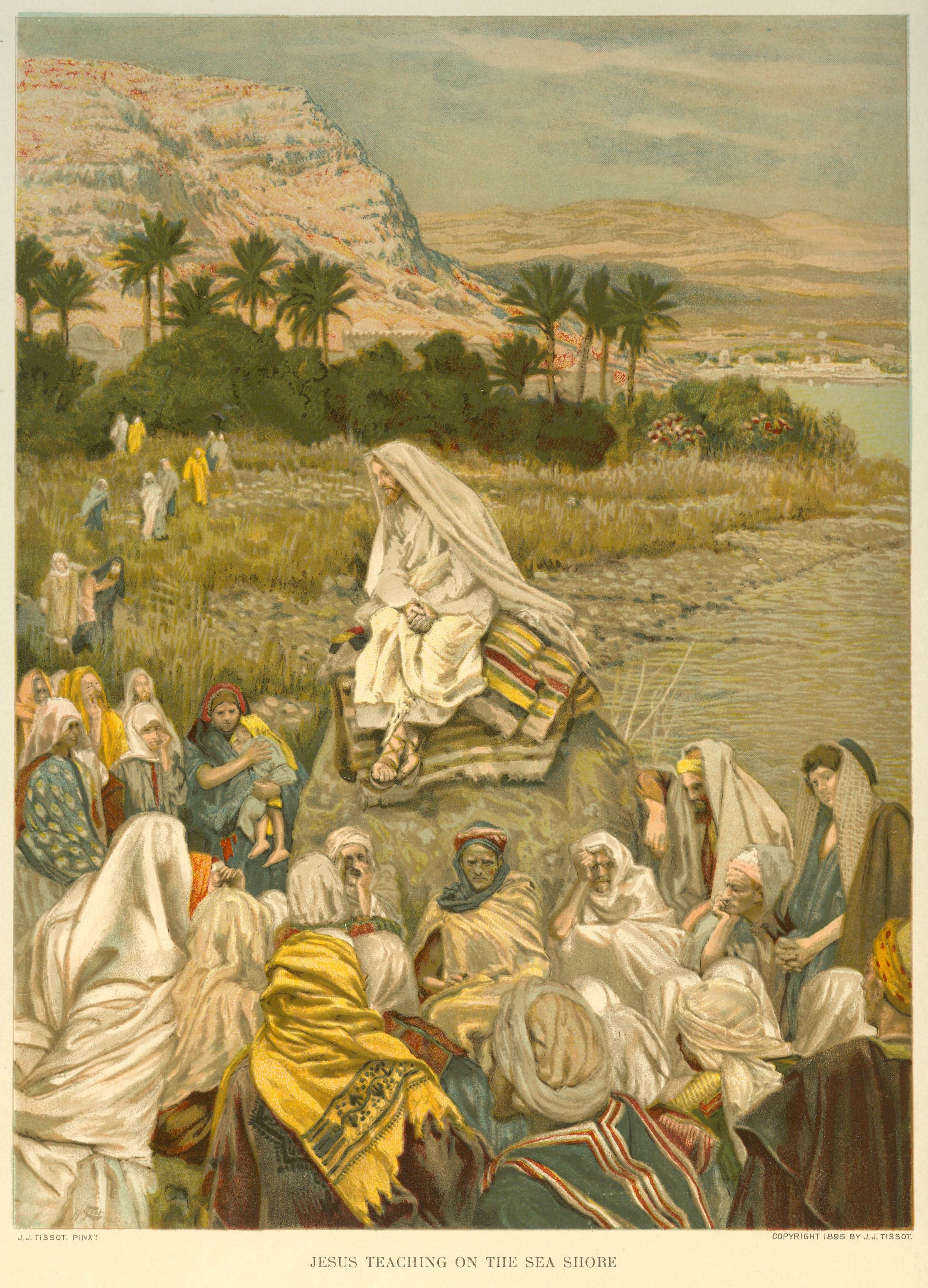
Earlier in the day, Jesus taught the crowds and his disciples gathered at the lakeshore, Mark’s Gospel says. His words were wise and reassuring, words to set the course of your life on. Then, as evening drew on, he said to them ‘Let us cross to the other side.’” (Mark 4:35-41) He and his disciples sail onto the Sea of Galilee and “ a violent squall came up, waves breaking over the boat so that it was already filling up. “Jesus was in the stern asleep on a cushion.” They were afraid they were going to drown, and Jesus in the stern of the boat seemed asleep, unaware of their fears. It’s hard to make him out in Rembrandt’s dramatic picture of the storm.
A good image of how life can turn out, isn’t it? Words of faith bring such strength and assurance. “Peace be with you.” “I am the vine, you are the branches.” “I’m with you all days.” “I am the way, the truth and the life.”
Then, the storms come; unexpectedly, powerfully, with frightening suddenness sometimes, turning our lives upside down. Overwhelmed by life’s quick tragedies and doubts, we forget God’s assurances. Like Jesus in the boat, God seems asleep, unaware of our experience.
Mark’s gospel is good to reflect on today, isn’t it? Wars, political and economic storms, the planet endangered by wild seas and changing weather. “The winds and the sea obey him,” our gospel today reminds us. God is for stormy times as well as fair. He doesn’t want us to perish. “Have faith,” he says, “I’m with you.” God’s with us in storms.
Still, like the disciples we say “Teacher, do you not care that we are perishing?” ( Mark 4:37)
Today’s reading from the Letter to the Hebrews offers another dimension to our story. Abraham and his wife Sarah are past child-bearing age. Where are the promises of God, they wonder? Like so many older people they can’t see a promise in the future. Their dreams of children or what they have given their life to, unfulfilled.
“Have faith, I am with you,” God says. God fulfills his promises.
Commentators find it hard to establish the time and place the Epistle to the Hebrews was written. Most say it was written for early Jewish Christians trying to figure out their relationship to the religion of their ancestors.
I wonder if Jewish Christians in Rome would be especially among those for whom the letter was written. Rome is one of the places commentators say it might have originated..
The Jewish Christian community of Rome was a large community attached to Jerusalem and the temple, even Jews who had embraced a new faith. They would have been onlookers as Titus marched triumphantly into the Rome carting the spoils and slaves in chains from the Jewish wars and the destruction of the temple in 70. Afterwards, they would have watched the Colosseum bring built with the gold from the temple. Less than 5 years before some were singled out as renegade Jews and blamed by Nero for the great fired that had destroyed the city.
As we read the words from the Epistle to the Hebrews today I wonder if we hear words written especially for them.
“Let us hold unwaveringly to our confession that gives us hope, for he who made the promise is trustworthy.We must consider how to rouse one another to love and good works. We should not stay away from our assembly, as is the custom of some, but encourage one another, and this all the more as you see the day drawing near.” Hebrews 10:19-25
It would be a hard time then for Jewish Christians in Rome “to put your light on a lamp stand,” as we read in today’s gospel . It was a time for laying low, “staying away from our assembly.”
Faith has to be professed in season and out of season. It’s never to be hid under a bushel.
Jesus said to the crowds: “This is how it is with the Kingdom of God; it is as if a man were to scatter seed on the land and would sleep and rise night and day and the seed would sprout and grow, he knows not how. Of its own accord the land yields fruit, first the blade, then the ear, then the full grain in the ear. And when the grain is ripe, he wields the sickle at once, for the harvest has come.”
He said, “To what shall we compare the Kingdom of God, or what parable can we use for it? It is like a mustard seed that, when it is sown in the ground, is the smallest of all the seeds on the earth. But once it is sown, it springs up and becomes the largest of plants and puts forth large branches, so that the birds of the sky can dwell in its shade.” With many such parables he spoke the word to them as they were able to understand it. Without parables he did not speak to them, but to his own disciples he explained everything in private. (Mark 4: 26-34)
“Without parables, he did not speak to them.” The parables Jesus spoke were mostly from the natural world, if we read Mark right. Is that how we should speak to the crowds today, from the world of nature?
Mark’s gospel today describes the arrival of Mary his mother and some of his relatives from Nazareth. (Mark 3: 32-35) They’re outside a house crowded with people gathered around Jesus, some looking to be cured, some to listen to what he has to say. Jesus and his disciples don’t even have time to eat, Mark says.
His family come because they want to take him home; some think he is out of his mind . (Mark 3:20-21) When people tell him ‘Your mother and your brothers and your sisters are outside asking for you.’ Jesus said to them in reply, ‘Who are my mother and my brothers?’ And looking around at those seated in the circle he said, ‘Here are my mother and my brothers. For whoever does the will of God is my brother and sister and mother.’” (Mark 3: 32-35)
Jesus sees people of faith as his family, his mother, brother and sister. He considers us who believe in him his family.
But we continue to ask: Why does his own family think he is out of his mind?
His mother Mary is with them. What does she think?
The gospels, Matthew 13:54-58, Mark 6: 1-6, Luke 4:16-30 all point to Nazareth as a place where Jesus is rejected. Luke’s gospel sees the rejection of Jesus at Nazareth in the harshest terms. They are ready to hurl him from the hill after the claims he makes in their synagogue. His visit to Nazareth is headed for violence, but a violence postponed, and no one takes his part. ( Luke 4:16-36 )
Mary lived there. What was it like for her? What was it like to be with family members who thought her son was mad? What was it like to be day after day with people who didn’t believe in her son? No one from Nazareth is among the 12 disciples Jesus chooses. The rejection of Jesus by the people of his own town, his own family and relatives, was a sword that pierced her heart.
We might say Mary’s faith was strong and kept her secure, but was it a faith that knew everything? Did it save her from questioning?
I wonder if we can see Mary’s appearance at Lourdes and Fatima in some way related to her own experience at Nazareth. She appears in places when the faith of ordinary people is severely challenged by a world increasingly hostile to belief.
She knows how to believe when everyone else does not. We welcome her today to be with us.
Two worlds are described in the readings at Mass these weekdays. The Gospel of Mark tells of the world around Capernaum by the Sea of Galilee, where Jesus called his first disciples, encountered a demon in the synagogue, cured Peter’s mother in law, the paralyzed man and the leper– where he was fiercely opposed. (Mark 1,14-2,12) He became involved in a world like ours..
The world described in the Letter to the Hebrews is a world beyond this one, the world of the Risen Lord where he sits at the right hand of God the Father Almighty..
The Letter to the Hebrews describes him further as a High Priest entering a heavenly sanctuary to intercede for us, a merciful High Priest. He is the same Jesus who entered Capernaum and cured Peter’s mother in law, the paralyzed man and the leper. He’s knows our humanity with its yearning, its weakness and hardness; he carries the wounds of suffering and death.
It’s hard to keep these two worlds in mind, but our readings, like our creed, tell us to do it. The worlds are not sealed off, they’re joined. They have a common goal: “Our Father, thy will done, thy kingdom come.” The Risen Jesus is present in both of these worlds as Savior and Redeemer. Through him, God’s kingdom will come.
Unfortunately, we may think only of the world we see now, unsure or confused about a world beyond this one. We may see the world beyond as an escape from this life, an isolated world in the clouds.
Both worlds are important to keep in mind. Together they help us see life in the full. A gift of God, greater than we can imagine.
In its first chapters Mark’s gospel highlights the remarkable actions of Jesus in the towns near the Sea of Galilee as he confronts demons and heals many. Only in chapter 4 does Mark give examples of his teaching.
For Mark, what Jesus did was more important than what he said. When he taught, he taught in parables– “without parables he did not speak to them.”
“A parable is a metaphor or simile drawn from nature or common life, arresting the hearer by its vividness or strangeness and leaving the mind in sufficient doubt about its precise application to tease it into active thought.” (C.H. Dodd)
Jesus drew his parables from the natural, religious and political worlds around him. Galilee was a land of farms and vineyards, farmers and fishermen, so when Jesus spoke of the ways of seed and soil, of nets cast into the sea, he spoke of a world his hearers knew well. When he spoke of David feeding his followers on the Sabbath or Elijah the prophet, or scribes and Pharisees, his hearers knew those figures as well.
What about his political world? Galilee then was ruled by Herod Antipas, an ambitious descendant of Herod the Great and a member of a family fighting fiercely for positions of power under Rome’s thumb. He ambitiously expanded Galilee’s economy. Large cities like Tiberias, Sephorris, Caesarea Philippi, Caesarea Maritima were being built, roads to ship Galilee’s produce were laid out. Funding for its development came from the collection of taxes. Some grew rich; many did not. The burden fell on the poor.
The scribes and pharisees were not the only ones who saw themselves targets of the parables Jesus spoke. The “Herodians”, followers of Herod Antipas, also saw the political world they represented attacked. (Mark 3: 6)
The parables of Jesus, in C. H. Dodd’s words, are meant “to tease the mind into active thought.” They call us to think and question, to wonder and then act. In his parables Jesus asks “What do you think and what will you do about it ?”
We don’t live in the time of Jesus, but his parables still call us. His parables drawn from nature may be especially important today as our world faces climate change. We need to re-engage more deeply with nature and it seasons and its care
But we also need to engage in our religious and political worlds as he did. We’re not spectators looking on, accepting what we see on a screen. HIs parables are meant to tease our minds into active thought. What do you think and what will you do about it ?”
“What do you think of your church and what will you do about it?”
“What do you think of your country and what will you do about it?”
“What do you think of your world and what will you do about it?”



 The Victor's Place