For this week’s homily, please watch the video below.
16th Sunday c: Hospitality
Leave a reply
For this week’s homily, please watch the video below.

This Thursday, appropriately, we read the Passover account from the Book of Exodus in our lectionary. The mystery of the Passover is the mystery of Christ, the beautiful homily of Melito, an early bishop of Sardis, says.
“For the sake of suffering humanity he came down from heaven to earth, clothed himself in that humanity in the Virgin’s womb, and was born a man. Having then a body capable of suffering, he took the pain of fallen humanity upon himself; he triumphed over the diseases of soul and body that were its cause, and by his Spirit, which was incapable of dying, he dealt man’s destroyer, death, a fatal blow.
He was led forth like a lamb; he was slaughtered like a sheep. He ransomed us from our servitude to the world, as he had ransomed Israel from the hand of Egypt; he freed us from our slavery to the devil, as he had freed Israel from the hand of Pharaoh. He sealed our souls with his own Spirit, and the members of our body with his own blood.
He is the One who covered death with shame and cast the devil into mourning, as Moses cast Pharaoh into mourning. He is the One who smote sin and robbed iniquity of offspring, as Moses robbed the Egyptians of their offspring. He is the One who brought us out of slavery into freedom, out of darkness into light, out of death into life, out of tyranny into an eternal kingdom; who made us a new priesthood, a people chosen to be his own for ever. He is the Passover that is our salvation.
It is he who endured every kind of suffering in all those who foreshadowed him. In Abel he was slain, in Isaac bound, in Jacob exiled, in Joseph sold, in Moses exposed to die. He was sacrificed in the Passover lamb, persecuted in David, dishonored in the prophets.
It is he who was made man of the Virgin, he who was hung on the tree; it is he who was buried in the earth, raised from the dead, and taken up to the heights of heaven. He is the mute lamb, the slain lamb, the lamb born of Mary, the fair ewe. He was seized from the flock, dragged off to be slaughtered, sacrificed in the evening, and buried at night. On the tree no bone of his was broken; in the earth his body knew no decay. He is the One who rose from the dead, and who raised man from the depths of the tomb.
At that time Jesus said in reply,* “I give praise to you, Father, Lord of heaven and earth, for although you have hidden these things from the wise and the learned you have revealed them to the childlike.
Yes, Father, such has been your gracious will. All things have been handed over to me by my Father. No one knows the Son except the Father, and no one knows the Father except the Son and anyone to whom the Son wishes to reveal him.
“Come to me, all you who labor and are burdened, and I will give you rest. Take my yoke upon you and learn from me, for I am meek and humble of heart; and you will find rest for yourselves. For my yoke is easy, and my burden light.”
There’s new interest today in the founders of my country: Washington, Jefferson, Adams, Franklin. New biographies and media presentations, present their struggles to bring our country to birth in trying circumstances. Yes, they had clay feet, like all of us. They could be vain, deceitful, wrong-headed and trapped in the limited vision of their time. So are we. But they were also brave, idealistic, courageous, patient, willing to sacrifice for the unknown. We hope to imitate them.
They tell the story that General Washington after the war met with a number of his disgruntled troops, who hadn’t been paid or rewarded by the Continental Congress for their long years of hard service. The ex-soldiers were angry, on the brink of another revolution.
Washington took out a paper to address the troops, but he couldn’t read it. His eyesight was failing him. So he put on a pair of spectacles. “Excuse me, gentlemen,” he said, “ but I have lost my sight in the service of my country. “
No one remembered what Washington said that day, but the mood of the men changed. They remembered what this man had gone through.
It’s important to honor our heroes, to keep them in mind. We’re living in an unfinished world, an unfinished church and an unfinished country. They lived that way too. We must learn from them how to do what we are given to do.
In the gospel today, Jesus says, “Come to me, all you who labor and are burdened, and I will give you rest…Learn from me.”
He is the Great Hero. Remember his story: his poor birth, his love for those with little, his assurances of God’s care, his cruel death and then his resurrection. With our labors and burdens, we come to rest in him, to learn from him, to share his life and be refreshed.
He is the Bread of the Strong, so that in our time we can be strong.

Modern historians, looking at Moses, ask did he really exist? When did he live and what are the facts of his life?
The 4th century writer, Gregory of Nyssa, in his classic work “The Life of Moses”, asks a different question: How can we see our own journey to God in him?
In the 120 years of his life Moses was on a journey to God. . He shows us how God draws us to himself in our life’s journey.
Exodus 2,1-15 brings us to his birth and first 40 years. His Jewish mother puts him in the Nile river in a little boat ( the word for boat in Exodus is the same word used in Genesis for Noah’s ark). Those years are not without danger, but Moses–like all of us – is placed on the river of life, with a mission from God and God’s protection.
Moses’ adoption by Pharoah’s daughter brought him the wealth of Egypt. He makes his way to God with human gifts as well as divine gifts, and so do we. We’re blessed with gifts, human and divine, and we must use them.
Moses’ first forty years end with the killing of the Egyptian and his subsequent flight to the mountainous desert of Midian. There, Moses meets God alone in the burning bush and choses to stand with God.
If we want to see the face of God, we’re called to face the burning mystery of God and choose to stand with him.
Then, at eighty years, Moses begins the next stage of his life: leading his people through the desert to the promised land. Eighty years old– hardly a good time for something like that, isn’t it?
For Gregory, though, Moses’ life is an inward journey, not so much of events, as a journey of desire, and the journey of desire is a constant journey–an ascent– that never ends or grows old in this life. It’s not ended by sickness or the cessation of our active lives and responsibilities. Here’s how Gregory describes it:
“…the great Moses, becomes ever greater, he never stops his ascent, never sets a limit to his upward course. Once setting his foot on the ladder that God sets up (as Jacob says) he continually climbed to the step above and never ceases to rise higher, because there was always a step higher than the one he attained…though lifted up through his lofty experiences, he’s still unsatisfied in his desire for more. He still thirsts for what seems beyond his capacity… asking God to appear to him, not according to his capacity, but according to God’s true being.
“Such an experience seems to me to belong to the soul who loves the beautiful. Hope always draws the soul from the beauty that’s seen to what ‘s beyond; it always kindles the desire for what’s hidden from what’s now known. Boldly requesting to go up the mountain of desires the soul asks to enjoy Beauty, not in mirrors, or reflections, but face to face. “ (Gregory of Nyssa)
“Old men ought to be explorers
Here or there does not matter
We must be still and still moving
Into another intensity
For a further union, a deeper communion
Through the dark cold and the empty desolation,
The wave cry, the wind cry, the vast waters
Of the petrel and the porpoise. In my end is my beginning.” T. S. Eliot, Four Quartets

The 11th and 12th chapters of Matthew’s gospel which we’re reading this 15th week of the year describe a growing opposition to Jesus after he begins his ministry in Galilee. It’s a dark section of the gospel.
The Pharisees now take “counsel against him to put him to death” and begin to oppose him. (Matthew 12.14) They’re not satisfied with his teachings and his miracles and demand a sign. They’re joined by the Herodians, agents of Herod Antipas, ruler in Galilee. The political establishment joins the opposition.
Jesus is also opposed by “this generation” of Israelites, the towns “where most of his mighty deeds had been done,” Corazin, Bethsaida, Capernaum. (Matthew 11,16-19) The towns that first welcomed him enthusiastically now dismiss him.
Finally, another group, who may surprise us, appear to oppose him – his family from Nazareth. (Matthew 12,47-50) All together, this opposition must have affected Jesus, as he faced the fickleness of humanity and even those closest to him.
But it also must have affected his disciples as well, who joined him expecting to see God’s kingdom come. I think they’re among those whom Jesus prays for in the gospel read today and tomorrow:
“I give praise to you, Father, Lord of heaven and earth, for although you have hidden these things from the wise and the learned you have revealed them to the childlike.
Yes, Father, such has been your gracious will. All things have been handed over to me by my Father. No one knows the Son except the Father, and no one knows the Father except the Son and anyone to whom the Son wishes to reveal him.”
His first disciples were not wise or learned, they were more like children excited by what they saw Jesus do and say. They were struck by the miracles he worked and the wisdom he taught in parables. Yet, they would have been affected by the growing rejection to him.
Are we like them in a time like ours, when he in the church he founded meets so much rejection? The Lord prays for us too, little children not wise or clever.

You would expect a great theologian like St. Bonaventure (July 15) to tell you to hit the books if you would want to go to God. After all, his treatise we read on his feast is called “The Journey of the Mind to God.”
Instead he directs us to Christ and the Cross as our way to God.
” If you ask how such things can occur, seek the answer in God’s grace, not in doctrine; in the longing of the will, not in the understanding; in the sighs of prayer, not in research; seek the bridegroom not the teacher; God and not man; darkness not daylight; and look not to the light but rather to the raging fire that carries the soul to God with intense fervour and glowing love.”
A shelf of scripture commentaries and theology books wont bring us wisdom of themselves, St. Bonaventure says in his Breviloquium, otherwise only scholars would enter the kingdom of heaven. That’s not to say study isn’t important and scholars and scientists are not necessary. Bonaventure was a great theologian, but he knew we must be humble before God and the divine plan that’s beyond our grasp.
“The stream of holy Scripture flows not from human research but from revelation by God. It springs from the Father of lights, from whom all fatherhood in heaven and on earth takes its name. From him, through his Son Jesus Christ, the Holy Spirit flows into us; and through the Holy Spirit, giving, at will, different gifts to different people, comes the gift of faith, and through faith Jesus Christ has his dwelling in our hearts. This is the knowledge of Jesus Christ which is the ultimate basis of the solidity and wisdom of the whole of holy Scripture…
If we are to follow the direct path of Scripture and come straight to the final destination, then right from the beginning – when simple faith starts to draw us towards the light of the Father – our hearts should kneel down and ask the Father to give us, through his Son and the Holy Spirit, true knowledge of Jesus and of his love. Once we know him and love him like this, we shall be made firm in faith and deeply rooted in love, and we can know the breadth, length, depth and height of holy Scripture.”
Sometime ago I stumbled on a map of New York rivers and lakes. Rivers and lakes were the roads and highways used by the native peoples and early settlers centuries ago. Even today, the New York Thruway follows the Hudson and Mohawk Rivers from New York City to Buffalo.
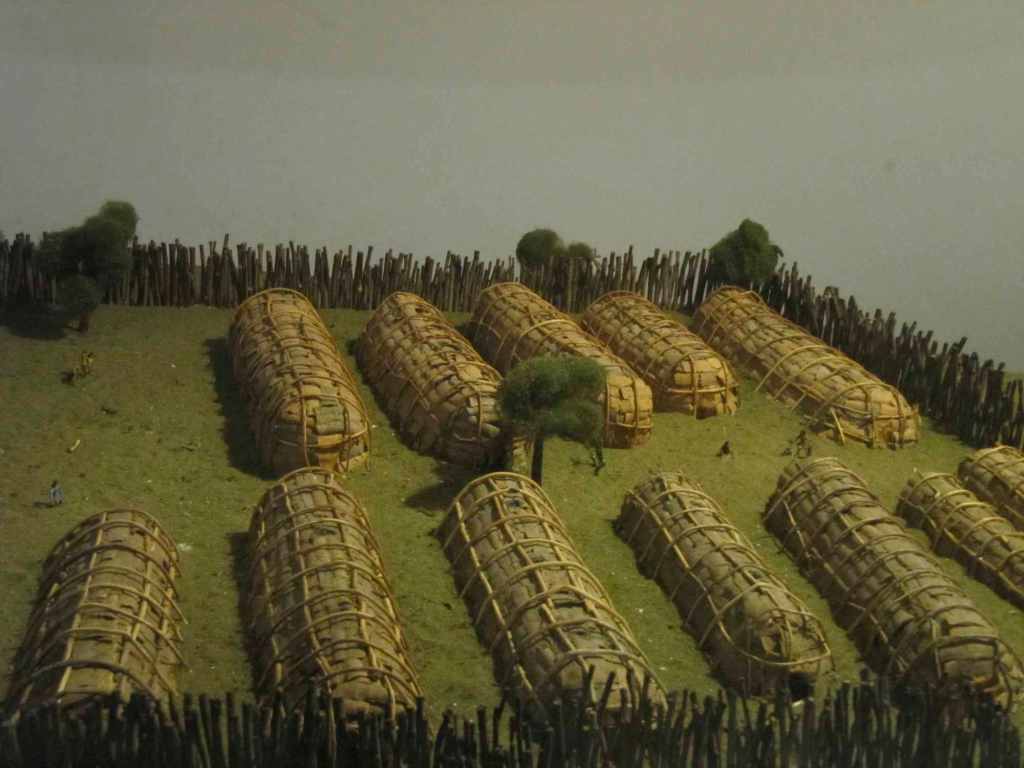
Just north of Albany near the town of Fonda are the ruins of the17th century Mohawk village of Caughnawaga, excavated in the 1950s by a Franciscan priest, Thomas Grassmann. In the excavated village are traces of 12 long houses surrounded by a fortified stockade which was built in 1666 after a French army from Quebec destroyed an earlier Mohawk village at Osserneron (today, Auriesville) a few miles south.
The French army was punishing the Mohawks for their part in the Iroquois-Huron wars, when they plundered and destroyed villages along the St. Lawrence River belonging to the Hurons and Algonquins, Indian allies of the French. The Mohawks, members of the Iroquois confederation, wanted to gain control of the fur trade from their northern neighbors.
In destroying Ossernenon, the French army was also probably avenging the deaths of Fr. Isaac Jogues, SJ, and Rene Goupil and Gabriel Lalande, three French missionaries killed in that village some years before: honored today by the Church as martyrs.
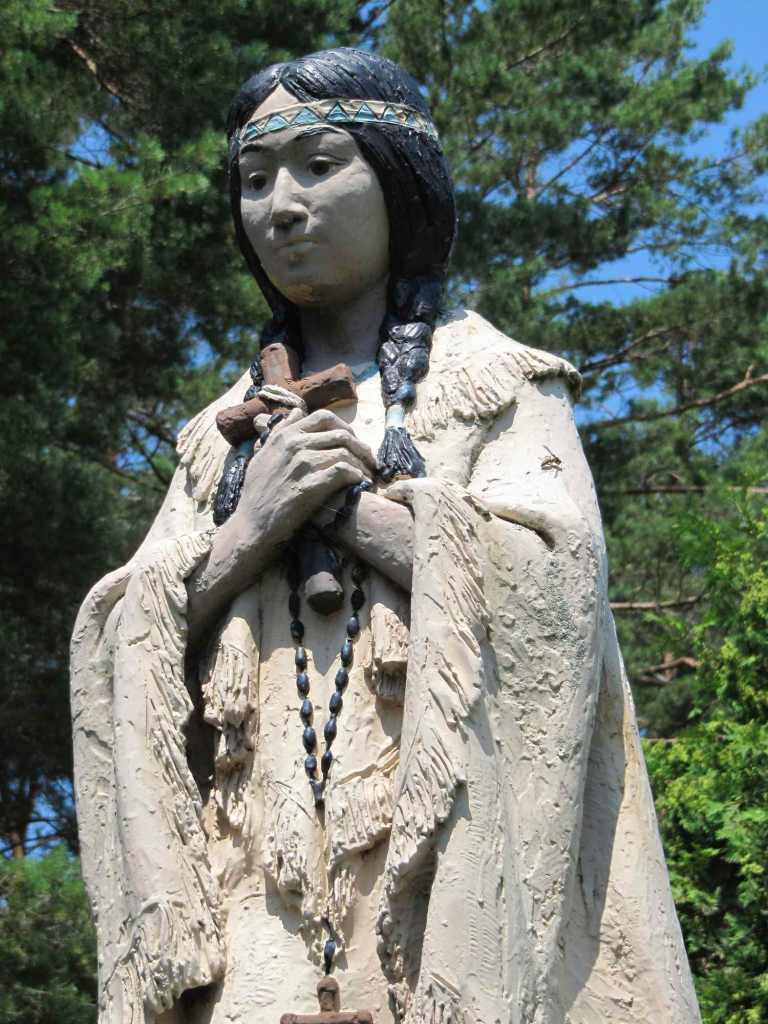
In the war against their neighbors to the north, the Mohawks took women and children captive. At the time, native tribes replenished their own numbers–diminished by wars or disease– by kidnapping members from other tribes. One of the Christian Algonquin women captured in an earlier raid married a Mohawk brave from Ossernenon and they had a daughter, Kateri Tekakwitha (1656-1680), whom the Catholic Church honors as a saint.
An epidemic of smallpox ravaged Ossernenon when Kateri was four years old, killing many children and adults. The young girl almost died of the disease that left her disfigured. Her early Jesuit biographer says, “ She almost lost her eyesight, and her eyes hurt so much from this illness that she covered herself with a blanket when out in strong light.” (The Life of the Good Catherine Tekakwitha, Claude Chauchetiere, SJ , 1695)
Both parents died when Kateri was a little girl and she was taken in by relatives in the new Mohawk village of Caughnawaga (Fonda), where she lived most of her life. Her mother was a devout Christian and must have told her about Christianity, but Kateri’s new family and tribe strongly opposed the religion.
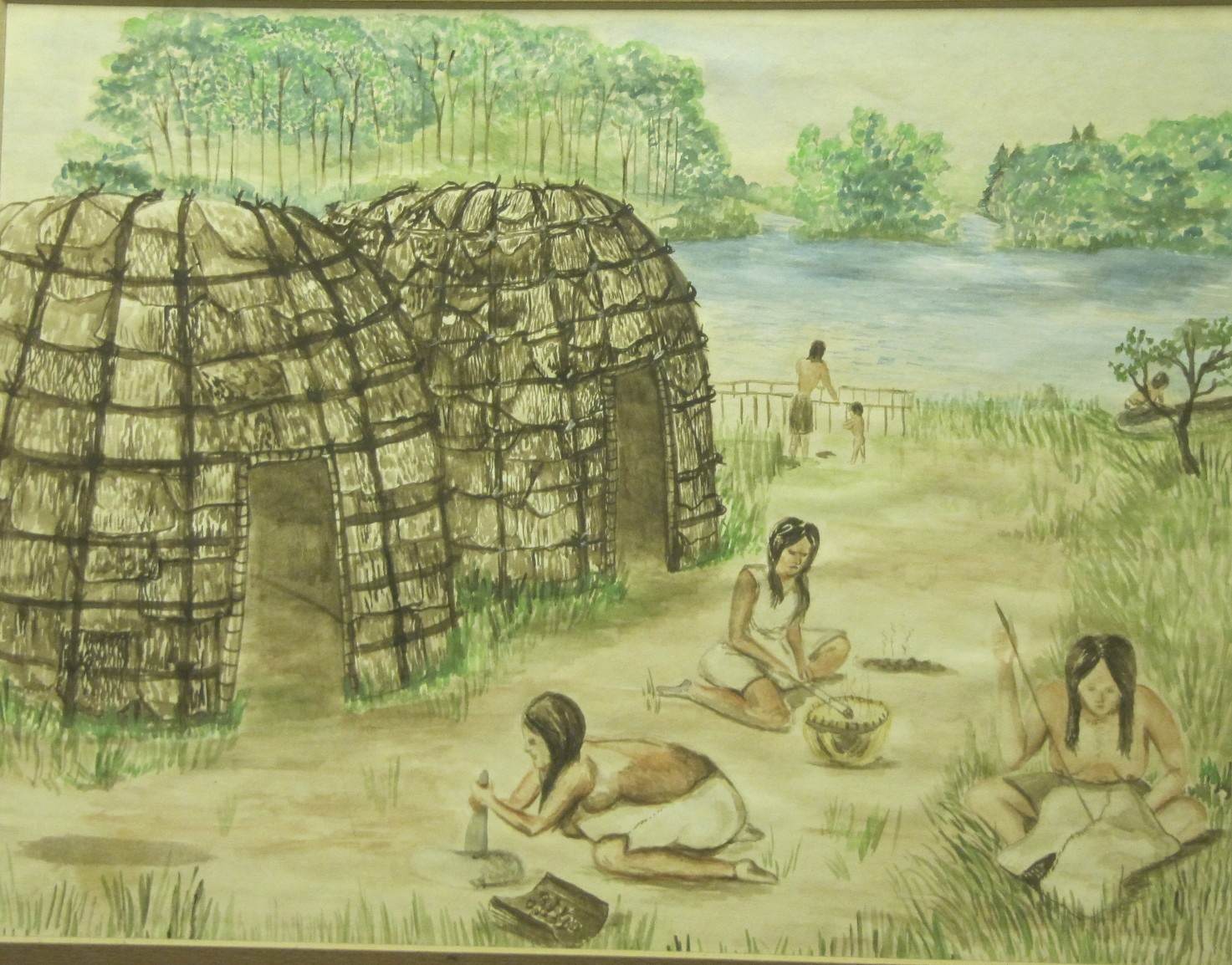
The French military, as one condition for not returning to the Mohawk villages, demanded that Jesuit missionaries be allowed to visit them and minister to captive Christians or others interested in their faith. Jesuit missionaries visited Caughnawaga for three days in 1667 and received hospitality in the long house where Kateri lived with her uncle, a Mohawk leader opposed to Christians.
According to witnesses, Kateri was a normal Indian girl and young woman. “She brought wood and tended the fire when her aunt ordered her, and got water when those in the long house needed it. When she had nothing to do she amused herself making small jewels and dressing as other girls of her age. She placed shell bead necklaces around her neck, shell bead bracelets on her arms, rings on her fingers and ornaments in her ears.” (The Life of the Good Catherine Tekakwitha, Claude Chauchetiere, SJ , 1695)
Though sickly, she was not lazy or proud. She never talked about others. Timid, she avoided dances and games. She didn’t like seeing captives harmed or people tortured, witnesses said.
In the spring of 1675 Jesuit Father Jacques de Lamberville visited Caughnawaga . Kateri was alone in her long house because a foot injury prevented her from working in the fields and the priest entered her lodge. She spoke to him of her desire to receive baptism and on Easter, 1676, the young Indian girl was baptized and took the name Kateri, after St. Catherine of Siena, the mystic and a favorite patron of Christian Indian women. She was 20 years old.
Her uncle and relatives in the long house opposed her conversion to Christianity and pressured her to marry and follow their ways, though against her beliefs. The early Jesuits considered it a miracle for a Christian to resist family and tribal pressure such as Kateri experienced in Caughnawaga. Yet, her early biographer says “She practiced her faith without losing her original fervor and her extraordinary virtue was seen by all. The Christians saw her obeying their rules exactly, going to prayers every day in the morning and evening and Mass on Sunday. At the same time she avoided the dreams feasts and the dances,” practices endangering her belief. (The Life of the Good Catherine Tekakwitha, Claude Chauchetiere, SJ , 1695)
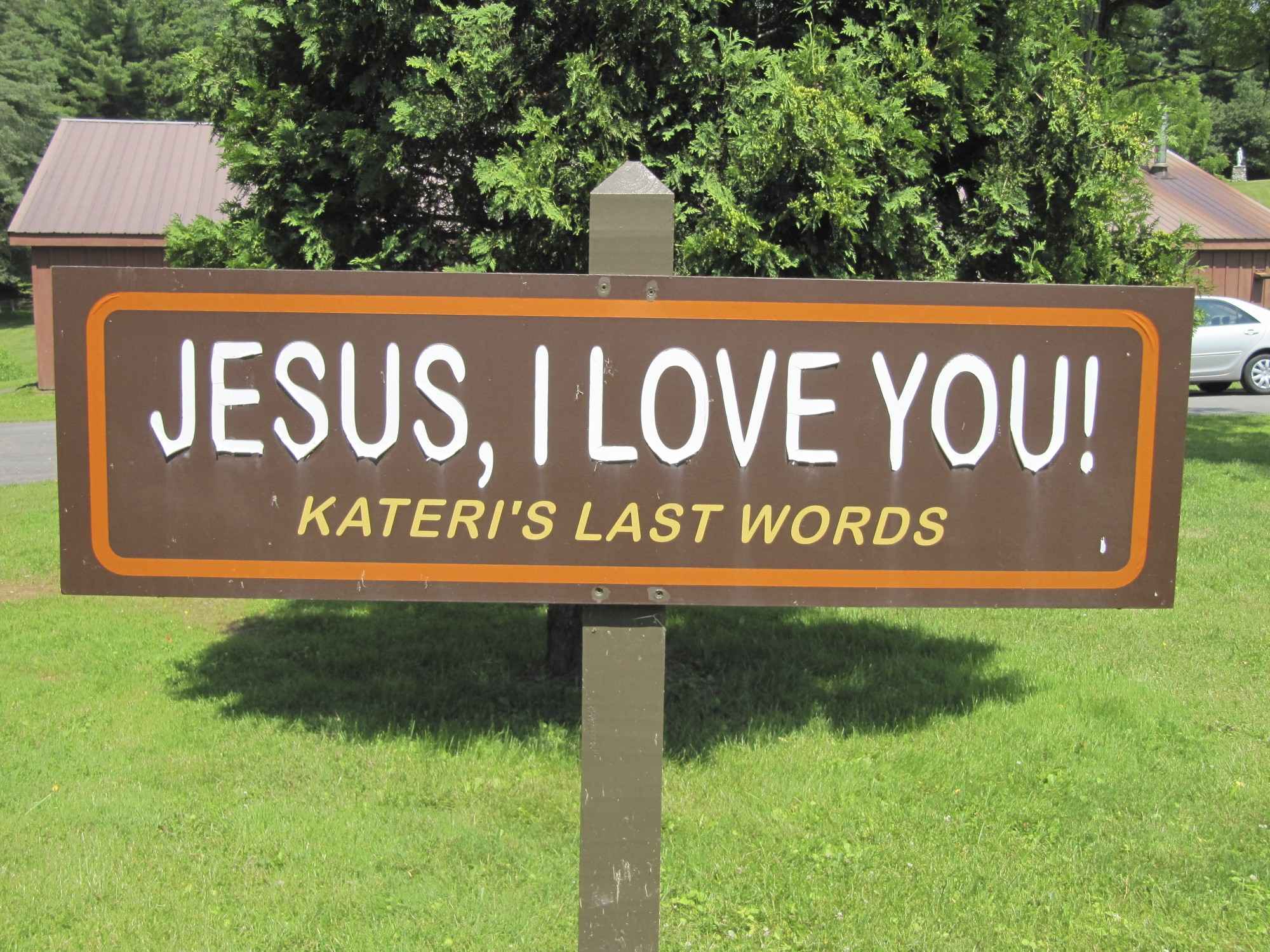
Father de Lamberville finally recommended that Kateri escape to the newly-established Indian Christian village in Kahnawake near Montreal, where she could live her faith more easily. In 1676, aided by other Christian Indians, she made the dangerous journey northward. There she lived a fervent life of prayer and faith; she died and was buried on April 17th, 1680.

She was canonized by Pope Benedict XVI on October 21, 2012, Her feast day is July 14.
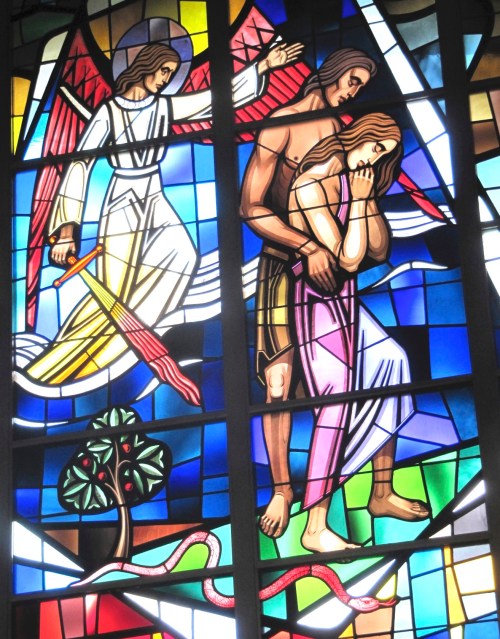
We take up the Book of Exodus in our lectionary this week, following the Book of Genesis. The mystery of the Exodus is central to Judaism and Christianity.
Until the 17th century, the common opinion was that the five books of the Pentateuch–Genesis, Exodus, Leviticus, Numbers, Deuteronomy– were written by Moses to tell the story of Israel from its origins at the creation of the world till the entrance to the promised land of Canaan. Since then, scholars say that many hands created the Pentateuch– the Torah.
Rather than figuring out what hands they are, it might be better to keep the big picture before us. God creates the heavens and the earth (Genesis), he creates human beings, male and female. Then God says to Adam and Eve, “Increase and multiply and fill the earth.” “Let there be more of you, and take possession of the land I’ve created for you.”
Human beings, we know, resist God’s plan through sin, and so after Adam and Eve, Cain and Abel, the flood and the destruction of tower of Babel, God turns to Abraham and Sarah, a landless, childless couple, and God renews the promise made first to Adam and Eve–many children and a land of their own. Through them, God will bless all the peoples of the earth and the earth itself.
Land and children. A fruitful land, a multitude of children. Those promises seem to elude Abraham and our ancestors as they go from place to place. When Jacob arrives in Egypt, the promises seem to come true. Egypt is an ideal land for children to flourish; Jacob’s descendants increase, they settle on good land and become a powerful, divisive group in Egyptian society.
But this isn’t the place, the Book of Exodus says, and so God commands Moses to lead them out through the desert. At Sinai God promises to be their God; they’ll have a law to guide them, bread to nourish them. It’s not an easy journey and they’re not an easy people, but God guides them on their way.
Scholars today say Moses didn’t write the books of the Pentateuch as we have them.. The final compilation of earlier sources was made after the Jews lost their homeland and were driven into exile in Bablyon in the seventh century BC. The compilers wanted the exiles to know their history. They’re children of Abraham. The God of their ancestors was their God. There’s a law to guide them, bread to nourish them, a desert to go through. But, they will reach a fruitful land and have a multitude of children, eventually.
The commentary from the New American Bible claims the editor made a substantial change to the ancient narrative to emphasize that last point:
“The last chapter of the ancient narrative—Israel dwelling securely in its land—no longer held true. The story had to be reinterpreted, and the Priestly editor is often credited with doing so. A preface (Genesis 1) was added, emphasizing God’s intent that human beings continue in existence through their progeny and possess their own land. Good news, surely, to a devastated people wondering whether they would survive and repossess their ancestral land.
The ending of the old story was changed to depict Israel at the threshold of the promised land (the plains of Moab) rather than in it. Henceforth, Israel would be a people oriented toward the land rather than possessing it.
The revised ending could not be more suitable for Jews and Christians alike. Both peoples can imagine themselves on the threshold of the promised land, listening to the word of God in order to be able to enter it in the future. For Christians particularly, the Pentateuch portrays the pilgrim people waiting for the full realization of the kingdom of God.”
Thoughts to hold onto in a changing world and a changing church?
From Monday of the 15 week of the year to Wednesday of the 19th week of the year we read from the Book of Exodus to the Book of Deuteronomy. Besides offering a description of the history of Israel from the time of its departure from Egypt to the frontier of the Promised Land, the Books of Exodus and Deuteronomy offer a biography of Moses, who dominates the events they describe.
The Book of Exodus begins with his birth, the Book of Deuteronomy ends with his death. He is a leader, lawgiver, intercessor and prophet for his people.
In the gospels Jesus calls upon Moses as a witness to his life and ministry. Like him, Jesus takes on the plight of his people. He leads them to deliverance, he teaches them a way of life, he endures their murmuring and complaints, he feeds them bread in the wilderness, he pleads for their life and asks for death in their place.
As Moses brought life-giving water to his people, Jesus entered the Jordan to make it life-giving. Moses put up a brazen serpent to win pardon, Jesus became a saving sign nailed to a cross.
As he began his journey from Galilee to Jerusalem, Jesus ascended a mountain where he was transfigured. Moses appeared with Elijah as witnesses to his mission as God’s Son.
We usually put aside one day in the year to remember a saint. For 4 weeks this year we remember Moses, a friend of God and witness to Jesus Christ.
For this week’s homily, please watch the video below.
 The Victor's Place