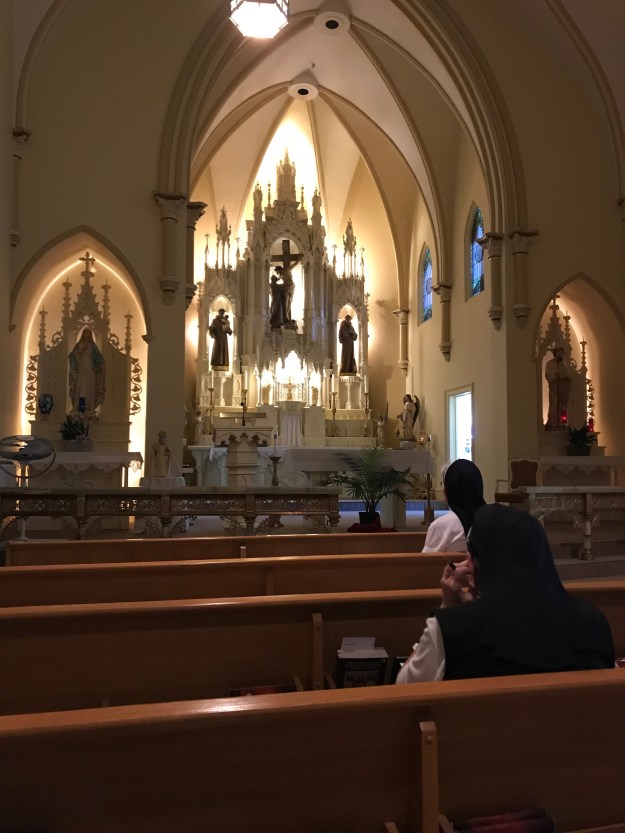
That’s the theme of Pope Francis’ exhortation “Gaudete et exultate” that he issued on March 19, 2018. I’m reflecting on his words in a retreat this week at the Franciscan Sisters of Christian Charity, Manitowoc, Wisconsin. It’s a call to persevere on the path of Vatican II.
The exhortation has 5 chapters. (1) The Call to Holiness, (2) Two Subtle Enemies of Holiness, (3) In the Light of the Master, (4) Signs of Holiness in Today’s World, and (5). Spiritual Combat, Vigilance and Discernment. Here’s a summary of the exhortation, but it’s better to read it all here.
1. THE CALL TO HOLINESS
In this introductory section, the pope says we’re all called to holiness, and he points out in particular the saints “next door”, the ordinary saints we live with. “I like to contemplate the holiness present in the patience of God’s people: in those parents who raise their children with immense love, in those men and women who work hard to support their families, in the sick, in elderly religious who never lose their smile. In their daily perseverance I see the holiness of the Church militant. Very often it is a holiness found in our next-door neighbours, those who, living in our midst, reflect God’s presence. We might call them “the middle class of holiness” (7)
The pope addresses ordinary people especially, not simply bishops, priests, or religious. They’re the saints “next door” whose lives are made up of small gestures (16), who live in patience and perseverance (7). They’re unique “each in his or her own way.” (10-11) They have their own calling, whether married or single, religious or layperson. All are called to grow in holiness through the grace of their baptism.(15)
Holiness is not just for Catholics either; it’s found beyond our church, the pope says. (9)
Holiness isn’t simply about personal fulfillment. It commits us to building with Jesus Christ “that kingdom of love, justice and universal peace.” “Thy kingdom come.” It requires effort and sacrifice, but it brings joy and enrichment to ourselves and our world. (25)
2. TWO SUBTLE ENEMIES OF HOLINESS
Francis points out two subtle enemies of holiness: Neo-gnosticism and Neo pelagianism, “false forms” of holiness found earlier in the church, but found now in our time.
Neo-gnosticism is a glorification of “a certain experience or a set of ideas and bits of information.” (36) “Gnostics think that their explanations can make the entirety of the faith and the Gospel perfectly comprehensible. They absolutize their own theories and force others to submit to their way of thinking.” (39) “When somebody has an answer for every question, it is a sign that they are not on the right road.” (41)
The Neo-gnostics tend to look down on others who do not think as they do; they fail to see God in those they dismiss: “Nor can we claim to say where God is not, because God is mysteriously present in the life of every person, in a way that he himself chooses, and we cannot exclude this by our presumed certainties. Even when someone’s life appears completely wrecked, even when we see it devastated by vices or addictions, God is present there. If we let ourselves be guided by the Spirit rather than our own preconceptions, we can and must try to find the Lord in every human life. This is part of the mystery that a gnostic mentality cannot accept, since it is beyond its control. (42)
Instead of knowledge, Neo-pelagianism believes that anything can be achieved by willing it or by personal effort. “The same power that the gnostics attributed to the intellect, others now began to attribute to the human will, to personal effort. This was the case with the pelagians and semi-pelagians. Now it was not intelligence that took the place of mystery and grace, but our human will. It was forgotten that everything “depends not on human will or exertion, but on God who shows mercy” (Rom 9:16) and that “he first loved us” (cf. 1 Jn 4:19). (44)
Neo-pelagianism is strong in a society like ours that’s convinced of the power of human creativity and human potential and the unlimited possibilities of an individual. It appears in some Christians who think you can have a perfect church, the pope says, appearing in “ an obsession with the law, an absorption with social and political advantages, a punctilious concern for the Church’s liturgy, doctrine and prestige, a vanity about the ability to manage practical matters, and an excessive concern with programmes of self-help and personal fulfilment. Some Christians spend their time and energy on these things, rather than letting themselves be led by the Spirit in the way of love, rather than being passionate about communicating the beauty and the joy of the Gospel and seeking out the lost among the immense crowds that thirst for Christ… (57) I encourage everyone to reflect and discern before God whether these subtle enemies may be present in their lives.” (62)
3. IN THE LIGHT OF THE MASTER
Turn to Jesus to find true holiness, the pope says, and so he devotes the 3rd chapter of his exhortation to the Beatitudes, the Sermon on the Mount, where Jesus taught the meaning of holiness with great simplicity. “”The word “happy” or “blessed” thus becomes a synonym for “holy”. (63-64)
Reflecting on the Beatitudes, the pope gives much of his attention to Jesus’ teaching on mercy. “Blessed are the merciful, for they shall obtain mercy.” He sees the “great criterion” of holiness in the 25th chapter of Matthew’s gospel where “Jesus expands on the Beatitude that calls the merciful blessed. If we seek the holiness pleasing to God’s eyes, this text offers us one clear criterion on which we will be judged. ‘I was hungry and you gave me food, I was thirsty and you gave me drink, I was a stranger and you welcomed me, I was naked and you clothed me, I was sick and you took care of me, I was in prison and you visited me.’” (vv. 35-36).
Living the beatitude of mercy isn’t easy, the pope says. We must deal with people individually, but also with the structures of society that affect those whom Jesus identifies with himself. Some make the mistake of seeing holiness as a personal matter that has nothing to do with our relationship to society:
“I regret that ideologies lead us at times to two harmful errors. On the one hand, there is the error of those Christians who separate these Gospel demands from their personal relationship with the Lord, from their interior union with him, from openness to his grace. Christianity thus becomes a sort of NGO stripped of the luminous mysticism so evident in the lives of Saint Francis of Assisi, Saint Vincent de Paul, Saint Teresa of Calcutta, and many others. For these great saints, mental prayer, the love of God and the reading of the Gospel in no way detracted from their passionate and effective commitment to their neighbours; quite the opposite.” (100)
“The other harmful ideological error is found in those who find suspect the social engagement of others, seeing it as superficial, worldly, secular, materialist, communist or populist. Or they relativize it, as if there are other more important matters, or the only thing that counts is one particular ethical issue or cause that they themselves defend. Our defence of the innocent unborn, for example, needs to be clear, firm and passionate, for at stake is the dignity of a human life, which is always sacred and demands love for each person, regardless of his or her stage of development. Equally sacred, however, are the lives of the poor, those already born, the destitute, the abandoned and the underprivileged, the vulnerable infirm and elderly exposed to covert euthanasia, the victims of human trafficking, new forms of slavery, and every form of rejection.[84] We cannot uphold an ideal of holiness that would ignore injustice in a world where some revel, spend with abandon and live only for the latest consumer goods, even as others look on from afar, living their entire lives in abject poverty.” (101)
4. SIGNS OF HOLINESS IN OUR WORLD
The pope describes 5 “signs” of holiness he finds important in the light of our times. The first is perseverance, patience and meekness. God calls us in a “fast-paced, noisy and aggressive world” to keep on the right path ourselves, but also not desert others in bad times when anger and aggressiveness, ridicule and lying infest the world around us.
(112-121)
Keep your sense of humor, the pope says. Joy is another sign we need today. “Hard times may come, when the cross casts its shadow, yet nothing can destroy the supernatural joy that “adapts and changes, but always endures, even as a flicker of light born of our personal certainty that, when everything is said and done, we are infinitely loved’”.
Boldness and passion are other signs of holiness the world needs. (129– 131} “Look at Jesus. His deep compassion reached out to others. It did not make him hesitant, timid or self-conscious, as often happens with us. Quite the opposite. His compassion made him go out actively to preach and to send others on a mission of healing and liberation. Let us acknowledge our weakness, but allow Jesus to lay hold of it and send us too on mission. We are weak, yet we hold a treasure that can enlarge us and make those who receive it better and happier. Boldness and apostolic courage are an essential part of mission.”
“Like the prophet Jonah, we are constantly tempted to flee to a safe haven. It can have many names: individualism, spiritualism, living in a little world, addiction, intransigence, the rejection of new ideas and approaches, dogmatism, nostalgia, pessimism, hiding behind rules and regulations. We can resist leaving behind a familiar and easy way of doing things. Yet the challenges involved can be like the storm, the whale, the worm that dried the gourd plant, or the wind and sun that burned Jonah’s head. For us, as for him, they can serve to bring us back to the God of tenderness, who invites us to set out ever anew on our journey.” (134)
Don’t go it alone, the pope says. We need to be with other in community, not apart by ourselves where we can “ grow too isolated, lose our sense of reality and inner clarity.” (141)
The common life, whether in the family, the parish, the religious community or any other, is made up of small everyday things. This was true of the holy community formed by Jesus, Mary and Joseph, which reflected in an exemplary way the beauty of the Trinitarian communion. It was also true of the life that Jesus shared with his disciples and with ordinary people. Let us not forget that Jesus asked his disciples to pay attention to details.
The little detail that wine was running out at a party.
The little detail that one sheep was missing.
The little detail of noticing the widow who offered her two small coins.
The little detail of having spare oil for the lamps, should the bridegroom delay.
The little detail of asking the disciples how many loaves of bread they had.
The little detail of having a fire burning and a fish cooking as he waited for the disciples at daybreak.
A community that cherishes the little details of love,[107] whose members care for one another and create an open and evangelizing environment, is a place where the risen Lord is present, sanctifying it in accordance with the Father’s plan. There are times when, by a gift of the Lord’s love, we are granted, amid these little details, consoling experiences of God.” (144-145)
Constant prayer is needed today, the pope emphasizes. The saints found ”an exclusive concern with this world to be narrow and stifling, and, amid their own concerns and commitments, they long for God, losing themselves in praise and contemplation of the Lord. I do not believe in holiness without prayer, even though that prayer need not be lengthy or involve intense emotions.”
“ We need to remember that “contemplation of the face of Jesus, died and risen, restores our humanity, even when it has been broken by the troubles of this life or marred by sin. We must not domesticate the power of the face of Christ”.[113] So let me ask you: Are there moments when you place yourself quietly in the Lord’s presence, when you calmly spend time with him, when you bask in his gaze? Do you let his fire inflame your heart? Unless you let him warm you more and more with his love and tenderness, you will not catch fire. How will you then be able to set the hearts of others on fire by your words and witness? If, gazing on the face of Christ, you feel unable to let yourself be healed and transformed, then enter into the Lord’s heart, into his wounds, for that is the abode of divine mercy.” (151-152)
“God reveals himself in Jesus Christ, but also “in our own lives, the lives of others, and all that the Lord has done in his Church. This is the grateful memory that Saint Ignatius of Loyola refers to in his Contemplation for Attaining Love, when he asks us to be mindful of all the blessings we have received from the Lord. Think of your own history when you pray, and there you will find much mercy. This will also increase your awareness that the Lord is ever mindful of you; he never forgets you. So it makes sense to ask him to shed light on the smallest details of your life, for he sees them all.”
“ Let us not downplay prayer of petition, which so often calms our hearts and helps us persevere in hope. Prayer of intercession has particular value, for it is an act of trust in God and, at the same time, an expression of love for our neighbour. There are those who think, based on a one-sided spirituality, that prayer should be unalloyed contemplation of God, free of all distraction, as if the names and faces of others were somehow an intrusion to be avoided. Yet in reality, our prayer will be all the more pleasing to God and more effective for our growth in holiness if, through intercession, we attempt to practise the twofold commandment that Jesus left us. Intercessory prayer is an expression of our fraternal concern for others, since we are able to embrace their lives, their deepest troubles and their loftiest dreams. Of those who commit themselves generously to intercessory prayer we can apply the words of Scripture: “This is a man who loves the brethren and prays much for the people” (2 Mac 15:14). (154)
“The prayerful reading of God’s word, which is “sweeter than honey” (Ps 119:103) yet a “two-edged sword” (Heb 4:12), enables us to pause and listen to the voice of the Master. It becomes a lamp for our steps and a light for our path (cf. Ps 119:105). As the bishops of India have reminded us, “devotion to the word of God is not simply one of many devotions, beautiful but somewhat optional. It goes to the very heart and identity of Christian life. The word has the power to transform lives”. (156)
“ Meeting Jesus in the Scriptures leads us to the Eucharist, where the written word attains its greatest efficacy, for there the living Word is truly present. In the Eucharist, the one true God receives the greatest worship the world can give him, for it is Christ himself who is offered. When we receive him in Holy Communion, we renew our covenant with him and allow him to carry out ever more fully his work of transforming our lives.” (157)
(5). SPIRITUAL COMBAT, VIGILANCE AND DISCERNMENT
In chapter 5 of his exhortation, the pope affirms the reality of evil and the devil. Our struggle is not just “against our human weaknesses and proclivities (be they laziness, lust, envy, jealousy or any others). It is also a constant struggle against the devil, the prince of evil.” (158-165)
“ How can we know if something comes from the Holy Spirit or if it stems from the spirit of the world or the spirit of the devil? The only way is through discernment, which calls for something more than intelligence or common sense. It is a gift which we must implore. If we ask with confidence that the Holy Spirit grant us this gift, and then seek to develop it through prayer, reflection, reading and good counsel, then surely we will grow in this spiritual endowment.” (166)
“For this reason, I ask all Christians not to omit, in dialogue with the Lord, a sincere daily “examination of conscience”. Discernment also enables us to recognize the concrete means that the Lord provides in his mysterious and loving plan, to make us move beyond mere good intentions.”
“An essential condition for progress in discernment is a growing understanding of God’s patience and his timetable, which are never our own. God does not pour down fire upon those who are unfaithful (cf. Lk 9:54), or allow the zealous to uproot the tares growing among the wheat (cf. Mt 13:29)… Discernment is not about discovering what more we can get out of this life, but about recognizing how we can better accomplish the mission entrusted to us at our baptism. This entails a readiness to make sacrifices, even to sacrificing everything. For happiness is a paradox. We experience it most when we accept the mysterious logic that is not of this world: “This is our logic”, says Saint Bonaventure,[125] pointing to the cross. Once we enter into this dynamic, we will not let our consciences be numbed and we will open ourselves generously to discernment.” (174)


 The Victor's Place