Category Archives: politics

6th Sunday c: How Do We Get to Heaven?

For this week’s homily please play the video file below.

The Epiphany Feast Isn’t Over!

Kings Point, New York

Like the Christmas feast, we can pass over the Feast of the Epiphany too easily. It can become a quaint story of no significance.

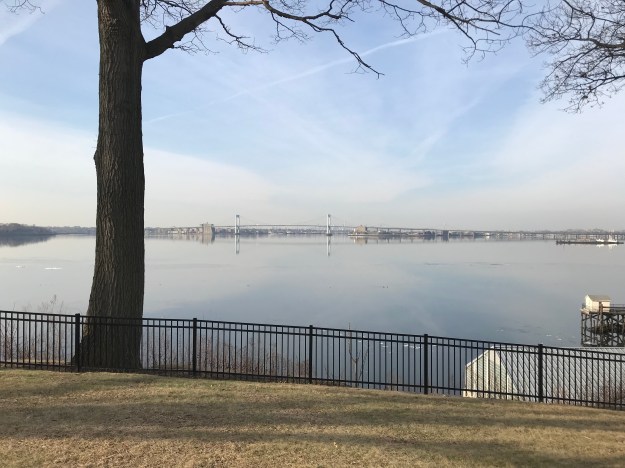
I spoke about the meaning of the Epiphany on Sunday at the Maritime Academy in Kings Point, New York, where young men and women are being trained for service on the ships that sail our seas and waterways. This feast should mean something to them.

The only gospel that records this story is the Gospel of Matthew, so why is it there?

Matthew’s gospel was written for Jewish Christians in Galilee and Syria some time after the temple in Jerusalem was destroyed by the Romans in the year 70. We can’t imagine how shocked they were by the complete destruction of the temple and the city itself. These were places where God’s promises would be fulfilled, they thought. The Messiah would appear there. This was where Jesus would come again. All nations would stream to Jerusalem, prophets like Isaiah foretold. Now they were gone.

Matthew’s gospel reminds his hearers–and us too–that Jesus must be known by all nations before he comes again. “Go and make disciples of all nations,” Jesus says in his final words in Matthew’s gospel, “baptizing them in the name of the Father and of the Son and of the Holy Spirit, teaching them to observe all that I have commanded you. And behold, I am with you always, until the end of the age.” (Matthew 28, 18-20)

Matthew’s story of the Magi is a reminder that even as Jesus is born, messengers, strangers, wise men from afar, want to know and acknowledge him as their king and God.

Jesus Christ came, our gospel says, not for only one people or nation, but for all. Though his ministry was first to the Jews, Jesus wishes to make the world one. God doesn’t wish to save a few. He wants to save all– all the world.

The Magi came, our story says, from the east. Could that be from Iran or Yemen; two places we hardly view positively today in our country? More and more, as we look at the world only through the lens of politics and economics; we fear the stranger, we reject the immigrant, we create enemies, we reject people not like us. We’re becoming tribal instead of global. We’re falling into individualism. As the old song said, we’re looking for “perfect peace, where joys never cease, and let the rest of the world go by.”

But we can’t let the rest of the world go by and we won’t be safe behind walls. We’re living in a big world that God wants to be one. That’s what the story of the magi tells us. We’re all commissioned on this Feast of the Epiphany, which is followed next Sunday by the Feast of the Baptism of Jesus, to go out into the whole world, “ baptizing them in the name of the Father, and of the Son, and of the Holy Spirit,” teaching them to observe all that Jesus commands. And he will be with us, even to the end of time.

I told the young men and women at Kings Point on Sunday that they’re commissioned as people of the sea. The oceans and waterways are highways uniting this world of ours. They shouldn’t be looked at only through the eyes of economics or politics. They’re meant to connect peoples, they’re bridges that make us one.

As I left the chapel, I met some people who are “furloughed” by the current government shut-down. We don’t have to look far to see how dangerous it is to see the world only through the eyes of politics and economics. We need a brighter star.

Speak, Lord, Your Servants are Listening

In times like this we should listen to the voice of the mystics in our church. They speak in troubled times.

Among the mystics I count the writers of scripture, Luke and Paul, who speak in our readings at Mass these days and see things from a higher perspective than we do. Be careful of human wisdom, Paul says today to the Corinthians enmeshed in the politics and personalities of their church:

“So let no one boast about human beings, for everything belongs to you,
Paul or Apollos or Cephas,
or the world or life or death,
or the present or the future:
all belong to you, and you to Christ, and Christ to God.”

Luke’s gospel today (Luke 5, 1-11) describes the fishermen on the lake, Cephas among them, who have come from fishing all night and caught nothing. The One from Nazareth, no fisherman at all, tells them to cast their nets for a catch.

Wisely, they defer to him and their human wisdom is replaced by the power of God.

I think too of Bridget of Sweden and Catherine of Siena, mystics of their day, whose vivid perception of the powerful presence of God in their meditations and prayers reminded the leaders and people of their church to listen to their Lord.

Prayer and listening to God’s word are not small gestures today. We’re like the Corinthians and the fishermen by the lake. We need to listen to the Lord who speaks to us. We get so caught up in the wisdom of the day.

24th Sunday: Forgiveness, Seventy-seven Times?


For this week’s homily, please play the video file below:

Crimes Against the Natural World


“Patriarch Bartholomew has spoken in particular of the need for each of us to repent of the ways we have harmed the planet, for “inasmuch as we all generate small ecological damage”, we are called to acknowledge “our contribution, smaller or greater, to the disfigurement and destruction of creation” He has repeatedly stated this firmly and persuasively, challenging us to acknowledge our sins against creation:

“’For human beings… to destroy the biological diversity of God’s creation; for human beings to degrade the integrity of the earth by causing changes in its climate, by stripping the earth of its natural forests or destroying its wetlands; for human beings to contaminate the earth’s waters, its land, its air, and its life – these are sins” For “to commit a crime against the natural world is a sin against ourselves and a sin against God.’

“At the same time, Bartholomew has drawn attention to the ethical and spiritual roots of environmental problems, which require that we look for solutions not only in technology but in a change of humanity; otherwise we would be dealing merely with symptoms. He asks us to replace consumption with sacrifice, greed with generosity, wastefulness with a spirit of sharing, an asceticism which “entails learning to give, and not simply to give up. It is a way of loving, of moving gradually away from what I want to what God’s world needs. It is liberation from fear, greed and compulsion” As Christians, we are also called “to accept the world as a sacrament of communion, as a way of sharing with God and our neighbours on a global scale. It is our humble conviction that the divine and the human meet in the slightest detail in the seamless garment of God’s creation, in the last speck of dust of our planet”.

Pope Francis ,Laudato SI, 8-9

Pope Leo the Great: Part 2

LEOATTILAa

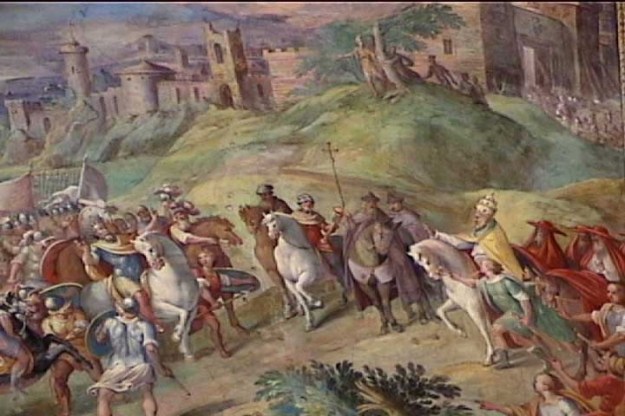
Pope Leo had to step in when Attila and his army were threatening to destroy Rome. The elite of Roman society had fled the city, the government was gone, the rest were busy securing their own homes in the city. I don’t think Leo, a churchman who was by nature a thinker deeply engaged in the study of spiritual things wanted to meet the dangerous invaders at the city gates, but he did. He rose to accept the responsibility.

When society is in danger because it refuses to face the issues that endanger it, the church can’t flee or look to its own security. It has to step in. That means not only church leaders but every believer has to meet the challenges at our gates today which government and society won’t acknowledge– Climate change and care for the earth, immigration and care of refugees, nuclear disarmament, universal healthcare, global peacekeeping, respect for the family and human rights.

“Remember your leaders who spoke the word of God for you. Consider how their lives ended and imitate their faith. “ (Hebrews 13, 7) (Common of Pastors} Remember Leo.

Tomorrow we have another leader, who fought for the poor when most were concerned for the rich: Martin of Tours. Remember Martin of Tours.

Is God at the Convention?

Our political conventions are beginning. A time, especially this year, when we wonder about our future. No perfect candidates, no perfect plans, no perfect solution. Should we pay any attention at all?

I’m thinking of John Henry Newman, the illustrious 19th century English theologian who converted from Anglicanism to Catholicism in 1845. An Italian Passionist priest, Fr. Dominic Barbari, received him into the church.

Newman’s conversion came through his efforts to bring the Church of England, then struggling against the rationalism of the Enlightenment, back to its orthodox Christian roots. He sought the answer in studying  early Christianity and its development to the present day. The Oxford Movement begun by Newman and other university friends strongly affected the Anglican church and other Christian churches of his time.

Originally convinced that the Catholic Church was corrupt and unfaithful to the gospel, Newman came to accept it as the Church founded by Jesus Christ. An important reason for his acceptance was his study of the Donatists, a 4th century Christian group that split from the larger church over who should be members of the church. The Donatists believed that the church should be a church of saints, not sinners.

Newman came to understand that the Church develops over time, and its development takes place in the real world, which is the world of saints and sinners. The spirituality he arrived at was anchored in this reality. We live in a world of weeds and wheat. “Nothing would be done at all if one waited until one could do it so well that no one could find fault with it.” We don’t live in a perfect world or a perfect church.

The world we live in is blessed by God with a purpose and a mission. No, it’s not perfect nor will it ever be perfect.We may cringe at the circus our political world can create these next few weeks. But that doesn’t mean we don’t try to make politics live up to its ideals. In all the hoopla God is at work.


Little Sisters of the Poor

IMG_1809
For the last 7 days I have been with some of the Little Sisters of the Poor on retreat at their place in Flemington, NJ. We’ve been reflecting, for the most part, on the scripture readings from the lectionary for these days in the easter season, and I put some of my reflections down in previous blogs.
IMG_1835

The Little Sisters of the Poor are currently engaged in a dispute on health care with the United States government and the case is before the Supreme Court. Here’s a website explaining their stand. They’re not an advocacy group; they take care of the elderly poor in residences in this country and throughout the world. Holy women, they’re doers, not talkers.

I didn’t mention the case in my talks these days; they were days of prayer and reflection. But the easter readings from the Acts of the Apostles do seem to offer them a template for this experience. As the teacher of the law Gamaliel said about the Jewish-Christians arranged before the Sanhedrin,, “If it comes from God, you will not be able to destroy them; you may even find yourselves fighting against God.” Acts 5, 39

Another lesson we learn from the Acts of the Apostles is that the mystery of the passion and resurrection is always present in our lives and the journey we make together as a community. No matter how dark it seems, God brings us to life and light. That’s the way the Kingdom of God comes.

The Little Sisters know a lot about caring for the elderly, especially the elderly poor, something our government may not know much about, if truth be told. Instead of prosecuting them for breaking a law, wouldn’t it be better to get their advice how to treat the frail elderly? Care for an aging population is a growing challenge for our society.

The Little Sisters know something about it.