Category Archives: Inspiration

Venerable Bede


The Venerable Bede (672-735), whose feast day is May 25th, was destined from his birth to be a monk. Born near Wearmouth Abby in England, he spent his life in that monastery from his earliest years, and became a scholar, teacher and spiritual guide. His commentaries on scripture and the history of England were known far beyond the place where he lived. He is considered the most learned man of his time.

“It’s ever been my delight to learn, to teach and to write,” he said, and he shared his learning with those he lived with; his wisdom inspires us today. Besides the scriptures and historical studies, Bede delighted in music, mathematics and learning about the natural world. He’s honored as a Doctor of the Church.

You can see from an account of his life by Cuthbert, a contemporary,  that his brothers in the monastery liked him and held him in esteem. And he liked them. Until the day of his death he continued to think and teach and write. On the day he died he was finishing up one of his studies, a commentary on the scriptures. When it was done “on the floor of his cell, he sat and sang “Glory be to the Father and to the Son and to the Holy Spirit”; and as he named the Spirit, the Breath of God, he breathed the last breath from his own body. With all the labour that he had given to the praise of God, there can be no doubt that he went into the joys of heaven that he had always longed for.”

Before he died, he wrote this:

“Before setting forth on that inevitable journey, none is wiser than the man who considers—before his soul departs hence—what good or evil he has done, and what judgement his soul will receive after its passing.”

Lord, give us a love of learning and a delight in your wisdom and truth, and the courage to look at ourselves.

Peter

Peter the Apostle, Cloisters, New York

Keep Peter in mind as we read the story of the conversion of Cornelius, the Roman centurion and his household. It was a decisive event for him and the other followers of Jesus. Peter was ministering to Jews in Joppa on the seacoast, when he’s called to Caesarea Maritime to baptize a Roman soldier. Joppa, remember, was the seaport where Jonah began his perilous journey to Nineveh and the gentile world.

In Joppa, the sleeping apostle on the roof of Simon the Tanner’s house overlooking the vast sea has a disturbing vision. Instead of the usual kosher food,  a gentile banquet is poured out before him. As a good Jew Peter pushes it away. Three times the vision invites him to eat.

Then, messengers appear at the door from Cornelius, a Roman soldier stationed in Caesaria Maritime, Rome’s headquarters just up the coast. Peter is to come and speak about “the things that had happened.” He’s invited to the gentile banquet he saw in his dream.

Peter made the journey up the coast and described their meeting: “As I began to speak, the Holy Spirit fell upon them as it had upon us at the beginning.” It was a Gentile Pentecost. Peter baptized the Roman soldier, his family and household. “I truly understand that God shows no partiality, but every nation is acceptable to him,” 

Would Peter know then where this visit to Cornelius would lead? He was a fisherman who spoke Aramaic with a Galilean accent, who felt the pull of home, family and fishing boats. I doubt he would ever be comfortable in a gentile world. After Caesaria he traveled to Antioch in Syria and then finally to Rome where he was killed in the Neronian persecution in the 60’s.

Artists usually portray Peter in Rome as a church leader firmly in charge of the church, holding its keys tightly in hand. Clearly, he is a rock and a strong leader.

I saw another image of Peter years ago in the Cloisters Museum in New York. He’s softer, reflective, more experienced, not completely sure of himself. There’s a consciousness of failure in his face. He seems to be listening humbly for the voice of the Shepherd, hoping to hear it and ever surprised by the unexpected coming of the Holy Spirit.

The early Roman church directed those newly baptized in St. John Lateran at Easter to visit the Church of St. Peter on Vatican Hill on Easter Monday. There they were to remember Peter, who came to Rome from afar to preach the gospel. He was a faithful follower of Jesus and a shepherd of flock. He would help them know Jesus and follow humbly lead the flock wherever Jesus told him to lead it.

Bless our new Pope Leo, Lord.

2nd Sunday of Easter: Thomas Doubts

For this week’s homily, please play the video below:

For this week’s homily please watch the video below.

readings here

This is the Second Sunday of Easter. Notice we don’t say the Second Sunday after Easter. We say it’s the 2nd Sunday of Easter because Easter isn’t a one day feast. It’s celebrated every Sunday of the year. Every Sunday is a little Easter. After the yearly feast of Easter we continue to celebrate it for fifty days.  Easter isn’t  for  one day.  

Why do we celebrate Easter so extensively? Because the resurrection of Jesus is the center of our faith. It’s central to what we believe. We believe in God who created us and all things. We believe in Jesus Christ, who came among us, died and rose from the dead on the third day. That belief has tremendous consequences for us and for our world.

                                                                                                                                                              The story of Thomas the apostle in today’s gospel offers another reason why we celebrate easter as often as we do. Thomas was one of Jesus’ closest followers, “one of the twelve” who heard him teach and saw him work wonders, but Thomas won’t believe the others who tell  him they saw Jesus, risen from death.

He’s deeply skeptical. You can hear skepticism in his words:  “Unless I see the marks of the nails, and put my finger into the nailmarks, and put my hand into his side, I won’t believe.”

Certainly Thomas isn’t the only one who’s skeptical. You can hear skepticism in the way the other disciples after Jesus rises from the dead. Thomas represents human skepticism, the slowness of us all to believe, the distrust we all have. What’s unique about Thomas is he represents skepticism at its worst.  

It’s all right to have some skepticism, you know. We shouldn’t believe everything we hear. We need to check things out. We have to make sure that facts are facts,  we need a certain caution in life. 

But Thomas’ skepticism seems more than the ordinary. He’s a strong doubter. Yet still, the next Sunday–notice it’s a Sunday–Jesus comes and says  “Put your finger here and see my hands, and bring your hand and put it into my side, and do not be unbelieving, but believe.”


Thomas answer, “My Lord and my God!” That’s a beautiful act of faith. 

What about us? We’re described in today’s gospel as “those who have not seen, but believe.” and Jesus called us blessed. Yet, we can relate to Thomas. In fact, we live today in skeptical times. We’re skeptical about politics, about our institutions, about our churches, about ourselves.  There’s a deep distrust today in the way we speak and in the way we think. We’re wary of others, especially people different from us.  It affects our faith too. 

Yet, as he did to Thomas,  Jesus never abandons us. He  gives us the gift to believe. His mercy is always at work. He strengthens us when he comes in the signs of the Eucharist; he strengthens us through the faith we share with each other, week by week, day be day.   

Our Sundays may not be the dramatic experience that Thomas had, but  something happens here. Our Sundays are always little easters. Jesus come into the room where we are, with our fears and lack of trust. He tells us, as he told his disciples: “Peace be with you.” He shows us the signs of his love and enters our lives.  Every Sunday is a happy Easter. Jesus gives us life.

The Easter Season:The Long Day

www.usccb.org   (Readings for the Easter Season)

Weekday Readings for Easter Week

APRIL 21 Mon Octave of Easter Acts 2:14, 22-33/Mt 28:8-15 

22 Tue  Octave of Easter Acts 2:36-41/Jn 20:11-18

23 Wed Octave of Easter Acts 3:1-10/Lk 24:13-35 

24 Thu  Octave of Easter Acts 3:11-26/Lk 24:35-48 

25Fri Octave of Easter Acts 4:1-12/Jn 21:1-14 

26 Sat  Octave of Easter Acts 4:13-21/Mk 16:9-15 

27  2nd SUNDAY OF EASTER  Acts 2:42-47/1 Pt 1:3-9/Jn 20:19-31

The gospel readings this week recall the Easter appearances of Jesus to his disciples, to , Mary Magdalene and the women at the tomb, to Peter and John, to the Emmaus disciples, to Thomas and the disciples from Galilee who came up with him to Jerusalem. We could call this week “a long day.” Every day this week is a solemnity, like Easter itself. Unfortunately, we limit feasts like Christmas and Easter to a day. We need to savor these feasts and let them sink in.

The Acts of the Apostles, which continues St. Luke’s Gospel and is an important reading in the Easter season, describes how the first witnesses, guided by the Holy Spirit, gave testimony and were received. Looking at the church then can help us understand the church now.

In our readings from Acts on Monday, the witnesses begin to speak. Peter is the first. Just as with Jesus in life, his words are accompanied by a sign from God. The crippled man, a temple regular whom everyone knows, is cured by Peter and John as they come to the temple to pray. He follows Peter and listens to him. He will be a sign that’s contradicted; the temple leaders refuse to credit him as a sign. (Acts, Wednesday to Friday)

From its beginnings in Jerusalem the church gradually spreads into the Roman world, incorporating gentiles, non-Jews, and eventually reaching Rome itself. Believers in the Risen Christ who give their testimony and signs that accompany their witness cause it to grow..  

Morning and Evening Prayers here. Week I, Sunday readings all week.

Children’s Prayers here.

Tenebrae: Holy Saturday

Today’s Tenebrae psalms (Psalms 15, 4, 24) speak of Jesus’ burial in the earth. He is the seed that falls to the ground, but he will rise and bring life:

“My heart rejoices, my soul is glad,                                                                                        Even my body shall rest in safety,                                                                                             For you will not leave my soul among the dead                                                                       Or let your beloved know decay.” Psalm 15

Jesus gives the gift of risen life, not only to humanity, but to the earth itself. “Cry out with joy to the Lord, all the earth. Serve the Lord with gladness.”“

It’s a gift we doubt is ours:

O men, how long will your hearts be closed
will you love what is futile and seek what is false"
It is the Lord who grants favors to those whom he loves.
Psalm 4

The gates of heaven open to Christ, risen from the dead, they are lifted high for all he loves:

O gates lift high your heads, grow higher ancient doors,
let him enter the King of Glory.
Who is the King of Glory, the Lord the mighty and valiant,
the Lord the valiant in war! Psalm 24

Tenebrae for Holy Saturday ends with an ancient homily: “Something strange is happening—there is a great silence on earth today, a great silence and stillness. The whole earth keeps silence because the King is asleep. The earth trembled and is still because God has fallen asleep in the flesh and he has raised up all who have slept ever since the world began. God has died in the flesh and hell trembles with fear.”

“The earth trembled and is still…” 

The Passion of Jesus is not only a human story; creation has part in it too. At his death “the earth quaked, rocks were split” Matthew’s gospel says. (Matthew 27,51) “From noon onwards darkness came over the whole land till three in the afternoon,” Matthew, Mark and Luke all say..

 The sun that rules the day, the moon that rules the night respond as Jesus cries out in a loud voice and gives up his spirit. Artists through the centuries place sun and moon at the cross of Jesus.

Remember too blood and water, those great elemental realities blood that John’s gospel says flowed from the side of Christ when a soldier pierced his side. Water refreshed with contact with the Word of God; blood source of life for living creatures come from the side of Jesus. They also share in the mystery of redemption.

The homily for today says that Jesus at his death goes “to search for our first parent…to free from sorrow the captives Adam and Eve…I am your God, who for your sake have become your son. Out of love for you and for your descendants I now by my own authority command all who are held in bondage to come forth, all who are in darkness to be enlightened, all who are sleeping to arise. Rise up, work of my hands, you who were created in my image. Rise, let us leave this place, for you are in me and I am in you; together we form only one person and we cannot be separated.”

Artists from the eastern Christian traditon see the Passion of Jesus leading to a great redemption. Jesus does not rise alone, but humanity and creation itself  will follow him.

Holy Thursday

On the evening of Holy Thursday, as we enter the Easter Triduum, we will relive the Mass in which we commemorate the Last Supper and what happened there. It is the evening when Christ left his disciples the testament of his love in the Eucharist, not as a memento, but as a memorial, as his everlasting presence. 

Every time we celebrate the Eucharist we renew this mystery of redemption. In this Sacrament, Jesus substituted the sacrificial victim — the Paschal lamb — with himself: his Body and Blood grant us salvation from the slavery of sin and death. The salvation from every form of slavery is there.

On this evening, he asks us to love one another by becoming servants to one another, as he did in washing the disciples’ feet, a gesture that anticipates his bloody oblation on the cross. And indeed, the Master and Lord will die on the next day to purify not the feet, but the hearts and the entire life of his disciples. He was a servant to us and by the service of his sacrifice he redeemed us all.

Pope Francis

For today’s homily, please play the video file below:

God of infinite compassion, to love you is to be made holy. Fill our hearts with your love. By the death of your Son you have given us hope, born of faith. By his rising again fulfill this hope in the perfect love of heaven where he lives and reigns with you, and the Holy Spirit, One God, forever and ever. Amen.

St. Gabriel Possenti, CP: February 27

St. Gabriel Possenti, was born on March 1, 1838. He was the 11th child of Agnes and Sante Possenti, governor of Assisi, Italy. Gabriel was baptized Francis after that city’s famous patron. He had everything a privileged child might hope for.

In 1841, the Possentis moved to Spoleto and Gabriel fell under the spell of that city’s bright social world. Spoleto was influenced by the Enlightenment, a movement that preferred what’s new to what’s old.

Lively, headstrong, intelligent, he was educated by the Christian Brothers and the Jesuits. Popular, usually head of his class, he embraced the city’s latest fashions, plays, dances and sporting events. Gabriel was charmed by it all.

Yet, something else kept calling him. A year after moving to Spoleto his mother Agnes died. Her death and the death of two brothers and three sisters made him think seriously about life. A couple of times he almost died himself. He heard Jesus calling him to give up everything and follow him, but then the call seemed to fade away.

In the spring of 1856, a fierce cholera epidemic struck Spoleto and Gabriel’s favorite sister died in the plague. The tragedy overwhelmed the people of the city. They processed through the streets with an ancient image of Mary. They prayed that she intercede to stop the plague. They also asked her to help them bear their heavy cross.

It was a transforming experience for Gabriel, who was drawn into the presence of Mary, the Sorrowful Mother. He passed the familiar mansions where he partied many nights. The theater and opera entertained him so often. He realized what little wisdom they offered now. He took his place at Mary’s side and at her urging joined the Passionist Congregation.

In a letter home, Gabriel described his new life as a Passionist to his father: “I would not trade even fifteen minutes here for a year. My new life is invaluable. I would not exchange it for any amount of time filled with shows and other pastimes of Spoleto. Indeed my life is filled with happiness.”

Gabriel died on February 27, 1862 and was canonized in 1920. Early biographies of Gabriel, especially that of his spiritual director Fr. Norbert, highlight his faithfulness to his religious rule. They stress his acceptance of sickness and death. They also note his great devotion to Mary, the Sorrowful Mother of Jesus.

Less noticed,  perhaps, is how Gabriel saw his life life answering the troubling times in which he lived. The Enlightenment was casting its spell on Italy in his day, threatening religious belief and church institutions. Yet, religious communities, like the Passionists, recovering from the Napoleonic suppression. were experiencing a surprising growth, sending missionaries to other parts of the world.

Gabriel would be aware that in 1845 John Henry Newman, the great English thinker joined the church. The Italian Passionist Dominic Barbari arrived in England a few years previously. He came to preach the gospel and received Newman into the church.

Newman’s writings, especially his University Sermons, describe the Enlightenment that affected England, but they could also describe could easily be describing its affect on Spoleto, Italy, and young people like Gabriel. At the same time, Newman was an apostle announciing a “New Spring ” for the world. It was a world Gabriel must have seen as he entered the Passionists.

Gabriel is a saint for young people. They are looking for the pearl of great price in the times in which they live. May he help young people find it today.. Interested in becoming a Passionist?

Lord God,

you hide your gifts “ from the learned and clever,

but reveal them to the merest children.”

Show your love to the young of today,

and call them to follow you.

Give them the grace you gave St.Gabriel,

grace to know you as good.

grace to judge life wisely,

grace to be joyful of heart.

Amen

The Days Since Genesis

It’ s a long way from the creation of the world to sitting on the porch in the morning. How many years before did God, the Creator of all things, bring light and water paving the way for a host of new things, non-living and living. Then, we humans enter the picture. A complex, changing world I belong to, sitting on the porch in the morning, looking eastward at the world before me.

.

Jessica Powers, a Carmelite nun and poet, wrote about our experience of that world– “Song At Daybreak”

This morning on the way,

that yawns with light across the eastern sky

and lifts its bright arms high –

It may bring hours disconsolate or gay,

I do not know, but this much I can say:

It will be unlike any other day.

God lives in his surprise and variation.

No leaf is matched, no star is shaped to star.

No soul is like my soul in all creation

though I may search afar.

There is something -anquish or elation-

that is peculiar to this day alone.

I rise from sleep and say: Hail to the morning!

Come down to me, my beautiful unknown.

“My Beautiful unknown”. Our world is beautiful, but unknown, surprising, with variations that bring “anguish or elation.” People of faith know this, since they believe in God who lives “in his surprise and variation”, but unfortunately we can make God too small. We “think like humans do.”

The Genesis account, which we just finished reading recently and the rest of the Bible, deserve a search for their wisdom. I know there’s a new story that science tells, but the scriptures were there first. We should listen to their special wisdom..

Noah and the Ark: Genesis 6-7

Where did the story come from?

A few years ago Nova on PBS featured a program called“The Secrets of Noah’s Ark.” In early times, floods were common in the “Fertile Crescent,” the area in Mesopotamia {modern Iraq} where the Tigris and Euphrates Rivers and the ancient city of Babylon were located. Floods, sometimes great floods, occurred, so the people had to be ready. You had to keep your boats handy, and a big boat also– you never knew..

But people then, as now, had short memories. “As it was in the days of Noah, so it will be at the coming of the Son of Man. In those days before the flood, they were eating and drinking, marrying and giving in marriage, up to the day that Noah entered the ark. They did not know until the flood came and carried them all away.” (Matthew 24, 37-38)

I suspect some Babylonian priests then– meteorologists and story tellers of the age– came up with a flood story thousands of years before the Noah story in Genesis, to keep people on their toes – and maybe challenge some early climate change deniers too. It reinforced important advice: “ Keep your boats in shape and make sure a big boat’s around for ‘the big one.’”

Jewish priests and scribes in 6th century Babylon saw the story a perfect fit for the story of human origins they were telling their people. For them the take-away from the story was not to keep a big boat handy, but to be faithful to God like Noah and Abraham and their families. If they were faithful, God would save them from the flood and bring them  to the Promised Land.

The Nova program showed evidence from today of those big boats there “just in case.”

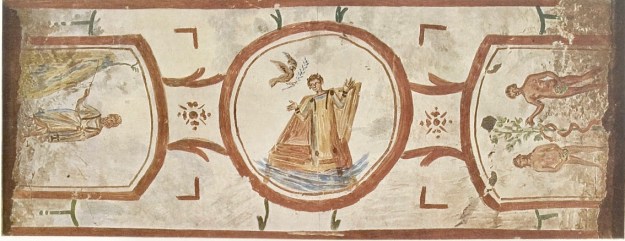
The story gave hope to the Jews driven from Jerusalem to exile in Babylon where, “By the rivers of Bablyon, we sat ad wept, remembering Zion.” (Psalm 137)  Christians– the pictures in the catacombs remind us (above)– saw Noah as a sign that the waters of baptism saved them from death and brought them the promise of paradise lost by Adam and Eve.

So the story of Noah and the ark is more than a myth.

Building a City: Genesis 11: 1-9

babel
Tower of Babel. Pieter Bruegel the Elder. 16th century

After the deluge, God renews a covenant with creation, and the descendants of Noah begin to fulfill God’s command “to increase and multiply and fill the earth.”

But then something else happens: human beings want to be together, so they build a city. A common origin and language draws them together, not just as families or clans, but in a larger society. They look for human flourishing in a city. (Genesis 11,1-9)

Unfortunately, they overreach. They want to get their heads into the heavens and so they plan a tower into the sky. Like Adam and Eve reaching for the Tree of the Knowledge of Good and Evil, they want to be like gods, “presuming to do whatever they want,” Their tower becomes a Tower of Babel. It collapses and they’re scattered over the world, leaving their city unfinished.

It’s important to recognize that the Genesis story does not claim God’s against human beings building a city. The bible, in fact, often sees the city as a place favoring human flourishing. In the Book of Jonah, God values the great city of Nineveh. Jesus sees Jerusalem, the Holy City, cherished by the Lord, the place where he dwells. The Spirit descends on his church in the city. The Genesis story sees the city as good, but it can be destroyed by sin and human pride..

The picture at the beginning of this blog is a painting of the Tower of Babel by the 16th century Dutch artist, Pieter Bruegel the Elder. It’s situates Babel in Antwerp, one of the key seaports of the time. Its shaky structure suggests it’s too ambitiously built. Still incomplete, it may not last. So the painter offers a warning against ambition and not caring for people, especially the needy.

It’s interesting to note that Pope Francis encourages mayors from cities to plan well. Commentators say the pope, conscious of a rising isolationism that’s affecting nations and international bodies today, sees cities to be agents for unifying peoples. They’re important places for humans to flourish. The United Nations also sees cities as key resources in the challenge that comes with climate change.

The picture at the end? You don’t have to be told. A great city. Still, its greatness will be judged, not by its big buildings or businesses, but how it encourages human flourishing.

img_1960