Category Archives: Environment

Wednesday, 2nd Week of Advent

Isaiah


In yesterday’s first reading for Advent, Second Isaiah repeats to the exiles in Babylon words he hears from God: “Comfort, give comfort to my people, says your God.” In today’s gospel reading Jesus says:“Come to me, all you who labor and are burdened, and I will refresh you.” A favorite reading for so many of us.

Notice Jesus speaks to the “crowds” in Matthew’s gospel, not just to the disciples who know him, or the Jewish Christian church Matthew wrote for at the end of the first century.  God’s love and God’s promises reach far beyond the circle of disciples or the church.  Jesus Christ came to refresh the world that labors and is burdened, even if it doesn’t know him.

 Second Isaiah in today’s readings appeals to Jewish exiles to remember the eternal God, creator of the ends of the earth. Do not to abandon God for the Babylon’s gods who are too small, he tells them and us all.  

“To whom can you liken me as an equal?
says the Holy One…
Do you not know
or have you not heard?
The LORD is the eternal God,
creator of the ends of the earth.
He does not faint nor grow weary,
and his knowledge is beyond scrutiny.”

God still holds us in his hands, sustains and comforts us, even if we do not know him or seem to care. God’s Spirit does not faint or grow weary

A Thanksgiving Prayer

Noah

Thanksgiving is a good time to remember our blessings, starting with Creation itself .  I’m sure that was Noah’s prayer when God delivered him.

All-powerful God,
you are present in the whole universe
and in the smallest of your creatures.
You embrace with your tenderness all that is.
Pour out upon us the power of your love,
that we may protect life and beauty.
Fill us with peace, that we may live
as brothers and sisters, harming no one.
O God of the poor,
rescue the abandoned
and forgotten of this earth,
so precious in your eyes.
Bring healing to our lives,
that we may protect the world and not prey on it,
that we may sow beauty,
not pollution and destruction.
Touch the hearts
of those who look only for gain
at the expense of the poor and the earth.
Teach us to discover the worth of each thing,
We thank you for being with us each day.
Encourage us, we pray, as we struggle
for justice, love and peace.

Happy Thanksgiving.

You are a Kingly People: Do Your Job!

We celebrated the feast of Christ the King last Sunday. It’s hard to think of Christ as king in a world where kings are few, at least in our western world. Royal families, where they exist, have mainly ceremonial roles.

Yet, Jesus Christ is king, and what’s more we share in his kingly role. (Catholic Catechism 1546) We’re all priests, prophets and kings by our baptism. “We’re a “chosen race, a royal priesthood, a people set apart,” (1 Peter 2,5)

How are we kings? The illustration of Adam, from the Book of Genesis, may tell us. Adam is given kingly powers by God in the garden, the symbol of the created world. He names the animals and is caretaker of God’s creation.

Psalms, like Psalm 8 (Saturday Morning, week 2), remind us that’s our role:
When I see the heavens, the work of your hands,
The moon and the stars that you arranged,
What are we that you keep us in mind,,
Mortal as we are that you care for us.

Yet you have made us little less than gods,
With glory and honor you crown us,
You have give us power over the works of your hand,
Put all things under our feet.”

This week’s readings from Daniel and Luke’s Gospel (Friday) seem to predict a world torn apart and discarded when God’s kingdom comes. But that’s not so. Creation itself awaits the promise of resurrection. Jesus Christ is our Savior and we are part of his saving work.

We have been given kingly care over creation. Let’s not forget it. We’re not here just to save ourselves nor is our purpose in life to escape from this world. We’re to care for creation and make it ready for God’s kingdom.

We have a job to do. Let’s do it.

Mother Cabrini: November 13

Mulberry Street, New York City, ca.1900

From 1880 to 1920 more than 4 million Italian immigrants came to the United States, mostly from rural southern Italy. Many were poor peasants escaping the chaotic political situation and widespread poverty of a recently united Italian peninsula.

Almost all the new immigrants came through Ellis Island; many settled in the crowded tenements of the New York region, where men found work in the subways, canals and buildings of the growing city. The women often worked in the sweatshops that multiplied in New York at the time. Almost half of the 146 workers killed as fire consumed the Triangle Shirtwaist Factory in 1911, were Italian women.

Over time, the immigrants moved elsewhere and became prominent in  American society, but at first large numbers suffered from the over-crowding, harsh conditions, discrimination and cultural shock they met in cities like New York. Many returned to Italy with stories of the contradictions and injustices lurking in “the American dream.”

Mother Maria Francesca Cabrini

Mother Maria Francesca Cabrini (1850-19170), founder of the Missionaries of the Sacred Heart, an order of women missionaries , came to America in 1889 at the urging of Pope Leo XIII to serve the underserved poor. Her work is succinctly described on the website of the Cabrini Mission Foundation. and in the movie Cabrini.

She proceeded to found schools, orphanages, hospitals and social services institutions to serve the needs of immigrants in the United States and other parts of the world. Despite poor health and frailty, Mother Cabrini crossed the ocean 25 times during 29 years of missionary work, and with her sisters founded 67 institutions in nine countries on three continents – one for each year of her life.

Mother Cabrini was a collaborator from the start of her missionary activity. She was a woman of her time, yet beyond her time. Her message – “all things are possible with God” – is as alive today as it was 110 years ago. Mother Cabrini lived and worked among the people, poor and rich alike, using whatever means were provided to support her works. She was a progressive, strategic visionary, willing to take risks, adaptable to change, and responsive to every opportunity that arose to help others. In recognition of her extraordinary service to immigrants, Mother Cabrini was canonized in 1946 as the “first American saint,” and was officially declared the Universal Patroness of Immigrants by the Vatican in 1950.”

Be good to have leaders like her today in the church, as well as in society, wouldn’t it? “… a progressive, strategic visionary, willing to take risks, adaptable to change, and responsive to every opportunity that arose to help others.”

Her feastday is November 13th. “Mother Cabrini, pray for us.”

St. Martin of Tours, November 11

martin_of_tours_204_detail_843x850

If saints are antidotes to the poison of their times, as Chesterton said, Martin of Tours is a saint worth reflecting upon.  So, what poison did Martin confront?

One was the poison of militarism. Martin was born into a military family in 316,  his father a Roman officer who arose through the ranks and  commanded the legions on the Roman frontier along the Rhine and Danube rivers. When his son was born his father saw him as a soldier like himself and named him Martin, after Mars, the god of war.

Rome was mobilizing then to stop invading barbarian tribes, and soldiers, like the emperors Constantine and Diocletian, were its heroes.  But Martin wanted nothing to do with war. As a young boy he heard a message of peace and non-violence from Christians he knew. Instead of a soldier, he became a Christian catechumen, over his father’s strong objections.

Martin was a lifelong peacemaker. He died on his way as a bishop to settle a dispute among his priests.

Another poison Martin confronted was the poison of careerism. Elected bishop of Tours by the people, Martin adopted a lifestyle unlike that of other bishops of Gaul, who were increasingly involved in imperial  administration and adopted the privileged style that came with an imperial administrator.

Bishops set themselves up in the cities;  Martin preferred to minister in the country, to the “pagani”, the uneducated poor. He established monasteries and the simple Christian life they promoted. The great monastic settlements that contributed to the evangelization of Gaul were largely his legacy.

Are the poisons of militarism and careerism around today? We remember our war veterans today.So many died in terrible wars these 100 years and many bear the scars of war. Militarism, the glamorizing of war, is still around.  So is careerism .

Finally, martyrdom was the great sign of holiness in Martin’s day, but Martin witnessed to another kind of martyrdom, the martyrdom of everyday. That could happen in embracing monasticism or religious life. It also could take place in embracing fully one’s own state in life. Martin was a martyr of another kind. For all these reasons, he is an important saint on our church calendar.

The story that epitomizes Martin, of course, is his meeting with a beggar in a cold winter as he was coming through the gate in the town of Amiens. Still a soldier but also a Christian catechumen, he stopped and cut his military cloak in two and gave one to the poor man. That night, the story goes, Christ appeared to him in a dream, wearing the beggar’s cloak. “Martin gave me this,” he said.

Pope Benedict XVI commented on this event.

“ Martin’s gesture flows from the same logic that drove Jesus to multiply the loaves for the hungry crowd, but most of all to leave himself to humanity as food in the Eucharist… It’s the logic of sharing.

May St Martin help us to understand that only by a common commitment to sharing is it possible to respond to the great challenge of our times: to build a world of peace and justice where each person can live with dignity. This can be achieved if an authentic solidarity prevails which assures to all inhabitants of the planet food, water, necessary medical treatment, and also work and energy resources as well as cultural benefits, scientific and technological knowledge.”

Well said.

In medieval Europe farmers, getting ready for winter at this time, put aside food and meat for the cold days ahead. Martin’s feast day was their reminder to put aside something for the poor. The poor are always with us; are we remembering them?

Today  Veterans’ Day in the USA honors those who fought in our country’s wars. It was originally called Armistice Day celebrating the end of fighting between the Allies and Germany on November 11, 1918. The United States lost 116,516 troops in the 1st World War; other countries lost millions more. The wars that followed added to that count.

St. Martin de Porres

7339021

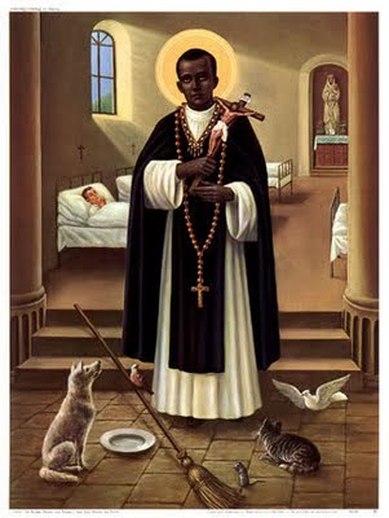
November 3rd we remember St. Martin de Porres. Born in Lima, Peru, in 1579, Martin’s father was Spanish and his mother a freed black woman. He entered the Dominican order in 1603 as a brother and tended the sick poor in the neighborhood as a nurse and pharmacist.  He’s often shown with a broom, surrounded by animals, because he took care of the cats and dogs and birds that came looking for something to eat, as well as the sick whom he attended to.

In his wonderful encyclical Laudato Si, devoted to preserving and enhancing the environment, Pope Francis observes that sometimes the poorest environment can be changed by individuals bringing love and care into it.

“A wholesome social life can light up a seemingly undesirable environment. At times a commendable human ecology is practised by the poor despite numerous hardships. The feeling of asphyxiation brought on by densely populated residential areas is countered if close and warm relationships develop, if communities are created, if the limitations of the environment are compensated for in the interior of each person who feels held within a network of solidarity and belonging. In this way, any place can turn from being a hell on earth into the setting for a dignified life.” (LS 148)

I think that’s what Martin de Porres did. He turned places that were “a hell on earth into the setting for a dignified life.”

Extreme poverty, the pope continues, “can lead to incidents of brutality and to exploitation by criminal organizations. In the unstable neighbourhoods of megacities, the daily experience of overcrowding and social anonymity can create a sense of uprootedness which spawns antisocial behaviour and violence. Nonetheless, I wish to insist that love always proves more powerful. Many people in these conditions are able to weave bonds of belonging and togetherness which convert overcrowding into an experience of community in which the walls of the ego are torn down and the barriers of selfishness overcome.”

You get the impression Pope Francis speaks from his own experience in these words. He probably would say today: that’s what saints like Martin de Porres do. They bring love where it’s needed.

Wikipedia has an excellent article on Martin de Porres

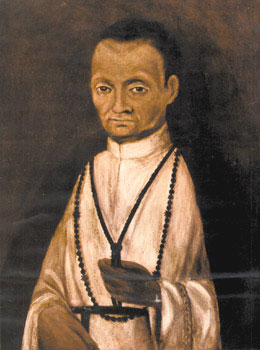
Martin de Porres, from an original portrait

Are We Caring for Our Common Home?


Pooe Leo began an important conference in Rome October1 on the environment with that question posed by Pope Francis ten years ago in his letter Laudao si’.Looks like many of the countries of the world, especially the USA, are turning away from that question. We are absorbed in our wars and political fights.

“ Our Sister Earth cries out, pleading that we take another course. Never have we so hurt and mistreated our common home as we have in the last two hundred years. Yet we are called to be instruments of God our Father, so that our planet might be what he desired when he created it and correspond with his plan for peace, beauty and fullness.

The problem is that we still lack the culture needed to confront this crisis. We lack leadership capable of striking out on new paths and meeting the needs of the present with concern for all and without prejudice towards coming generations. The establishment of a legal framework which can set clear boundaries and ensure the protection of ecosystems has become indispensable; otherwise, the new power structures based on the techno-economic paradigm may overwhelm not only our politics but also freedom and justice.

It is remarkable how weak international political responses have been. The failure of global summits on the environment make it plain that our politics are subject to technology and finance. There are too many special interests, and economic interests easily end up trumping the common good and manipulating information so that their own plans will not be affected. Any genuine attempt by groups within society to introduce change is viewed as a nuisance based on romantic illusions or an obstacle to be circumvented.”

Pope Francis, Laudato SI 54-55

Today at the Vatican Gardens outside Rome evironmental leaders of the world gathered to answer that question: Are we caring for our common home?

One thing to notice about this conference, which involved artists,scientists, politicians, business people, ordinary people. Pope Leo sat among them, not before them, as if to signify their equal task in the care of the environment. They bring an equal wisdom to the challenge of caring for the earth. It’s not just the task of religious people, or a pope. It’s a common task for a common good.

St. Maximilian Kolbe

A number of martyrs are remembered in our liturgy in mid-August. August 9, we remembered Teresa Benedicta of the Cross, Edith Stein, who died in the concentration camp at Auschwitz August 9, 1942.

August 10th, we remembered Lawrence the Deacon, one of the most important martyrs of the early church. August 13 Pontian and Hippolytus.

August 14 we remember Maximillian Kolbe, a Polish Franciscan priest, who died in Auschwitz about a year before Edith Stein, August 14, 1941.

Peter Brown, an historian of early Christianity, says it wasn’t the bravery of Christian martyrs that impressed the Romans. The Romans, a macho people, had war in their blood. They prided themselves on dying bravely.

Rather, the Romans marveled at how Christian martyrs approached death. They saw something beyond death. They considered themselves citizens of another world, who followed Jesus Christ in how they lived and believed in his promise of everlasting life.

Lawrence the deacon, for example, could have escaped Roman persecution, but he wouldn’t abandon the poor of Rome in his care. Jesus said take care of the poor.

Centuries later, Maximillian Kolbe was a priest who wouldn’t abandon the vocation God gave him.

Before World War II, Kolbe was active as a Franciscan priest, promoting devotion to Mary, the Mother of Jesus. He ran a large, successful Franciscan printing enterprise in Warsaw.

In 1939, after invading Poland, the Nazi arrested him and a number of other Franciscans and imprisoned them for some months. They ransacked their printing place, probably hoping to intimidate them. Then, they left them go.

Instead of being intimidated, Kolbe began to house refugees from the Nazis, some of them Jews. That got him into trouble, so he was arrested again, on February 14th, 1941, and sent to Auschwitz to do hard labor.

Concentration camps like Auschwitz where Maximillian Kolbe and Sr.Teresa Benedicta died are the nearest thing to Calvary in modern times. More than 1500 of them were spread mostly through German occupied territories in Europe. Twenty million people died in the camps in the Second World War, 6 million were Jews. 1.3 million people went to Auschwitz; 1,1 million died there.

Five months after Kolbe entered Auschwitz, in July 1941, a prisoner from his barracks escaped. In reprisal, the Nazis took 10 men from the barracks to put them to death by starvation. One of them cried out that he had a wife and children who would never see him again. Father Kolbe stepped forward and offered to take the man’s place.

He was the last of the ten men to die of starvation and an injection of carbolic acid two weeks later, on August 14, 1941.

Many stories of Kolbe’s ministry among the prisoners in Auschwitz were told after his death when Auschwitz was liberated. He was canonized by Pope John Paul II on October 19, 1983, who called him “Patron Saint of Our Difficult Age.”

He was a sign of God’s love in a place where God seemed absent.

Maximillian Kolbe’s death on the vigil of Mary’s Assumption into Heaven has been seen as a further sign. God’s hand reached into the dark horror of Calvary to save his Son. God reached out to Mary to bring her, body and soul, to heaven. God reached into Auschwitz and other camps of horror to bring suffering human beings to glory and peace.

The Song of Birds

Noah
Before 7 :
AM  I sit for a few minutes on the porch as the weather gets warmer, watching the birds. There are almost 40 different birds in our garden, just up from the E train.   The sparrows and the doves are usual visitors,  singing away, but the other day they couldn’t be seen or heard.  I soon saw why: a big hawk flew by overhead.

After awhile the birds were back,  chirping and moaning  as usual. Someone told me our ears are wired to hear the song of birds. Why? They tell us no dangerous enemies nearby, all is well.

Birds singing tell us the world’s in good hands. Is that why Noah sent a dove from the ark? The dove not only brought back olive branches signifying all was well, but sang the good news to those in the closed boat.

The Holy Spirit descends in the form of a dove. The ancients saw birds as mysterious visitors from heaven. I notice something fearless in the doves at our feeder. The sparrows scatter quickly at the least sign of danger; the doves stay and hold their ground. Like the dove, the Holy Spirit is a giver of life to our land and won’t abandon us.

By baptism we’re wired to hear God’s voice. We listen for God’s good news, despite the dangers. We listen for a world redeemed, a higher plan at play. Good reason to begin the day, listening to birds singing..

Mary’s Visits: Fatima

When Mary visited her cousin Elizabeth she said “all generations shall call me blessed, the Almighty has done great things for me, and holy is his name.” All generations know her; at times over the years Mary visits some in apparitions. 

Three prominent apparitions of Mary in the last 500 years are commemorated in major Marian shrines –in Mexico City, Lourdes and Fatima. In 1531, she appeared to the Mexican peasant Juan Diego on a hillside outside of Mexico City. In 1858 Mary appeared to 14 year old Bernadette Soubirous in Lourdes in France as she was gathering firewood. In 1917 Mary appeared to three shepherd children in Fatima in Portugal. These are major pilgrimage sites today. Three liturgical feasts in our church calendar honor these apparitions.

The depictions of Mary in art follow closely, if not perfectly, the accounts the visionaries gave of the apparitions. Mary, arms folded in prayer, prays for her children on earth and encourages them to pray with her in the Fatima appearance.  

The statue of Our Lady of Lourdes made by Fabisch in 1864 and placed in the grotto at Lourdes in France is a model for the many statues of Our Lady of Lourdes in churches and shrines throughout the world. We have one in our Lourdes Grotto in Jamaica, NY. (below)

Various images of Our Lady of Fatima exist; we have one in our monastery chapel.(above) Her bright white garments witness to the glory the visionaries saw surrounding her. She brings the glory of heaven to brighten the earth, as Jesus did at his transfiguration. “And he was transfigured before them, and his clothes became dazzling white, such as no fuller on earth could bleach them.” (Mark 9:2-3)

Images of Our Lady of Guadalupe show her in the native dress of the time; she identifies with the native peoples then under colonial subjugation.

Contemporaries of Bernadette and the children of Fatima faced trials of another kind than the native peoples of Mexico. Secularizing governments promoted unbelief in society and wars were increasing in number and intensity. Mary’s appearances were not only the occasion of physical cures and healing. To ordinary people then and afterwards Mary’s appearances brought reassurance and renewed faith in the promise of God’s glorious power and presence. Their faith was real.

In his letter Laudato si’ Pope Francis calls upon Mary to visit us today as we struggle to care for the earth we have neglected. I like this image of Mary, holding her Son, which we have in our Mary Garden. Creation seems to raise its voice in praise. Her Son, Jesus Christ, offers us life-giving Wisdom. “We can ask her to enable us to look at this world with eyes of wisdom,” the pope says. May she hold in her hand our wounded world.