Category Archives: contemplation

15th Sunday b: Get your Walking Stick!

For this week’s homily, please play the video below.

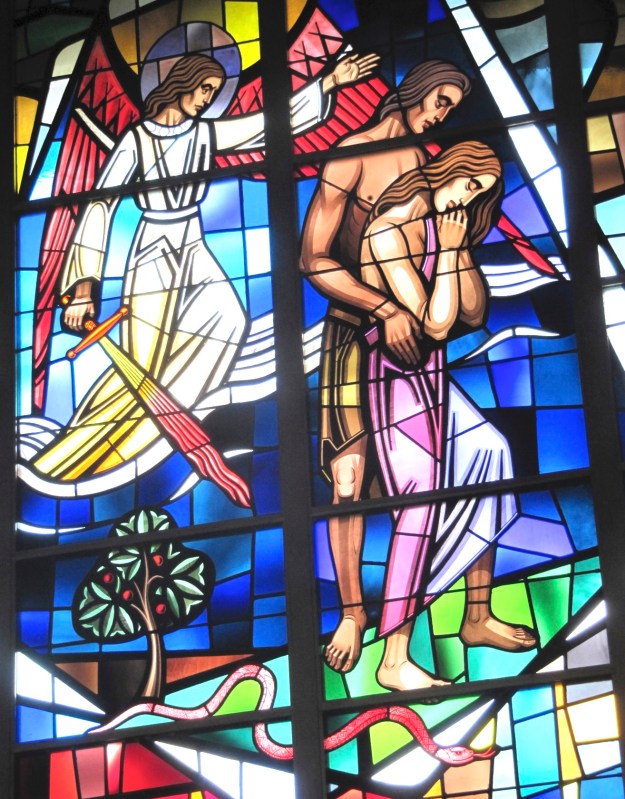
“Where are you?”


“Where are you?”

I’m beginning a retreat today with the Franciscan Sisters of Christian Charity in Manitowoc, Wisconsin, near Lake Michigan. The sisters have a college and a large motherhouse here. They serve the church as educators and spiritual directors and in health care.

We’re reflecting in the retreat on Pope Francis’ recent exhortation on holiness, Gaudete et exultate. “Where are you?” God asks us:

“The LORD God then called to the man and asked him: Where are you? He answered, “I heard you in the garden; but I was afraid, because I was naked, so I hid.” (Genesis 3)
That call of God to Adam is also a call to Eve, to all humanity, to you and me. “Where are you?”
It’s not an angry call that God makes in the garden. In the end there’s mercy.

Yes, man and woman, humanity, you and I, are part of a fallen world and must recognize our nakedness, our nothingness. Before God no one can boast, but addressing the serpent, God announces a merciful redemption:
“I will put enmity between you and the woman,
and between your offspring and hers;
They will strike at your head,
while you strike at their heel.” (Genesis 3, 15)

We’re promised victory in the battle of life.

“Where are you?” God asks. In a retreat we hear that question, try to answer it and wait for the merciful grace of God.

Pray for us.

12th Week in Ordinary Time


June 24 SUN THE NATIVITY OF SAINT JOHN THE BAPTIST
Solemnity
Is 49:1-6/Acts 13:22-26/Lk 1:57-66, 80 (587)

25 Mon Weekday (Twelfth Week in Ordinary Time)
2 Kgs 17:5-8, 13-15a, 18/Mt 7:1-5 (371) Pss IV

26 Tue Weekday
2 Kgs 19:9b-11, 14-21, 31-35a, 36/Mt 7:6, 12-14 (372)

27 Wed Weekday
[Saint Cyril of Alexandria, Bishop and Doctor of the Church]
2 Kgs 22:8-13; 23:1-3/Mt 7:15-20 (373)

28 Thu Saint Irenaeus, Bishop and Martyr
Memorial
2 Kgs 24:8-17/Mt 7:21-29 (374)

29 Fri SAINTS PETER AND PAUL, APOSTLES
Solemnity
Vigil: Acts 3:1-10/Gal 1:11-20/Jn 21:15-19 (590)
Day: Acts 12:1-11/2 Tm 4:6-8, 17-18/Mt 16:13-19 (591) Pss Prop

30 Sat Weekday
[The First Martyrs of the Holy Roman Church;
Lam 2:2, 10-14, 18-19/Mt 8:5-17 (376)

1st and 2nd Kings are Old Testament books that relate the history of the Jewish people after the time of Judges when Israel was ruled by kings, but they are not historical accounts as history is written today. Prophets like Elijah and Isaiah have an important part of play in these accounts. However grim and violent the accounts may see, the destiny of Israel is in God’s hands,. We might see them too much like the violent stories of today and turn away from them, but they’re reminders that our destiny is in God’s hands, no matter how bad our times are.

The saints we remember this week, Peter and Paul, Irenaeus, Cyril of Alexandria, take us back to the first centuries of the church. God provides leaders for every age, from the first centuries till now. The graces of the prophets are never lacking from age to age.

Be Holy!

What does it mean to be holy today, Pope Francis asks in his recent Letter “Gaudete et Exultate.” We’re called to holiness, God calls us. Jesus Christ is with us and saints encourage us to achieve that call. There’s a ”great cloud of witnesses” the Letter to the Hebrews says, and we’re called to be in that number.

Don’t miss “the saints next door,” the pope says. “These witnesses may include our own mothers, grandmothers or other loved ones (cf. 2 Tim 1:5). Their lives may not always have been perfect, yet even amid their faults and failings they kept moving forward and proved pleasing to the Lord.”

Canonized saints are not the only ones who are holy, Francis says. “I like to contemplate the holiness present in the patience of God’s people: in those parents who raise their children with immense love, in those men and women who work hard to support their families, in the sick, in elderly religious who never lose their smile. In their daily perseverance I see the holiness of the Church militant. Very often it’s a holiness found in our next-door neighbours, those who, living in our midst, reflect God’s presence. We might call them “the middle class of holiness”. (7]

The pope’s interested in ordinary holiness, and he has a gift for speaking about it. .

We are all called to be holy. “Each in his or her own way,” the Vatican Council says. Each of us has to discern God’s call; we must find our own path, discover the gifts God gives us. We don’t have to follow someone else’s path or have someone else’s gifts. To be holy means to grow with the gifts God gives us.

Some may think only those who have a church calling can be holy. We may think only those who belong to our religious tradition can be holy. Not so, Francis says, It’s a universal call.

You can read Gaudete and Exultate online at the Vatican website. Worth reading. It’s Francis at his best.

Love Is Not Easy

By Orlando Hernandez

This Thursday’s Gospel continues with the extremely challenging statements that our Lord pronounces in the Sermon on the Mount:

“I tell you, unless your righteousness surpasses that of the scribes and Pharisees, you will not enter into the Kingdom of Heaven. You have heard that it was said to your ancestors, ‘You shall not kill; and whoever kills will be liable to judgement.’ But I say to you, whoever is angry with his brother will be liable to judgement, and whoever says to his brother, ‘Raqa,’ will be answerable to the Sanhedrin, and whoever says, ‘You fool,’ will be liable to fiery Gehenna. Therefore, if you bring your gift to the altar, and there recall that your brother has anything against you, leave your gift there at the altar, go first and be reconciled with your brother, and then come and offer your gift.” (Mt 5: 20-24)

Our faith and religion is the great gift of God, but we can spoil this gift if we use it as an excuse to feel that we are “better” than our neighbor. Even prayer and piety can unfortunately be used as a cover for inhumane behavior. Our Lord points out the dangerous practices of self-righteousness that can lead to the escalation of conflict which condemns us not only to the loss of love of neighbor, but even to the total disregard for the sanctity of human life, whether through unfettered anger, cold calculation, or simple indifference. We find ourselves imprisoned by hate and guilt: “Your opponent will hand you over to the judge, and the judge will hand you over to the guard, and you will be thrown into prison.” (Mt 5: 25)

Abraham Lincoln’s famous quote explores this sad situation when he talks about the two sides in the Civil War: “Both read the same Bible and pray to the same God,and each invokes His aid against the other.” I imagine those prayers and see them as ferocious darts, adding to the countless wounds of our Jesus on the Cross. What is right and what is wrong? Why is there so much divisiveness in our country, in our world? Is our real “opponent” happily leading us in chains to the Judge? Are we already in a hopeless Gehenna, where truth and mercy are incinerated along with God’s goal of human unity within His loving embrace?

My conservative son complains that those on “the left” are merely hypocrites, calling themselves compassionate while they approve of the killing of unborn life. This kind-hearted couple, my friends, who were influential in my conversion, now call themselves “Buddhists.” After decades of being zealous Pentecostals, they now feel betrayed by their fellow fundamentalists, who support so many things that they consider divisive and cruel.

Lincoln goes on to say in his speech, “With malice towards none, with charity for all, with firmness in the right as God gives us to see the right, let us strive on to finish the work we are in, to bind up the nation’s wounds…” How do we begin to do this? How can I gauge what is “the right as God gives us to see?” How can I hold fast to love, to tolerance, to acceptance of so many people who seem so difficult to me? Only in prayer, in faithful surrender to the love of God can I find the way out of Gehenna, to defeat the real “opponent”, the accuser, the divider. Only God can give me the strength.

But oh, sometimes I feel totally bound up by these negative aggressive thoughts. My loving wife sees me there with that disturbed look she knows so well, and tells me, “Snap out of it! Look around!” Out of concern for me she got me this challenging checklist by Richard Rohr OFM, that she got at her last retreat. It sounds a lot like the Sermon on the Mount. And it is titled “What Might A Joyful Spirit Be?” Joyfulness seems to be the only way out of the prison, and this joy is the Grace that only communion with Jesus can give. Here are some examples, which can be fruitful conduits to prayer:
“ When you do not need to be right.
When you no longer need to compete–not even in your own head.
When you do not need to analyze or judge things as in or out, positive or negative, black or white.
When you can follow the intelligent lead of your heart.
When you are curious and interested, not suspicious and interrogating.
When you do not brood over injuries.
When you do not need to humiliate, critique, or defeat those who have hurt you- not even in your mind.
When you can let go of obsessive or negative thoughts.
When you do not divide and always condemn one side or group.
When you can find truth on both sides.
When you can critique and also detach from the critique.
When you can wait, listen, and learn.
When you can admit it was wrong and change.
When you can actually love without counting the cost.
When you can live satisfied without resolution or closure.
When you can find God in all things.”
Amen.

Orlando Hernández

10th WEEK OF THE YEAR

JUNE 10 SUN TENTH SUNDAY IN ORDINARY TIME
Gn 3:9-15/2 Cor 4:13—5:1/Mk 3:20-35 (89)

11 Mon Saint Barnabas, Apostle
Memorial
Acts 11:21b-26; 13:1-3 (580)/Mt 5:1-12 (359)

12 Tue Blessed Lorenzo Salvi, Passionist
1 Kgs 17:7-16/Mt 5:13-16 (360)

13 Wed Saint Anthony of Padua, Priest and Doctor of the Church
Memorial
1 Kgs 18:20-39/Mt 5:17-19 (361)

14 Thu Weekday
1 Kgs 18:41-46/Mt 5:20-26 (362)

15 Fri Weekday
1 Kgs 19:9a, 11-16/Mt 5:27-32 (363)

16 Sat Weekday
[BVM]
1 Kgs 19:19-21/Mt 5:33-37 (364)

Our first readings this week and next are from the Book of Kings–the story of Elijah, the prophet, who challenges Ahab the King of Israel and his notorious wife Jezebel. Elijah is a powerful prophet, one of the greatest of the prophets, who raises people from the dead and brings fire from heaven on his enemies, yet he left no writings; we know him mainly from the life he led.

In the First Book of Kings, Elijah is on the run most of the time, Ahab and his wife in pursuit. We follow him from water hole to water hole, hiding in mountain caves and isolated wadis in the desert, with scarcely enough to eat.

A difficult, humbling flight. Elijah appears in an icon hand to his head, wondering if he will make it, even as a raven hovers behind him bringing bread for the day. He makes it through a desperate drought, thanks to a poor widow who helps him out.

The powerful prophet is helpless, but God keep him going. And Elijah learns from experience how to see, so he sees God’s redeeming presence in a tiny far-off cloud and the whisper of a wind that says God is here.

Three holy people are remembered this week. St. Barnabas, a companion of Paul, is remembered on Monday. The Passionists remember Blessed Lorenzo Salvi on Tuesday, and the popular St. Anthony of Padua is remembered on Wednesday.

“Dissolved in Flames?”

In the coming “day of God…the heavens will be dissolved in flames and the elements melted by fire.” (2 Peter 3, 12-15) That’s a strong picture of the last days in the 2nd Letter of Peter we read today at Mass. Commentators say it’s the only place in the New Testament that predicts the world ending in fire.

Some years ago, after the Newshour in the evening, I would sometimes turn to the next channel on television to watch Harold Camping, a crusty old evangelist who was predicting the world ending in fire. The world was going to be burnt to a crisp and unless you explicitly professed faith in Jesus Christ you were going to go up in flames too.

Harold even figured out when it was going to happen, 6 PM, May 21, 2011. and if you wrote in he would send you his calculations. People called in with questions, some humorous. “Should I pay my income tax this year?” Some were sad. “My little boy can’t speak yet and profess his belief in Jesus. What about him?” Harold skirted that question.

May 21 came and nothing happened. I thought I was the only one listening to Harold until I noticed advertisements in the buses weeks before for “D Day May 21.” The day after May 21 I mentioned it to some people and one of them said she called her daughter who was driving over the Brooklyn Bridge that day to get off the bridge as soon as she could.

Harold said on a later broadcast he was recalculating the date, but some time later he died.

Harold isn’t the only one predicting an end for our planet. One of our greatest scientists, Stephen Hawkins, said before he died that we should start a colony in outer space soon because the earth is headed for destruction.

There’s a lot of pessimism in our world today. There was pessimism when the 2nd Letter of Peter was written. The apostles Peter and Paul had been viciously put to death. The City of Rome was almost completely destroyed by fire in the 60s. Jerusalem and the Jewish temple were destroyed by fire in the 70s. Christians were being persecuted and killed. I’m sure a lot of them were saying “This is the end.”

In times of pessimism we need to reaffirm God’s love for humanity and creation itself. That’s why Pope Francis’ encyclical Laudato Si is so important. Care for the earth and respect it, he says. God made our world out of love and promises to renew it.

Care for creation in practical ways, the pope says, but keep creation in mind in our prayers, especially the prayer of the Eucharist.

“In the Eucharist all that has been created finds its greatest exaltation.” Jesus became human; he was made flesh and his humanity comes from the earth. In the Eucharist, he takes bread and wine, which come from the earth, to give life to the world. Through “a fragment of matter” he communes with us.

“ Joined to the incarnate Son, present in the Eucharist, the whole cosmos gives thanks to God. Indeed the Eucharist is itself an act of cosmic love: Yes, cosmic! Because even when it is celebrated on the humble altar of a country church, the Eucharist is always in some way celebrated on the altar of the world”.[166]

“Creation is projected towards divinization, towards the holy wedding feast, towards unification with the Creator himself”.[LS 167]

God won’t destroy creation. He loves it and finds it good.

At The Waterfall


By Orlando Hernandez

A good Passionist priest once told me not to be suspicious of the images that come to my mind’s eye during special moments of prayer. He said that God gives us those “pictures” to help us understand the power and mystery of His love. The fragment from verse 5 of the 5th Chapter of
St. Paul’s letter to the Romans has always had such an influence on my imagination (or vision?) : “ The love of God has been poured out into our hearts through the Holy Spirit that has been given to us.”

At my son’s Parish in Florida which has a large, powerful, Pentecostal-style choir, I often find myself in the middle of Mass feeling as if a glorious waterfall is raining over all of us in that church, especially on my beloved grandchildren, who see me crying and try to “console” me! During many prayer meetings at the Passionist Monastery in NY, as we sing, praise, and pray over people, I have “seen” this unbearably bright, milk-like substance fall upon us and splash all over the chapel. At times of great peace I can actually feel the grace of God falling upon the world like mist from a waterfall.

Last month, Fr. Chris Cleary CP, spoke to us on a Day of Reflection at Bishop Molloy Retreat House in Queens, NY. He was talking about the Holy Spirit in our everyday lives, how the Spirit leads us to see God in everyone around us. It was a very moving presentation. It truly spoke to me, sometimes I tend to ignore those around me. And then, at the end, he invited us to close our eyes and let him lead us through a meditation. He took us through green pastures, hills, and forests until we got to a lovely waterfall. He invited us to sit on a rock and within that “holy space” imagine Jesus coming and sitting with each one of us. I enjoy these meditations. They can be interesting or even entertaining, but that day, oh boy, I was TAKEN by it. I really met my Lord at the waterfall. It was so overwhelming and mysterious that I do not have the images or words to describe what I saw, heard and felt. I guess the Lord decided to hit me hard that day, and He did !

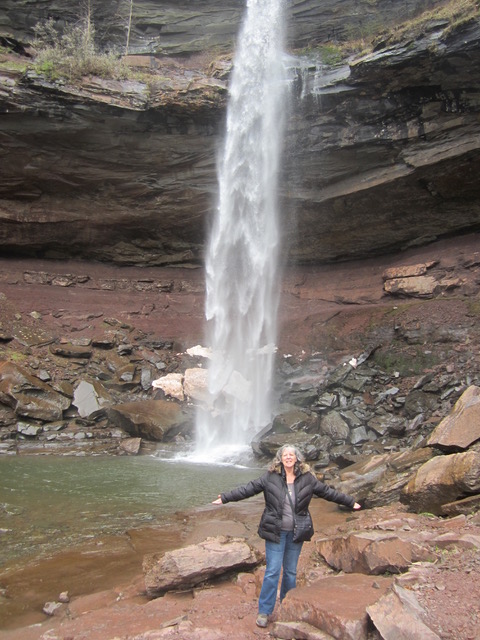
The waterfall in the vision was an actual place that I love, The Upper Falls of Kaaterskill Creek in the Catskill Mountains of New York state. My wife Berta loves the place too, so the next week we drove the three-plus hours to the place. I wanted to “meet” Jesus there to re-live the meditation experience. The one-mile hike is not that hard, but I still had to use my cane. My wife and I held each other as we negotiated the slippery rocks on the trail. We finally got there and it was awesome. Because of the recent rains the water was roaring over the edge of the 100 feet-high cliff that was looming over us. Cool midst would fog up my glasses within seconds, but we found a fairly dry, comfortable rock near the edge of the cliff behind us, where the creek poured over the Lower Falls into the vast mountain ravine.

We sat there looking at the ghostly patterns formed by the falling water before us, and “waiting” for Jesus. Well, it wasn’t at all like my experience during the meditation. The place was full of people! There were various young persons hopping from rock to rock, climbing up the grotto behind the waterfall. There were dogs of all sizes and colors carefully held in leashes by their owners. And many children- the older ones trying to skip to the other side of the creek, getting their feet soaked, the little ones vey carefully watched and chased by their parents. People came and went. We had a nice lunch at our rock and watched and watched the falling water and the people until it was time to scramble back up the trail to our car.

Oh well, no intimate communion with Jesus, no precious mystical moment, no deep prayer. Such gifts, as we all have to accept, come in God’s own time. But now, in retrospect, I remember that day with such gladness. Of course our Lord was there. He was there in His people, His lovely children. They actually did not bother me at all. They were nice to look at! We were all sharing in the miracle of God’s creative power. Even if we did not realize it we were sharing a blessed moment. We were in a “holy space”. I just did not appreciate it at that time.

Today I remember the original intent of Fr. Chris’ talk. We can find God in the most ordinary moments. The Holy Spirit is present in all the people that crowd our spaces. And I thank God that I now re-live the happiness that I felt there, so close to my wife and even to those around us as the love of God was being poured unto us.

By Orlando Hernandez

8th Week of the Year


Graphic Pentecost

May 27 SUN THE MOST HOLY TRINITY
Solemnity
Dt 4:32-34, 39-40/Rom 8:14-17/Mt 28:16-20 (165)

28 Mon Weekday (Eighth Week in Ordinary Time)
1 Pt 1:3-9/Mk 10:17-27 (347)

29 Tue Weekday
1 Pt 1:10-16/Mk 10:28-31 (348)

30 Wed Weekday
1 Pt 1:18-25/Mk 10:32-45 (349)

31 Thu The Visitation of the Blessed Virgin Mary
Feast
Zep 3:14-18a or Rom 12:9-16/Lk 1:39-56 (572)

June 1 Fri Saint Justin, Martyr
Memorial
1 Pt 4:7-13/Mk 11:11-26 (351)

2 Sat Weekday
[Saints Marcellinus and Peter, Martyrs; BVM]
Jude 17, 20b-25/Mk 11:27-33 (352)

The First Letter of Peter, read this week, was written from Rome by Peter, the apostle, to Christians threatened by persecution, ancient tradition says. Some modern scholars question if Peter himself wrote it and suggest a later author wrote using his name. You can hear in the readings early baptismal teaching which the author uses to remind his listeners who they are.

In chapters 10 and 11 of Mark’s gospel, Jesus begins his journey to Jerusalem, a journey many do not understand and, like the rich young man, they decide not to join him. James and John also thought his journey would bring power and prestige, but it was not to be. We hear in these readings lessons for the Roman church of the 70s, but the lessons are also meant for us..

A feast of Mary occurs every month in the calendar. This month it’s the Visitation (May 31), placed in the calendar between the Feast of the Annunciation (March 15) and the Birth of John the Baptist (June 24) We’re reminded of Mary’s role as a bearer of good news to her older cousin Elizabeth, who will give birth to John. Mary always brings her Son to us too.

A Small “Sermon on a Mount”

by Orlando Hernandez.

This Thursday we observe the Solemnity of the Ascension of the Lord. The first reading describes how “as they were looking on, He was lifted up, and a cloud took Him from their sight. While they were looking intently at the sky as He was going, suddenly two men dressed in white garments stood beside them. They said, ‘Men of Galilee, why are you standing there looking at the sky? This Jesus that has been taken up from you into heaven will return in the same way as you have seen Him going into heaven.’ Then they returned to Jerusalem from the mount called Olivet, which is near Jerusalem, a sabbath day’s journey away.” (Acts1: 9-12)

The Gospel of Luke describes this scene like this: “Then He led them as far as Bethany, raised His hands, and blessed them. As He blessed them He parted from them and was taken up to heaven. They did Him homage and then returned to Jerusalem with great joy.” (Lk 24: 50-52)

I was a little troubled when I first read this passage years ago. How could they feel “joy” when they had lost the company of the Beautiful One, risen and glorified? He was “taken up” from them, for how long, centuries?
On December 3, 2011 (it seems like only yesterday!), I was looking out the window of the tour bus as we passed the increasingly populated steep hills of the Judean countryside and we entered a long tunnel. As we emerged into the light, the panorama of the city of Jerusalem lay before us, the golden Dome of the Rock, at its center, the huge, crenelated Turkish wall surrounding the ancient city where our Lord died and resurrected. It was overwhelming. Our guide, Fr. Vasko O.F.M., called our attention to the Mount of Olives on our right, and at the top of the crowded hillside, pointed to a chapel-like structure, perhaps a minaret, which he called “ the place of the Ascension”. I suddenly broke into tears, and foolishly, like a child, I asked within my mind, “Why did You have to go back and leave us, dear God? Why did You leave us like this?” I gazed at the vast mass of humanity of this city, torn by war, destruction, bloodshed and prejudice for some two thousand years! I felt tiny before such a terrible, formidable story.

The next day, the bus took us up through impossibly narrow winding streets to the top of the Mount of Olives, in the Palestinian neighborhood where Bethany used to be. We got off at a dusty, neglected plot where a single, very old-looking domed structure stood, the Chapel of the Ascension. Fr. Vasko told us that a huge Crusader church stood there once. I wondered why the later Muslim rulers decided to let this chapel stand after destroying everything else. Perhaps the answer was inside. Within the empty structure there was nothing but a flat rock with what seemed to be a footprint implanted on it. It was said to be from Jesus’ foot, just as He started to rise into heaven! Fr. Vasco opened the Bible and read passages from the Ascension story. I felt disturbed by it all.

We wound our way down “ the mount called Olivet” past the vast Jewish cemeteries facing the Old City on the other side of the Kidron Valley until we stopped in front of the church Dominus Flevit for a rest stop on the way to the Garden of Gethsemane. My wife and I had been walking with our new found friend, Fr. Bill Kalin, making sure he was safe negotiating the cobblestones. He was an elderly man and his legs were going. But a benefactor had paid for his tour to Israel, and he could not pass it up. He was living in a retirement home near Lincoln, Nebraska,his home state, and he was not too happy about it. He loved talking with my wife and I because it gave him a chance to review his Spanish.This man had spent the last twenty years of his life as a missionary in the garbage dumps somewhere in Venezuela, ministering to the people that actually lived there. All the folks in our group had fallen in love with him. We would all take turns helping him out.

From the place where Jesus wept as He faced the Holy City, I dared to ask Fr. Bill why Jesus had “returned” to heaven and left us without Him. He graciously gave us one of those mini-homilies that he would share with us at different points in our pilgrimage. Most of you readers are probably acquainted with the points that he made. I just wish that I could convey to you the PRESENCE of this gentle, holy man. His very shining self was part of the message. He told us with a smile on his face, “You all know that He has never really left us. But He had to return to heaven for three reasons.” The first reason was that He WAS God, and He had to return to His fully divine state. He was close to His beloved Abba as a man, but we can only guess at the glory of His divine intimacy in union with His Father.
The second reason was a little harder for us to comprehend. “He returned to heaven to prepare a place for us.” Again, I cannot even imagine what this place, these “many rooms” are like. But He did promise us that . Like a child waiting for Christmas I was filled with joy as I looked into Fr. Bill’s blue eyes.

The final reason was the one that satisfied me the most. Fr. Bill joked about how difficult it would have been to meet Jesus if He had remained on Earth as some kind of king, spiritual leader, or pope. Most of us would not even be able to get a five-minute audience with Him! Instead, thanks to His full access to the Divine, Jesus can send us His Holy Spirit (which I believe with all my heart is actually another revelation of His Very Self!) whenever we pray, and seek Him. He is with us individually, one-on-one all the time! He had to “ascend” in order for this to happen.

Fr. Bill had actually told me something that I already knew deep inside. This intimate communion with God was the force that had brought me on that pilgrimage to the Holy Land. Fr. Kalin’s loving talk had just brought this knowledge to light, a light that healed me in many ways and took away the morose state in which I had found myself that day
.
Years back we sent him a card to his address in Nebraska. He sent us back a beautiful answer. We’ve been out of touch with him for a while. I wonder how he is doing. I think I’m going to write a letter to this man of God who was so influential in my life. Thank You, ever present, beloved Jesus!
Orlando Hernández