Category Archives: art

St. Peter in Chains

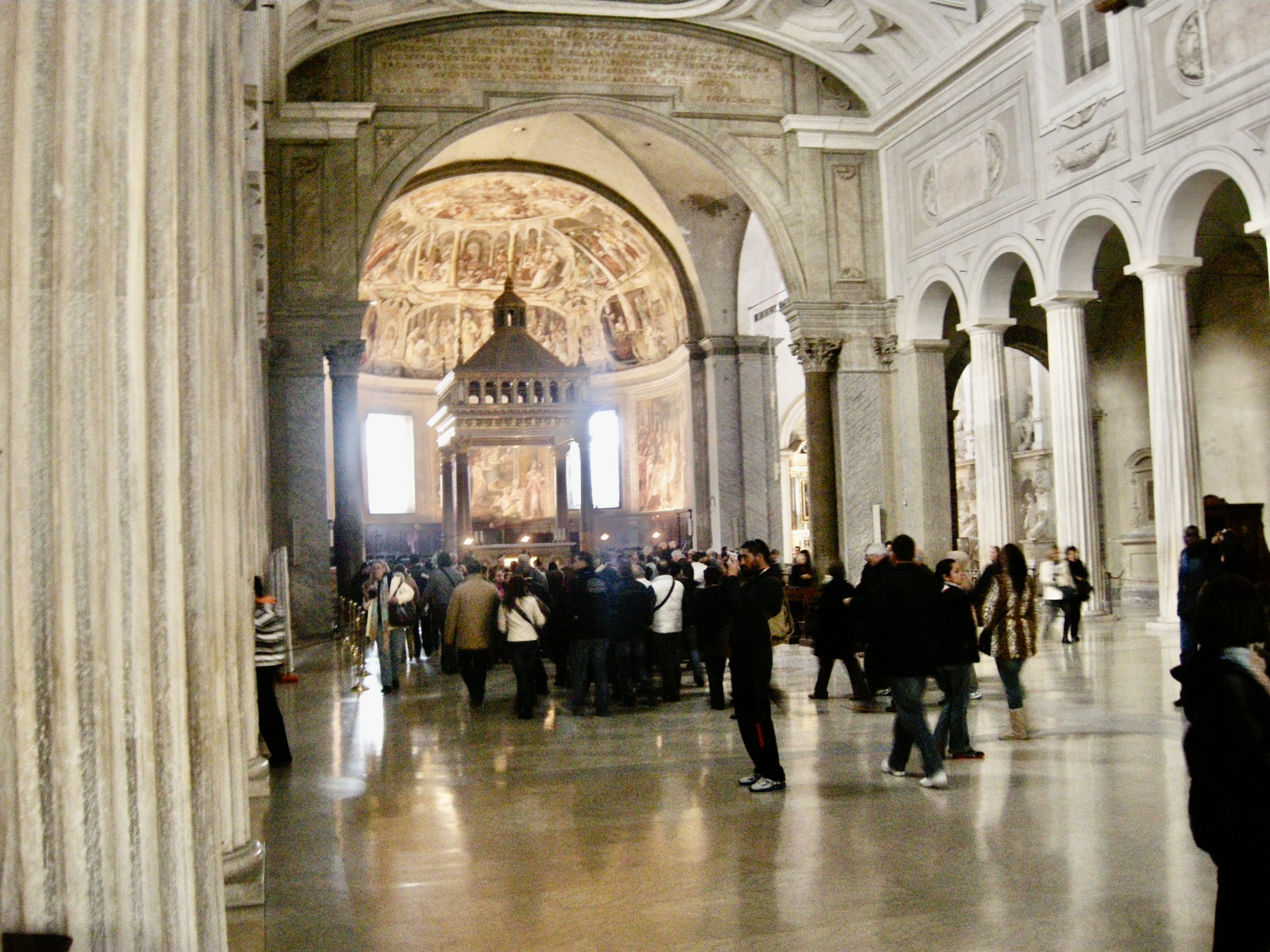
The Vatican Basilica where Peter the Apostle is buried is a prime destination for pilgrims to Rome today, but another important place dedicated to the memory of the apostle is the Church of St. Peter in Chains. It was built in the 5th century by the Empress Eudoxia on the western slope of the Esquiline Hill, next to the site of the early Roman Prefecture, not far from the Colosseum and the Roman Forum.

Justice was still being dispensed at the Roman Prefecture in Eudoxia’s day. Rome’s main prison was also nearby, where suspected criminals were tortured, questioned and judged. Not far away, just outside the city, those condemned were beheaded or strangled.

I would guess that Eudoxia was inspired to build this church next to the Roman Prefecture by the dramatic story we read today from the Acts of the Apostles of Peter being freed from his chains from a Jerusalem prison. (Acts 12:1-11) I imagine she saw the Prefecture as the place where judgment was carried out for so many Christians, even Peter and Paul.

Eudoxia gathered chains from the prisons in Jerusalem and Rome and placed them under the altar of this church she built, according to reports. Modern visitors usually turn to Michelangelo’s famous statue of Moses, located in the same church, but they should keep the chains in mind. They represent the imprisonment of Christian martyrs like Peter and Paul, and so many others.

A strong tradition among early Christian communities — affirmed today by many historians and archeologists — says that Peter met his death at Nero’s circus on the Vatican and Paul was beheaded along the Via Ostia near the place where Constantine later built a church in his honor. The apostles Peter and Paul, were martyred late in the persecution. Many details of their martyrdom are unknown, but like others they must have been arrested, put in chains, questioned, and sentenced before being executed.

Were Peter and Paul and many of the Christian martyrs who died in Nero’s persecution arrested, enchained and sentenced here?

There are later legends, of course. One says Peter and Paul were imprisoned in the Mamertime Prison, near the Capitoline Hill, where they converted and baptized their jailers. Peter, freed from his chains, escaped and fled along the Via Appia until he reached the place where the chapel, Domine, Quo Vadis? now stands. There he met Jesus coming into the city. “Where are you going, Lord?” Peter asked. When Jesus told him he was going to join those suffering, the apostle turned to embrace the same fate.

In the apse of the church of St Peter in Chains there’s a 16th century painting of Eudoxia presenting the chains to the pope. According to some 8th century homilies, one is from a Jerusalem prison. The other is from a Roman prison, possibly the one nearby? Eudoxia was a woman who listened to the scriptures with her imagination and saw connections. Good example for us who listen to the scriptures today.

Basilica di s.pietro in vincoli, A.P.Frutaz, Rome ?

The Roman Catacombs and Their Martyrs, l. Hertling SJ and E.Kirschbaum,SJ, Milwaukee, USA 1956

Venerable Bede


The Venerable Bede (672-735), whose feast day is May 25th, was destined from his birth to be a monk. Born near Wearmouth Abby in England, he spent his life in that monastery from his earliest years, and became a scholar, teacher and spiritual guide. His commentaries on scripture and the history of England were known far beyond the place where he lived. He is considered the most learned man of his time.

“It’s ever been my delight to learn, to teach and to write,” he said, and he shared his learning with those he lived with; his wisdom inspires us today. Besides the scriptures and historical studies, Bede delighted in music, mathematics and learning about the natural world. He’s honored as a Doctor of the Church.

You can see from an account of his life by Cuthbert, a contemporary,  that his brothers in the monastery liked him and held him in esteem. And he liked them. Until the day of his death he continued to think and teach and write. On the day he died he was finishing up one of his studies, a commentary on the scriptures. When it was done “on the floor of his cell, he sat and sang “Glory be to the Father and to the Son and to the Holy Spirit”; and as he named the Spirit, the Breath of God, he breathed the last breath from his own body. With all the labour that he had given to the praise of God, there can be no doubt that he went into the joys of heaven that he had always longed for.”

Before he died, he wrote this:

“Before setting forth on that inevitable journey, none is wiser than the man who considers—before his soul departs hence—what good or evil he has done, and what judgement his soul will receive after its passing.”

Lord, give us a love of learning and a delight in your wisdom and truth, and the courage to look at ourselves.

Mary’s Visits: Fatima

When Mary visited her cousin Elizabeth she said “all generations shall call me blessed, the Almighty has done great things for me, and holy is his name.” All generations know her; at times over the years Mary visits some in apparitions. 

Three prominent apparitions of Mary in the last 500 years are commemorated in major Marian shrines –in Mexico City, Lourdes and Fatima. In 1531, she appeared to the Mexican peasant Juan Diego on a hillside outside of Mexico City. In 1858 Mary appeared to 14 year old Bernadette Soubirous in Lourdes in France as she was gathering firewood. In 1917 Mary appeared to three shepherd children in Fatima in Portugal. These are major pilgrimage sites today. Three liturgical feasts in our church calendar honor these apparitions.

The depictions of Mary in art follow closely, if not perfectly, the accounts the visionaries gave of the apparitions. Mary, arms folded in prayer, prays for her children on earth and encourages them to pray with her in the Fatima appearance.  

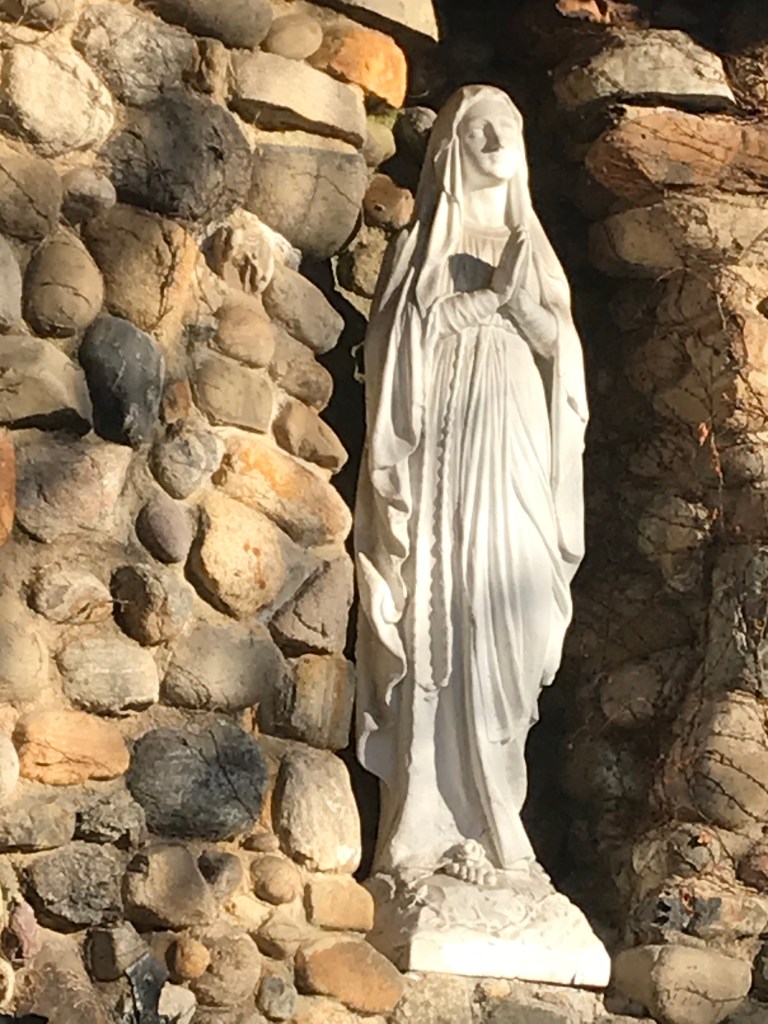
The statue of Our Lady of Lourdes made by Fabisch in 1864 and placed in the grotto at Lourdes in France is a model for the many statues of Our Lady of Lourdes in churches and shrines throughout the world. We have one in our Lourdes Grotto in Jamaica, NY. (below)

Various images of Our Lady of Fatima exist; we have one in our monastery chapel.(above) Her bright white garments witness to the glory the visionaries saw surrounding her. She brings the glory of heaven to brighten the earth, as Jesus did at his transfiguration. “And he was transfigured before them, and his clothes became dazzling white, such as no fuller on earth could bleach them.” (Mark 9:2-3)

Images of Our Lady of Guadalupe show her in the native dress of the time; she identifies with the native peoples then under colonial subjugation.

Contemporaries of Bernadette and the children of Fatima faced trials of another kind than the native peoples of Mexico. Secularizing governments promoted unbelief in society and wars were increasing in number and intensity. Mary’s appearances were not only the occasion of physical cures and healing. To ordinary people then and afterwards Mary’s appearances brought reassurance and renewed faith in the promise of God’s glorious power and presence. Their faith was real.

In his letter Laudato si’ Pope Francis calls upon Mary to visit us today as we struggle to care for the earth we have neglected. I like this image of Mary, holding her Son, which we have in our Mary Garden. Creation seems to raise its voice in praise. Her Son, Jesus Christ, offers us life-giving Wisdom. “We can ask her to enable us to look at this world with eyes of wisdom,” the pope says. May she hold in her hand our wounded world.

The Ethiopian Eunuch

Philip eunuch

Readings
Rembrandt’s biblical subjects are always interesting. As a child he used to sit with his mother while she prayed and look at the illustrations in her prayerbook. All his life the painter was attracted to the bible. Even without a commission, he’d sketch a biblical story that caught his eye.

Here’s the Ethiopian eunuch–our reading from Acts for today– kneeling and looking intently at the stream of water, waiting to be baptized by Philip the deacon. He’s been profoundly moved by the story he’s been told.

His servant stands behind him holding his rich outer garments. He’s the queen’s treasurer, don’t forget, but something greater awaits him now.  An imposing guard on horseback, armed to the teeth, maybe an Ethiopian security agent, looks on. The rest of his retinue stand back, maybe puzzled by it all and anxious to get on their way on the long trip home from Jerusalem.

Like Zacchaeus — another rich man Luke recalls — the Ethiopian sees something greater than riches in Jesus and the water promising life.

Though visibly absent, the Holy Spirit who orchestrated this scene is here too. .

How does it all turn out, we wonder? When they get home, does the eunuch get sacked because the security agent turns him in for foolish behavior? Does the servant who watched the baptism become a follower of Jesus too? Did the eunuch tell the Queen the story of Jesus? Did he ever get back to Jerusalem again?

Luke is a wonderful story-teller. In his day Ethiopia was the end of the world, and so the gospel reaches there. In this account, he invites us to think about another path taken in the spread of the gospel.  Luke is a wonderful story-teller, and Rembrandt is too.

The Cross in Early Christian Art

cross, 4th Century Sarcophagus, Rome

Cross, 4th Century Sarcophagus, Rome

There are no realistic representations of Christ Crucified and his passion in early Christian art. Realistic portrayals of Christ on the cross and his passion only appear in the early middle ages in the western church. The Crucifixion of Jesus was only portrayed symbolically at first, as in the example above, and early on appears in a variety of ways.

The Anchor Cross

anchor 4

Travelers from one port to another on the Mediterranean Sea at the time of Jesus were never sure of a safe passage until they dropped anchor. The anchor became the symbol of safe arrival, and so ancient seaports on the Mediterranean like Alexandria and Antioch adopted the anchor as a symbol for their city.

Early Christians used the anchor as a symbol of their hope of reaching a heavenly port, the kingdom of God and they inscribed it on their burial sites  in the catacombs to express their hope in Jesus Christ. The anchor closely resembles a cross and early Christians surely saw the resemblance. It’s the most common and sometimes only mark found on the earliest Christian graves in the ancient Roman catacombs of Priscilla, Domitilla and Callistus.

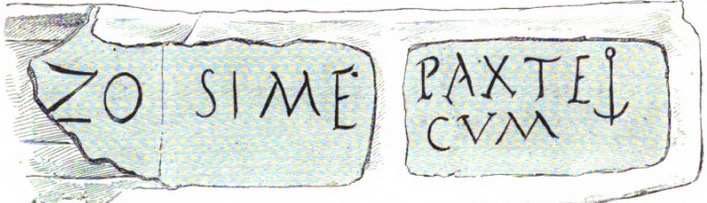
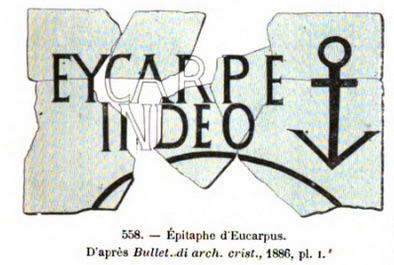
“Pax tecum,” “Peace be with you” the inscription (above) next to an anchor on one of these gravesites reads; the name of the deceased has been half-destroyed by grave robbers looking for valuables long ago. “Eucarpus is with God” we see in another below.

anchor 3

One reason early Christians hesitated to portray the crucifixion of Christ realistically was because the practice  was still  common in the Roman world until the Emperor Constantine  banned it in the 4th century. With crucifixion still before their eyes, Christians would hardly want it portrayed realistically in art, even if it were the crucifixion of the Savior.

FullSizeRender

The oldest known portrayal of the crucifixion of Jesus, (left), is a mocking graffiti found on the wall of a barracks on the Palatine Hill in Rome, showing a crucified man with the head of a donkey, and before him a man with hand raised to the image. The Greek inscription from about the year 220 AD reads: “Alexander worships his god.” Undoubtedly, Alexander is a Christian being mocked for belief in Jesus crucified.

The first centuries of Christianity, in  fact, produced little art. For one thing, it inherited a strong iconoclastic tradition from Judaism. The 2nd century writer Justin Martyr also offers another explanation in his Apology disputing Roman claims that Christians were atheists and a danger to society. Justin acknowledges they had no temples, no statues of gods, and did not participate in the rites of Roman prayer.  But Christians were loyal Romans who believed in God, Justin argues. They worship, though, in their own homes and pray there to a God who cannot be imagined or adequately portrayed. (Apology 9,67)

Great Christian churches and shrines were not built till the 4th century, after  emancipation by the Emperor Constantine. Before that, Christian art is found mainly in the catacombs, where Christians buried their dead.

Moses strikes the Rock, Noah saved by the wood. Catacombs

Moses strikes the Rock, Noah saved by the wood.
Catacombs

The art of the catacombs, which are found mostly  around the city of Rome, comes down to us in a fragile state and can be hard to decipher after being underground for centuries. Its simple symbolic style can leave its powerful religious significance unappreciated. Art historians lament its lack of style compared to the sophisticated Roman art of its day.

The writings of Justin Martyr and other early Christian writers may help us better understand its simple, powerful message. In his Dialogue with Trypho the Jew, Justin uses a list of Jewish scriptures that he claims predict the coming of Christ, his life, death and resurrection. The  scriptures were used by other Christian writers of his day–Tertullian, Barnabas, Irenaeus–   to prove that “all the prophets bear witness” to Christ, the promised Messiah. (Acts 10,43)  Before them, Jesus appealed  to Moses and all the prophets to show why it was necessary for the Messiah to suffer. (Luke 24,26-27)

These same Jewish scriptures influenced the formation of the gospels and early Christian baptismal catechesis. They were read in Christian worship and decorated  Christian burial places. The Jewish scriptures are the key to understanding the art of the catacombs.

In his Dialogue with Trypho Justin proposes to his Jewish opponent scriptures such as Psalm 22 and the Servant Songs of Isaiah 53, that indicate God’s plan to send a suffering Messiah who would redeem his people. These same scriptures shaped the accounts of the passion of Jesus in the four gospels.

In the 86th chapter of his Dialogue with Trypho, Justin lists other scriptures, beginning with the tree of life planted in paradise, that reveal the saving power of the wood of the cross. That saving wood was prefigured in the wooden rod Moses used to bring water from the rock in the desert and divide the sea for his people to pass over. The cross was prefigured in the ladder Jacob saw mounting to heaven. Abraham saw it in the oak at Mamre and in the wood Isaac carried to his sacrifice. David saw the cross in the tree planted by running waters, mentioned in Psalm 1. The cross was signified in the wood that saved Noah from the flood.

MOSES ROCK *

Isaac carry the wood of sacrifice. Roman catacombs.

Isaac carries the wood of sacrifice.
Roman catacombs.

Many of these Old Testament figures connect wood with water and feature in the early church’s catechesis and rites of initiation. The same catechesis speaks to the dead resting in the catacombs, who  believed in Christ. Through baptism and the sacraments Jesus Christ would bring them, through the mystery of his death and resurrection, to eternal life.

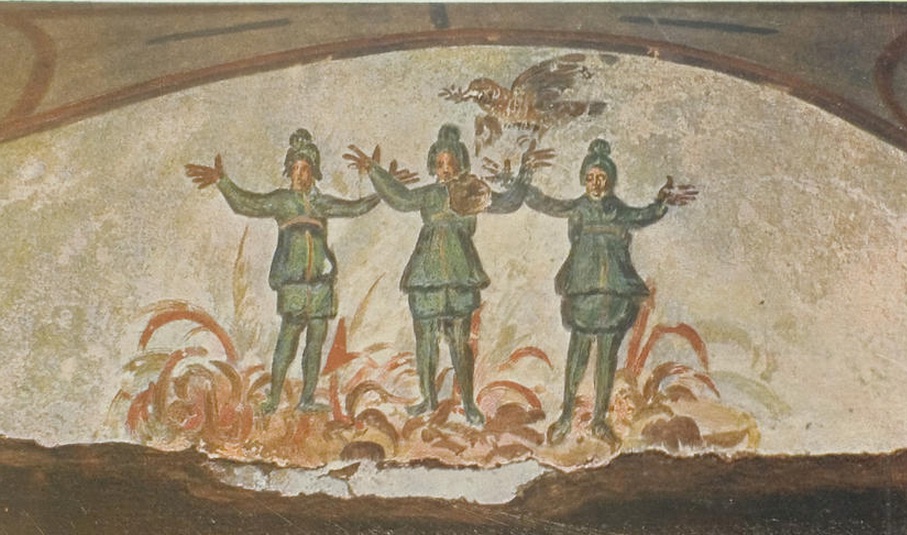
In other parts of the Dialogue, Justin offers the Three Children in the Fiery Furnace, Daniel in the Lion’s Den, and other Old Testament stories as images that speak of the Passion of Jesus. All these “signs” also appear extensively in the art of the catacombs.

3 children 1

Daniel in the Lion's den. Catacombs

Daniel in the Lion’s den.
Catacombs

In the 55th chapter of his Apology Justin adds signs from nature and human society to expand his argument for Christianity and the mystery of the cross, A ship can’t sail and arrive at its destination without a sail; a field can’t be plowed without a plow. Both of these are in the form of a cross. Human beings themselves are made in the form of a cross, Justin emphasizes. Figures with arms outstretched, Orants, appear everywhere in the catacombs. They imitate Christ who prayed with arms outstretched on the cross, and his prayer was heard. (Tertullian, On Prayer 14)

Orans, Catacomb

Orans, Catacomb

Noah saved by the wood of the ark. Roman catacombs

Noah saved by the wood of the ark.
Roman catacombs

The art of the catacombs found mostly in the 40 or so catacombs around Rome, offers a rich fascinating look at early Christian belief. Today In the Catholic Church’s prayers for the dying we can still hear the figures portrayed there  invoked once more.

“Welcome your servant, Lord, into the place of salvation…Deliver your servant Lord, as you delivered Noah from the flood, Deliver your servant, Lord, as your delivered Moses from the hand of Pharaoh. Deliver your servant, Lord, as you delivered Daniel from the lions den. Deliver your servant, Lord, as you delivered the three young men from the fiery furnace. Deliver your servant, Lord, as you delivered Job from his sufferings. Deliver your servant, Lord, through Jesus our Savior, who suffered death for us and gave us eternal life.” (Roman Ritual)

Good Shepherd, Old Testament figures of the Passion. Catacombs

Good Shepherd, Old Testament figures of the Passion. Catacombs

Following Jesus Christ

I like Rembrandt’s drawing of Jesus preaching to a crowd representing all ages, shapes and sizes of ordinary humanity. Jesus’ disciples, like Peter, James and John are there, but they don’t stand out.Some of his enemies are there, but they don’t stand out either. They’re all there listening, except maybe the little child on the ground playing with something he’s found. Jesus sheds his light on them, even on the little child.

Did Rembrandt find these faces in the people of his neighborhood, ordinary people? If so, this crowd could be us.

All the gospels recall Jesus journey from Galilee to Jerusalem, which we recall in Mark’s gospel. . Some women from Galilee follow him. He calls Zachaeus, the tax collector, down from a tree to join him. Follow me, he says to a blind man begging in the same place for years. He called people of every shape and form, sinners, tax-collectors, everyone.

They follow him, not just to see him die, but to go with him to glory. “Come with me this day to paradise, “ Jesus says to the thief on the cross. Our creed says he descends into hell, to those waiting for centuries for the redemption he brings. He calls all generations to follow him.

Following Jesus to glory means taking up our cross each day.“Then he said to all, ‘If anyone wishes to come after me, he must deny himself and take up his cross daily *and follow me. For whoever wishes to save his life will lose it, but whoever loses his life for my sake will save it.’” ( Luke 9, 23-24 )

Jesus speaks to “all”. Everyone in this world has a challenge to take up and a burden to bear. “Take up your cross.” It’s a cross that’s distinctly ours, not the physical cross Jesus bore; it’s the cross we bear. “Do you want to see the cross? Hold out your arms; there it is.” (Wisdom of the Desert)

He blesses those who share his cross. He gives them strength to bear what they have to bear and to carry out the mission they have been given.

Even the little child in Rembrandt’s painting is blessed with his grace, even though he’s in his own world, playing with some little thing, not hearing a word. Even the child is blessed.

Noah and the Ark: Genesis 6-7

Where did the story come from?

A few years ago Nova on PBS featured a program called“The Secrets of Noah’s Ark.” In early times, floods were common in the “Fertile Crescent,” the area in Mesopotamia {modern Iraq} where the Tigris and Euphrates Rivers and the ancient city of Babylon were located. Floods, sometimes great floods, occurred, so the people had to be ready. You had to keep your boats handy, and a big boat also– you never knew..

But people then, as now, had short memories. “As it was in the days of Noah, so it will be at the coming of the Son of Man. In those days before the flood, they were eating and drinking, marrying and giving in marriage, up to the day that Noah entered the ark. They did not know until the flood came and carried them all away.” (Matthew 24, 37-38)

I suspect some Babylonian priests then– meteorologists and story tellers of the age– came up with a flood story thousands of years before the Noah story in Genesis, to keep people on their toes – and maybe challenge some early climate change deniers too. It reinforced important advice: “ Keep your boats in shape and make sure a big boat’s around for ‘the big one.’”

Jewish priests and scribes in 6th century Babylon saw the story a perfect fit for the story of human origins they were telling their people. For them the take-away from the story was not to keep a big boat handy, but to be faithful to God like Noah and Abraham and their families. If they were faithful, God would save them from the flood and bring them  to the Promised Land.

The Nova program showed evidence from today of those big boats there “just in case.”

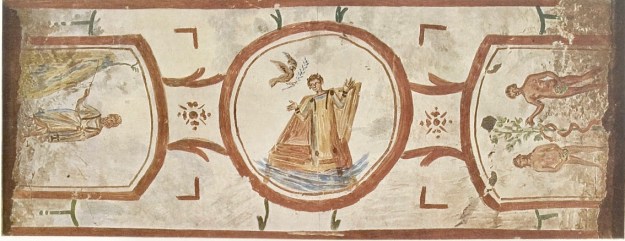
The story gave hope to the Jews driven from Jerusalem to exile in Babylon where, “By the rivers of Bablyon, we sat ad wept, remembering Zion.” (Psalm 137)  Christians– the pictures in the catacombs remind us (above)– saw Noah as a sign that the waters of baptism saved them from death and brought them the promise of paradise lost by Adam and Eve.

So the story of Noah and the ark is more than a myth.

Building a City: Genesis 11: 1-9

babel
Tower of Babel. Pieter Bruegel the Elder. 16th century

After the deluge, God renews a covenant with creation, and the descendants of Noah begin to fulfill God’s command “to increase and multiply and fill the earth.”

But then something else happens: human beings want to be together, so they build a city. A common origin and language draws them together, not just as families or clans, but in a larger society. They look for human flourishing in a city. (Genesis 11,1-9)

Unfortunately, they overreach. They want to get their heads into the heavens and so they plan a tower into the sky. Like Adam and Eve reaching for the Tree of the Knowledge of Good and Evil, they want to be like gods, “presuming to do whatever they want,” Their tower becomes a Tower of Babel. It collapses and they’re scattered over the world, leaving their city unfinished.

It’s important to recognize that the Genesis story does not claim God’s against human beings building a city. The bible, in fact, often sees the city as a place favoring human flourishing. In the Book of Jonah, God values the great city of Nineveh. Jesus sees Jerusalem, the Holy City, cherished by the Lord, the place where he dwells. The Spirit descends on his church in the city. The Genesis story sees the city as good, but it can be destroyed by sin and human pride..

The picture at the beginning of this blog is a painting of the Tower of Babel by the 16th century Dutch artist, Pieter Bruegel the Elder. It’s situates Babel in Antwerp, one of the key seaports of the time. Its shaky structure suggests it’s too ambitiously built. Still incomplete, it may not last. So the painter offers a warning against ambition and not caring for people, especially the needy.

It’s interesting to note that Pope Francis encourages mayors from cities to plan well. Commentators say the pope, conscious of a rising isolationism that’s affecting nations and international bodies today, sees cities to be agents for unifying peoples. They’re important places for humans to flourish. The United Nations also sees cities as key resources in the challenge that comes with climate change.

The picture at the end? You don’t have to be told. A great city. Still, its greatness will be judged, not by its big buildings or businesses, but how it encourages human flourishing.

img_1960

Learning from Genesis

tree-of-life-2


Pope Francis, in his encyclical Laudato Si, , invites Christians to turn to the Book of Genesis to understand how they’re related to the earth.

Genesis makes clear in its first chapter that the earth, “our common home,” is God’s work. God works for 5 days to create the world; only on the 6th day does God create man, whom he gives dominion over creation– but not absolute dominion. God made this world, not us, and every created thing enjoys a distinct relationship to its creator.

The dominion we have from God is a gift and is not absolute. We’re to help, respect, understand, tend, care for creation: creation isn’t ours to do what we want with it.

eden-2

The 2nd chapter of Genesis describes the creation of man. The earth is dry dust, but water wells up making a soft wet clay from the dust. God, like a potter, fashions man from the clay, breathing the breath of life into him and making him a living being.

We’re creatures of the earth, the story says.  As we’re reminded on Ash Wednesday, “You are dust and to dust you shall return.”

After creating man, God places him in a garden filled with all kinds of plants and trees. Two trees are singled out, the tree of life, and the tree of the knowledge of good and evil. Man is forbidden to eat from that tree.

What’s the tree of the knowledge of good and evil? Why is it forbidden to eat its fruit?  There are different interpretations. Some interpret eating from the tree as a decision of moral autonomy. By eating its fruit, I claim a knowledge of good and evil; I say what’s right or wrong.

Not unusual to hear that today, is it? Some believe they’re in absolute control of their lives. They choose what’s right or wrong, good and evil, rejecting the limits of the human condition and the finite freedom God gives human beings.

Another interpretation sees eating from the tree as a decision to trust only in human experience and human knowledge that we gain as we grow and progress individually and as a people. Like children distancing themselves from their parents, we must be self sufficient, gaining a wisdom on our own. The danger is that human experience and human wisdom become absolute.  We distance ourselves from God.

Can we see both these approaches harmful to our environment? The first leads to a possessiveness of created things;  they belong to us alone and we can do anything we want with them.

The second way also leads to harming our environment. Pope Francis speaks of the danger of “anthropocentrism,” putting human beings at the center of everything, a trend he traces back to the beginnings of the Enlightenment in the 16th century. Trusting human knowledge and human creativity, some are convinced that science and technology alone can bring about a perfect world.

Technology isn’t enough to meet our present environmental crisis, the pope says, we humans need to change. We need to humbly accept our place in creation, as God meant it to be.

What about the tree of life in the Genesis narrative? In the garden the tree was a promise of continuing life. Once banished from the garden,  human beings face death.

tree-of-life

When Christ came in the fullness of time, he brought life to the world, Christians believe. In his death on the cross, the sign of death was replaced by a sign of life. His cross is a tree of life.

Here’s Pope Francis from Laudato si:

“The creation accounts in the book of Genesis contain, in their own symbolic and narrative language, profound teachings about human existence and its historical reality. They suggest that human life is grounded in three fundamental and closely intertwined relationships: with God, with our neighbour and with the earth itself. According to the Bible, these three vital relationships have been broken, both outwardly and within us. This rupture is sin. The harmony between the Creator, humanity and creation as a whole was disrupted by our presuming to take the place of God and refusing to acknowledge our creaturely limitations. This in turn distorted our mandate to “have dominion” over the earth (cf. Gen 1:28), to “till it and keep it” (Gen 2:15). As a result, the originally harmonious relationship between human beings and nature became conflictual (cf. Gen 3:17-19).

It is significant that the harmony which Saint Francis of Assisi experienced with all creatures was seen as a healing of that rupture. Saint Bonaventure held that, through universal reconciliation with every creature, Saint Francis in some way returned to the state of original innocence.[40] This is a far cry from our situation today, where sin is manifest in all its destructive power in wars, the various forms of violence and abuse, the abandonment of the most vulnerable, and attacks on nature.”

Pope Francis, Laudato SI  66

Noah’s ark, the Magi, the Slaughter of the Innocents

Noah’s ark, the Magi, the Slaughter of the Innocents. “They’re just myths,” you hear it said. I don’t like those stories dismissed that way, because it easily leads to a further dismissal: ”Is any of it true? Probably not.”

We think straight reporting is the only thing true. “Just the facts, Mam.” Everything else is fake news. But are these stories fake?

“The Secrets of Noah’s Ark” a recent Nova program on PBS examining the biblical story makes good sense to me. In early times, floods were common in the “Fertile Crescent” the area in Mesopotamia {modern Iraq} where the Tigris and Euphrates Rivers and the ancient city of Babylon were located. So you had to keep boats handy– you never know.

You had to be ready for a great flood too, but people have short memories and people then, as now, tend to forget “the big ones.” “As it was in the days of Noah, so it will be at the coming of the Son of Man. In those days before the flood, they were eating and drinking, marrying and giving in marriage, up to the day that Noah entered the ark. They did not know until the flood came and carried them all away.” (Matthew 24, 37-38)

I suspect some Babylonian priests– meteorologists and story tellers of their time– came up with a flood story thousands of years before the Noah story to keep the people of their day on their toes – and maybe challenge some early climate change deniers too. It reinforced important advice: “ Keep your boats in good shape and make sure there’s also a big boat around for ‘the big one.’”

dsc00301

Exile of Jews  to Babylon

In 587 BC, thousands of Jews were driven from Jerusalem, destroyed by Babylonian armies, and were forced to make the thousand mile journey in Babylon. It was their Exile. When they heard the story of the great flood they saw it as a symbol of their own tragic circumstances. “By the rivers of Babylon, we sat and wept, remembering Zion.” (Psalm137)

Returning from exile, the Jews incorporated their version of the flood story into the Torah. It became a reminder to keep the covenant God made with them and beware of living unfaithfully as “in the days of Noah.”

Does real history underlie the story of the Magi and the Slaughter of the Innocents? Begin with Herod the Great, ruler of Palestine then, whom secular sources and many archeological monuments from the time describe quite well. Herod was a micro-manager who built fortified palaces in Jerusalem, the Herodium outside Bethlehem and other places to keep watch over his kingdom.

dsc00291-version-4

Citadel, Herod’s Palace Fortress, Jerusalem

fullsizerender

Herodium, Mountain Fortress of Herod the Great

He promoted trade with the outside world; he built the seaport of Caesarea Maritima on the Mediterranean Sea and cultivated the trade routes from Yemen and other eastern parts that led all the way to Rome. He would have kept tabs on those arriving with spices and luxury goods of all kinds. He knew who came and went.

Were the Magi wealthy eastern traders, quite knowledgeable about the religious world of the people with whom they traded? Did they hear of the Child in Bethlehem? Herod’s advisors and everyone else knew Bethlehem was associated with the legendary King David and there were prophecies about an heir to his throne coming from there. Did the foreigners visit the Child, bring their gifts, gold, frankincense and myrrh, the prizes of their trade, and then quickly leave, well aware of Herod’s paranoia, quick temper and brutality.

Given Herod’s jealous hold on power, the story of the slaughter of the Innocents in Matthew’s Gospel doesn’t seem unlikely, True, it’s not mentioned in any secular source, but neither are many other tragic stories of the time. Bethlehem, after all, was a small town, off the beaten track. The death of perhaps 20 or so infants might go unnoticed and be quickly forgotten.

Matthew’s story is hardly a myth. Rather, it sees things through God’s eyes. The star points to the real power guiding human history; the magi represent the rest of the world coming to adore the Child. Angelic powers are always at our side. The slaughtered infants are like so many tragic deaths that seem to question God’s promise of life, but God doesn’t forget, the story says, even if human history doesn’t remember. “The souls of the just are in the hands of God and no torment shall touch them.”

If you ever visit Bethlehem, go to see the Herodium, Herod’s massive fortified palace looking down on the nearby town. Joseph wouldn’t need much urging to take the Child and his mother from this place,would he? Go to the Citadel in Jerusalem built on the highest spot in the city. You can walk where Herod once walked and imagine him looking down on his kingdom. But it was not his kingdom, after all, it was God’s. Go to Caesaria Martima, the splendid port city created by Herod. Did the Magi’s caravans reach here?

Then ask yourself if the stories of Jesus’ birth and infancy are myths.

dsc00006

Caesaria Maritima