Author Archives: vhoagland

19th Sunday a: Faith–Up to a Point

For this week’s homily please watch the video below.

Some years ago I was out on a fishing boat in Southern Maryland and I remarked to the captain  that I didn’t see any of the fancy navigational equipment on his boat that some yachts have  nowadays. “Ah”, he said, “I don’t need that. I know these waters like the palm of my hand. If there’s a storm coming up I’m back to the shore before any of those people with their expensive gadgets know what’s going on.”

I think Peter and the rest of Jesus’ disciples were like that captain. The fishermen on the Sea of Galilee were experts in what they did. They knew the waters like the palms of their hands. Historians today say the Galilean fishermen, far from being poor and ignorant, were savvy businessmen, comparatively well off; they knew their way around that part of the world. 

Probably that was why Jesus chose them. Fishermen, and a tax collector like Matthew, would  be good guides to the places he wanted to visit. They knew where to go and how to get there; the Sea of Galilee was their usual highway.

But a sudden storm like that described in our gospel today (Matthew 14,22-33) would shake anybody, even the experts. Walking on water was completely beyond their experience.

When we read about a miracle story like the calming of the sea and someone walking on water, we recognize the power of Jesus.  The wind and the sea obey him. Only God has such power. 

But we also need to recognize what this story says about us. First, like Peter and the rest of the disciples, we can easily fall into thinking that there are some things beyond God’s power–and ours– to do. These were confident men, yet their faith could be weak like ours. They believed –  up to a point. 

When told by Jesus to walk on the water, Peter believed– up to a point– then he said, “This can’t be; it’s not possible; it’s beyond my power and his.” And in fear and doubt he began to sink. 

Isn’t this what happen to us too? We believe – up to a point– and then we doubt. Our doubts about God’s power come, for example, in the major storms that seem to overwhelm our world. Like the vicious wars and threats of war today, the specter of global warming – global boiling, the president of the United Nations called it the other day. There are the political storms in our country today. How quickly we throw up our hands as if they all beyond God’s power and ours. 

The boat on the Sea of Galilee is the world on the sea of history. It’s the church in time. It’s the uncertainties of life that affect us all. Sickness, personal disappointments, failures, are all storms that affect us.

 We believe –up to a point – and then we doubt. How quickly we dismiss God.  There’s nothing God can do, there is nothing we can do and we sink into fear.  God doesn’t care; God doesn’t hear. God can do nothing. We may pray for awhile but that doesn’t help and we give up.

Life can sometimes be like being in a boat in a storm; it’s like walking on water. Life is not always easy, but when we call for help God hears. Maybe not right away, maybe not by working a miracle. But God’s hand is there reaching for ours. 

Peter saw how strong the wind and became frightened. “Beginning to sink, he cried out, ‘Lord, save me!’ Immediately Jesus stretched out his hand and caught Peter. Even through he believed –up to a point – Jesus stretched out out his hand and caught him.

Let’s not forget our first reading today about Elijah finding God. Where does he find God? Not in the wind, or the earthquake, or fire, but in a “tiny whispering sound.” What is the “tiny whispering sound” where we find God? Isn’t it in ordinary daily life. God is there every day, every moment. And we believe that too–up to a point.

When we bring our offerings of bread and wine to the altar, we bring our world in all its mysterious complexity to God:  its storms and its ordinariness. God come to us in Jesus Christ, our Savior, who takes us by the hand and walks with us, who believe– up to a point.  
Sermons of Moses

Moses said to the people:

“Hear, O Israel! The LORD is our God, the LORD alone! Therefore, you shall love the LORD, your God, with all your heart, and with all your soul, and with all your strength.

Take to heart these words which I enjoin on you today. Drill them into your children. Speak of them at home and abroad, whether you are busy or at rest. Bind them at your wrist as a sign and let them be as a pendant on your forehead. Write them on the doorposts of your houses and on your gates. (Deuteronomy 6: 4-13)

We hear the sermons of Moses today and into next week from the Book of Deuteronomy. Today’s sermon begins with the first commandment and key to the Mosaic Law. Jesus cited these words as “the greatest and first commandment; all others are contained in it. (Matthew 22:37-38)

Called in Judaism the Shema, it was a recited in later Jewish tradition every evening and morning.

“Take the words to heart,” Moses says, “drill them into your children, speak them at home and abroad, when you are busy or at rest.”

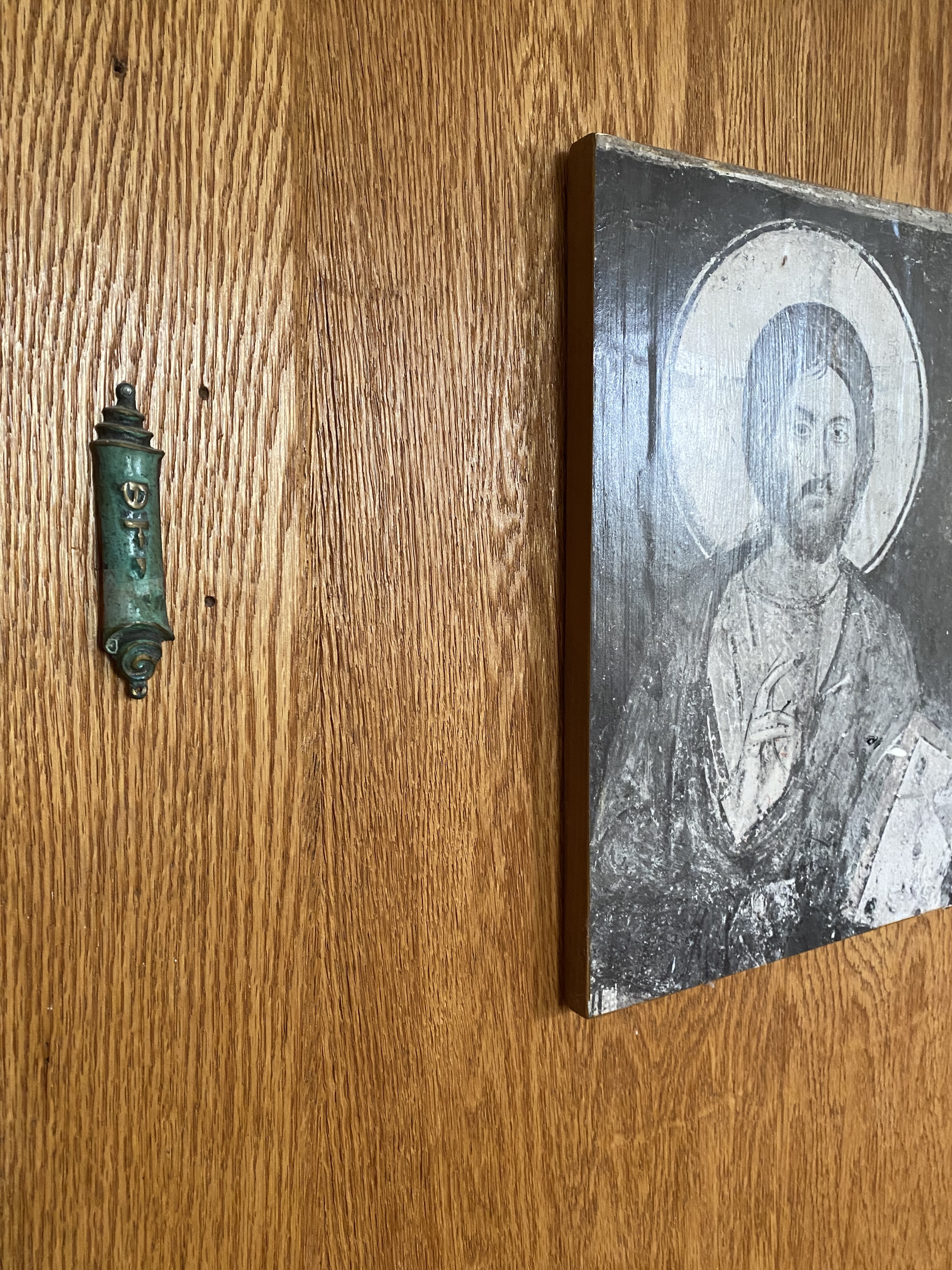
Years ago, Fr. Victor Donovan, a priest of my community, the Passionists, who was a devoted friend of the Jewish people, gave me this mezuzah, which I have on the door to my room, to remind me of this commandment.  (Above)

No Small World

In spite of his words to the Syro-Phoenicean woman in today’s gospel from Matthew, Jesus doesn’t limit the gospel to his own people. His action points to a world beyond Judaism, St. John Chrysostom says.

 “You are the salt of the earth. It is not for your own sake, he says, but for the world’s sake that the word is entrusted to you. I am not sending you only into two cities or only into ten or twenty, not to a single nation, as I sent the prophets of old, but across land and sea, to the whole world. And that world is in a miserable state. For when he says: You are the salt of the earth, he is indicating that all humanity had lost its savor and had been corrupted by sin…

  Do not think, he says, that you are destined for easy struggles or unimportant tasks. You are the salt of the earth… 

  Then he passes on to a more exalted comparison: You are the light of the world. Once again, “of the world”: not of one nation or twenty cities, but of the whole world. The light he means is an intelligible light, far superior to the rays of the sun we see, just as the salt is a spiritual salt. First salt, then light…A city set on a hill cannot be hidden; nor do men light a lamp and put it under a basket. Here again he is urging them to a careful manner of life and teaching them to be watchful, for they live under the eyes of all and have the whole world for the arena of their struggles.

Too Much, Too Unrealistic?

Our reading from the Book of Numbers today warns of shying away from God’s great vision. “It’s too much, too unrealistic,” we say. 

The LORD said to Moses [in the desert of Paran,] “Send men to reconnoiter the land of Canaan, which I am giving the children of Israel.”

Their report: “We cannot attack these people; they are too strong for us.”So they spread discouraging reports among the children of Israel about the land they had scouted, saying,”The land that we explored is a country that consumes its inhabitants. And all the people we saw there are huge, veritable giants; we felt like mere grasshoppers, and so we must have seemed to them.”

God reacted strongly to their lack of trust and vision, and they suffered for not trusting in God and accepting God’s great vision.

“Our ancestors in Egypt considered not your wonders…They forgot the God who had saved them, who had done great deeds in Egypt, Wondrous deeds in the land of Ham, terrible things at the Red Sea.” Psalm 106, the responsorial psalm says.

I noticed Psalm 76 in our morning prayer today speaks of the same forgetfulness of God’s plan and power. “Will the Lord reject us for ever? Will he show us his favor no more? Has his love vanished for ever? Has his promise come to an end? Does God forget his mercy or in anger withhold his compassion?”

God is powerless. The vision is unattainable. We have nothing.

The psalmist goes on to remember the great deeds of God in creation and in the history of his people, and so must we. We’re not grasshoppers.

“I remember the deeds of the Lord, I remember your wonders of old, I muse on all your works and ponder your mighty deeds.You are the God who works wonders. You showed your power among the peoples.Your strong arm redeemed your people,…The earth was moved and trembled when your way led through the sea, your path through the mighty waters and no one saw your footprints.You guided your people like a flock by the hand of Moses and Aaron.”

Calming the Storms (Matthew 14:22-36)

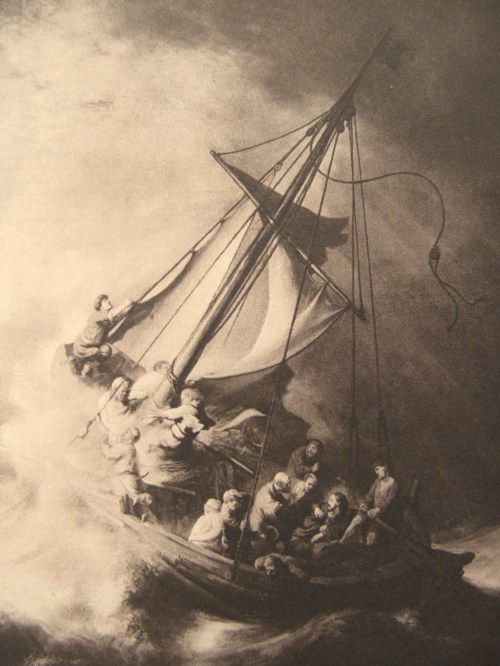
Jesus storm at sea
The giant waves on the Sea of Galilee in Rembrandt painting would be hard to survive, let alone walk on, but that’s what Jesus did, Matthew’s gospel today tells us. Jesus walked on the waters and tamed them. Only God does that, the psalms say.

“You uphold the mountains with your strength.
You are girded with power.
You still the roaring of the seas
And the roaring of their waves,
And the tumult of the peoples. “ Psalm 65

We usually read the stories of the disciples in the storm at sea as stories of rescue, and they are. God saves us from the storms we face on our life journey. But first, the stories testify to Jesus’ mastery over creation. On the shore his power touched human beings, like the leper, the deaf and those who could not speak; on the sea he rules creation. “Truly, you are the Son of God,” his disciples say after he gets into the boat and the wind dies down. (Matthew 14,22-36)

In his encyclical on the environment “Laudato Si” Pope Francis emphasizes the power of God over creation. As creator and savior, God gives all things their dignity and purpose. Human beings are not lords of this world, God alone is.

The story of Peter in our gospel takes on new interest in that perspective. Jesus invites him to walk on the water, giving him a share in God’s power. But Peter’s fear and lack of faith overcomes him. He begins to sink.

In our unfolding environmental crisis (storms, winds, floods) are we like Peter, called to share God’s power but turning away from our responsibility to calm the waters? Too big for us to take on. If that’s so, we sink.

The Old Testament: Mirror for the New?

Moses and the People. James Tissot

Readings this week from the Book of Numbers and the Book of Deuteronomy continue to describe the journey of the Israelites to the Promised Land led by Moses. Not an easy journey, not an easy people.

They grumble, they’re jealous, they doubt.  They’re hardly heroic as they journey on. Listen to their laments:  “Would that we had meat for food! We remember the fish we used to eat without cost in Egypt and the cucumbers, the melons, the leeks, the onions, and the garlic. But now we are famished; we see nothing before us but this manna.”

 Moses is hardly a secure leader, unaffected by them: 

“Why do you treat your servant so badly?” Moses asked the LORD.”Why are you so displeased with me that you burden me with all this people?Was it I who conceived all this people?  Or was it I who gave them birth, that you tell me to carry them at my bosom, like a foster father carrying an infant,to the land you have promised under oath to their fathers?Where can I get meat to give to all this people? For they are crying to me, ‘Give us meat for our food.’ I cannot carry all this people by myself,for they are too heavy for me If this is the way you will deal with me, then please do me the favor of killing me at once, so that I need no longer face this distress.”

Exhausted by the journey, Moses has had enough.

Are the new people of God so different from their ancestors in the desert? Are its leaders better than Moses?

One reason we read the Old Testament is it’s a mirror for the New.

18th Week: Readings and Feasts

AUGUST 7 Mon Weekday [St Sixtus II, and Companions, St Cajetan].     Nm 11:4b-15/Mt 14:13-21                                                                               8 Tue St Dominic Nm 12:1-13/Mt 14:22-36 or 15:1-2, 10-14                       9 Wed Weekday [St Teresa Benedicta of the Cross] Nm 13:1-2, 25—14:1, 26-29a, 34-35/Mt 15:21-28                                                                          10 Thu St Lawrence 2 Cor 9:6-10/Jn 12:24-26                                           11 Fri St Clare Dt 4:32-40/Mt 16:24-28                                                            12 Sat Weekday [St Jane Frances de ChantaL BVM].Dt 6:4-13/Mt 17:14-20                                                                                    13 19TH SUNDAY 1 Kgs 19:9a, 11-13a/Rom 9:1-5/Mt 14:22-27

The first readings this week, from the Book of Numbers and the Book of Deuteronomy,  describe the journey of the Israelites to the Promised Land led by Moses. Not an easy journey, not an easy people. Moses faces their grumbling, their jealousies, their doubt. 

The Gospel readings this week from Matthew, chapters 14-17 offer his first account of the miracle of the loaves and fish, the cure of the daughter of the Canaanite woman, the miracle of the storm at sea, and the confession of faith led by Peter. Matthew follows Mark’s narrative but softens Mark’s picture of the disciples and is less harsh on them for their unbelief.  

St. Lawrence and St. Clare are two important saints celebrated this week. Edith Stein, Sr. Teresa Benedicta of the Cross was a Jewish philosopher who converted to Catholicism, entered the Carmelites and was killed in a German concentration camp during the  2nd World War.

The Transfiguration of Jesus

For this week’s homily please watch the video below.

Numbering Our Days Aright

The Book of Leviticus, which we begin reading this week, gets its name from the tribe of Levi, Jewish priests involved in worship. Among their duties, they kept the Jewish calendar of feasts, which began with the Sabbath, the seventh day of the week, a day “of complete rest, a declared holy day; you shall do no work. It is the LORD’s sabbath wherever you dwell.”

Leviticus then lists the Jewish feasts of Passover, Unleavened Bread, Atonement, Booths. We can recognize feasts of our Christian calendar – Sunday, Easter, Pentecost. We follow the Jewish calendar as it’s found in Leviticus, now complete with the mysteries of Jesus Christ.

I appreciate calendars more and more, especially our religious calendars. As a psalm says, they help us “number our days aright that we may gain wisdom of heart.” There are “appointment calendars” for marking where or when you might be going to the doctors or meeting someone for dinner, but religious calendars go a step further. They not only mark the day for you, but they put you in touch with the past and point to the future. 

They invite you into the presence of God and the saints. 

I try to put a calendar at the beginning of each month in this blog. We will be publishing a calendar for 2024. For more on the calendar see. https://vhoagland.com/confraternity/

God Spoke to Moses Face to Face

Psalms and scriptural verses following the first readings in our lectionary help us understand what they mean and deepen our reflection on them. Today’s reading and responsorial psalm are an example:

The Book of Exodus says that:                                        

As Moses came down from Mount Sinai with the two tablets of the commandments in his hands, he did not know that the skin of his face had become radiant while he conversed with the LORD. (Ex 34:29} 

The responsorial psalm –from Psalm 99– follows:

Holy is the Lord our God. Extol the LORD, our God, and worship at his footstool;holy is he!Holy is the Lord our God. From the pillar of cloud he spoke to them; they heard his decrees and the law he gave them.

“The LORD used to speak to Moses face to face, as one man speaks to another,” yesterday’s reading claimed.( Exodus 33:11) No doubt Moses had a special relationship with God, but our psalm reminds us that the Lord, our God, is holy. We worship at his footstool, with our eyes down. God is beyond human understanding and can be known only in a pillar of cloud, in other words, in a darkness that signifies God’s transcendence. 

Still, when we meet with God in prayer our faces are transformed like Moses, because we have accepted God’s invitation to friendship. Jesus, “ image of the invisible God”, who came in the fulness of time, renews and completes that divine invitation.

When Moses asked God to see his glory, God responded “You cannot see my face, for no one can see me and live.” (Exodus 33:20)

St. Ephrem the Syrian explains our limits from the human experience we have looking at the sun: “Our eyes look at the sun but do not see it. Still, we are aided by what we see, but stay unharmed by what we do not see. Our eyes see what they can, but turn away from what we can’t. “

The image of the sun that lights the world is a good symbol of God, whom we describe in our prayers as light. We have imperfect sight; we only see so much. That is so with God; it’s also so in the way we see people and things around us.