Author Archives: vhoagland

The whole world awaits Mary’s reply

You have heard, O Virgin, that you will conceive and bear a son; you have heard that it will not be by man but by the Holy Spirit. The angel awaits an answer; it is time for him to return to God who sent him. We too are waiting, O Lady, for your word of compassion; the sentence of condemnation weighs heavily upon us.

  The price of our salvation is offered to you. We shall be set free at once if you consent. In the eternal Word of God we all came to be, and behold, we die. In your brief response we are to be remade in order to be recalled to life.

  Tearful Adam with his sorrowing family begs this of you, O loving Virgin, in their exile from Paradise. Abraham begs it, David begs it. All the other holy patriarchs, your ancestors, ask it of you, as they dwell in the country of the shadow of death. This is what the whole earth waits for, prostrate at your feet. It is right in doing so, for on your word depends comfort for the wretched, ransom for the captive, freedom for the condemned, indeed, salvation for all the sons of Adam, the whole of your race.

  Answer quickly, O Virgin. Reply in haste to the angel, or rather through the angel to the Lord. Answer with a word, receive the Word of God. Speak your own word, conceive the divine Word. Breathe a passing word, embrace the eternal Word.

  Why do you delay, why are you afraid? Believe, give praise, and receive. Let humility be bold, let modesty be confident. This is no time for virginal simplicity to forget prudence. In this matter alone, O prudent Virgin, do not fear to be presumptuous. Though modest silence is pleasing, dutiful speech is now more necessary. Open your heart to faith, O blessed Virgin, your lips to praise, your womb to the Creator. See, the desired of all nations is at your door, knocking to enter. If he should pass by because of your delay, in sorrow you would begin to seek him afresh, the One whom your soul loves. Arise, hasten, open. Arise in faith, hasten in devotion, open in praise and thanksgiving. Behold the handmaid of the Lord, she says, be it done to me according to your word. 

St. Bernard

The Genealogy of Jesus

Advent began two weeks ago with Isaiah’s promise that all nations, along with his chosen people in exile, would hear God’s call to dwell in peace on God’s holy mountain. On December 17 our liturgy turns to Matthew’s gospel and the account of the genealogy of Jesus, “son of David, son of Abraham.” Matthew’s gospel traces his ancestry back to his Jewish beginnings. ( Matthew 1,1-17)

Whenever we read this gospel, filled with so many hard to pronounce names I am reminded of my mother.  She had a remarkable memory for relationships, whether her own family relations or others. Honestly, I often tuned out as she probed with delight family trees. After she died I realized I had lost my connection with countless relatives and people she had firmly in mind.  She would have appreciated the genealogy above.

This is not a superfluous project the evangelists are engaged in. They’re intent on describing the Incarnation of Jesus. He wasn’t isolated from humanity, above it all, but  he was part of the human family. And his family tree was not an army of saints; sinners are there for sure.

We will hear from some of his saintly forbears in the next few days, Mary, Joseph, Elizabeth and Zachariah. But let’s not forget the others.They are his family too. He loved them all.

In our family tree above Mary points to Joseph. Like her his ancestry goes back to David and Abraham. Appearing to him in a dream the angel says “Joseph, son of David, do not be afraid to take Mary your wife into your home. For it is through the holy Spirit that this child has been conceived in her.”

3rd Sunday of Advent b: Be Who You Are

For this week’s homily please watch the video below.

In the Fulness of Time

Here’s St. Bernard on the fullness of time:

“When the fulness of time came, there came too the fulness of the Godhead. He came in the flesh, so that at least he might make himself manifest to our earthly minds, so that when this humanity of his appeared, his kindness might also be acknowledged. Where the humanity of God appears, his kindness can no longer be hidden. In what way, indeed, could he have better commended his kindness than by assuming my flesh? My flesh, that is, not Adam’s, as it was before the fall.

“What greater proof could he have given of his mercy than by taking upon himself that very thing which needed mercy? Where is there such perfect loving-kindness as in the fact that for our sake the Word of God became perishable like the grass? Lord, what is man, that you make much of him or pay him any heed?

“Let us infer from this how much God cares for us. Let us know from this what God thinks of us, what he feels about us. Do not ask about your own sufferings; but about what God suffered. Learn from what he was made for you, how much he makes of you, so that his kindness may show itself to you from his humanity.

“The lesser he has made himself in his humanity, the greater has he shown himself in kindness. The more he humbles himself on my account, the more powerfully he engages my love. The kindness and humanity of God our Saviour appeared says St Paul. The humanity of God shows the greatness of his kindness, and he who added humanity to the name of God gave great proof of this kindness.”

Advent: Thursday, 2nd Week

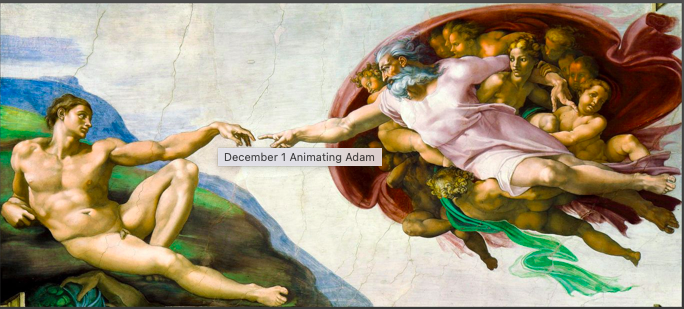
Michelangelo’s creation of Adam doesn’t seem to fit the Lord’s words we hear in our first reading today from Isaiah.  

I am the LORD, your God,
    who grasp your right hand;
It is I who say to you, “Fear not,
    I will help you.”
Fear not, O worm Jacob,
    O maggot Israel;
I will help you, says the LORD;
    your redeemer is the Holy One of Israel.

(Isaiah 41:13-21

Michelangelo’s Adam could be an ad for a modern health spa, hardly someone who fits Isaiah’s description of Jacob and Israel, as a worm or maggot. He represents the Renaissance ideal of human power and beauty. Hardly someone with fears, he might be a picture of today’s confident, flourishing humanity.

So why does God reach out to touch him, since he seems to have everything? Could his nakedness indicate a nakedness within, a spiritual emptiness, a need for meaning that only God, the Creator, can give? Is he humanity today?

Describing Michelangelo’s reimagining of the Genesis story, an early biographer and friend  Ascanio Condivi, said: “with his hand God is seen as giving Adam the precepts for what he should do and not do.”

That seems to be what we ask for this Advent when we celebrate the coming of the Word, Jesus Christ. “Renew our minds and hearts, Lord. Teach us how to live and what to do.”

Advent: Monday, 2nd Week

Today’s readings from the Old and New Testament complement one another, as the readings all through Advent do. Isaiah 35:1-10 speaks to Jewish exiles in Babylon, calling them to take a “holy way” through the wilderness to Jerusalem’s “holy mountain. Yet not just exiles in Babylon are called, God calls all nations to take the journey. All people, even the frailest, the weakest, are called to take it: the blind, the deaf, the lame, the fearful will take it, for God will strengthen them. The lame will leap “like a stag” and the “tongue of the mute will sing.”

The paralyzed man brought to Jesus in the gospel and sent away singing and dancing, (Luke 5:17-26), is a symbol of a paralyzed world that Jesus invites to take this journey, and humanity’s hopes are fulfilled as well as the hopes of prophets and peoples of the Old Testament are fulfilled. Our hopes as well. God wishes to heal our paralyzed world. Isaiah’s vision isn’t small.

Our vision shouldn’t be small either. When we hear ourselves saying “They’re not going anywhere.” “They’ll never change.” “The world’s never going to change.” we need to listen to ourselves. We’re living in a cynical world. We shouldn’t let our hope become too small.

Let’s not forget those in the gospel who lowered the paralyzed man from the roof down to where Jesus was. They were people of hope, willing to chance it with someone who looked like he would never move his limbs again. We need more of their kind today.

“They will see the glory of the LORD, the splendor of our God. Strengthen the hands that are feeble, make firm the knees that are weak, Say to those whose hearts are frightened: Be strong, fear not! Here is your God, he comes to save you.Then will the eyes of the blind be opened, the ears of the deaf be cleared; Then will the lame leap like a stag,then the tongue of the mute will sing… A highway will be there, called the holy way;
No one unclean may pass over it,
 nor fools go astray on it.
 No lion will be there,
  nor beast of prey go up to be met upon it.   It is for those with a journey to make,
 and on it the redeemed will walk.”

2nd Sunday of Advent b: Comfort my people

For this week’s homily please watch the video below.

Advent: Saturday, 2nd Week

The readings for the 1st week of Advent end today with Jesus going “to all the towns and villages, teaching in their synagogues, proclaiming the Gospel of the Kingdom, and curing every disease and illness.” His heart goes out to them.

And his heart goes out to us.

The towns and villages of Galilee won’t be the last places Jesus goes. We are called to go out with him for the hours we can. ( Matthew 9:35ff)  As God’s harvest goes on, he calls others to join him and he empowers them.

As we end this first week of Advent, I’m grateful to those who so skillfully gave us after the 2nd Vatican Council the lectionary readings and prayers for this season. It just didn’t happen. Prayerful hands, steeped in the scriptures and the liturgy, humbly serving the church, gave them to us. Blessed are they.

I hope the liturgy, its readings and prayers, will be a treasure we appreciate more and more. It forms us in our faith and tells us how to live and it surprises us day by day. A renewed liturgy and a renewed understanding of the scriptures were goals of the 2nd Vatican Council, goals still to be fulfilled, I think.

I found this quote from Pius XI appropriate:

“For people are instructed in the truths of faith, and brought to appreciate the inner joys of religion far more effectually by the annual celebration of our sacred mysteries than by any official pronouncement of the teaching of the Church. Such pronouncements usually reach only a few and the more learned among the faithful; feasts reach them all; the former speak but once, the latter speak every year – in fact, forever. The church’s teaching affects the mind primarily; her feasts affect both mind and heart, and have a salutary effect upon the whole of man’s nature” (Encyclical Quas primas, 11 December 1925).”

Isaiah’s promise of a holy mountain will be fulfilled, our readings today say. The Messianic times arrive with the coming of Jesus Christ. In our first reading today, Isaiah renews the promise of a holy mountain to exiles, like those in the Middle East, Ukraine, Somalia, and like us.  

Isaiah Promises…On this mountain, Yahweh will prepare for you a banquet rich in goodness. On this mountain, Yahweh will remove the veil of darkness covering God’s people. Death will be destroyed, you shall weep no more. You shall rejoice in your God on this mountain.    (Isaiah 25:6-9)

 Here’s a music version of “On that Holy Mountain”

What’s in a Name

When the Passionists came to New York City in 1924 they looked to Mary, the Mother of Jesus, to guide their new foundation. She’s there at the front door of our monastery. She has a prominent place with us. Her statue stands outside our church.

Assumption window

Window of the Immaculate Conception, Jamaica, NY

Mary’s in the great window in the back of our church announcing the mystery of the Immaculate Conception, the title of our monastery and parish. She is flanked by St. Catherine Laboure and St. Bernadette.

Mary appeared to St. Catherine Laboure in Paris in 1850 and to St. Bernadette at Lourdes in 1858. It was a troubled age, battered by the skepticism of the Enlightenment, the anti-religious activity of the French Revolution and the degradation to human dignity brought about by the Industrial Revolution.

Mary, free from original sin, brought the wisdom of God to that world. Her message was that God “scatters the proud and lifts up the lowly.” God’s wisdom is greater than the wisdom of this world.

IMG_0972
Lourdes Grotto, Jamaica, NY

In the 1950s, as we faced continuing wars and the threat of nuclear war, we saw Mary’s appearance to Catherine Laboure and Bernadette a sign that God is still with us. Retreatants from our monastery retreat house memorialized Mary’s appearance at Lourdes by building a beautiful grotto in her honor in our garden. “All generations will call me blessed,” Mary said.

Today, we have a sign of Mary’s presence to our generation facing the threat of climate change– a Mary Garden, which we blessed on September 23, 2018

OLYMPUS DIGITAL CAMERA
Mary Garden, Jamaica, NY

Mary Gardens originated in Europe following the Black Death, a pandemic that caused millions to die in Europe in the 14th century. Gardens in monasteries and churches, reminded people that God brings life, not death, from the earth.

The Mary Garden with its flowers, medicinal herbs and edible plants is a sign of the beauty, healing and nourishment God gives us on this earth. Mary presenting her Child stands in the midst of the garden, promising life and hope. “Make us worthy of the promises of Christ,” we pray. We have a small Mary Garden at the entrance of our chapel as we pray for the vision to see the beauty of God’s creation and the wisdom to care for it.

We have also repositioned our retreat house in the light of climate change and renamed it Thomas Berry Place, a non-profit center for spirituality, community empowerment, and ecological stewardship, in New York City. Father Thomas Berry (1914-2009) was a Passionist scholar who lived in our Passionist monastery in the 1960s and taught at Fordham University. Father Berry was an internationally recognized environmentalist who believed in taking steps to preserve the planet.

The current Passionists have embraced that goal. 

“We are dedicated to serving those who are suffering. We also want to expand that to include helping a suffering planet,” said Father Jim O’Shea, C.P., the provincial for the Passionists for the Eastern U.S., Canada, Puerto Rico, and parts of the Caribbean. “Thomas said we need a new story.”

.

Advent Weekday Readings: 1st Week

The Old Testament readings for the 1st week of Advent– all from Isaiah–  are a message of universal salvation. Isaiah 2:1-5 (Monday) is the prophet’s classic announcement that all nations will stream to God’s mountain and listen for God’s instruction. “They will beat their swords into plowshares and their spears into pruning hooks.” Wars are over; the fragmentation destroying humanity comes to an end.  

For Isaiah, the mountain of the Lord– site of the Jewish temple in Jerusalem– has a central place in God’s promise. All nations will come there; they will be fed a rich banquet (Wednesday), there the poor will triumph (Thursday), the blind will see (Friday); it’s the rock where people dwell in safety, where children play around the cobra’s den, and the lion and the lamb lie down together (Tuesday). The prophet’s poetic imagery in the readings for the 1st week of Advent is strikingly beautiful. 

The gospels in the 1st week point to the Isaian prophecies fulfilled in Jesus Christ. The Roman centurion humbly approaching Jesus in Capernaum represents all the nations coming to him. Jesus feeds a multitude on the mountain. He gives sight to blind humanity, he affirms that his kingdom will be built on rock. He praises the childlike, who will enter the kingdom of heaven.

Matthew’s gospel, source of many of our Advent readings, portrays Jesus teaching on a mountain (Isaiah’s favorite symbol) and working great miracles there that benefit all who come.  He is also the new temple, the new Presence of God, Emmanuel, God with us.