Author Archives: vhoagland

30th Sunday b: Take heart, follow Him

For this week’s homily please watch the video below.

For the last five Sundays or so, Mark’s gospel describes the journey of Jesus and his disciples from Galilee to Jerusalem where he’ll die and rise from the dead. It’s not a day by day account of the journey or a list of each place they pass;  the gospel is more interested in the people Jesus encounters and invites to follow him  along the way.

Good ordinary people, as far as we can judge. Peter and his brother Andrew,  the other fishermen from Galilee,  James and John, were among the first who follow him. Good, solid reasonable people. The rich young man who meets Jesus on the way– our gospel reading a few weeks ago– a good, solid individual. Jesus calls him to follow him.

But Mark indicates his followers often fail to understand him, especially his message about suffering and death. Yet he calls them anyway, even though over and over Mark says, “They did not understand him.” 

 “You think like human beings think,” Jesus says to Peter,  who wanted him to put thoughts of suffering and death from his mind. James and John are looking for positions in Jesus’ earthly kingdom, a sure thing. The rich young man’s afraid of losing what he has. They think like human beings think. They don’t understand him.

Of course, Mark’s gospel says that’s the way we think too. We’re  limited, we’re self-serving, we’re  afraid to trust in the wisdom and promises of God. We think like human beings. 

At one point in Mark’s gospel,  the disciples throw up their hands in desperation after Jesus admonishes them,  “Then who can be saved?” Are you looking for a perfect remnant?

Today’s gospel seems to answer that question. “As Jesus was leaving Jericho near the end of his journey, Bartimaeus, a blind man, the son of Timaeus, is sitting by the roadside begging.” The blind beggar sits there by the road. He can’t see.  And he has nothing to recommend him. Nobody wants to look at him, but Jesus calls him and gives him his sight. 

Not only does Jesus give him sight, but Bartimaeus, the son of Timaeus, gets up and follows Jesus on the way, up to Jerusalem. 

In a simple, beautiful way, Mark’s Gospels presents a powerful story of God’s mercy. The blind man is a symbol of humanity, blind to so much. But God’s mercy is stronger than human understanding, human weakness, even human sin. God’s mercy helps us to see, to get up and to go with Jesus to Jerusalem.

A powerful story of hope. It’s not a small remnant that will be saved. It’s an immense throng. Listen to Jeremiah, our first reading.  

“The LORD has delivered his people,
        the remnant of Israel.
    Behold, I will bring them back
        from the land of the north;
    I will gather them from the ends of the world,
        with the blind and the lame in their midst,
    the mothers and those with child;
        they shall return as an immense throng.
    They departed in tears,
        but I will console them and guide them;
    I will lead them to brooks of water,
        on a level road, so that none shall stumble.
    For I am a father to Israel,
        Ephraim is my first-born.”
Letter to the Ephesians: 4:1-6

Our readings these days from Paul’s Letter to the Ephesians and Luke’s gospel speak of a people on a journey, longing to see God’s face. But first, there’s a mountain to climb before standing in God’s holy place. Not an easy climb. (Responsorial psalm, Friday)

I, a prisoner for the Lord,
urge you to live in a manner worthy of the call you have received,
with all humility and gentleness, with patience,
bearing with one another through love,
striving to preserve the unity of the spirit
through the bond of peace;  
one Body and one Spirit,
as you were also called to the one hope of your call;
one Lord, one faith, one baptism;
one God and Father of all,
who is over all and through all and in all. (Ephesians 4:1-6)

Paul calls for patience, unity and peace from his flock in Ephesus, whose leader is now a prisoner. Most likely, they feel adrift. When the shepherd is struck the sheep scatter.

And so Paul promises the care of the Good Shepherd who cares for his flock from on high, whose care never ceases.

The one who descended is also the one who ascended
far above all the heavens,
that he might fill all things. And he gave some as Apostles, others as prophets,
others as evangelists, others as pastors and teachers,
to equip the holy ones for the work of ministry,
for building up the Body of Christ,
until we all attain to the unity of faith
and knowledge of the Son of God, to mature manhood
to the extent of the full stature of Christ,
so that we may no longer be infants,
tossed by waves and swept along by every wind of teaching
arising from human trickery,
from their cunning in the interests of deceitful scheming.
Rather, living the truth in love,
we should grow in every way into him who is the head, Christ,
from whom the whole Body,
joined and held together by every supporting ligament,
with the proper functioning of each part,
brings about the Body’s growth and builds itself up in love. (Ephesians 4:7-16) 

A good teaching for the church today.

Sunrise

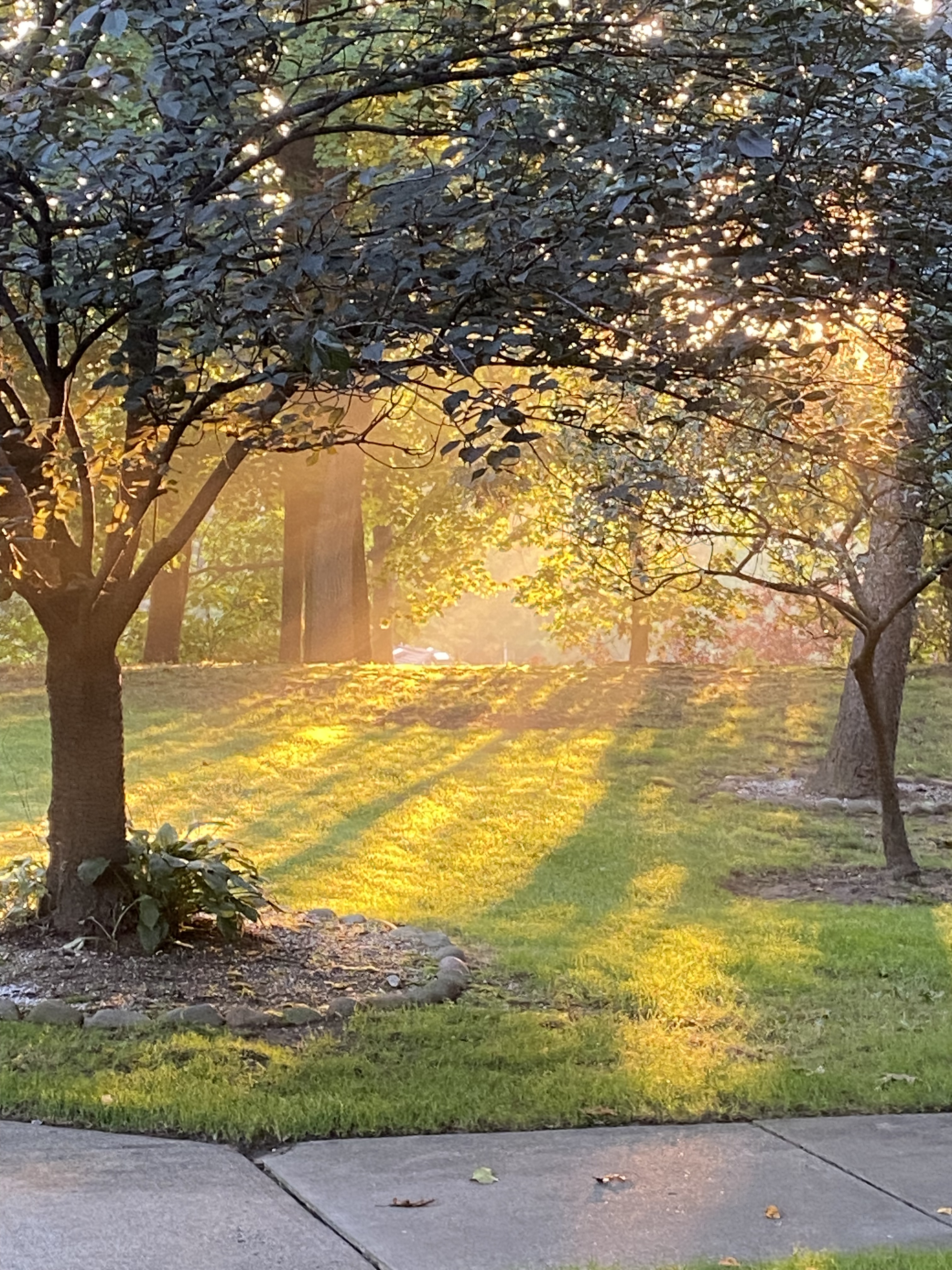
The autumn sun has a special brilliance as it rises in the morning bathing our oak trees, our spruce, our plum and cherry trees with light. Toward the end of the 1st century, St. Clement of Rome wrote a letter to the Christians of Corinth, the church St. Paul wrote two letters to earlier.

In lyrical language Clement pictures God’s great plan for creation. “Fix your gaze on the Father and Creator of the whole world.” You can see the Creator in the world he made.

“By God’s direction the heavens are in motion, and they are subject to him in peace. Day and night they fulfill the course God has established. The sun, the moon and the choirs of stars revolve in harmony at his command in their appointed paths without deviation….The earth blossoms in the proper seasons and produces abundant food…”

The destiny of creation is not destruction but resurrection. The world has its fierce, stormy seas, but God commands the seas.

“ Consider, beloved, how the Lord keeps reminding us of the resurrection that is to come, of which he has made the Lord Jesus Christ the first fruits by raising him from the dead. Let us look, beloved, at the resurrection that occurs at its appointed time. Day and night show us a resurrection; the night lies in sleep, day rises again; the day departs, night takes its place. Let us think about the harvest; how does the sowing take place, and in what manner? The sower goes out and casts each seed onto the ground. Dry and bare, they fall into the earth and decay. Then the greatness of the Lord’s providence raises them up again from decay, and out of one many are produced and yield fruit.”

It’s not nature mysticism Clement recommends. It’s a world seen through the eyes of faith. God’s “great providence” is at work.

Sunrise through the trees in our garden the other day whispered that to me.

Scholars and Ordinary Believers

Scholars are usually cautious about what they say or write, particularly if other scholars are checking on what they say. The scholars commenting on the Letter to the Ephesians, our reading in our liturgy, might be typical. They say the letter may or may not be written to the church at Ephesus. No particular references to that church or any problems it has. They wonder too if Paul wrote the letter, or was it written by a secretary. Paul wrote it from prison; was he in prison in Jerusalem or in Rome? 

Scholars can only go so far when they sift through the words of scripture. And that where believers come in:

“The sacred synod also earnestly and especially urges all the Christian faithful… to learn by frequent reading of the divine Scriptures the “excellent knowledge of Jesus Christ” (Phil. 3:8). “For ignorance of the Scriptures is ignorance of Christ.”(5) Therefore, they should gladly put themselves in touch with the sacred text itself, whether it be through the liturgy, rich in the divine word, or through devotional reading,,, And let them remember that prayer should accompany the reading of Sacred Scripture, so that God and man may talk together; for ‘we speak to Him when we pray; we hear Him when we read the divine saying.’ (Dei Verbum 25 )

That strong statement from the Second Vatican Council asks ordinary Christians to read and pray the scriptures. The good commentaries and translations from the scholars are there, now it’s the turn of ordinary Christians to do their part. That’s not a small matter.

The Constitution on Holy Scripture from Vatican II speaks of a growth in understanding of the plan of God and our place in it that takes place through the prayerful reading of the scriptures:

“For there is a growth in the understanding of the realities and the words which have been handed down. This happens through the contemplation and study made by believers, who treasure these things in their hearts (see Luke, 2:19, 51)… For as the centuries succeed one another, the Church constantly moves forward toward the fullness of divine truth until the words of God reach their complete fulfillment in her.” ( Dei Verbum 8 )

The Spirit awaits our prayerful reading of the scriptures to bring God’s blessings to us, ordinary believers that we are.

29th Sunday b: Gospel of Success

For this week’s homily please watch the video below.

Native Peoples, Colonists and Missionaries

H.Hudson halfmoon

For the injustices against the native peoples and the land God provided,“Lord, have mercy.”

For the brave missionaries that ministered to them. “Thanks be to God.”

The native peoples are often forgotten in the story of the “discovery” of America. Our heroes tend to be the settlers who came on ships, built towns and cities, explored the land and gave us what we have today. But it came at a price.

If you ever visit New York harbor by way of the Staten Island Ferry look at the  shores now crowded by the buildings and piers of today.  Native peoples once fished, hunted and traded in large numbers here. The water was fresher then, fish and shellfish plentiful, the air cleaner, the earth less damaged by human activity.

The National Museum of the American Indian , located in the old customs house across from Battery Park near the ferry, is a good place to remember the role of the native peoples in the story of America. They traded with the Europeans; they were their guides into an unknown land; they provided many of the foods that fed growing populations in Europe and America. They respected  the land more than those who came after them.

A young Indian woman, Kateri Tekakwitha and a Jesuit priest, Isaac Jogues, are figures to remember  in the customs house. They represent the clash of civilizations that occurred when Europeans and native peoples met. Across the street from the customs house is the statue of Christopher Columbus.

Europeans brought disease.  Smallpox  disfigured and partially blinded Kateri Tekakwitha, a young Mohawk woman who lived along the Mohawk River past Albany, NY. The native peoples had no immunity to small pox and other diseases. Three out of ten died from it. By some estimates 5 million native people lived in North America when the first Europeans arrived. Within a hundred years there were only 500,000. Besides disease, the major cause of their diminishment, the native peoples also suffered from wars and greed.
Museum of American Indian

At the museum, besides Kateri Tekakwitha remember Father Isaac Jogues, the Jesuit missionary who, while attempting to advance peace-keeping efforts with the Mohawks at Ossernonon (Auriesville) was killed by a war party on October 18, 1646. Previously, in 1642  Jogues had been captured by this same tribe. He escaped in 1643, fled here to New Amsterdam (New York City) and then was put on a ship for France by a kindly Dutch minister.

The French missionaries came to the New World out of the turmoils of the Old World expecting a new Pentecost among the native peoples here, but it didn’t turn out that way. Instead, disease and political maneuvering made the native peoples suspicious of  foreigners and the seed of the gospel fell on hard ground.

Letters back to France from the early Jesuits–marvelously preserved in “The Jesuit Relations”–often express the missionaries’ disappointment  over their scarce harvest, but it didn’t stop them. They were well grounded in the mystery of the Cross.

 “My God, it grieves me greatly that you are not known, that in this savage wilderness all have not been converted to you, that sin has not been driven from it. My God, even if all the brutal tortures which prisoners in this region must endure should fall on me, I offer myself most willingly to them and I alone shall suffer them all.” St. John de Brebéuf

The Indian woman and the priest persevered. We forget how difficult it is when civilizations clash– like now. We remember the Christian missionaries: Saints John de Brébeuf and Isaac Jogues, Priests and their compassions on October 19th..

Columbus, Central Park, NYC
Indian behind symbols of European trade and expansion: Customs House, New York City

Here’s a video on the Jesuit Martyrs at Auriesville:

Saints of Auriesville

North American Martyrs: October 19

Jesuit Map, 17th century, Wikipedia

The North American Martyrs, eight Jesuits and their associates were killed by warring Indian tribes in the 17th century. They’re the first saints of North America and we celebrate their feast October 19th. I’ve visited Auriesville in New York State and the Midlands in Canada where they were martyred; in both places their heroic faith and bravery are remembered.

The missionaries came to the New World expecting a new Pentecost among the native peoples of this land, but it didn’t turn out that way. Instead, disease and political maneuvering made the native peoples suspicious of the foreigners and the seed of the gospel seemed to fall on hard ground. The martyrdom of the eight Jesuits witnesses that resistance.

Letters back to France from the early Jesuits–marvelously preserved in “The Jesuit Relations”–often express the missionaries’ disappointment  over their scarce harvest, but it didn’t stop them. They were well grounded in the mystery of the Cross.

Not far from Auriesville, near Fonda, NY, is the Indian village called Caughnawaga.  In the spring of 1675, after the Jesuits were killed in Auriesville in 1646, Father Jacques de Lamberville visited Caughnawaga . The priest entered a lodge where a young Indian girl Kateri Tekakwitha was alone because a foot injury prevented her from working in the fields. She spoke to him of her desire to receive baptism and on Easter, 1676, the young Indian girl was baptized and took the name Kateri, after St. Catherine of Siena, the mystic and a favorite patron of Christian Indian women. She was 20 years old.

IMG_1053

Her uncle and relatives in the long house opposed her conversion to Christianity and pressured her to marry and follow their ways. The early Jesuits considered it a miracle that Kateri resisted  family and tribal pressure.  Her early biographer says “She practiced her faith without losing her original fervor and her extraordinary virtue was seen by all. The Christians saw her obeying their rules exactly, going to prayers everyday in the morning and evening and Mass on Sunday. At the same time she avoided the dreams feasts and the dances,” practices endangering her belief.  (The Life of the Good Catherine Tekakwitha, Claude Chauchetiere, SJ , 1695)

Father de Lamberville finally recommended that Kateri escape to the newly-established  Indian Christian village in Kahnawake near Montreal, where she could live her faith freely.  In 1676, aided by other Christian Indians, she made the dangerous journey northward. There she lived a fervent life of prayer and faith;  she died and was buried on April 17th, 1680.

Kateri was canonized  October 21th in Rome by Pope Benedict XVI. “The blood of martyrs is the seed of Christians.” (Tertullian)

Further resources here and here.

FOR A VIDEO ON THE NORTH AMERICAN MARTYRS, SEE HERE:

SAINTS OF AURIESVILLE

Letter to the Ephesians

It’s so easy to see a world out of control these days, and to believe that nothing can be done. We’re going nowhere. 

The Letter to the Ephesians, read this week at Mass, says that’s not so. It’s written, not just to the  church at Ephesus, but to other churches as well, commentators says. So it’s written to our church too.

A great plan of God is at work from “the foundation of the world,” a plan for the “fulness of time,” a “mystery made known to us” in Christ Jesus, our Lord. We have this “word of truth” this gospel of our salvation, from Jesus himself. The Spirit he promised is the “first installment of our inheritance.”“First installment,” That’s what we working with now, It may not seem like much but it gets us where we’re going.

It promises more than we think or expect. “May the God of our Lord Jesus Christ, the Father of glory, give you a spirit of wisdom and revelation resulting in knowledge of him. May the eyes of [your] hearts be enlightened, that you may know what is the hope that belongs to his call, what are the riches of glory in his inheritance among the holy ones, and what is the surpassing greatness of his power for us who believe, in accord with the exercise of his great might, which he worked in Christ, raising him from the dead and seating him at his right hand in the heavens, (Ephesians 1)

Every Monday of the four week cycle of the Liturgy of the Hours we read Ephesians 1, 3-10 at evening prayer, a reminder to see the day, however small and confusing it may be, as part of the great unfolding plan of God in Christ, our Lord.

Paul, an Apostle of Christ Jesus by the will of God,
to the holy ones who are in Ephesus
and faithful in Christ Jesus:
grace to you and peace from God our Father and the Lord Jesus Christ.

Blessed be the God and Father of our Lord Jesus Christ,
who has blessed us in Christ
with every spiritual blessing in the heavens,
as he chose us in him, before the foundation of the world,
to be holy and without blemish before him.
In love he destined us for adoption to himself through Jesus Christ,
in accord with the favor of his will,
for the praise of the glory of his grace
that he granted us in the beloved.

In Christ we have redemption by his Blood,
the forgiveness of transgressions,
in accord with the riches of his grace that he lavished upon us.
In all wisdom and insight, he has made known to us
the mystery of his will in accord with his favor
that he set forth in him as a plan for the fullness of times,
to sum up all things in Christ, in heaven and on earth.

Faith and the Law: Galatians 5:1-6

What about the Pharisees Luke describes in today’s gospel (Luke 11:37-41) and the judaizers upsetting Paul’s converts in Galatia (Galatians 5:1-6) with their demands they accept circumcision?

We usually picture the Pharisees as religious, almost fanatically religious in fact. But there’s another picture of them history invites us to consider. The Pharisees were shrewdly practical, good organizers who kept the Jewish religion alive after the fall of Jerusalem in 70 AD. They preserved Jewish identity in the Roman world by concentrating on Jewish practices, like circumcision. 

Jewish identity was important before Roman law. Nero chose Christians for persecution in the 60s because they were seen as Jewish separatists, non-practicing Jews. In later persecutions, Christians were seen as opponents of Rome because they would not offer sacrifice to the Roman gods. On the contrary, Jews were exempt by Roman law from offering sacrifice because of their religion. They were not persecuted.

Were the Judaizers in Galatia calling for greater Jewish identity from Paul’s converts for the safety it would bring them before Roman law? Paul refused this accommodation. He upheld faith in Jesus Christ and his Cross.

Makes us think, doesn’t it?