Author Archives: vhoagland

2nd Sunday of Easter: Thomas Doubts

For this week’s homily, please play the video below:

For this week’s homily please watch the video below.

readings here

This is the Second Sunday of Easter. Notice we don’t say the Second Sunday after Easter. We say it’s the 2nd Sunday of Easter because Easter isn’t a one day feast. It’s celebrated every Sunday of the year. Every Sunday is a little Easter. After the yearly feast of Easter we continue to celebrate it for fifty days.  Easter isn’t  for  one day.  

Why do we celebrate Easter so extensively? Because the resurrection of Jesus is the center of our faith. It’s central to what we believe. We believe in God who created us and all things. We believe in Jesus Christ, who came among us, died and rose from the dead on the third day. That belief has tremendous consequences for us and for our world.

                                                                                                                                                              The story of Thomas the apostle in today’s gospel offers another reason why we celebrate easter as often as we do. Thomas was one of Jesus’ closest followers, “one of the twelve” who heard him teach and saw him work wonders, but Thomas won’t believe the others who tell  him they saw Jesus, risen from death.

He’s deeply skeptical. You can hear skepticism in his words:  “Unless I see the marks of the nails, and put my finger into the nailmarks, and put my hand into his side, I won’t believe.”

Certainly Thomas isn’t the only one who’s skeptical. You can hear skepticism in the way the other disciples after Jesus rises from the dead. Thomas represents human skepticism, the slowness of us all to believe, the distrust we all have. What’s unique about Thomas is he represents skepticism at its worst.  

It’s all right to have some skepticism, you know. We shouldn’t believe everything we hear. We need to check things out. We have to make sure that facts are facts,  we need a certain caution in life. 

But Thomas’ skepticism seems more than the ordinary. He’s a strong doubter. Yet still, the next Sunday–notice it’s a Sunday–Jesus comes and says  “Put your finger here and see my hands, and bring your hand and put it into my side, and do not be unbelieving, but believe.”


Thomas answer, “My Lord and my God!” That’s a beautiful act of faith. 

What about us? We’re described in today’s gospel as “those who have not seen, but believe.” and Jesus called us blessed. Yet, we can relate to Thomas. In fact, we live today in skeptical times. We’re skeptical about politics, about our institutions, about our churches, about ourselves.  There’s a deep distrust today in the way we speak and in the way we think. We’re wary of others, especially people different from us.  It affects our faith too. 

Yet, as he did to Thomas,  Jesus never abandons us. He  gives us the gift to believe. His mercy is always at work. He strengthens us when he comes in the signs of the Eucharist; he strengthens us through the faith we share with each other, week by week, day be day.   

Our Sundays may not be the dramatic experience that Thomas had, but  something happens here. Our Sundays are always little easters. Jesus come into the room where we are, with our fears and lack of trust. He tells us, as he told his disciples: “Peace be with you.” He shows us the signs of his love and enters our lives.  Every Sunday is a happy Easter. Jesus gives us life.

The Easter Tree

san clemente copy

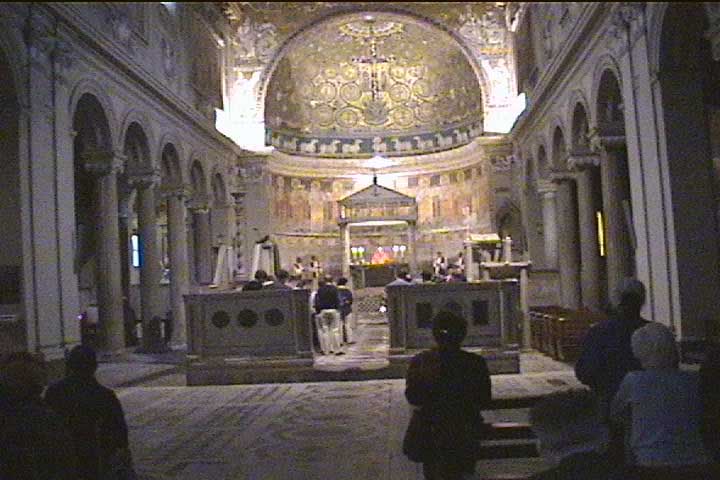
The Cross  flowers at Easter time. There’s a flowering cross brimming with life  in the great apse of the church of San Clemente in Rome. Its branches swirl with the gifts God gives. It brings life, not death. Humanity is there, signified in Mary and the disciple John. We are there in the doves resting on it. Creation itself is there, drawing new life from it. The hand of God makes it so.

The sacraments offered in this sacred place bring life-giving graces to us.

An early preacher Theodore the Studite  praises the mystery of the cross:.

“How precious the gift of the cross, how splendid to contemplate! In the cross there is no mingling of good and evil, as in the tree of paradise: it is wholly beautiful to behold and good to taste. The fruit of this tree is not death but life, not darkness but light. This tree does not cast us out of paradise, but opens the way for our return.

“This was the tree on which Christ, like a king on a chariot, destroyed the devil, the Lord of death, and freed the human race from his tyranny. This was the tree upon which the Lord, like a brave warrior wounded in his hands, feet and side, healed the wounds of sin that the evil serpent had inflicted on our nature. A tree once caused our death, but now a tree brings life. Once deceived by a tree, we have now repelled the cunning serpent by a tree.

“What an astonishing transformation! That death should become life, that decay should become immortality, that shame should become glory! Well might the holy Apostle exclaim: Far be it from me to glory except in the cross of our Lord Jesus Christ, by which the world has been crucified to me, and I to the world!”

San Clemente, Rome

See Children’s Prayers here for a children’s version of the Easter Tree.

Recognizing the Risen Christ

One of the great French scripture scholars, Xavier Leon Dufour, wrote a book on the accounts of  Jesus’ Resurrection in the four gospels which he began by recalling how he first understood the Resurrection as a child from the stained glass window in his parish church.

Jesus was pictured in shining light coming out of the tomb,  the soldiers with hands up high in fear at the sight. It’s a common portrayal found in many of our churches.

Dufour writes of his surprise that this picture can’t be found anywhere in the gospels. The gospel accounts of the appearances of the Risen Christ are much more complex, which is one reason we read them all through Easter week, the “Long Day” of Easter.

In today’s reading,  the two Emmaus disciples returning to Jerusalem are greeted with cries, “he is risen, he had appeared to Simon.” Then they report how he appeared to them on the road, how he opened the scriptures and how they recognized him in the breaking of bread.

Then Jesus appeared to them. Luke says his appearance causes them “fear and panic”; they think he is a ghost. His appearance seems to be different than that of Lazarus who, when raised from the dead, was the same as before. The Risen Jesus is different. He doesn’t come back from the dead the same as Lazarus did. 

To assure them who is is, Jesus tells them to touch him, to eat with him. Only after he assures them does Jesus recall the scriptures that speak of a Messiah who dies and is raised from the dead. He tells them a message of forgiveness is to be preached in his name. They are witnesses of him. They’re to wait in the city for power from on high to come upon them: “The promise of the Father.”

Then Jesus takes them out to Bethany and ascends into heaven.  This all happens on Easter Sunday, according to Luke’s gospel. He ends his gospel there. After that he begins the second part, Acts of the Apostles, the story of the coming of the Spirit and the spread of the message of Jesus through his. church.

Luke’s gospel would have us recognize the Risen Jesus– we who are on the way —-   especially in the scriptures and the breaking of the bread.

Earth Day and the Long Day of Easter

We celebrate Earth Day, appropriately,  during the Long Day of Easter. 

How slowly do his disciples understand the mystery of the Resurrection of Jesus ! Some at first,  like Thomas, need hard evidence he is alive. For them life ends in death.  Some, like Peter and John,  see at first only the burial cloths in the tomb and wonder if he, like Lazarus, has come back from the dead.  Most of them, like the disappointed disciples on the way to Emmaus, had limited hope in him. They saw him restoring Israel to a place among the nations. A Secular Messiah.

As he appeared to them and ate with them and spoke with them their hopes grew.  He  broke bread with them and explained the scriptures.  Go to Galilee and meet him there, they were told. At the lake, according to John’s gospel, Jesus commanded them to bring his message to a wider world. In Mark’s gospel, he gave his command from a mountain. 

Their understanding of the mystery of the Resurrection grew. “He rose from the dead, according to the scriptures.” He brings the promise of  life to generations before and generations ahead. As Lord of all ages, his message of eternal life goes out to the heavens and the earth.  

 Jesus Christ is not just a solitary man brought back to life. He is, “the image of the invisible God.” In him all things have their being. He brings the promise of life to a broken world. Not just to one, or a few, but all. Not just to one nation, or a few, but all. Not just to the human race, but to all creation.

The opening prayer for Mass today recognizes the mysteries we celebrate this Long Week of Easter as “paschal remedies”, medicine for our weakness, healing for our blindness, hope for our doubt, new understanding. We are meant to grow through them.

How like the first disciples we are in our limited understanding of the mysteries of God. Yet God expands our knowledge. Is God expanding our understanding of the Resurrection now, calling our attention to his creature, our Earth. As we reflect on the death of Pope Francis, we recognize his challenge to care from the poor and the marginalized of our world. But let’s not forget his challenge to care for the earth that he made in his great encyclical “Laudato si’ “

Earth Day belongs in the Long Day of Easter.

Pope Francis

God give him that rest the scriptures promise a servant who had done well.

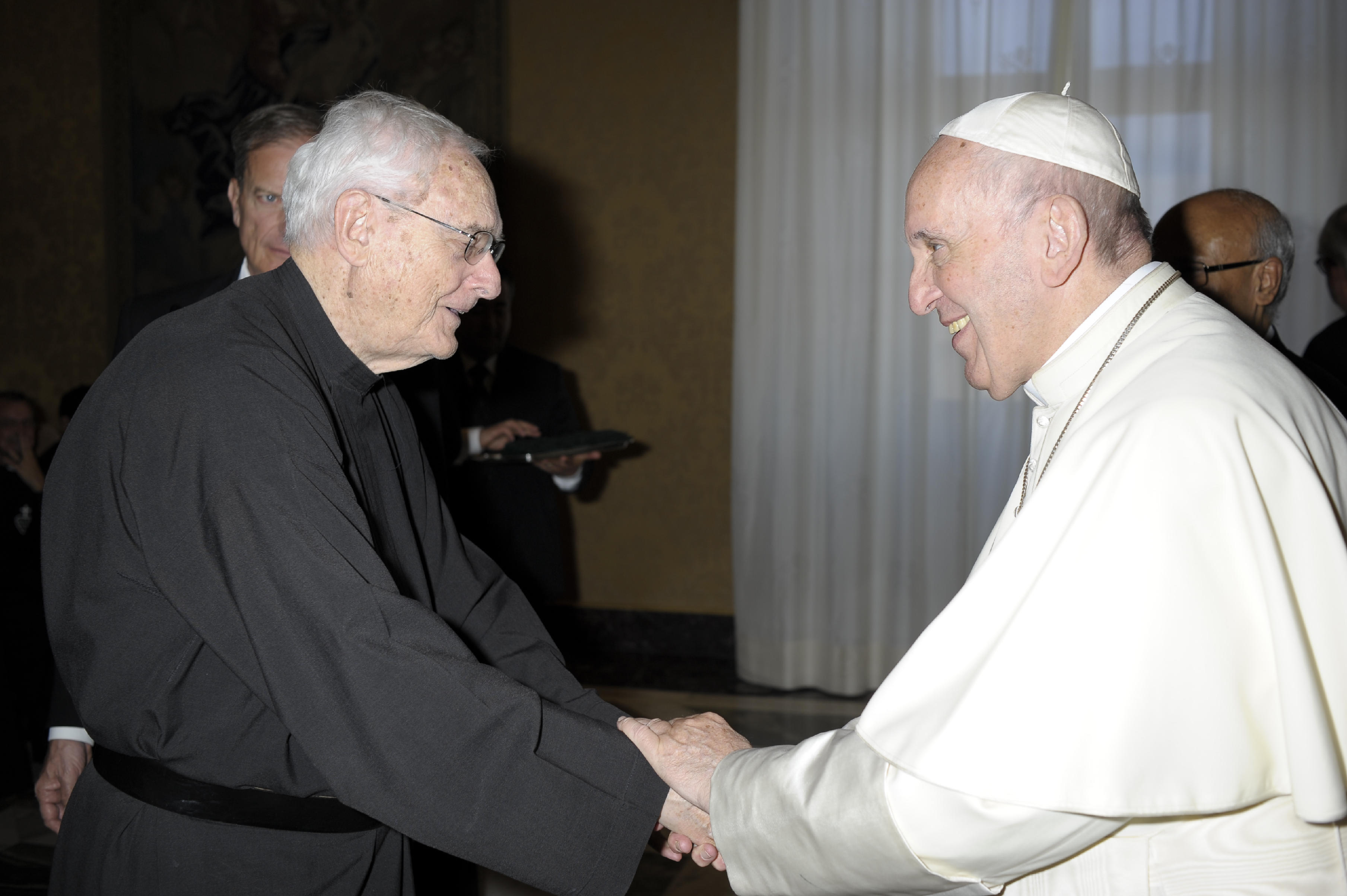
I remember his greeting four years ago, when he met Passionists taking part in their general chapter in Rome. He had come from a busy morning yet instead of going for lunch he spoke to us and greeted each of us.

He greeted about forty of us, each with the same attentiveness that he greeted me. Like Mary Magdalen, I want to cling to him as our leader and pope, but like Jesus he has to “go to the Father.”

He passes on during the long day of Easter.

https://www.vaticannews.va/en/pope/news/2025-04/twelve-years-of-new-paths-processes-and-open-doors.html

Easter Sacraments

Easter Week is an extension of Easter Day. The whole week is considered one day. Risen from the dead, Jesus made us one with him this day. We remember this week the signs of our union with him, baptism, the Eucharist and the other sacraments.  

As he did with the two disciples on the way to Emmaus, Jesus walks with us and breaks bread with us. The Paschal Candle next to the scriptures are a sign his light never fails.  The water blessed for baptism on the side of the altar reminds us we have been reborn of water and the Holy Spirit. 

The water has been blessed by Christ himself, for it comes from his pierced side when the soldier’s spear pierced his heart. It was blessed at the Easter vigil  with the sign of the Cross.

This week the those newly baptized are led into the mysterious world of sacraments and saints This week St. Cyril of Jerusalem and  St. Ambrose of Milan, preaching on the sacraments, often pointed out how insignificant the signs seem to be.  Only faith reveals their power.  

We need to remember newly baptized Christians, for we received the same gift as they have. An early sermon describes the gift given to the newly baptized at Easter: 

“Remember the newly formed: children born from the life-giving font of holy Church… As they emerge from the grace-giving womb of the font, a blaze of candles burns brightly beneath the tree of faith. The Easter festival brings grace from heaven to us. Through the repeated celebration of the sacred mysteries we receive the spiritual nourishment of the sacraments. We worship  the one God, adoring the triple name of his essential holiness, and together with the prophet sing the psalm which belongs to this yearly festival: This is the day the Lord has made; let us rejoice and be glad. 

And what is this day? It is the Lord Jesus Christ himself, the author of light, who brings the sunrise and the beginning of life, saying of himself: I am the light of day; whoever walks in daylight does not stumble. That is to say, whoever follows Christ in all things will come by this path to the throne of eternal light.” (Office of Readings, Wednesday of Easter Week.)

The Easter Triduum

The mysteries we celebrate in the Triduum from Holy Thursday evening till Easter Sunday are not separate from one another.   The Eucharist, the Passion and Death of Jesus, his Resurrection are joined together.  We”re meant to consider them together,  They are the Paschal Mystery. 

We cannot consider, for example,  the Eucharist only as a sacrament in which we adore Jesus Christ, the Son of God. He gives himself to us in this sacrament as a Servant, whose blood is poured out for us. He is the Lamb of God who gives us life for the journey God calls us to make.

Like his people in Egypt, we are to stand ready for the passage we are to make. He will be our food. He will wash our feet to make them clean and strong for the way, He is our Bread, our Manna. Our Companion on the journey.

The Passion of Christ is not only a dramatic story of the sufferings Jesus Christ endured on Good Friday. We see in his sufferings the love that conquers suffering and death. St. John’s gospel, read on Good Friday, reveals glory in him whom they pierced. He brings life to us and our world. 

We cannot celebrate Jesus Christ risen from the dead without seeing the wounds in his hands and his side.   His victory over death was not without cost.  To rise with him we must die with him. “Lord, by your Cross and Resurrection you have set us free.” 

The Easter Triduum celebrates consecutively three mysteries of Jesus Christ that belong together. They are the most important mysteries of our faith. 

Alleluia!         

The Cross in Early Christian Art

cross, 4th Century Sarcophagus, Rome

Cross, 4th Century Sarcophagus, Rome

There are no realistic representations of Christ Crucified and his passion in early Christian art. Realistic portrayals of Christ on the cross and his passion only appear in the early middle ages in the western church. The Crucifixion of Jesus was only portrayed symbolically at first, as in the example above, and early on appears in a variety of ways.

The Anchor Cross
anchor 4

Travelers from one port to another on the Mediterranean Sea at the time of Jesus were never sure of a safe passage until they dropped anchor. The anchor became the symbol of safe arrival, and so ancient seaports on the Mediterranean like Alexandria and Antioch adopted the anchor as a symbol for their city.

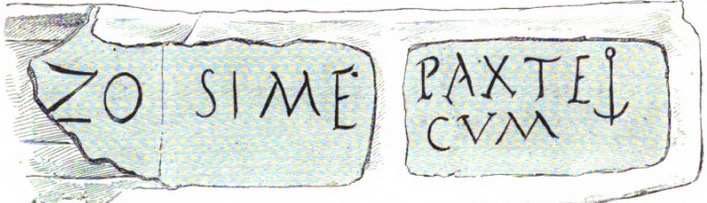
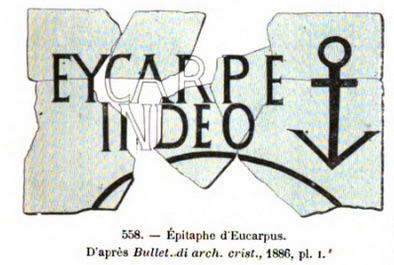
Early Christians used the anchor as a symbol of their hope of reaching a heavenly port, the kingdom of God and they inscribed it on their burial sites  in the catacombs to express their hope in Jesus Christ. The anchor closely resembles a cross and early Christians surely saw the resemblance. It’s the most common and sometimes only mark found on the earliest Christian graves in the ancient Roman catacombs of Priscilla, Domitilla and Callistus.

“Pax tecum,” “Peace be with you” the inscription (above) next to an anchor on one of these gravesites reads; the name of the deceased has been half-destroyed by grave robbers looking for valuables long ago. “Eucarpus is with God” we see in another below.
anchor 3

One reason early Christians hesitated to portray the crucifixion of Christ realistically was because the practice  was still  common in the Roman world until the Emperor Constantine  banned it in the 4th century. With crucifixion still before their eyes, Christians would hardly want it portrayed realistically in art, even if it were the crucifixion of the Savior.
FullSizeRender

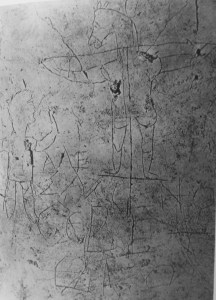
The oldest known portrayal of the crucifixion of Jesus, (left), is a mocking graffiti found on the wall of a barracks on the Palatine Hill in Rome, showing a crucified man with the head of a donkey, and before him a man with hand raised to the image. The Greek inscription from about the year 220 AD reads: “Alexander worships his god.” Undoubtedly, Alexander is a Christian being mocked for belief in Jesus crucified.

The first centuries of Christianity, in  fact, produced little art. For one thing, it inherited a strong iconoclastic tradition from Judaism. The 2nd century writer Justin Martyr also offers another explanation in his Apology disputing Roman claims that Christians were atheists and a danger to society. Justin acknowledges they had no temples, no statues of gods, and did not participate in the rites of Roman prayer.  But Christians were loyal Romans who believed in God, Justin argues. They worship, though, in their own homes and pray there to a God who cannot be imagined or adequately portrayed. (Apology 9,67)

Great Christian churches and shrines were not built till the 4th century, after  emancipation by the Emperor Constantine. Before that, Christian art is found mainly in the catacombs, where Christians buried their dead.

Moses strikes the Rock, Noah saved by the wood. Catacombs

Moses strikes the Rock, Noah saved by the wood.
Catacombs

The art of the catacombs, which are found mostly  around the city of Rome, comes down to us in a fragile state and can be hard to decipher after being underground for centuries. Its simple symbolic style can leave its powerful religious significance unappreciated. Art historians lament its lack of style compared to the sophisticated Roman art of its day.

The writings of Justin Martyr and other early Christian writers may help us better understand its simple, powerful message. In his Dialogue with Trypho the Jew, Justin uses a list of Jewish scriptures that he claims predict the coming of Christ, his life, death and resurrection. The  scriptures were used by other Christian writers of his day–Tertullian, Barnabas, Irenaeus–   to prove that “all the prophets bear witness” to Christ, the promised Messiah. (Acts 10,43)  Before them, Jesus appealed  to Moses and all the prophets to show why it was necessary for the Messiah to suffer. (Luke 24,26-27)

These same Jewish scriptures influenced the formation of the gospels and early Christian baptismal catechesis. They were read in Christian worship and decorated  Christian burial places. The Jewish scriptures are the key to understanding the art of the catacombs.

In his Dialogue with Trypho Justin proposes to his Jewish opponent scriptures such as Psalm 22 and the Servant Songs of Isaiah 53, that indicate God’s plan to send a suffering Messiah who would redeem his people. These same scriptures shaped the accounts of the passion of Jesus in the four gospels.

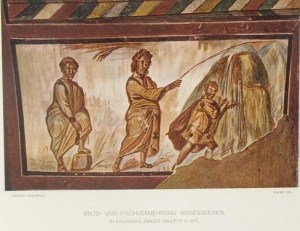
In the 86th chapter of his Dialogue with Trypho, Justin lists other scriptures, beginning with the tree of life planted in paradise, that reveal the saving power of the wood of the cross. That saving wood was prefigured in the wooden rod Moses used to bring water from the rock in the desert and divide the sea for his people to pass over. The cross was prefigured in the ladder Jacob saw mounting to heaven. Abraham saw it in the oak at Mamre and in the wood Isaac carried to his sacrifice. David saw the cross in the tree planted by running waters, mentioned in Psalm 1. The cross was signified in the wood that saved Noah from the flood.
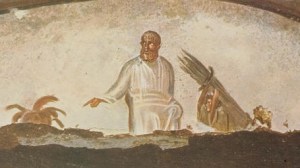
MOSES ROCK *

Isaac carry the wood of sacrifice. Roman catacombs.

Isaac carries the wood of sacrifice.
Roman catacombs.

Many of these Old Testament figures connect wood with water and feature in the early church’s catechesis and rites of initiation. The same catechesis speaks to the dead resting in the catacombs, who  believed in Christ. Through baptism and the sacraments Jesus Christ would bring them, through the mystery of his death and resurrection, to eternal life.

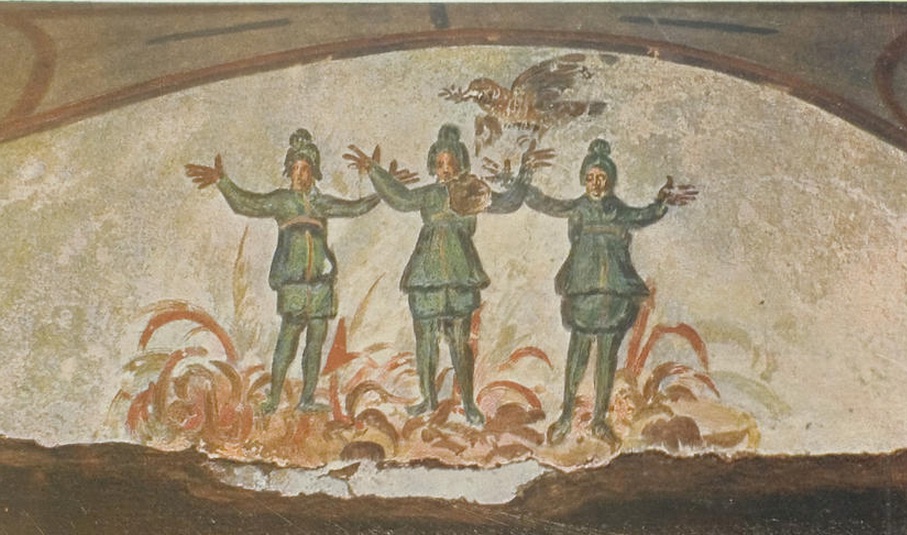
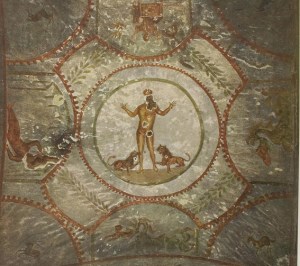
In other parts of the Dialogue, Justin offers the Three Children in the Fiery Furnace, Daniel in the Lion’s Den, and other Old Testament stories as images that speak of the Passion of Jesus. All these “signs” also appear extensively in the art of the catacombs.
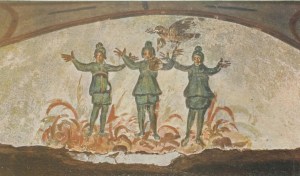
3 children 1

Daniel in the Lion's den. Catacombs

Daniel in the Lion’s den.
Catacombs

In the 55th chapter of his Apology Justin adds signs from nature and human society to expand his argument for Christianity and the mystery of the cross, A ship can’t sail and arrive at its destination without a sail; a field can’t be plowed without a plow. Both of these are in the form of a cross. Human beings themselves are made in the form of a cross, Justin emphasizes. Figures with arms outstretched, Orants, appear everywhere in the catacombs. They imitate Christ who prayed with arms outstretched on the cross, and his prayer was heard. (Tertullian, On Prayer 14)
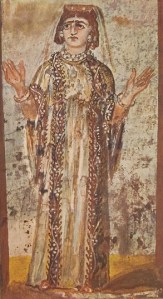
Orans, Catacomb
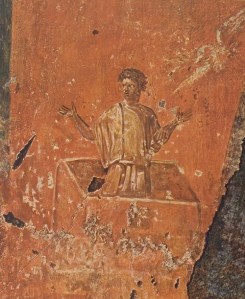
Orans, Catacomb

Noah saved by the wood of the ark. Roman catacombs

Noah saved by the wood of the ark.
Roman catacombs

The art of the catacombs found mostly in the 40 or so catacombs around Rome, offers a rich fascinating look at early Christian belief. Today In the Catholic Church’s prayers for the dying we can still hear the figures portrayed there  invoked once more.

“Welcome your servant, Lord, into the place of salvation…Deliver your servant Lord, as you delivered Noah from the flood, Deliver your servant, Lord, as your delivered Moses from the hand of Pharaoh. Deliver your servant, Lord, as you delivered Daniel from the lions den. Deliver your servant, Lord, as you delivered the three young men from the fiery furnace. Deliver your servant, Lord, as you delivered Job from his sufferings. Deliver your servant, Lord, through Jesus our Savior, who suffered death for us and gave us eternal life.” (Roman Ritual)
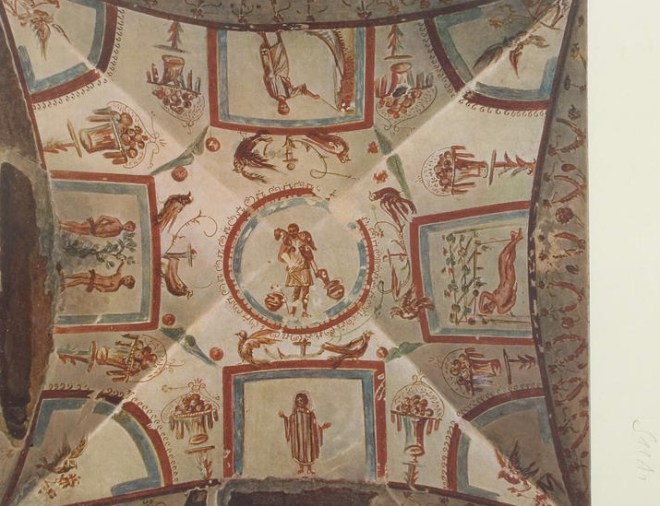
Good Shepherd, Old Testament figures of the Passion. Catacombs

Good Shepherd, Old Testament figures of the Passion. Catacombs