Author Archives: vhoagland

Keeping Balanced

Picasso, Three Dancers

We have an exercise session every Wednesday here in our community with a very good instructor. He asked the other day what’s the major concern elderly people have about their physical mobility? Keeping their balance, he said. 

Balance is a good thing to pay attention to in many ways, isn’t it? Our instructor is taking us through ways to keep physically balanced, simple exercises to keep the parts of the body supple and in tune. 

Our spirits need balance too. Besides breathing in and breathing out, stretching muscles and limbs, we have to make sure our spirits reach out beyond ourselves. That’s done by prayer, for one thing.

Our own spiritual tradition says that prayer is important and points to the beginning of the day and the end of the day, morning and evening, as special times to exercise that gift. Beginning and ending the day are times favoring prayer.

Jesus prayed in the morning and evening, scripture say. He prayed at other times too, but in the morning and evening he prayed the prayers his people prayed, the psalms. He came to know them by heart. 

There’s a balance in the psalms. They speak for you personally and they remind you of the world beyond yourself. You can walk in this world without fear, but there’s always a danger of falling. Pay attention to the time you have and where you’re going.

Mindfulness is not only for physical movements. We need to be mindful of the signs of the times and the One who sets us in these times. As we do our exercises, our instructor reminds us to keep close to our chair. Grab on to it if you’re losing your balance.

The Lord is my Rock, my fortress, my refuge. In him alone is my hope.
November 1-7: Readings and Feasts

NOVEMBER 1 Mon ALL SAINTS Solemnity  Rv 7:2-4, 9-14/1 Jn 3:1-3/Mt 5:1-12a 

2 Tue All Souls . Wisdom 3:1-9/John 6:37-40 

3 Wed Weekday [Saint Martin de Porres, Religious] Rom 13:8-10/Lk 14:25-33 

4 Thu Saint Charles Borromeo, Bishop. Memorial Rom 14:7-12/Lk 15:1-10 

5 Fri Weekday Rom 15:14-21/Lk 16:1-8 

6 Sat Weekday Rom 16:3-9, 16, 22-27/Lk 16:9-15

7 SUN THIRTY-SECOND SUNDAY IN ORDINARY TIME

1 Kgs 17:10-16/Heb 9:24-28/Mk 12:38-44 or 12:41-44 

All Saints Day and All Souls Day begin the month of November, when the fall season reminds us that life passes away. But does life end or does it change? “Life is changed, not ended” our faith says.

St. Martin de Porres (Wednesday) reminds us of the holiness found in those who care for the sick and the needy.

St. Charles Borromeo was a reformer of the Catholic Church at the time of the Reformation.

Readings from the Letter to the Romans conclude this week with interesting greetings to various members of the Roman church, both Jewish Christians and Greeks.

Morning and Evening Prayers here. 

31st Sunday b: Hearing for the First Time

For this week’s homily please watch the video below.

UN Conference on Climate Change October 31-November 12

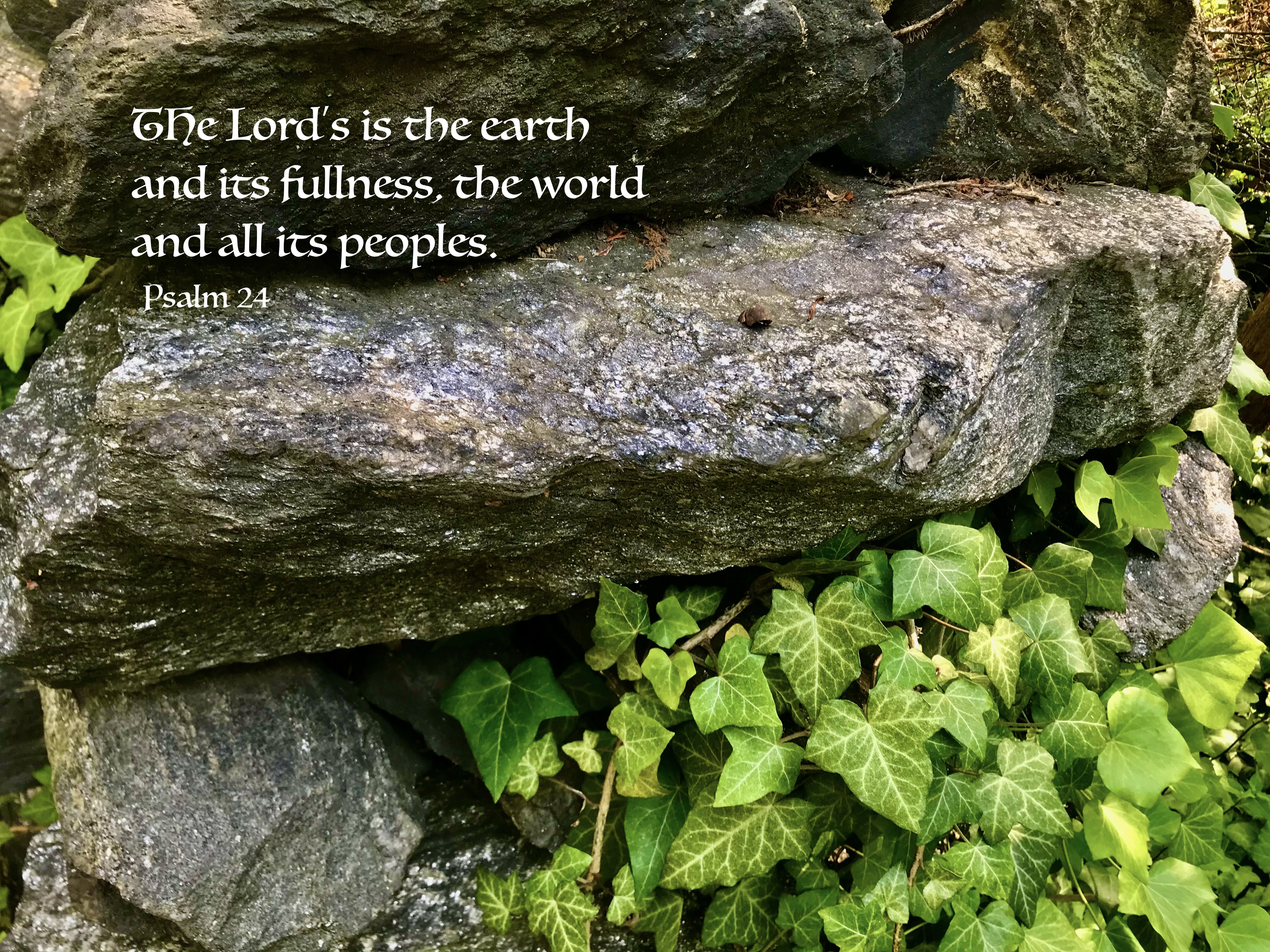
Psalm 24 does not forget where we come from. “The Lord’s is the earth and its fullness, the world and all its people.” The earth comes first. God has “set it on the seas, on the waters he made it firm.” 

The earth was created before us, and we depend on it for life. Its minerals, its water, its plant life sustain us. We are its fullness.

We’re called to climb the mountain of the Lord, to stand in his holy place, to share in his glory. We go with the gifts of creation. 

We have received blessings from the Lord, to seek him, to seek the face of the God of Jacob. Let’s not forget how many of those blessings come from the earth, so let us care for it. The earth shares in the promise made to us.

The UN Conference on Climate Change  (COP26) takes place in Glasgow, Scotland October 31-November 12. 197 countries have agreed to a framework for dealing with climate change. Scientists say we have about a decade to deal with fuel emissions due to the Industrial Revolution that began in the 18th century. Yet, the human response to this threat to the earth is inadequate thus far. Over 20,000 people, government officials, scientists, interested parties, will attend the conference. 

Come, Holy Spirit, and renew the face of the earth.

October 25-30: Readings and Feasts

OCTOBER 25 Mon Weekday Rom 8:12-17/Lk 13:10-17 

26 Tue Weekday Rom 8:18-25/Lk 13:18-21 

27 Wed Weekday Rom 8:26-30/Lk 13:22-30 

28 Thu Saints Simon and Jude, Apostles Feast Eph 2:19-22/Lk 6:12-16

29 Fri Weekday Rom 9:1-5/Lk 14:1-6 

30 Sat Weekday Rom 11:1-2a, 11-12, 25-29/Lk 14:1, 7-11 

31 SUN THIRTY-FIRST SUNDAY IN ORDINARY TIME

Dt 6:2-6/Heb 7:23-28/Mk 12:28b-34

We continue reading this week from St. Paul’s important Letter to the Romans. On Tuesday we read his timely teaching on creation. I wonder if St. Paul were writing to the Americans, or Chinese or Europeans today if, instead of the question of the law, which was bothering the Roman church then, he would devote his whole epistle to the importance of creation.

Saints Simon and Jude are the apostles we’re remember this month, on Thursday.

We’re reading from the Gospel of Luke along with Paul’s Letter to the Romans. Luke was a disciple of Paul, so he will emphasize some of Paul’s teachings in his gospel. For instance, the gospel is meant for everyone, the whole world. No one’s left out.

Creation’s Expectation

Paul’s Letter to the Romans, which we read for almost four weeks at Mass, is considered his most important letter, but it can be hard to follow. Paul writes to a Jewish-Christian community in Rome to establish his credentials as an apostle of Christ and to enlist their help in a journey he wants to make to Spain. He knows also that this community of Jewish and Roman converts is trying to reconcile Jewish law and tradition with faith in Christ, so his letter takes on that question at length. 

It’s helpful to remember the letter is based on Paul’s basic teaching, the common creed of the church he shares with the other apostles. For example, today’s reading (Romans 8: 12-17) is a beautiful reflection on the mission of the Holy Spirit, who leads us to become children of God. The Spirit leads us to call God, the creator of heaven and earth, “Abba, Father!” We are God’s adopted children. We are “joint heirs with Christ” called to share in his glory, “if only we suffer with him.” 

Tomorrow’s reading continues this teaching as it applies to creation. “Creation awaits with eager expectation the revelation of the children of God.” It “groans in labor pains” until that day comes when there will be a “new heaven and a new earth.” Just as we are awaiting the fruit of our adoption, creation waits to share in our adoption in “the redemption of our bodies.” 

All creation groans in labor pains, shares a common suffering,  is waiting for the Spirit to fulfill his promise. Creation has a share in the resurrection of Christ. 

This teaching about creation you won’t get from science. We have it from faith. It’s an important teaching for us today. It’s important, too, to recognize this is not just Paul’s personal teaching. He’s preaching from the basic teaching of the church.

Paul also speaks about creation as he begins his Letter to the Romans.  “Ever since the creation of the world, God’s invisible attributes of eternal power and divinity have been able to be understood and perceived in what he has made.” Creation reveals God to us, yet human beings turn from the God of creation, creating gods of their own, St. Paul says.

Paul’s words are a timely commentary on our own response to climate change today as we continue to put our national and personal interests, our oil fields and coal mines and life-styles above the well being of our earth. His teaching on creation is a basic teaching of our faith. That teaching needs to be heard.

30th Sunday: B. God’s Mercy

Most Sundays this year we’re reading from the Gospel of Mark.  Mark’s Gospel is a wonderful work of art. By that I mean it’s not just a series of stories or sayings of Jesus put together historically as a  account of Jesus’ life. No, Mark’s Gospel is skillfully arranged to teach us who Jesus is and what it means to follow him.

For the last five Sundays or so, Mark is taking us on the journey of Jesus and his disciples from Galilee in the north, where he began his ministry, to Jerusalem in the south where he will die and rise from the dead. Mark’s not interested in the places he passes day by day. He’s telling us what Jesus is revealing about himself, and how people react to him.

On the journey Jesus tells his disciples he will be betrayed and crucified and die on the cross and rise again. He also tells them if they want to follow him, they have to take up their own cross. But over and over they can’t see what he’s telling them. Over and over, Mark says, “They did not understand him.”

Now, those following Jesus are good, normal people, as far as we can judge. Peter and the other fishermen from Galilee, James and John, for example, are good, solid reasonable people. The rich young man who approached Jesus in our gospel reading a few weeks ago– a good, solid individual. But they did not understand him.

“You think like human beings think,” Jesus says to Peter earlier in Mark’s Gospel. Peter had told him to put any thought of suffering and dying from his mind. James and John thought they could become big players in Jesus’ earthly kingdom. He would be a ticket to success when they reached Jerusalem. The rich young man was afraid of losing what he had. They’re all examples of the way human beings think. They did not understand him.

Of course, Mark’s gospel is pointing out this is the way we think too. We’re so limited,  so self-serving, so afraid to trust in the wisdom and promises of God. We think like human beings. At one point in Mark’s gospel, the disciples throw up their hands, seemingly in desperation, and say among themselves, “Then who can be saved?”

Today’s gospel answers to that question. “As Jesus was leaving Jericho with his disciples and a sizable crowd, Bartimaeus, a blind man, the son of Timaeus, sat by the roadside begging.” They’ve reached Jericho where the road turns up to Jerusalem. The blind beggar is sitting on the road. He can’t see. He had nothing to recommend him, it seems. Nobody wants him near them, but Jesus calls him and gives him his sight.

Not only does Jesus give him his sight, but Bartimaeus, the son of Timaeus, gets up and follows Jesus on the way, up to Jerusalem. In a simple, beautiful way, Mark’s Gospels tells us a powerful story of God’s mercy. The blind man is a symbol of humanity,  blind to so much. But God’s mercy is stronger than human thinking, human weakness, even human sin. It reaches out  and helps us . God’s mercy helps us to see, to get up and with Jesus enter Jerusalem.

30th Sunday b: The People Jesus Calls

For this week’s homily, please watch the video below.

October 18-24: Readings and Feasts

OCTOBER 18 Mon Saint Luke, Evangelist Feast 2 Tm 4:10-17b/Lk 10:1-9 

19 Tue USA: Saints John de Brébeuf and Isaac Jogues, Priests,

and Companions, Martyrs Memorial Rom 5:12, 15b, 17-19, 20b-21/Lk 12:35-38 

20 Wed Weekday Saint Paul of the Cross, Priest Rom 6:12-18/Lk 12:39-48 

21 Thu Weekday Rom 6:19-23/Lk 12:49-53 

22 Fri Weekday [Saint John Paul II, Pope] Rom 7:18-25a/Lk 12:54-59 

23 Sat Weekday [Saint John of Capistrano, Priest;] Rom 8:1-11/Lk 13:1-9 

24 SUN THIRTIETH SUNDAY IN ORDINARY TIME Jer 31:7-9/Heb 5:1-6/Mk 10:46-52 

Wednesday is the Feast of St. Paul of the Cross, founder of the Passionists. This year the Passionists celebrate their 300th anniversary.You can find his biography here. 

Readings for his feast here.https://bible.usccb.org/bible/readings/1020-memorial-paul-cross.cfm

The Jesuit North American Martyrs are remembered on Tuesday.

29th Sunday b: The Gospel of Success

For this week’s homily please watch the video below.