Author Archives: vhoagland

16th Sunday c: Martha and Mary

For this week’s homily please watch the video below.

Gardens and Space

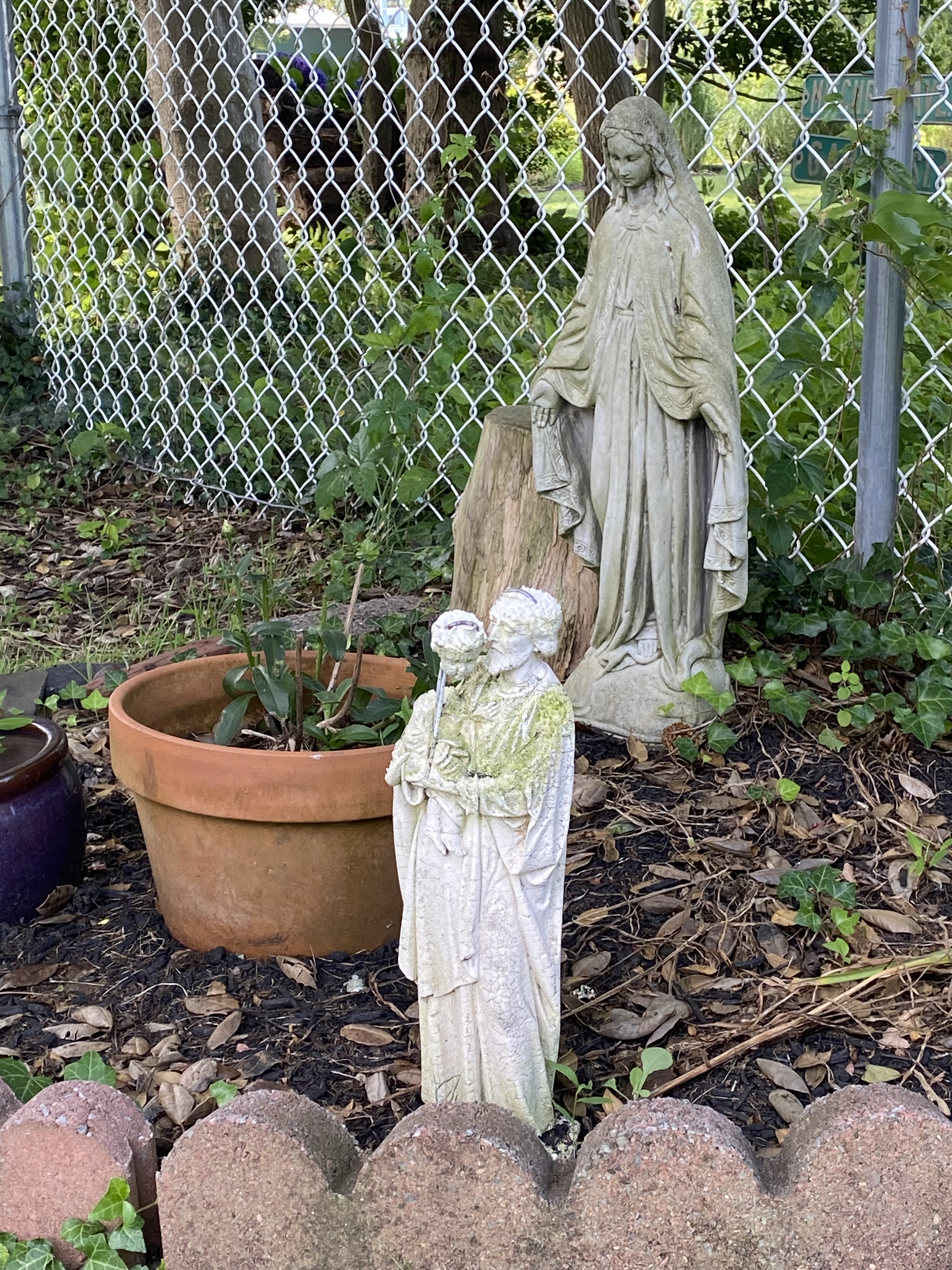
I’m sitting this morning in my sister’s backyard, shaded by a big Chinese maple and a big holly tree. She has a small shrine to Mary there and a statue of Joseph holding a broken child Jesus, which she salvaged from someone else’s backyard.

A young robin and a young cowbird are nearby searching for food, a little perturbed, I think, to find me occupying  part of the territory that’s usually theirs.


We usually think we own the world. What rights do robins and cowbirds have to this backyard I’m enjoying now?

We didn’t make the trees, the ground we’re on, the air we breathe. They’re gifts to us and make us who we are. NASA released on Tuesday images and data from the new James Webb Space Telescope that offered a spectacular view of our universe. We know only a small part of the cosmos we live in.

Neither do I know a part of the small garden I’m sharing with the robins and cowbirds this morning.

Nasa

Hidden Treasures

Jesus, the Teacher. Br. Robert Mc Kenna, CP

There are treasures in life, but you don’t get ahold of them easily. You need to discover them and then give all you have to get  them. That’s what Jesus teaches in the parables we’re reading recently.

Treasures in the parables are hidden in the ground and in the deep waters of the sea, so you can’t expect to see them right away. You have to dig for them and cast your net out for them.

The times you live in may not make finding treasure easy either. The times in which Jesus lived were hardly ideal, as we see in chapters from the Gospel of Matthew which immediately precede the parables. 

 Yet, instead of closing your eyes and ears and hanging on tight, Jesus tells his disciples to open their eyes and their ears, because treasures are there. “Blessed are your eyes, because they see and your ears because they hear. Many prophets and righteous people longed to see what you see but did not see it and hear what you hear and did not hear it.”  (Matthew 13,16-17)

Bad times can be the best times to find treasure. That’s another lesson Jesus teaches in Matthew’s series of parables. Some of the best things we discover in life, some of the best things we have, some of our most creative moments come in bad times.

God doesn’t stop sowing seed in bad times. Even then, treasures, pearls of great price are there to be discovered. That’s the message found in the parables. It’s the message found in the mystery of his Cross..

Browsing Through A Library

From time to time I like browsing through the large collection of books we have downstairs. Libraries, bookstores, now the internet, are treasuries and junkyards all at once. You never know when you’re going to stumble upon something that sparks questions or open your mind. 

Awhile ago, I stumbled on a book called Pride of Place: The Role of Bishops in the Development of Catechesis in the United States, by Sr. Mary Charles Bryce. It’s  a study of catechisms and catechesis in our country from the time of Bishop John Carroll, way back in the 18th century, to the 1980’s. How are we going to teach and form our people in faith? That’s the question they were asking then. It’s a question we face now.

Catechesis is on my mind lately. We’ve had a big development in theology and scripture and liturgy since the Second Vatican Council in the 1960s, but has that reached the ordinary people of the church, young or old? I think we need a better way to make the riches of our faith available to them. Catechesis is one of our prime needs as Catholic schools decline and dioceses, parishes, religious orders and their resources diminish.

“Pride of Place” Sister Bryce called her book, a title from an old pastoral letter of the American bishops on catechesis. Not a bad priority for the church today. How are we going to pass on the faith we have received in our time. What are the words and ways we’re going to use? Pope Francis in his recent letter Desiderio Desideravi calls us to see the liturgy as a catechetical school.

The Eternal Word needs to become incarnate from age to age:

“For last year’s words belong to last year’s language
And next year’s words await another voice.”  (T.S. Eliot)

We need to renew our liturgical life. We need  good catechetical sites online and there’s still something to be said for the books in our library downstairs. They were gathered by people before me, who were wondering about things as I am now.  Someone recognized  Sister Bryce’s book was a good book to hold on to.

Thanks.

Wisdom for the Childlike

The 11th and 12th chapters of Matthew’s gospel which we’re reading this week describes a growing opposition to Jesus after he begins his ministry in Galilee. It’s a dark section of the gospel. 

The Pharisees now take “counsel against him to put him to death” and begin to oppose him. (Matthew 12.14) They’re not satisfied with his teachings and miracles and demand a sign. They’re joined by the Herodians, followers of Herod Antipas who ruled in Galilee. The political establishment joins the opposition. 

Jesus is also opposed  by “this generation” of Israelites, the towns “where most of his mighty deeds had been done,” Corazin, Bethsaida, Capernaum. (Matthew 11,16-19) The towns that enthusiastically first welcomed him seem to dismiss him.

At the end of this section of Matthew another group, who may surprise us, appear to oppose him – his family from Nazareth.  (Matthew 12,47-50)

All together, this opposition must have affected Jesus, as he faced  the fickleness of humanity. But it also must have affected his disciples as well, who joined him expecting to see God’s kingdom come. 

I think they’re among those whom Jesus prays for in today’s gospel. 

“I give praise to you, Father, Lord of heaven and earth,
for although you have hidden these things
from the wise and the learned
you have revealed them to the childlike.
Yes, Father, such has been your gracious will.
All things have been handed over to me by my Father.
No one knows the Son except the Father,
and no one knows the Father except the Son
and anyone to whom the Son wishes to reveal him.”

From what we know of them, the first disciples of Jesus were not wise and learned, they were more like children excited by what they saw Jesus do and say. They had no deep theories or plans to draw upon; they had no experience to go by when they faced failure and rejection. They only heard the simple wisdom Jesus offered as he spoke to them in parables.

And that was enough. 

Are we like them, and is our time now like theirs? In a time like ours this gospel reminds us God reveals his wisdom to the childlike. His Son still reveals himself to us. We praise God through Jesus Christ, our Lord. The childlike will be taken care of.

The Liturgy is Our School

Pope Francis in his recent letter Desiderio Desideravi gives a lot of attention to the Eucharist, but he also points out that we encounter Jesus Christ in the sacraments and in the church year. The liturgy of the church is our common prayer where, when we gather in his name, two or three of more, Jesus is in our midst. 

Two tendencies endanger common prayer today, the pope says. One he calls neo-Gnosticism, the other neo-Pelagianism. 

“The first, neo-Gnosticism, shrinks Christian faith into a subjectivism that ‘ultimately keeps us imprisoned in our own thoughts and feelings.’” (EG 94) We might say neo-Gnosticism shrinks the world into what I happen to be interested in now, what I’m doing, what’s going on in my life, what I think is good for me.  Everything else doesn’t matter, or is too much to think about. The early gnostics dismissed much of the world as evil, and consequentially made the world too small.

Neo-Pelagianism cancels out the role of grace, the pope says. It leads us to believe we can do anything if we set my minds to it. I don’t need anything beyond what I can do with my own hands and my own mind. So why do I need God?  

These two tendencies today endanger in a particular way our encounter with Christ in the Eucharist and the liturgy and our common prayer. In his letter later on, the pope recommends we study the liturgy and celebrate it the right way, but he stresses the importance of examining ourselves on those two tendencies.

The liturgy “frees us from the prison of a self-referencing nourished by our own reasoning and our own feeling” the pope say. It frees us from small-mindedness.  “it does not leave us alone to search out the mystery of God. Rather, it takes us by the hand, together, as an assembly, to lead us deep within the mystery that the Word and the sacramental signs reveal to us. And it does this, consistent with God’s action, following the way of the Incarnation…” (18)

The liturgy follows the way of the Incarnation. How does it do that? One way is that it recognizes we human beings learn day by day. The liturgy is a daily school; it takes us by the hand day by day into a world of simple signs. It’s the most important school we go to. 

We’re reading from chapters 11-12 of Matthew’s gospel this week which  describes the growing opposition to Jesus after his initial ministry in Galilee. How can we face opposition in our own world if we don’t recognize Jesus faced opposition in the world he lived in? 

This week we’re reading key passages from the Prophet Isaiah at Mass, the most frequently referenced Old Testament source in the New Testament, after the psalms.

There are some interesting saints this week. Today we celebrate St. Benedict, a founder of western monasticism, who brought a new way of Christian life into the church.  Can he help us envision new forms of life in our church today”

We celebrate St. Bonaventure this week. He brought a new dimension to the early Franciscan movement. Are there new dimensions taking place in church communities today?

The liturgy leads us by the hand into the mystery of Christ. It’s a daily school for us and our community. That why we begin our prayers with prayers like this:“O God,come to my assistance. O Lord, make haste to help me.” Take me from my small world, into your great world. Take us from our small world, into your great world.

“Glory be to the Father, and to the Son, and to the Holy Spirit, as it was in the beginning is now and will be forever. Amen.”

A world much bigger than what we see now.
15th Week of the Year: Readings and Feasts

JULY 11 Mon Saint Benedict, Abbot Memorial Is 1:10-17/Mt 10:34—11:1 

12 Tue Weekday Is 7:1-9/Mt 11:20-24 

13 Wed Weekday [St Henry] Is 10:5-7, 13b-16/Mt 11:25-27)

14 Thu USA: Saint Kateri Tekakwitha, Virgin Memorial Is 26:7-9, 12, 16-19/Mt 11:28-30 

15 Fri St Bonaventure, Bishop and Doctor of the Church Memorial

Is 38:1-6, 21-22, 7-8/Mt 12:1-8

16 Sat Weekday [Our Lady of Mount Carmel] Mi 2:1-5/Mt 12:14-21 

17 SUN 16TH SUNDAY IN ORDINARY TIME Gn 18:1-10a/Col 1:24-28/Lk 10:38-42 

This week we’re reading key passages from the Prophet Isaiah at Mass. Isaiah is the most frequently referenced Old Testament source in the New Testament, after the psalms. We read Isaiah extensively in our liturgy in Advent, Lent and Easter. 

Chapter 11-12 of Matthew’s gospel describe a growing opposition to Jesus after his initial ministry in Galilee. “Do not think that I have come to bring peace upon the earth. I have come to bring not peace but the sword,” Jesus says to his disciples.

Interesting saints celebrated this week: St. Benedict, a founder of western monasticism, is remembered July 11. 

St. Bonaventure who brought his considerable intellectual gifts to the early Franciscan movement is remember July 15.The saints often bring new dimensions to their religious community.

Mary, the Mother of Jesus, enriches the charism of so many great religious traditions in the church by her presence. Our Lady of Mount Carmel (July 16) enriched the Carmelite tradition.

We remember Saint Kateri Tekakwitha, the first canonized saint from the American native peoples, July 14. Holiness can be found in all people.

Neighbors and Strangers

by Orlando Hernandez

 The parable of the “Prodigal Father” is my most beloved because it presents such a portrait of our Loving, Creator Father in Heaven. But right next to this one I hold in my heart the parable of the “Good Samaritan.” This parable (Lk10:25-37) shows us two different portraits of our merciful Savior,Jesus Christ. Pope Benedict XVI in his book “Jesus of Nazareth” writes that the Samaritan traveler represents our Lord, Healer, and Savior, as He intimately comes to the rescue of each member of our wounded humanity. Benedict goes on to say that the dying traveler also symbolizes our Lord, representing each hurting, bleeding human being as He takes upon Himself our sorry state through His Passion, and is brought to resurrection by our Loving Father (the Samaritan?). 

     But, what about the priest and Levite who passed by the afflicted man without helping him? Do they represent me and every one of us? A few years ago, some psychologists and sociologists in Boston did an experiment. They secretly filmed an actor, a heavy-set man in very shabby clothes on a wheelchair in a street corner . The actor suddenly feigned going into convulsions, making loud sounds, and falling from the wheelchair upon the concrete. He yelled out a few times and went silent. Passers-by would see him on the ground and would give him a wide berth. This went on for several minutes until finally some “good samaritans” stopped to attend him.

     Why did so many people keep away from him at first? Was it fear, indifference, racial prejudice, repulsion for the seemingly homeless man? Were they too busy with their own problems? Did they suspect this was a gimmick to get their money? Were they used to scenes like this? Would I have stopped to help him? Would I stop at a fresh accident site even though I have back problems? Would I dare to interrupt a beating of a person in the street? Am I brave enough to take such risks for a stranger? Or, are all these strangers our neighbors?

     Then, I think of my actual neighbors around my home. I try to say “Hi”, but I am not close to any one of them. I have never been to their houses or invited them to mine. Why am I so afraid to get involved with other folks? I do pray for them, but seem to prefer to keep my distance. Strangers, so many strangers, at church, in the subway, the supermarket, the street. Why are we so afraid of each other that we avoid making eye-contact, nodding in acknowledgement, or even smiling at each other ? I think of the many people that drift by my peripheral vision but never really see. And the images of thousands of suffering souls on the evening news, how can I live with this as a Christian?

     Only by faithfully engaging in contemplation with our Loving Savior, approaching Him even as the scholar of the law did and asking Him, “What can Ido?”, can I begin to find a way. 

     Lord, You are our Guide in the way of love of neighbor. You’re actually our closest neighbor! Let us enjoy our sacred time together and share the look of love. My wife, my family, they too are my neighbors because You live in them. Help me to truly show them Your love and mine. All the many Church Brothers and Sisters, who teach me and bring me healing and hope, they are also You. The people around my house, do I love them? I think so! I see their efforts at being good for their families. I see their efforts at being civil. Let me do a better job at seeking their eyes and smiles, letting them see that somebody sees them.

     Then, all the other people I run into: bless them Lord, help them, use me whenever I am needed for their sake. Help me to walk around in confidence that if I need it one of them will be “Neighbor” to me and help me. At my age, Lord, give me the peace of knowing that I am surrounded by so many well-meaning, even if imperfect people. My faith in You compels me to also have faith in them. Lord, help us to be compassionate and merciful with each other.You did not die on that Cross for the sake of a hopeless species. Remind us that we are worthy of Your Sacrifice, even if it is hard of us to believe it. You are the one who knows. You are the one who reigns. I trust in Your all-powerful Love. Lord, make me an instrument of Your peace. Amen.

15th Sunday of the Year c: Your Neighbor

For this week’s homily please watch the video below.

How Bad Can It Get

The Disciples’ Unbelief Charter

The gospel is supposed to be life at its best, but it also presents life at its worst. What’s worse than being a lamb among wolves? Than living with people who don’t support you and in fact hate you? Than having people beat you with whips? Than having your own brothers and sisters turn against you? Than having people throw you out of town?

Can it get worse than that? You’ll experience all these things, Jesus says in today’s gospel to the Twelve and those who go out with them.

Today’s gospel from Matthew is part of the commissioning of disciples whom Jesus sends as heralds of the kingdom of heaven. They have power to “cure the sick, raise the dead, cleanse lepers and drive out demons.” Great powers. But that’s not all. They must exercise these powers in the real world.

We can’t forget we live in the real world that Jesus describes in today’s gospel. His way of living in this world is unique. He doesn’t send out armed divisions or powerful super salespeople, but vulnerable lambs. Yet, his lambs are stronger than wolves. Don’t be awed by governors and kings or crushed by adversity or rejection, Jesus says. Just listen to the “Spirit of your Father speaking in you,” and you’ll have wisdom enough.

Even if you’re thrown out of one town, another town waits for the coming of the Son of Man. The real world is not as strong as it seems.