Monthly Archives: January 2026

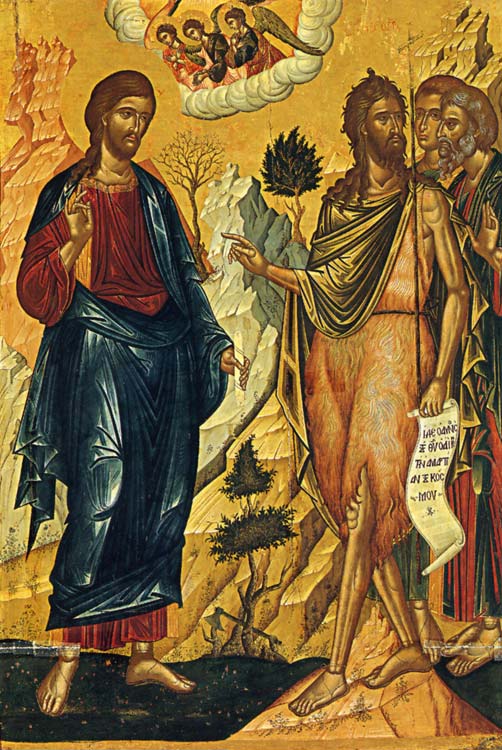
John the Baptist, “I am not the Christ”

 In the days before Christmas Luke’s gospel linked the birth of John the Baptist closely to the birth of Jesus, noting carefully Jesus’ superiority to John. At the same time Luke indicates that John had a privileged role in announcing Jesus as the Messiah. Luke alone mentions John and Jesus are related.

In these day’s after Christmas John’s gospel offers the Baptist’s testimony to Jesus. “I am not the Christ,” John responds to the Jewish leaders who question him about his ministry near the Jordan River. “I am the voice of one crying out in the desert,‘Make straight the way of the Lord.’”

The lower Jordan valley where John preached and baptized was a place hallowed by heroic events and figures of the Jewish past. There, for example, Joshua led the Israelites over the Jordan to conquer the city of Jericho and enter the “land flowing with milk and honey.”

Late in the 8th century B.C., the prophet Elijah began preaching reform there as Israel turned to the false gods of the wicked Queen Jezebel. God sent ravens to the Wadi Cerith near the Jordan to feed Elijah in a terrible drought. Returning to the lower Jordan, Elijah disappeared mysteriously there at the end of his life,.

Later Jewish tradition said that Elijah would return – most likely to the Jordan valley – to announce the Day of the Lord, God’s final coming. And so, when John came dressed in a rough camel hair cloak, like Elijah of old, and preached with great power at this memorable place, people wondered: “Has Elijah returned?”

For the Jews the Jordan valley was a place to recapture the ancient faith of their forebears. The desert air was purer and life more simpler in that hard, memorable land that seemed to belong to God alone.

Strongly religious people, like the communities of Qumran, preferred living in the desert to Jerusalem, rejecting what they saw was the compromise and spiritual lukewarmness of smainstream Judaism. Living there, they hoped for a Messiah and Teacher to bring renewal to their people.

Besides the communities of Qumran, Jewish revolutionaries were also associated with the Judean wilderness. In 6 A.D. after the failure of a bloody revolt led by Judas the Galilean against Roman rule, bands of his followers waged a guerrilla campaign for Jewish independence from these barren hills.

And so, the Roman authorities and their local allies kept a wary eye on anyone like John the Baptist preaching in a place so significant, a major pilgrim road to Jerusalem.

Pilgrims from Galilee came this way. Jesus himself and some of his followers were among them, John’s gospel points out. I suspect the authorities watching John the Baptist also associated Jesus and his followers with him. They needed to be watched too.
January 2: Basil and Gregory

January 2nd is the feast of St. Basil the Great and St. Gregory Nazianzen,  saints of the eastern church of the 4th century. They were not martyrs like Stephen and others we celebrate after the feast of Christmas. Rather, they fought for a truth so often questioned in the Christmas mystery: Who was Jesus Christ? 

Basil defended our belief in the Trinity, Father, Son and Holy Spirit. He upheld the divinity of Jesus Christ against the Arians who denied he was fully divine. When we say Jesus is “consubstantial” with the Father – as we do at Mass in our creed – we repeat a word used by Basil, “homoousios” (of the same essence), to describe the relationship between the Father and the Son.

Basil belonged to a well-to-do Christian family from Caesaria  in Asian Minor, a major center of the Christian world. Other members of his family are also honored as saints: his mother Emily, his grandmother Macrina, his sister, also Macrina, and his brothers Gregory of Nyssa and Peter of Sebaste. 

Gregory of Nazianzen, a school mate and friend of Basil, later became bishop of Constantinople. Like Basil, he is an important theologian who articulated the doctrine of the Trinity, He saw the trinity as “a triple light gathered into one splendor,” Family and friendship were important to Gregory and Basil. They saw the Arian heresy to be, not just a theological error, but an evil bringing fear and suspicion to the Christian community.

Basil and Gregory are considered among the greatest of the early church’s teachers.

“God’s gifts can’t be numbered,” St. Basil writes,  “The blessings of God can’t be named or understood, they’re more numerous than everything in this world of ours. Yet, one blessing stands out – God’s mercy. Keep it in mind. Mercy is God’s surprising gift, a gift that lifts us  from failure. 

“God never abandons us, even when we fail and persist in our failure. His mercy is beyond our expectations. The cross is mercy’s great sign, bringing us life. Nor was God content merely to bring us back from death to life;, God gives us also the dignity of his own divine nature and prepares a place of joy for us that surpasses anything we imagine.”

We forget mercy so easily, the saint says.

Here’s a prayer Gregory of Nazianzen offered on the occasion of his friend Basil’s death.

Good and kind God, in this life and the next, you ask so little and give so much.  If only we could be what we should be. 

Hoping in you and loving you, let us accept everything and give thanks for everything, since everything brings us to salvation through you. To you we commend ourselves and those who have reached the place of rest before us, walking the same road we do. Lord and Creator of all, our God and Father, Ruler of your children,

Lord of life and death, guide and friend of our souls.  You fashion and transform all things in due time through your creative Word, In your deep wisdom and providence, receive those who have gone ahead in our journey from this life. 

Receive us too when our time comes and guide us through the years, as long as they last. Receive us as we come humbly before you, not troubled, nor shrinking back before the day of death, like those who love this world too much. Instead, may we set out eagerly for that everlasting and blessed life which is in Christ Jesus.

To him be glory for ever and ever. Amen 

A New Year Is Here

new year


Looking at the New Year, Karl Rahner speaks of our need for “a mysticism of everyday life.” It’s not in big things God’s grace will be found, but in steady, commonplace living. Accepting time in small dimensions readies us for its big moments.

“The New Year is coming.  A year like all the rest.  A year of trouble and disappointment with myself and others. When God is building the house of our eternity, he puts up fine scaffolding in order to carry out the work. So fine, that we may prefer to live in it.

“The trouble is we find it is taken down again and again. We call that dismantling the painful fragility of life. We lament and become melancholy if we look at the new year and see only the demolition of the house of our life, which is really being quietly built up for eternity behind this scaffolding that’s put up and taken down again.

“No, the coming year is not a year of disappointment or a year of pleasing illusions. It’s God’s year. The year when decisive hours are approaching me quietly and unobtrusively, and the fullness of my time is coming. Shall I notice these hours? Or will they be empty, because they seem too small, too humble and commonplace?

“Outwardly they won’t look different and can be overlooked: the slight patience it takes to make life slightly more tolerable for those around me; the omission of an excuse; risking good faith in someone I’m inclined to mistrust because I’ve had an bad experience with them before; accepting someone’s criticism of me; allowing an injury done to me to die away, without complaining, bitterness or revenge; being faithful to prayer without being rewarded by “consolations” or “religious experience”; trying to love those who get on my nerves (through their fault, of course); trying to see in someone else’s stupidity an intelligence that is not mine; not trading on my virtues to justify my faults; suppressing my complaints and omitting self-praise.”

Rahner doesn’t glamorize everyday mysticism. It can be both tough and boring. “Even the saints yawn sometimes, and have to shave.”

K. Rahner, The Great Church Year, New York 1994  p. 85

January 1: Mary, the Mother of God

Mary sorrows copy
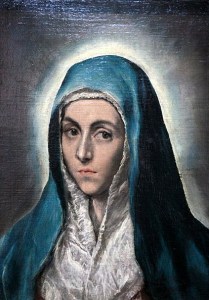
Mary. El Greco

Today we celebrate the oldest feast in the Roman calendar honoring Mary, the mother of God.  We celebrate it in the Christmas season because she is the unique witness who guarantees the mysteries of Jesus, born of Mary.. 

Who else but Mary could tell us about the early life of Jesus? It had to be her. “Mary kept all these things in her heart,” Luke says in his gospel. 

Mary and Joseph are our key witnesses to the early life of Jesus. People after the resurrection of Jesus must have asked Mary about those early years: How was he born, what was he like growing up? They must have questioned her. 

She must have told them of God’s invitation to bear his Son, of his birth in Bethlehem, the shepherds, the strangers from the east, Herod’s attempt to kill her child, the old people in the temple who recognized him, their flight into Egypt. 

She would have told them he grew up like other children, She and Jospeh were mother and father to him. They held him in their arms, fed  him, clothed him, taught him his first words, helped him take his first steps, brought him to the synagogue, instructed him in their tradition, taught him to pray, listened to his questions. Angels didn’t bring him up. They did. 

The words we hear in Luke’s story of their journey to Jerusalem to celebrate Passover are surely hers: “Son, why have you done this to us? Your father and I have been looking for you.”

Yet, he was a Child beyond others. Her witness to that was so important. All looked to Mary for her word. He was God’s Son. She was God’s humble servant, She was the Mother of God. 

This ancient feast celebrates Mary’s witness to the humanity and divinity of Jesus Christ. Churches of the Byzantine and Syrian rites celebrate this feast on December 26. The Coptic rite celebrates it on January 16.

From earliest days to later councils, the church turned to  Mary when it asks “Who is  Jesus?” We call on her this Christmas season to tell us who he is.

“Lord, holy Father, almighty and eternal God, we praise, bless, and glorify your name on the Solemnity of the Motherhood of the Blessed ever-Virgin Mary.  For by the overshadowing of the Holy Spirit she conceived your Only Begotten Son, and without losing the glory of virginity,  she brought forth into the world the eternal Light, Jesus Christ our Lord. “ (Preface for the feast)

The papal Mass for her feast in Rome begins with this chant:

Hail Mary, most beautiful of our human race,                                                                          Virgin worthier than all others,                                                                                            enthroned in the heavens above.

Hail Mary, Virgin bearing the Child who sits at the Father’s right hand,  ruling heaven and earth and all things,  once hidden in your womb.

Hail Mary, the Uncreated God created you, the Only-Begotten Son loved you deeply,  the Holy Spirit made you pregnant in a wholly divine way.

God wonderfully made and called you,  his hand-maid, to be the mother of his Son.  No other was made like you.

Be our mother, our comfort, our joy,  and after this our exile, may we be with you in heaven forever.