Monthly Archives: May 2025

5th Week of Easter: Readings and Feasts

Spanish

The Acts of the Apostles, read this week, describes  the church’s growth after the Resurrection of Jesus as Paul and Barnabas bring the gospel tos the gentiles in the Asia Minor cities of Lystra, Derbe, and Pisidia. Yet, the mission raised questions in the Jewish Christian community at Jerusalem. Are the gentiles taking over?

To meet what some considered a threat,  a council was called in Jerusalem, which had enormous consequences . Councils are usually important events in the life of the church. The Second Vatican Council that took place in the 1960s was an important event for the church in our time.

The Council of Jerusalem is described on Wednesday to Saturday of this week.

The gospel readings for the remainder of the Easter season are from the Farewell Discourse from John’s gospel. They help us understand the presence of Jesus in the Eucharist and the other sacraments.

“I will not leave you orphans,” Jesus says, yet he will not be with them as he was before. The Paraclete, the Spirit of truth, will teach them all things; Jesus will be present to them –and to us– in signs.

5th Sunday of Easter c: New Heavens, New Earth

For this week’s homily please watch the video below.

The Farewell Discourse of Jesus

From this Thursday until the end of the Easter Season, our gospel readings are from the Farewell Discourse of Jesus at the Last Supper. (John 15-17) His disciples experienced him when they ate and drank with him at the Last Supper and after his resurrection. Their experience indicates how we meet Jesus in the Eucharist and the other sacraments. We know him in signs.

His disciples were troubled when told he would leave them physically. They feared becoming orphans. Now they were to know him in another way. “Do not let your hearts be troubled and afraid… I go and prepare a place for you, I will come back again and take you to myself, so that where I am you also may be.” (John 14:1-6)

 “A little while and you will no longer see me, and again a little while later and you will see me,” Jesus told them. ”So they said, “What is this ‘little while’ [of which he speaks]? We do not know what he means.” (John 15:17)

Our experience of Jesus is similar to theirs, a “little while” experience. We know him in signs like bread and wine, through a faith that accepts his presence in signs. He called us blessed, who believe and do not see.

“In the sacraments Christ himself is at work” the catechism says, “ it is he who baptizes, he who acts in his sacraments in order to communicate the grace that each sacrament signifies.” (Cat. 1127)  Yet it’s the Christ of faith at work. “Although you have not seen him you love him; even though you do not see him now yet believe in him,” Peter says. (1 Peter 1:3-9)

John’s Farewell Discourse became the church’s basic source for learning about the world of signs that Jesus left his disciples after his resurrection. We read from it the next weeks of the Easter season. Reflecting on it refreshes our faith. He assured them. He is the Vine, we are the branches. He will strengthen us.

Readings here

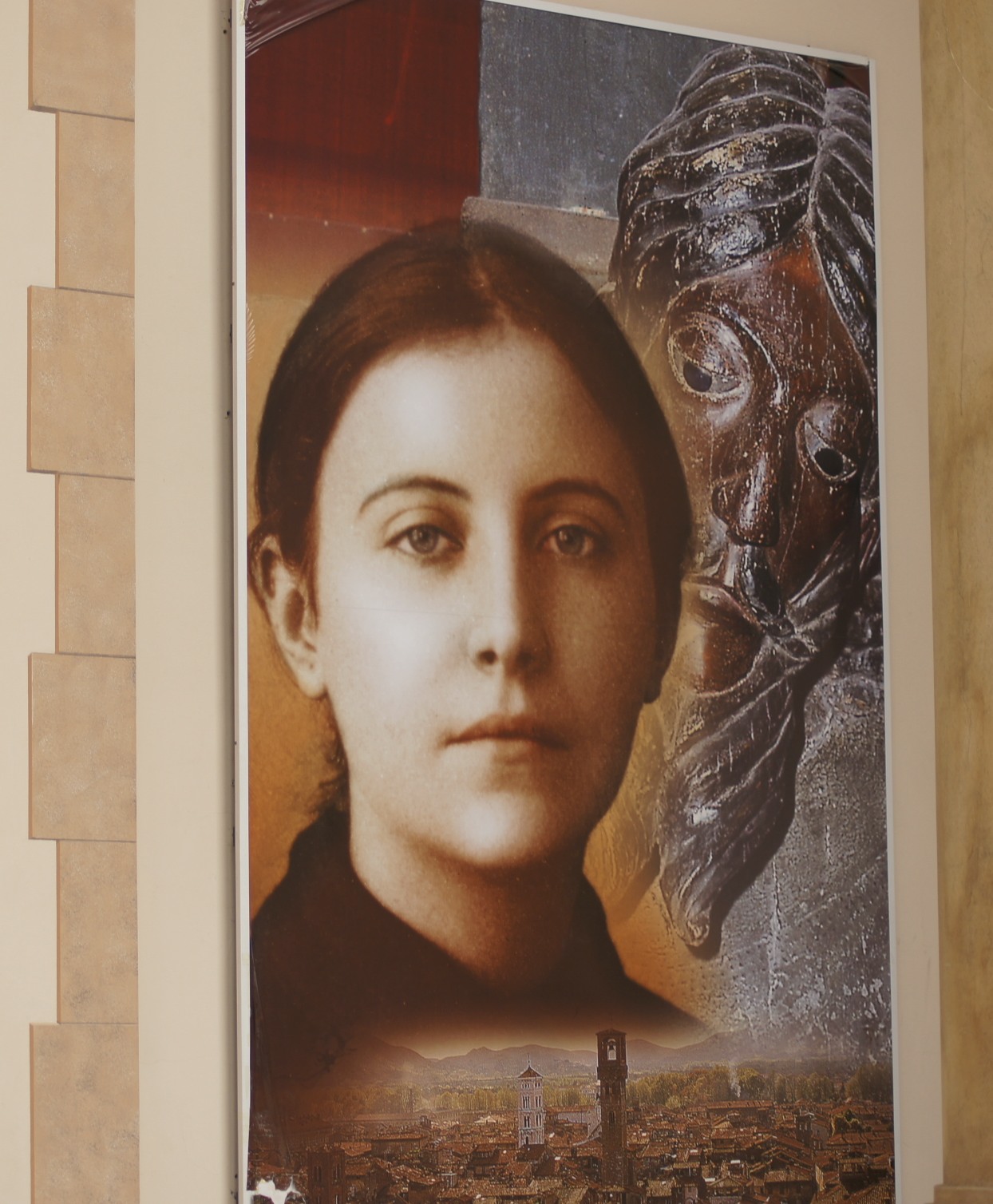
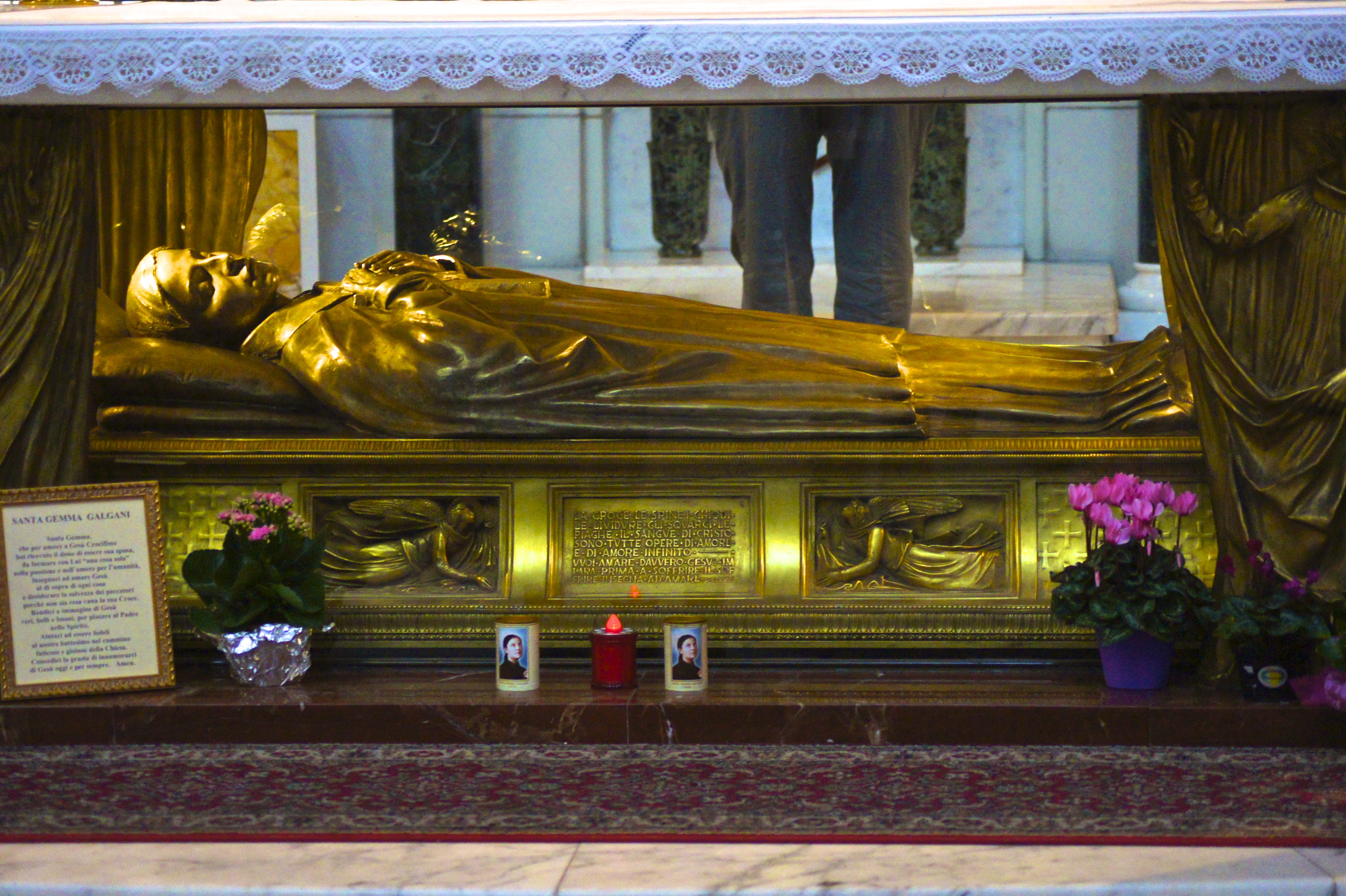
St. Gemma Galgani

SONY DSC

Gemma Umberta Pia Galgani
(1878-1903)

Gemma Galgani died on Holy Saturday, 1903 in Lucca, Italy. Her death should have been completely unnoticed. She was often sickly in her 25 years of life and had to be taken care of. She left no children or family/. No hospitals, schools or any human achievement bear her name. Disappointments marked her life at every turn. She never got her wish to enter the Passionist Nuns or any other religious community.

Yet, at the news of her death on Holy Saturday, her neighbors gathered quickly in the Lucca’s ancient streets proclaiming “A saint has died.” Today in the Easter season we’re celebrating her feast.

Holy Saturday, the day after Jesus suffered and died, is the day before Jesus rose from the dead and appeared to his disciples. They report that he ate and drank with them for some days before ascending into heaven. He showed them the wounds in his hands and his side. He appeared to them, not just to prove he was alive, but affirm his love for them and for the whole world. He promised life. 

Gemma knew the mysteries of Jesus’ death and resurrection in a special way. She spoke familiarly with the Risen Jesus, as we see from her writings, and in a unique way she bore his wounds in her body.

“Poor Gemma”, she called herself; but she was’t poor. Frail in body and mind, she wasn’t a  failure. In declaring her a saint, Pope Pius XII said that Gemma experienced what the great apostle Paul experienced: “I have been crucified with Christ and the life that I live is not my own: Christ lives in me.

The stigmata, the bodily experience of the wounds of Christ, is a rare experience. It was not reason Gemma was declared a saint. Her heroic life of faith, patience and humility revealed her union with Christ, living in her.

The stigmata is a rare experience given to individuals, but it’s not meant for individuals themselves; it’s given to strengthen the belief of many. In Gemma’s time, “enlightened” thinkers like Freud and Jung were beginning to explore the human person. They were little concerned with God’s presence in human life. They would likely have dismissed Gemma’s spiritual experiences as delusional. A number of  Lucca’s “enlightened” people had that opinion of her.

Gemma’s Passionist spiritual director, Father Germano, was introduced to her while preaching in Lucca. He saw God working in her. The church concurred in his judgment by declaring Gemma a saint in 1940.

Many today still define humanity in human terms and sees success here on earth as our ultimate goal. Gemma is a strong reminder of God’s presence in humanity, in ordinary people, even in unsuccessful, imperfect people. Her devotion to the Passion of Jesus gave her a deep sense that Jesus loved her and lived in her.  She saw her life fulfilled in him and she believed his promise of life beyond this. 

Many today think the spiritual world faraway; for Gemma it wasn’t faraway at all– saints and angels, Jesus himself, were ever at her side. She once wrote: “Often I seem to be alone; but really I have Jesus as my companion…I am the fruit of your passion, Jesus, born of your wounds. O Jesus, seek me in love; I no longer possess anything; you have stolen my heart.”

Lucca Streets
SONY DSC
Lucca St. Michael 3

We’re not alone. Jesus Christ is our companion as well.

You can get St. Gemma’s Autobiography or a The Life of St. Gemma Galgani by writing to the Passionist Nuns, 1151 Donaldson Highway, Erlanger, Kentucky 41018
(859)371 8568

“Then one day I became very discouraged because I saw that it was impossible for me to become a Passionist, because I have nothing at alI: all I have is a great desire to be one. I suffer much seeing myself so far from realizing my desires. No one will be able to take this desire away from me. But when will it come about?” Letter to Germano

Gemm’a buried at the Convent of the Passionist Nuns in Lucca, Italy. The house where she lived before she died has been turned into a museum honoring her. Both places worth a visit.

Her feast day is May 16th.

How Does the Church Grow?

The Easter Season is dominated by the mystery of the resurrection of Jesus from the dead. He ascends into heaven and we no longer see him physically, but in signs. His Spirit causes his church to spread.

A cursory reading of the Acts of the Apostles may give the impression that the church spreads like wild fire. “The word of God continued to spread and grow.” (Acts 12,24) Leaving the church at Antioch, fearless missionaries like Paul and Barnabas, blessed by the Holy Spirit, set out for other towns and places and brought the gospel to the gentiles. 

It seems like a lively church, confident, joyful, united, focused on saving the world, with no doubts or questions. “O God, let all the nations praise you,” our psalm for today says. Yet, a careful reading the Acts reveals confusion, division, uncertainty in this church. In Antioch in Pisidia Paul remarks “It is necessary for us to undergo many hardships
to enter the kingdom of God.”( Acts 14) The church then was more like our own church today than we suspect. The church grows only through the mystery of the passion and resurrection of Jesus.

The recent election of Pope Leo XIV seems to me to be a surprising promise of resurrection.

We pray:

“May God have pity on us and bless us;
may he let his face shine upon us.
So may your way be known upon earth;
among all nations, your salvation.”

The face of the Risen Christ is always a surprise.

“Merciful God, Word come into a dark world, 

remember us and bless us.

 Jesus Christ, son of Mary, turn your face towards us and enlighten us. 

 You came into the world as light, so that we might not remain in our darkness. 

Now turn your face and shine on us,

so that we may make your way known upon earth, among all nations.”

Voice from the Supper Room

We’re reading about the missionary journeys of Paul from the Acts of the Apostles and the Last Supper discourse of Jesus with his disciples from the Gospel of John these final weeks of the Easter Season, readings so different in tone. The Acts of the Apostles follows Paul on his fast-paced, adventurous mission to bring the gospel to the ends of the earth. John’s Gospel takes us to the hushed Supper Room where Jesus speaks his final words to his disciples. 

We need to listen to the Voice from the Supper Room.Maybe we’re not getting thrown into prison or confronted by shouting crowds like Paul, but our daily journey and our duties in life can try us just the same, some days more than others.  

Jesus describes himself as Bread, Shepherd, Vine, and Friend in the Easter readings from John’s Gospel.  He wasn’t speaking only to his followers then, he’s speaking to us now. He also said “the Father and I are one.”

The world too receives daily bread, a shepherd’s care and the friendship of God. The Spirit has been sent to teach all truth. The voice speaks to more than believers.

Glory to the Father and to the Son and to the Holy Spirit. As it was in the beginning is now and ever shall be, world with end. Amen.

Feast of St. Matthias: May 13

Thomas

May 14th is the Feast of St.Matthias, chosen by lot to take the place of Judas. Appropriately, the feast falls in the Easter season, the time he was selected. Matthias brings the number of apostles back to twelve, symbolic of the twelve tribes of Israel who await the promises of God. The Spirit comes after Matthias is selected in Luke’s account.

The qualifications for a new apostle seem simple enough. Peter says it should be someone “who accompanied us the whole time the Lord Jesus came and went among us, beginning from the baptism of John until the day on which he was taken up from us. He joins us as a witness to his resurrection.”

Two have those qualifications. Joseph called Barsabbas and Matthias.

Then, they pray:
“You, Lord, who know the hearts of all,
show which one of these two you have chosen.”
Then they gave lots to them, and the lot fell upon Matthias,
and he was counted with the Eleven Apostles.” (Acts 1,15-17, 20-25)

Yet, it isn’t as easy as it sounds. To be a witness to Jesus it wasn’t enough to get all the details right about what Jesus did or said, as a reporter or witness at a trial might do. In John’s gospel read for Matthias’ feast, Jesus describes a disciple as one who abides in him, who remains in him– a friend committed to him. So, a disciple cannot be just an on-looker, but one who enters the mystery of Jesus’ death and resurrection. He’s one who weathers doubts and uncertainties as the disciples listening to Jesus’ Farewell Discourse did. He’s like Thomas who sees the wounds in the Lord’s hands and side and learns to trust and believe through them.

I think also that the disciples of Jesus were conscious of their own failures as they selected Matthias. They thought Jesus was the key to an earthly kingdom, but he was not. Surely, they wanted someone who looked beyond their vision as a successor for Judas. They were looking for someone with a new vision of things.

Rembrandt’s wonderful portrayal of Jesus showing his wounds to Thomas (above) presents Thomas, not as a lonely skeptic, but someone representing all the disciples. All the disciples must look at Jesus’ wounds.

Pope Francis in a homily  spoke of the importance of the wounds of Christ for a disciple of Jesus. We’re on an exodus beyond ourselves, he said, and there are two ways open for us. “one to the wounds of Jesus, the other to the wounds of our brothers and sisters.”

“If we are not able to move out of ourselves and toward our brothers and sisters in need, to the sick, the ignorant, the poor, the exploited – if we are not able to accomplish this exodus from ourselves, and towards those wounds, we shall never learn that freedom, which carries us through that other exodus from ourselves, and toward the wounds of Jesus.”

The wounds of Christ and the wounds of our brothers and sisters– we learn from both to see victory over death and to trust in the passion of Jesus.

Like Matthias, we’re called to be witnesses..

Mary’s Visits: Fatima

When Mary visited her cousin Elizabeth she said “all generations shall call me blessed, the Almighty has done great things for me, and holy is his name.” All generations know her; at times over the years Mary visits some in apparitions. 

Three prominent apparitions of Mary in the last 500 years are commemorated in major Marian shrines –in Mexico City, Lourdes and Fatima. In 1531, she appeared to the Mexican peasant Juan Diego on a hillside outside of Mexico City. In 1858 Mary appeared to 14 year old Bernadette Soubirous in Lourdes in France as she was gathering firewood. In 1917 Mary appeared to three shepherd children in Fatima in Portugal. These are major pilgrimage sites today. Three liturgical feasts in our church calendar honor these apparitions.

The depictions of Mary in art follow closely, if not perfectly, the accounts the visionaries gave of the apparitions. Mary, arms folded in prayer, prays for her children on earth and encourages them to pray with her in the Fatima appearance.  

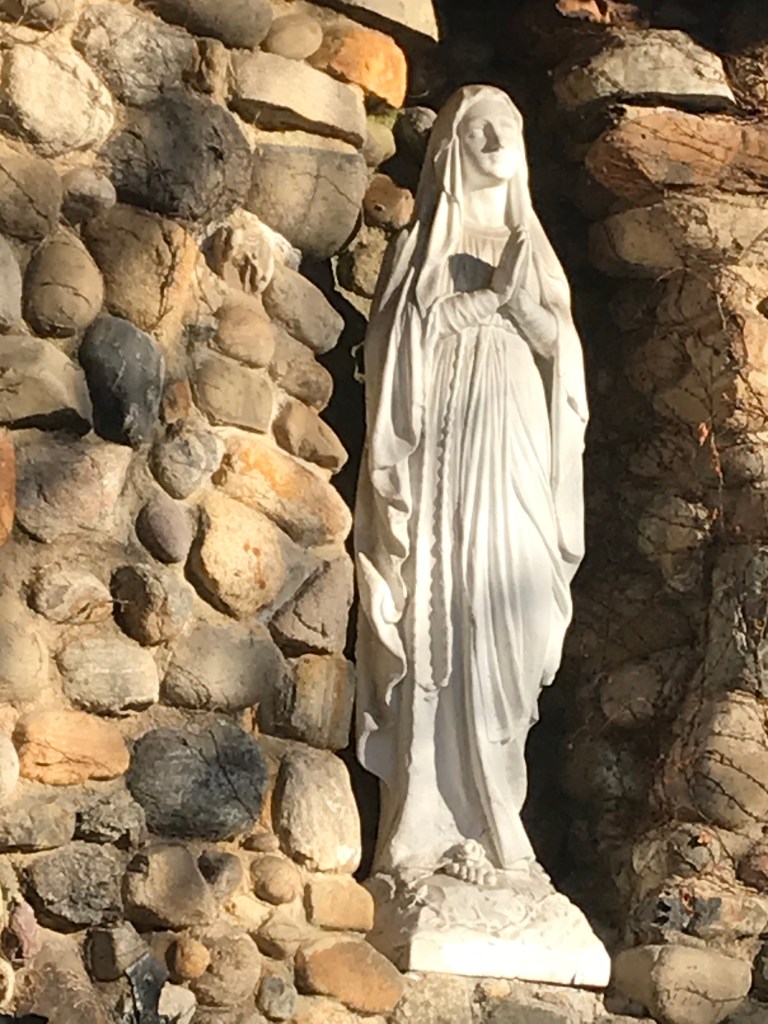
The statue of Our Lady of Lourdes made by Fabisch in 1864 and placed in the grotto at Lourdes in France is a model for the many statues of Our Lady of Lourdes in churches and shrines throughout the world. We have one in our Lourdes Grotto in Jamaica, NY. (below)

Various images of Our Lady of Fatima exist; we have one in our monastery chapel.(above) Her bright white garments witness to the glory the visionaries saw surrounding her. She brings the glory of heaven to brighten the earth, as Jesus did at his transfiguration. “And he was transfigured before them, and his clothes became dazzling white, such as no fuller on earth could bleach them.” (Mark 9:2-3)

Images of Our Lady of Guadalupe show her in the native dress of the time; she identifies with the native peoples then under colonial subjugation.

Contemporaries of Bernadette and the children of Fatima faced trials of another kind than the native peoples of Mexico. Secularizing governments promoted unbelief in society and wars were increasing in number and intensity. Mary’s appearances were not only the occasion of physical cures and healing. To ordinary people then and afterwards Mary’s appearances brought reassurance and renewed faith in the promise of God’s glorious power and presence. Their faith was real.

In his letter Laudato si’ Pope Francis calls upon Mary to visit us today as we struggle to care for the earth we have neglected. I like this image of Mary, holding her Son, which we have in our Mary Garden. Creation seems to raise its voice in praise. Her Son, Jesus Christ, offers us life-giving Wisdom. “We can ask her to enable us to look at this world with eyes of wisdom,” the pope says. May she hold in her hand our wounded world.

The Shepherd’s Voice

The Second Vatican Council said the liturgy is the most important place for teaching and catechesis in the church. The seasons of lent and easter are the most important times for teaching and catechesis. In the liturgy Jesus, the Bread of life, feeds us with his wisdom.

The easter season is a time for mystagogic catechesis, when we recognize the presence of the Risen Christ in the sacraments, in the church and in the signs of the times. The Second Vatican Council extended the celebration of the easter season.  In the past, the mystagogic catechesis took place for one week after Easter and was focused on the newly baptized. Now in the church’s liturgy mystagogic catechesis takes place, not for just one week, but for 50 days until the feast of Pentecost. It’s not just for the newly baptized, but for the whole Christian community. 

However well we may remember the questions and answers of our catechism or what we learned in theology courses, we’re lifelong learners.  We’ re also forgetful listeners.  We’re living in a changing world which we desperately need to understand, not just through the lens of politics, but  in the light of faith. For those reasons, we follow our liturgy year by year, season by season.

We have to continually study the mystery of the church. That’s true these day with the election of our new pope. The media coverage of this event  has been massive, whether its television,  YouTube, the New York Times. Six thousand journalists covered the pope’s election. It was a big story, but lens of politics, usually the dominant lens of the media, couldn’t  cover it all. 

It seems to me the readings in our liturgy these days offer a better coverage than anything the media might offer.

 Our gospel today speaks of sheep recognizing the voice of the shepherd. Doesn’t it seem these days that the world itself was listening for the voice of a shepherd? Our readings from the Acts of the Apostles these days describe a church breaking out from the confines of Jerusalem to speak to the world a message of life.  Doesn’t that seem to be a picture of our church these days?  In Acts, Peter appears so humble, a poor man yet ready to accept the task of bringing a wisdom, ancient and new, to a world so powerful yet so broken. Is that Pope Leo following in his footsteps?

We need to keep listening for the wisdom that is our daily bread in our liturgy The Good Shepherd still speaks.

Peter

Peter the Apostle, Cloisters, New York

Keep Peter in mind as we read the story of the conversion of Cornelius, the Roman centurion and his household. It was a decisive event for him and the other followers of Jesus. Peter was ministering to Jews in Joppa on the seacoast, when he’s called to Caesarea Maritime to baptize a Roman soldier. Joppa, remember, was the seaport where Jonah began his perilous journey to Nineveh and the gentile world.

In Joppa, the sleeping apostle on the roof of Simon the Tanner’s house overlooking the vast sea has a disturbing vision. Instead of the usual kosher food,  a gentile banquet is poured out before him. As a good Jew Peter pushes it away. Three times the vision invites him to eat.

Then, messengers appear at the door from Cornelius, a Roman soldier stationed in Caesaria Maritime, Rome’s headquarters just up the coast. Peter is to come and speak about “the things that had happened.” He’s invited to the gentile banquet he saw in his dream.

Peter made the journey up the coast and described their meeting: “As I began to speak, the Holy Spirit fell upon them as it had upon us at the beginning.” It was a Gentile Pentecost. Peter baptized the Roman soldier, his family and household. “I truly understand that God shows no partiality, but every nation is acceptable to him,” 

Would Peter know then where this visit to Cornelius would lead? He was a fisherman who spoke Aramaic with a Galilean accent, who felt the pull of home, family and fishing boats. I doubt he would ever be comfortable in a gentile world. After Caesaria he traveled to Antioch in Syria and then finally to Rome where he was killed in the Neronian persecution in the 60’s.

Artists usually portray Peter in Rome as a church leader firmly in charge of the church, holding its keys tightly in hand. Clearly, he is a rock and a strong leader.

I saw another image of Peter years ago in the Cloisters Museum in New York. He’s softer, reflective, more experienced, not completely sure of himself. There’s a consciousness of failure in his face. He seems to be listening humbly for the voice of the Shepherd, hoping to hear it and ever surprised by the unexpected coming of the Holy Spirit.

The early Roman church directed those newly baptized in St. John Lateran at Easter to visit the Church of St. Peter on Vatican Hill on Easter Monday. There they were to remember Peter, who came to Rome from afar to preach the gospel. He was a faithful follower of Jesus and a shepherd of flock. He would help them know Jesus and follow humbly lead the flock wherever Jesus told him to lead it.

Bless our new Pope Leo, Lord.