Monthly Archives: January 2023

January 30-February 5: Readings and Feasts

JANUARY 30 Mon Weekday Heb 11:32-40/Mk 5:1-20 

31 Tue Saint John Bosco, Priest Memorial Heb 12:1-4/Mk 5:21-43 

FEBRUARY 1 Wed Weekday Heb 12:4-7, 11-15/Mk 6:1-6 

2 Th Presentation of the Lord Feast Mal 3:1-4/Heb 2:14-18/Lk 2:22-40 or 2:22-32 

3 Fri Weekday  [St Blaise, Bishop Martyr; St Ansgar, Bishop] Heb 13:1-8/Mk 6:14-29 

4 Sat Weekday [BVM] Heb 13:15-17, 20-21/Mk 6:30-34 

5 SUN 5 SUNDAY IN ORDINARY TIME Is 58:7-10/1 Cor 2:1-5/Mt 5:13-16 

Our readings this week from chapters 5 and 6 of Mark’s gospel begin: “They came to the other side of the sea, to the territory of the Gerasenes.” That’s pagan territory. He begins chapter 6: ”He departed from there and came to his native place, accompanied by his disciples.”

Two important destinations for us, as well. Our native place, where we usually live,  and the world beyond. The readings this week show two worlds. The Letter to the Hebrews tells us to lift our eyes to heaven. Another world awaits us.

January 1 is the celebration of St. John Bosco, founder of the Salesians, one of the largest religious communities in the Catholic Church. 

February 2 is the Feast of the Presentation of Jesus in the Temple, one of the final events of Luke’s Infancy Narrative and a major feast of our calendar. The feast is also called Candlemass Day because candles are blessed this day. Jesus Christ brought light to Simeon and Anna who were waiting in the temple,  representatives of all who wait for the light of Christ.

February 3 is the Feast of St. Ansgar, apostle to Scandinavia. We celebrate apostles to various part of the world in our yearly calendar. Ansgar (801-856) experienced only small success in his efforts, but missionary efforts are not judged by complete success. Rather they succeed by planting the see.
Priests and a Priestly People

Are priests a class apart, separate from the rest of humanity? The Letter to the Hebrews, our weekday reading at Mass, offers an extended reflection on the priesthood of Jesus in the light of Jewish tradition of priesthood found in the temple of Jerusalem. The Letter to the Hebrews was probably written to the Roman church where many Jewish Christians were lamenting the fall of Jerusalem and its temple in the year 70. Can it throw light on the meaning of priesthood today?.

Jesus is our new high priest, but he did not separate himself from the rest of humanity. He became fully human to bring humanity to God in sacrifice and praise. Here’s how St.Fulgensius of Ruspe explains it:

“When we speak of Christ’s priesthood, what else do we mean than the incarnation? Through this mystery, the Son of God, though himself ever remaining God, became a priest. To him along with the Father, we offer our sacrifice. Yet, through him the sacrifice we now offer is holy, living and pleasing to God. Indeed, if Christ had not sacrificed himself for us, we could not offer any sacrifice. For it is in him that our human nature becomes a redemptive offering.

When we offer our prayers through him, our priest, we confess that Christ truly possesses the flesh of our race. Clearly the Apostle refers to this when he says: Every high priest is taken from among us. He is appointed to act on our behalf in our relationship to God; he is to offer gifts and sacrifices to God.”

A priest embraces the mystery of the Incarnation, the saint says. Like Jesus, priests are called to embrace humanity in its weakness. Following him, they must embrace their own times and place, without isolating themselves from the world they live in.  Otherwise, how can they bring it to God?

All who are baptized also share in the priesthood of Christ. Every Sunday, we gather as a priestly people. The priestly call belongs to us all. “Let us give thanks to the Lord, our God,” we say at Mass. We’re a priestly people.

3RD Week in Ordinary Time: Readings and Feasts

JANUARY 23 Mon USA: Day of Prayer for the Legal Protection of Unborn Children

[USA: Saint Vincent, Deacon and Martyr; USA: Saint Marianne Cope, Virgin]

5 Heb 9:15, 24-28/Mk 3:22-30 

24 Tue St Francis de Sales, Bishop Doctor Heb 10:1-10/Mk 3:31-35 

25 Wed Conversion of St Paul Apostle Feast Acts 22:3-16 or Acts 9:1-22/Mk 16:15-18 

26 Thu Sts Timothy and Titus, Bishops Memorial 2 Tm 1:1-8 or Tit 1:1-5 /Mk 4:21-25 

27 Fri Weekday [Saint Angela Merici, Virgin] Heb 10:32-39/Mk 4:26-34 

28 Sat St Thomas Aquinas, Priest Doctor Memorial Heb 11:1-2, 8-19/Mk 4:35-41 

29 SUN 4TH SUNDAY IN ORDINARY TIME Zep 2:3; 3:12-13/1 Cor 1:26-31/Mt 5:1-12A

The Conversion of St. Paul (January 25) and his two disciples, Timothy and Titus (January 26). What would our church be without them? During the Octave for Church Unity we pray that God give a converting grace to all the Christian churches that they become the one church Jesus prayed for.

St. Francis de Sales ( Jan 24) was a great communicator when a fractured Europe needed communication. He the patron of publishers; would he be interested in the internet today? St. Thomas Aquinas (Jan 27) is one of the great teachers of the Church.

Two women saints this week are reminders of what women have done in the church. St. Angela Merici (Jan 27)began a community to teach children. Big need today. St Maryanne Cope (Jan 23) was a American nun who, after founding two hospitals in upstate New York, served lepers in Hawaii.

January 23 is also a day of prayer in the United States for the legal protection of unborn children. A major issue in society today.

Sustainable Goals: 2022

Faith breaks boundaries, our previous blog announced. Lest we leave that in a synagogue in Capernaum, let’s think about how that applies to the world we live in this year 2023. What are the boundaries our world faces today? For some the sustainable goals set by the United Nations in 2015 may seem unreachable. Can followers of Jesus say they are?

Readings and Feasts: January 16-22

JANUARY 16 Mon Weekday Heb 5:1-10/Mk 2:18-22 

17 Tue Saint Anthony, Abbot Memorial Heb 6:10-20/Mk 2:23-28 

18 Wed Weekday Heb 7:1-3, 15-17/Mk 3:1-6 

19 Thu Weekday Heb 7:25—8:6/Mk 3:7-12 

20 Fri Weekday [St Fabian, Pope Martyr; St Sebastian, Martyr] Heb 8:6-13/Mk 3:13-19 

21 Sat St Agnes, Virgin and Martyr Memorial Heb 9:2-3, 11-14/Mk 3:20-21 

22 SUN 3RD SUNDAY ORDINARY TIME Is 8:23—9:3/1 Cor 1:10-13, 17/Mt 4:12-23 

In the Gospel of Mark this week Jesus confronts opposition, and we also remember a young girl, Agnes, and a soldier, Sebastian, who made him known to early Christians by following him into the mystery of his death and resurrection. They tell us to witness to him in our time.

Mark’s Gospel this week says the scribes, Pharisees and Herodians saw Jesus as a danger to their society and brought him to his death. Roman judges and leaders saw Agnes challenging the norms of their world, and Sebastian betraying their military code. They must die. Their stories correspond well with Mark’s account of Jesus’ ministry in Galilee and his eventual death and resurrection in Jerusalem.They were treated unjustly.

The two Roman martyrs must also have faced rejection by their own families and friends, as Jesus faced rejection in Nazareth. Jesus is not the only one who bears the mystery of the Cross; his followers bear it too. In fact, it’s part of everyone’s life.

Yet Mark’s Gospel sees Jesus going forward, still drawing crowds, still casting out demons, forging ahead to new ground in spite of opposition. The mystery of the Cross leads to Resurrection and the coming of God’s kingdom. It does not end in death.

Nor do the stories of martyrs end in death; they share in the resurrection of Jesus Christ.“ If you can have some share in the sufferings of Christ, be glad, because you will enjoy a much greater gladness when his glory is revealed.” (1 Peter 4:13-14) The martyrs follow the Suffering Christ–as one sees already in the story of first martyr, Stephen, so carefully crafted to show Stephen following Jesus.

Waiting for an executioner’s sword in the arena, Agnes also sees the heavens open and with arms outstretched says: “ I pray to you, holy Father; behold, I am coming to you, whom I have loved, whom I have sought, whom I have always desired.”

Read the scriptures. Also remember the saints, young girls and soldiers, men and women from every time and place, who heard the same Word we do and believed in that Word. They say : “Follow him.”

Keeping Heroes in Mind

We’re reading the Letter to the Hebrews at length these days in our liturgy at Mass. Why was this written? When and to whom was it written? Interpreters of the Letter to the Hebrews ask these questions to understand this writing better.

Obviously Hebrews is written to Jewish-Christians, some think in Rome which had a substantial Jewish-Christian population in the 1st century. It was written after a time of persecution, perhaps when the Emperor Claudius banished Jewish Christians from the city in 49 AD because they were causing riots in Rome’s synagogues in disputes over Jesus Christ. Or maybe a later persecution.

Did that  cause the followers of Jesus there to tamper down their efforts and embrace their faith less fully? Perhaps. The writer of Hebrews warns his hearers against “drawing back” and “losing confidence” in the faith they profess. Were they losing their enthusiasm? That sounds like something that happens to us too.

Keep before you the heroes of faith, beginning with Jesus, the author of Hebrews says as he draws up for them a lengthy list of inspiring believers.

“For, after just a brief moment, he who is to come shall come; he shall not delay. But my just one shall live by faith, and if he draws back I take no pleasure in him.”

 To that list of Old Testament heroes we can add the saints of the New Testament and saints of our times. They can inspire us too.

Jesus in Caphernaum

img_0065

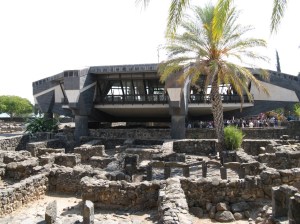
  Near the shore of the Sea of Galilee, in Israel, one can visit the excavations of the ancient town of Capernaum. There the Franciscans have built a lovely hexagonal church over the restored ruins of a circular stone house, with the opening for its front door clearly visible. We pilgrims believe in our hearts of faith that this is the house mentioned in today’s Gospel.

      ” On leaving the synagogue Jesus entered the house of Simon and Andrew with James and John. Simon’s mother-in-law lay sick with a fever. They immediately told Him about her. He approached, grasped her hand, and helped her up. Then the fever left and she waited on them.

     ” When it was evening, after sunset, they brought to Him all who were ill or possessed by demons. The whole town was gathered at the door.” (Mk 1; 29-33).

     We believe that right at that door Jesus healed dozens, if not hundreds, of people (including the paralytic, who was lowered with ropes through the ceiling). He might also have preached the Good News of the Kingdom in front of that humble threshold.

     I cannot help but imagine my Lord residing in my own private room within my heart. I know that there, through the Eucharist or prayer, planned or unexpectedly, He continuously “grasps my hand and helps me up”. He stands at the door of my heart and encourages me to serve, to invite all those around me, in my family and community, who might need some of the hope and healing that He compels me to share. This is what I live for.

     And He asks for more: ” Let us go on to the nearby villages that I may preach there also. For this purpose have I come.” (Mk 1; 38). With His holy companionship I am asked to reach out to those beyond the locust of my comfort zone: to the stranger, the different, the unpleasant one,the hopeless one, the one whose political ideas or interests are so different from mine.

     May He give me the strength and faith, and courage, to try and “grasp” the hand that might reject mine. He has given me so much undeserved grace and love. He has given me the eyes to “see Him”. For what “purpose” has He come to me, if not so that I may be an instrument of His peace and love?   

                                      Orlando Hernandez