
Monthly Archives: February 2019

Facing “Unclean Spirits”

Edvard Munch: The Scream


When Jesus and his disciples cross the sea into pagan territory– an important new step in his ministry– they meet a man in the tombs and Jesus drives the unclean spirit out of him. (Today’s reading: Mark 5, 1-20) 

Throughout  his ministry “whenever unclean sprits saw him they would fall down before him and shout, ‘You are the Son of God.’ (Mark 3,11) Unclean spirits were favorite targets for Jesus in his ministry.

What’s an “unclean spirit”?

In their fine commentary on Mark’s gospel John R. Donahue, SJ, and Daniel Harrington, SJ, say “In this context ‘unclean’ (akatharton) primarily connotes not a moral (even less a sexual) fault), but something opposed to the “holy.” In the command of the Old Testament to be holy (Leviticus 11,44) it implies life, wholeness and completeness,( Leviticus 21, 17-21) whereas uncleanness implies something that should not be, something out of place ( e.g. soil in a farmer’s field is productive, while in a house it’s dirt). The opposite of the realm of the holy is the demonic, hence the spirits there are “unclean”. Physical defects or psychological aberrations can make a person “unclean”in a sense of incomplete, imperfect and out of order.”
(The Gospel of Mark, Sacra Pagina, Liturgical Press 2002 page 80.)

Jesus did not focus on the intellectual establishment or the religious establishment in his ministry. He engaged the chaotic world of the “unclean spirits.” He set up a “field hospital” to use a phrase dear to Pope Francis.

That can be a messy, scary world, as we see in Mark’s gospel. Just think of the poor man in the tombs, chained and hurting himself. Who wants to deal with him? But Jesus gives his disciples “authority” over unclean spirits. His followers have the power to take them on.

Jesus commissioned  his apostles for this ministry. He summons “the twelve and began to send them out two by two and gave them authority over unclean spirits.” (Mark 6, 7) We’re not out of place in our chaotic world today.
4th Sunday c: Nazareth

For this week’s homily, please play the video below.

Presentation in the Temple, February 2nd


DSC00129

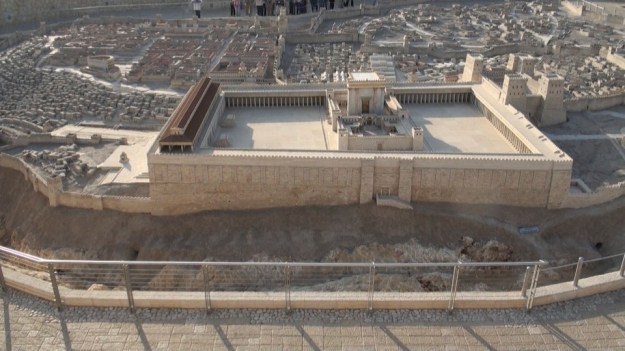
Temple of Jerusalem, 1st century, Israel Museum

The Presentation of Jesus in the temple, forty days after his birth, is a Christmas feast, even though our Christmas decorations are put away. It’s part of Luke’s Infancy Narrative.

The temple of Jerusalem– a reproduction is pictured above– plays a big part in Luke’s Infancy Narrative,  even more important than the stable to which the shepherds came.  The angel announced John’s birth to Zachary in the temple, and there Jesus is presented after his birth. Later, he will come to the temple as a young boy and  impresses its teachers, as he listens to them and asks them questions.

Luke doesn’t dwell on the rituals or appearance of the temple– he may not know much about them–but the temple for him is where God is present, and so it’s the place where Jesus would be recognized. Forty days after his birth, two elderly Jews, Simeon and Anna, recognize him. They’re  faithful believers who  represent the generations waiting for the Messiah.

Old Simeon takes the child in his arms:

“Now, Master, you may let your servant go
in peace, according to your word,
for my eyes have seen your salvation,
which you prepared in the sight of all the peoples:
a light for revelation to the Gentiles,
and glory for your people Israel.”  (Luke  2,22-40)

Afterwards in his gospel Luke describes the rejection of Jesus by his neighbors in the synagogue at Nazareth– neighbors who saw him so frequently but don’t recognize him. Here in the temple two faithful Jews, Simeon and Anna, waiting for years, receive him. The long wai in the temple has not dulled their eyes. In fact, it has made them sharper. They see salvation in this little child, ” a light of revelation to the gentiles, and the glory of  your people Israel.”

Presentation

So true, isn’t it, waiting can dull our eyes? Year by year can diminish what we expect and hope for. Day after day, faith can get tired. Prayers can become rote, sacraments can become routine. A holy place can become just another place.

It wasn’t so for these two elderly Jews. Their steady presence in the temple made them sharper, quicker to recognize the light that came to that place. We bless candles today, to burn in our church this year, and we pray that our church may never be dark but a place where we see the light of Christ and recognize his will for us and for our world.

“Outwardly Jesus was fulfilling the law, but in reality he was coming to meet his believing people. Prompted by the Holy Spirit Simeon and Anna came to the temple. Enlightened by the same Spirit, they recognized the Lord, so let us also gathered by the Holy Spirit, enter the house of the Lord and encounter Christ and recognize him in the breaking of the bread until he comes again, revealed in glory.”  (Feast of the Presentation)


Faith like a Mustard Seed.

We would like a stronger faith, like the apostles, “Increase our faith,” they ask Jesus, faith that understands everything immediately and sees everything clearly–right away! We can hear ourselves asking for faith like that.

In response, Jesus offers a mustard seed. Look at this tiny seed, he says. With faith like this, you can accomplish the most impossible things. What does he mean?

A mustard seed is so small that you hardly can see it in the palm of your hand, Yet once in the ground it grows into a full sized tree, through cold and heat, nights and days, all kinds of weather. But it takes time.

Faith is like that. It grows, but its growth takes place over time, day by day, through the common experiences that come our way. God dwells in the ground of daily life and it’s there we meet him most of all. That’s why the psalm insists: “If today you hear his voice, harden not your hearts.”

Today in countless little things, in unassuming moments, God speaks to us. God acts. And even as the moments slip by, God’s plan unfolds. We need a daily faith, a patient faith, a faith like the mustard seed, to wait until it reaches its completion.

“The vision still has its time, presses on to fulfillment, and will not disappoint. If it delays, wait for it, it will surely come, it will not be late.”
A daily faith that watches God’s plan unfold in the course of things.