Tag Archives: Wilkes Barre

Traditions about St. Ann

In my part of the world, novenas to Saint Ann have begun in churches and dioceses, like Scranton, PA. Where did the story of Saint Ann come from? From earliest times Christians wondered who the parents of Mary were and, as you would expect, that interest was particularly strong in Palestine. Ann and Joachim were first honored there as the mother and father of Mary, the mother of Jesus Christ.

Around the year 550, a church in her honor was built in Jerusalem on the site where her home was said to be, near the Pool of Bethesda, where Jesus cured the paralyzed man. Since then, many churches honoring Ann and Joachim have been built throughout the Christian world; The saints appear frequently in Christian art.

Feasts of St. Ann

Feasts honoring Mary’s birth (September 8) and her presentation in the temple (November 21) – inspired by the Protoevangelium– were introduced into the liturgies of the Eastern churches in the 6th century. Feasts in honor of St.Joachim and Ann (September 9), the conception of St Ann (December 9), and St.Ann alone (July 26) have been celebrated from the 7th century in the Greek and Russian churches.

The western church, adopting the eastern traditions, has celebrated the feast of St. Ann on July 26 since the 16th century. In 1969 her feast was joined with her husband Joachim to become the Feast of Saints Joachim and Ann.

Why was the story of Ann and Joachim so popular?  Besides satisfying curiosity about the family background of Mary and Jesus, they supported traditional belief that Jesus is the Son of God, born of the Virgin Mary, a belief questioned by heretical elements in the church as well as outsiders of the faith from the beginning.

Ann and Joachim also offered inspiration to mothers and fathers, wives and husbands, grandmothers and grandfathers in their roles in family life.

Devotion to St. Ann in Europe

In the western church, devotion to St.Ann was fed by a popular belief that relics of her were brought to France by Mary Magdalen, Lazarus, Martha, and other friends of Jesus who crossed the stormy sea from Palestine to bring the Christian faith to the region around Marseilles.

Her relics were buried in a cave under the church of St.Mary in the city of Apt by its bishop, St. Auspice, the story goes. Barbarians invaded the area and the cave was filled with debris and almost forgotten, only to be unearthed 600 years later during the reign of Charlemagne. You can see why sailors and miners would be devoted to St. Ann.

Crusaders from Europe – many from France – went to the Holy Land in the 11th century, and they rebuilt the ancient church of St. Ann in Jerusalem. The date the crusader church was consecrated, July 26, is the day we celebrate the feast of Joachim and Ann in the western church today.

By the 14th century, devotion to St. Ann was on the rise throughout Europe as the Black Death struck the continent and raged everywhere for over 150 years, wiping out almost 30 percent of its population. Families bore the brunt of the catastrophe as they tended their sick and cared for the healthy.

They needed models like Mary and Joseph, Ann and Joachim, who supported their child and grandchild. Mothers and grandmothers were particularly important for raising children.

When the plague ended, Europe’s population expanded dramatically in the late 15th and 16th centuries; new towns and cities sprang up everywhere and families were uprooted from places and people familiar to them. Families needed help to stay together and survive.

Faith suggested Mary and Joseph, Ann and Joachim as models to be imitated.  Images of the nursing Madonna and the caring grandparents became important sources of Christian inspiration.

Christians joined Confraternities of St. Ann, dedicated to caring for widows, orphans and families under stress. Images of Mary and Ann, nursing their children, playing with the Christ Child and/or John the Baptist were more than pious pictures; they had a social purpose as well.

One picture from this era, still popular today, portrays St. Ann teaching her little daughter how to read.  Sometimes the words on the book are words of scripture; sometimes they’re basic numbers or letters of the alphabet: 1,2,3,4-A,B,C.
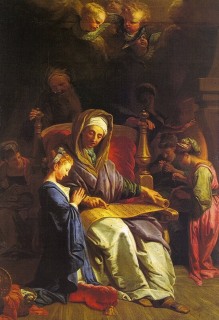
Playing with children, teaching them the ABC’s, passing on the mysteries of God to them are vital actions. Simple as they may seem, they’re holy actions and they can make those who do them saints.

MATTHEW 12:47-50: Family Values

Our readings from St. Matthew this week deal with the growing opposition to Jesus as he preaches and performs miracles in Galilee. IT foreshadows his final rejection in Jerusalem. Concluding this section, Matthew adds another source of opposition to Jesus that may surprise us. His own family from Nazareth seems to oppose him.

“While he was still speaking to the crowds, his mother and his brothers appeared outside, wishing to speak with him. [Someone told him, “Your mother and your brothers are standing outside, asking to speak with you.”]*But he said in reply to the one who told him, “Who is my mother? Who are my brothers?” And stretching out his hand toward his disciples, he said, “Here are my mother and my brothers. For whoever does the will of my heavenly Father is my brother, and sister, and mother.” (Matthew 12,47-50)

A little about family life at the time of Jesus may help us appreciate this gospel. For one thing, in Jesus’ day nuclear families– a mother, father and children living alone– were not the norm. In Jesus day families were extended families or clans, living and working together.

And so, the picture we sometimes have of the Holy Family– Mary, Joseph and the Child Jesus all by themselves in a small house in Nazareth– is not a realistic picture. Families in Nazareth, as we know from excavations in towns like Capernaum, lived in compounds, as they often do today in the Middle East, working together in the fields or in a business and offering each other support.

There were obligations to your extended family or clan. Everyone had to help in the harvest; you were expected to promote your family’s interest. The mother of James and John approaching Jesus looking for a good place for her sons in his kingdom was only doing what she was expected to do.

What we see in this gospel is the extended family of Jesus descending on him as he speaks to the crowds to remind him of his family obligations. What did they want to remind him of, we wonder? Were they off to a wedding or a funeral of a relative and were telling him to come along? Or, was the wheat harvest ready at Nazareth and they came looking for help? Or, they just wanted him for themselves for awhile? From Mark’s gospel we know some thought he was out of his mind.

Whatever it was, Jesus said that his family was those before him h meant to be with them.  “ I belong here now,” Jesus seems to be saying to them. The kingdom of God, God’s family, God’s purpose, is greater than his family’s interests.

Today, of course, individualism is our predominant value, and it often stands in the way of family interests. It’s what “I” want that counts. But even today, family interests, family pressure can be strong and can get in the way of what God wants. Sometimes those closest to us, our own family, can be hard to manage, even though they want the best for us.

Jesus experienced that too.

Novena to St. Ann

Throughout the Catholic world novenas honoring St. Ann begin July 17.

You won’t find the names of Ann and Joachim in the bible, but they’re mentioned in one of the apocryphal books, the Protoevangelium of James, written shortly after our New Testament writings.

Interest in Jesus’ family came about because of claims that he was “Son of David,” the Messiah  expected to come from David’s line. Against those who said Jesus was only a carpenter from Nazareth, the infancy narratives in Matthew and Luke assert that  Jesus is the Messiah, descended from David.

The Protoevangelium of James also sees Joachim and Ann  in David’s line, and therefore Mary was too. It says they lived in Jerusalem. Did they accompany Mary to Nazareth after her marriage to Joseph? If so,  Jesus had grandparents taking care of him for a time.

If that’s true, it means Ann and Joachim gave Jesus something more besides proof of his bloodline.  Along with Mary and Joseph, they brought him up. As a young child he learned from them, the simplest and the most sublime things. Knowledge came to him, as it comes to us–through the senses, through mothers and fathers, grandmothers and grandfathers.

St. Ann is often pictured with her daughter Mary holding a small book in her hands. Written on the book in the statue here in this church are the words, “If today you hear God’s voice, harden not your heart,” a verse from the psalms.

Other statues of her have different words in the book. “I,2,3,4; A,B,C,D.” The basics of life. Or notice Giotto’s picture of the presentation of Mary in the temple. (above) Ann pushes her little daughter into the temple. Just like pushing kids to church today?

Parents and grandparents play a powerful role in the lives of their children and grandchildren. They teach kids their abc’s and the  sublime mysteries of faith. Maybe that’s why so many of them make this novena.  They know that’s true.

The Spirit of the Child

For most of our novena the gospel readings at Mass are from the 11th and 12th chapters of Matthew’s gospel, which deal with the growing opposition to Jesus as he preaches and performs miracles in Galilee. It’s a rather dark section of the gospel.

Jesus is opposed by the Pharisees, who now take “counsel against him to put him to death” (Matthew 12.14) and by “this generation” of Israelites, the towns “where most of his mighty deeds had been done.”  (Matthew 11,16-19). He meets little success.

Concluding this section, Matthew adds another source of opposition to Jesus that may surprise us. His own family from Nazareth seems to oppose him.

Yet, in this bleak section of the gospel, when so many turn against him, Jesus praises his Father, Lord of heaven and earth, “for although you have hidden these things from the wise and the learned you have revealed them to the childlike.”  (Matthew 11,25)

He praised those who have the spirit of the child and keep it. Certainly, St. Ann taught her daughter Mary that spirituality. On this day of the novena, we will  reflect on it.

St. Leo the Great, an early pope, said that becoming like a child– remember Jesus told his disciples to become like little children– does not mean going back to infancy physically. It means, like children, to be free from crippling anxieties, to be forgetful of injuries, to be sociable, and to wonder before this world.