Tag Archives: the Our Father

The Lord’s Prayer, Norm for Every Prayer

The Lord’s Prayer is the norm for every prayer. That’s true, especially, for the Eucharistic Prayer  in which we thank God, our Father, for blessing us “always and everywhere.”  The Eucharistic Prayer is the Lord’s Prayer in another form.

As we do in the Lord’s Prayer, we call God “Our Father” at Mass and thank him for the blessings we receive as his children.

God’s blessings are symbolized in bread and wine. At Mass bread has the same manifold meaning  it has in the Lord’s Prayer.  “Give us this day our daily bread.” Daily Bread stands for the whole of creation, the bread of everything,  It also stands for “the True Bread come down from heaven,” Jesus Christ. 

Bread and wine are signs of God’s past and present blessings. They also promise of a new creation and new life to come.

In bread and wine, we bring to the Father everything that’s  given to us. At Mass, Jesus Christ, our priest, takes them in his hands as he did at the Last Supper and gives them new meaning. Giving thanks to his Father he gives himself to us as God’s supreme Gift.  “Take, eat and drink, this is my body; this is my blood.”

He gives us all the gifts of creation as well as the promise of a new creation surpassing this one.  “God’s kingdom is coming,” he said and he himself is the way to it.

“Your will be done.” Jesus fulfilled God’s will when he came as God’s love “poured out” for the forgiveness of sins. In his death and resurrection we’re promised a way to a kingdom to come.

The Lord’s Prayer is at the heart of the Eucharistic Prayer. With Jesus we pray to Our Father in heaven, whose gifts are without measure. With Jesus we ask to do his will and work that his kingdom come. We receive Jesus Christ as our daily bread, our food and drink, our teacher and Lord. He is the shepherd who leads us through the temptations of this life.

After the Eucharistic Prayer said by the priest, we pray the Lord’s Prayer together, to prepare for receiving the Bread of Life.



Songs of the Saints

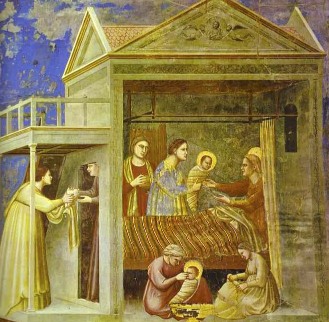
Ann, Mary, the Child Jesus, Massacio

Someone told me about a recent program on NPR on which a scientist said our hearing is wired to hear the song of birds. Our earliest ancestors learned to listen to the song of birds, I suppose because birds could tell them there was water and food nearby–or perhaps their silence warned of enemies.

I wrote about this awhile ago on this blog.

It may be a good analogy for discussing saints.  Saints are like the song of birds telling us there’s another kind of water and food nearby; they point to the presence of God. And we have different saints, just as we have different kinds of birdsong.

What kind of saint is St. Ann? Like all saints she faced challenges in her life. Her greatest challenge was that she and her husband Joachim were not able to have a child for a long time. This was at the time when children were looked upon as treasures and those who did not have children were sometimes seen as cursed by God. Besides, as descendants of David they had a duty to continue his line.

Ann and her husband had a long, hard wait before she conceived Mary, who became the Mother of Jesus. Once, she’s described as bursting into tears as she looked up and saw some sparrows building a nest in a laurel tree. “Why was I born, Lord?” she said, “The birds build nests for their young and I have no child of my own. The creatures of the earth, the fish of the sea are fruitful, but I have nothing. The land produces fruit, but I have no child to hold in my arms.” (Protoevangelium)

You can see why some pray to St. Ann for help in marriage or to have children. Perhaps grandparents today as they’re called to help out with younger grandchildren can see in her an older person who did that too.

Saints have different lessons to teach, but all saints have this in common: they have a deep faith in God’s will and they’re constant in prayer. They’re faithful in prayer, in good times and in bad. Prayer is their daily song to God. It may be a sorrowful song like Ann’s in the example above. Or it may be joyful. But prayer gives them wisdom and strength and peace, from moment to moment, from day to day.

One of the great early saints from the Egyptian desert, St. Anthony, was asked once what’s the hardest thing you have to do in life? “ The hardest thing you have to do in life is pray,” he said, “Everything else you can stop doing, but you can’t stop praying.”

I’m afraid today daily prayer isn’t high on our priorities. I think it’s going the way of Sunday Mass, becoming “occasional prayer.” We only think about prayer when a tragedy like yesterday’s shootings in Colorado happens.

Daily prayer gets us ready for what God gives us to do each day.  Jesus taught his disciples the Our Father; that’s a daily prayer. It tells us who we are each day: we’re children of God and should act like God’s children. We need to remember God’s kingdom is coming and we’re to work for it day by day. We need daily bread of all kinds. We’re part of a messy, noisy world that’s torn apart by selfishness and smallness and pride. We’re bring our share of sin into the world, so we ask for forgiveness each day and forgive others day by day.

“Deliver us from evil” today. Deliver all of us from evil, today.

Learning to Pray

Last night at the mission I spoke about learning to pray. First of all, we have a gift for prayer. It’s a unique gift, like the face we wear. You can find some of the material I covered at http://www.cptryon.org/prayer/index.html

It’s a good summary of this important part of our lives. Take a look at it, if you have time. There’s a lot there.

Last night, I also spoke about Matthew’s gospel, which presents us with Jesus the Teacher. We’re neglecting the teaching role of Jesus today, I think, as we look on religion as outmoded, outdated, having nothing to say to us. Then too, the church has had its scandals, and they turn people away.

Matthew presented Jesus as a Teacher to counter the pharisees who, at the time he wrote (about 90 AD) were increasingly assuming the leadership of Judaism and claiming teaching aurthority. Matthew says to the church of his time, and to ours too, Jesus is the wise teacher who will always lead us to the mountain as his disciples and sit down with us and teach us.

I spoke of some of Jesus’ teachings in his Sermon on the Mount, especially his words against anger and forgiveness. As our times get worse, we get mad. Anger can be a good response, but it also can kill.

In the same way, we can become unforgiving. We need to have respect. Looking again is God’s way. We have to look again.