Tag Archives: the Kingdom of God

Reading Mark’s Gospel

Mark

Mark 1, 7-11-  Mark 8, 14-21

After the Feast of the Baptism of Jesus we read at Mass from the first 8 chapters of the Gospel of Mark until Ash Wednesday.

Mark’s Gospel makes no mention of Jesus’ birth in Bethlehem but begins with his baptism in the Jordan River. Then he describes his miracles and teaching in the towns around the Sea of Galilee– the Jewish towns first, then in the gentile region. Then Jesus goes up to Jerusalem and his death and resurrection.

Until recently, Mark’s Gospel received little attention compared to the gospels of Matthew, John or Luke. It was hardly read in the liturgy. Earlier commentators thought Mark was simply a synopsis of Matthew’s Gospel. Commentators today, however, recognize Mark’s Gospel as the first to be written and appreciate the powerful way it tells the story of Jesus. It’s not just a simple portrayal of historical facts or a synopsis of Matthew. It’s rich in symbolism of its own.

Mark’s Gospel, for example, begins in the waters of the Jordan River, where Jesus is called God’s beloved Son on whom the Spirit rests. Water is a recurring image in Mark’s portrayal of Jesus’ ministry.

John Donahue SJ, a recent commentator on the Gospel of Mark (Liturgical Press, 2002) , points out the symbolic nature of the various events in Jesus’ ministry, beginning with his baptism in the Jordan River and then his ministry around the Sea of Galilee. As the Spirit rested on the waters of the Jordan, so does the Spirit stir the waters in Galilee, drawing more and more to Jesus, God’s Son. Crossing from the western to its eastern side of the Sea – from a side largely Jewish to a side largely gentile – Jesus and his disciples bring the gospel to gentiles as well as Jews. 

The storms Jesus and his disciples face on waters of the Sea of Galilee are more than historic storms; they symbolize the fearful challenge and rejection to be faced in bringing the gospel to others. (Mark 6:45-52)

“As he passed by the Sea of Galilee,” Jesus calls some fishermen, Simon, his brother Andrew, James and his brother John. He makes them “ fishers of men.” (Mark 1, 16-19) Along the sea, Jesus teaches the crowds in parables.

The journeys of Jesus and his disciples to Tyre and Sidon, seaports on the Mediterranean Sea, are also more than historical markers. The Syrophoenician woman and the deaf man, both gentiles healed there, are signs that the gospel must be brought over the seas to the gentiles at ends of the earth. ( Mark 7:24-37) 

Jesus multiplies bread on both sides of the Sea of Galilee in Mark’s Gospel. The gentiles are to be fed and blessed as well as Jews. (Mark 6:31-44; Mark 8:1-10)

The Spirit moves in the waters of the Jordan, the Sea of Galilee and the waters beyond yet, as Mark’s Gospel indicates repeatedly, the Jewish leaders, the pharisees, scribes, Herodians, members of his own family, his disciples, do not understand. Neither do we.

Still, the Spirit works through the waters, softening, cleansing, strengthening, giving new life.

I suspect Mark’s gospel had an important affect on the early community of Roman Christians as they survived the Neronian persecution in the 60s, when Peter and Paul were killed. A common opinion is that Mark, a disciple of Peter, wrote this gospel in Rome in part to support the Roman community after their experience. He reminded them of Peter’s words and example.

Our readings from Mark end on Ash Wednesday.
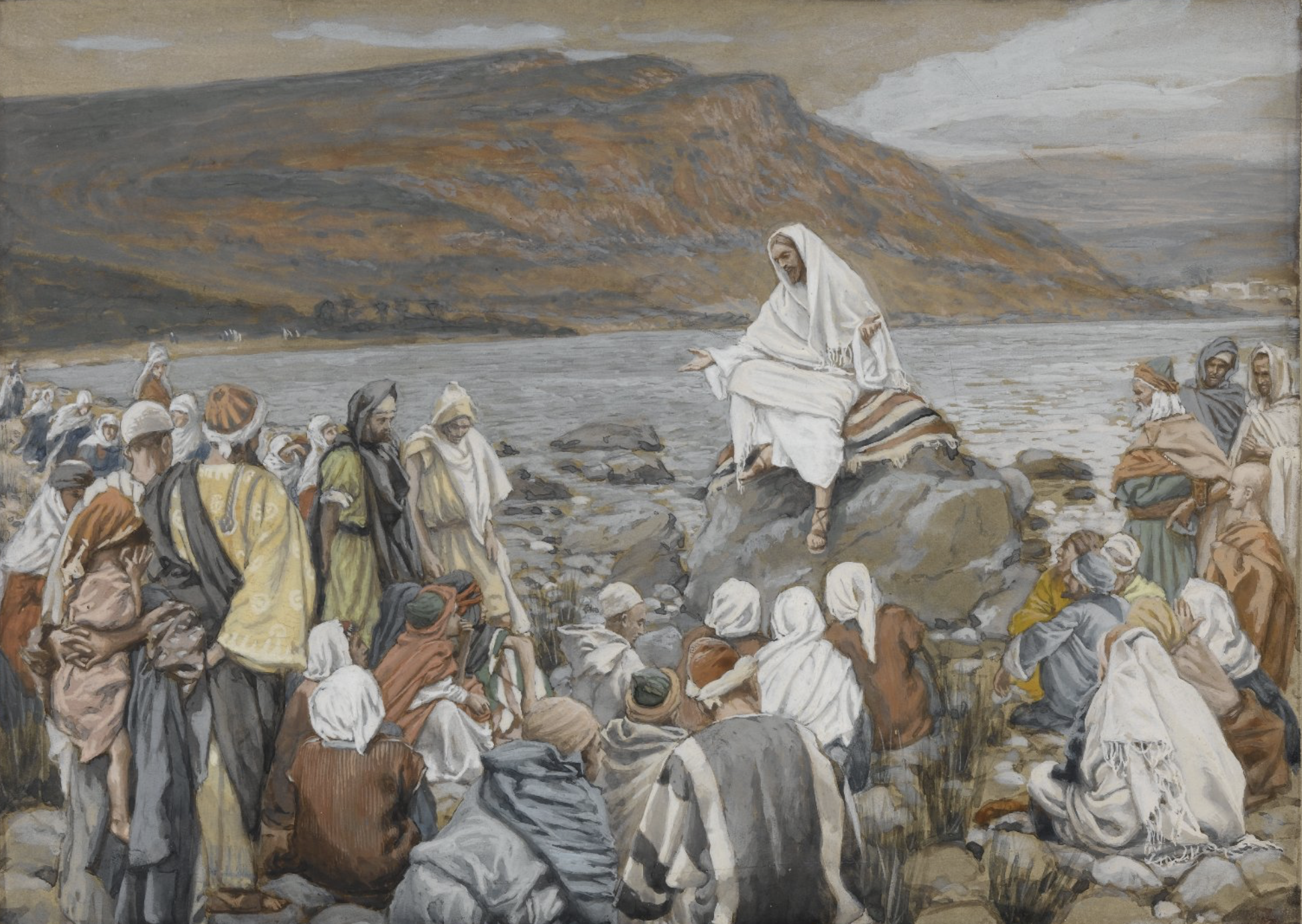
Seed on Tough Ground: Matthew 13:1-9

Teaching by the Sea. James Tissot

“A sower went out to sow. some seed fell on the path, and birds came and ate it up. Some fell on rocky ground, where it had little soil. It sprang up at once because the soil was not deep, and when the sun rose it was scorched, and it withered for lack of roots.Some seed fell among thorns, and the thorns grew up and choked it.” ( Matthew 13:1-9)

Jesus tells the crowd at the lakeside the parable of the sower after the Pharisees, the towns where he taught and worked wonders and his own family from Nazareth oppose him. (Matthew 11-12) Previously, Jesus sent his own disciples out to proclaim his life-giving message but he tells them:   “Do not go into pagan territory or enter a Samaritan town. Go rather to the lost sheep of the house of Israel. As you go, make this proclamation: ‘The Kingdom of heaven is at hand.’” (Matthew 10:

When they proclaimed his message to the lost sheep of Israel the seed fell on tough ground. They found the same opposition that Jesus did, more than they expected. .

Our reading today is an example of how an evangelist like Matthew used what Jesus experienced as an example for the church of his time. Matthew’s gospel was written around 90 AD with an eye on the religious conditions then in Galilee. The area had changed since the time of Jesus. After the Romans destroyed Jerusalem in 70 AD, many Jews influenced by the Pharisees moved into Galilee seeking to rebuild Judaism. They strongly opposed the followers of Jesus of Nazareth.

Matthew’s gospel reflects the increasing tension between Christians and Jews in his day. The parable Jesus originally taught throws light on this new situation. The ground is hard, rocky, with little soil. Still, the seed must be sown, however it’s received. Don’t give up on the tough ground, don’t judge it hopeless, Matthew’s gospel insists: Some seed falls on good ground.

A lesson for us today? Seems so. The soil was unwelcoming then, Matthew’s gospel says. Our soil seems unwelcoming now… Still!

An Abundant Harvest

Samaritan woman

As Jesus announces the coming of the kingdom of God, he often speaks of it as a harvest. It’s an “abundant” harvest, he says today in Matthew’s gospel– bigger than you think. That’s because it’s  God’s harvest. You need plenty of laborers to bring it in.

In one of his harvest parables, Jesus describes the owner of a vineyard calling workers into his vineyard. He’s obviously underestimated the size of the harvest. The first crew he sends  at 9 in the morning aren’t enough, so he calls more workers at noon, then 3 in the afternoon. At 5 in the afternoon he’s still adding to his workforce.

Though it’s not the main point of that parable, I think we can surmise that the vineyard owner didn’t grasp how big the harvest was. Neither do we grasp how “abundant” God’s harvest is, how great is the Kingdom that comes. We don’t see it.

Yet, the harvest is abundant, Jesus says as he goes through the towns and cities along the Sea of Galilee. Even as Pharisees and scribes oppose him, as he faces a lack of understanding from his disciples and his own family, as the towns where he ministers reject him, Jesus sees the coming of God’s kingdom.

He’s not looking at statistics; he doesn’t need a pollster or opinion polls to tell him the situation. He sees a harvest in the yearning for God, the desire for God, the workings of God in the people he meets.

According to John’s gospel, the woman he meets at Jacob’s well in the middle of the afternoon is enough for him to see God’s work. His disciples wonder why he’s talking to her,  a Samaritan woman. Jesus answers that he sees fields ripe for harvest in her.