Tag Archives: Temple

People Who Go Back And Forth

Our gospel today (John 7, 1-2,10,25-30) recalls Jesus’ visit to Jerusalem for the feast of Tabernacles, a popular autumn feast drawing crowds of visitors to the city. News of his teaching and the wonders he worked in Galilee had already reached the center of Judaism. John describes the reaction of the Jewish leaders: “the Jews were trying to kill him.” Along with them, his coming also draws the attention of “the inhabitants of the city.”

Who are they?

“The inhabitants of the city” are not the leaders who later put him to death. They’re the ordinary public who watch the leaders, who know what’s happening in the city, who follow trends and pass gossip. They watch Jesus with curiosity as he enters the temple area and teaches.

“Do our leaders now believe he’s the Messiah?” “How can he be, because he’s from Galilee and no one will know where the Messiah is from?” They’re people who go back and forth, the undecided who wait to see who wins before taking sides. Like Pilate, they would rather wash their hands of blame, but they’re involved just the same.

Jesus does not absolve them from responsibility. In John’s gospel, though immediate blame for rejecting him and putting him to death falls on the Jewish leaders, the “inhabitants of Jerusalem” are also responsible for their blindness to the Word in their midst.

In the larger perspective, then, aren’t we all “inhabitants of Jerusalem” who bear responsibility for not recognizing Jesus and putting him to death? Our Christian tradition sees the sins of us all responsible for the Passion of Jesus.

Jewish Feasts as Signs

Jesus came again to Jerusalem for another feast, the Feast of the Dedication of the Temple, John’s Gospel read in as today’s Lenten reading says. It’s the Hanukkah feast celebrated sometime in late November to late December, recalling the rededication of the temple after its profanation by Antiochus Epiphanes in the second century BC.

In John’s Gospel the Jewish feasts are signs revealing who Jesus is; they inspire his words and the miracles he does. In fact, he replaces them.

On the Sabbath, (chapter 5) he heals the paralyzed man at the pool at Bethsaida. The Son will not rest from giving life as the Father never rests from giving life.

On the Passover (chapter 6), he is the true Bread from heaven, the manna that feeds multitudes.

On the Feast of Tabernacles (chapters 7–9) he calls himself the light of the world and living water.

On the Feast of the Dedication, (chapter 10,31-42) he reveals himself as the true temple, the One who dwells among us and makes God’s glory known. Once more, Jesus proclaims in today’s Gospel his relationship to the Father, “the Father is in me and I am in the Father.”

Yet, once more hostile listeners do not see the signs and accuse him of blasphemy, trying to stone him or have him arrested. But Jesus evades them and goes back across the Jordan to the place where John baptized and “many there began to believe in him.” He will return to Jerusalem to raise Lazarus from the dead. (chapter11)

So many signs are given to us. We have the scriptures, the sacraments, the witness of the saints. How tragic not to follow them to the Word made flesh! Follow the feasts and let them speak to us.

St. Joseph: March 19

“Each year Jesus’ parents went up to Jerusalem for the feast of the Passover, and when he was twelve years old they went up according to festival custom.” Luke 2,41

At twelve, Jesus enters a new stage in life – his “Bar Mitzvah.” He took on the responsibilities of the law, which later he said was: “Love the Lord, your God, with your whole heart…Love your neighbor as yourself.”

Growing up, Joseph and Mary led him to know God and his neighbor in nature, in the scriptures and in ordinary human life at Nazareth. Their hand is evident in his later teaching; they influenced him. Now he entered a new stage in his life; “each year” the attraction to the temple increased, until he “had” to go up to Jerusalem. His destiny was there.

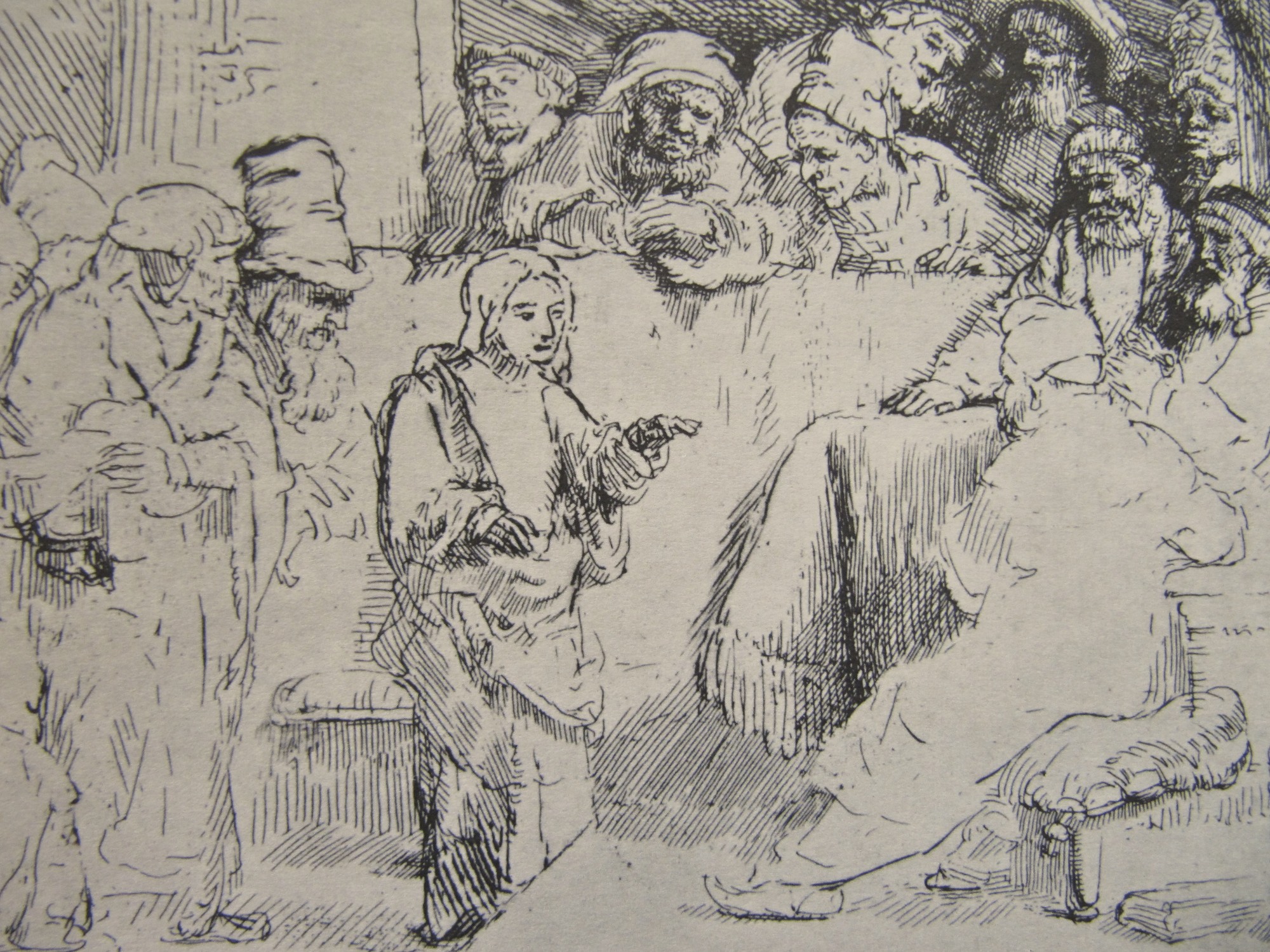
The young Jesus was absorbed in the life of the temple, Luke indicates. Here he questioned the rabbis in its courts, but more importantly here he experienced in a unique way the Presence of God. “Why were you looking for me? Did you not know I must be in my Father’s house.”

What did Joseph and Mary make of this as they anxiously searched for the Son they raised as their own? Certainly it raised questions, but did they too grow in love of his Father’s house when they found him? Did he deepen their thirst for the living God who dwelt there?

Hanukkah and Christmas

Today I wrote a reflection for our province website entitled “Hanukkah and Christmas.” The Jewish and Christian celebrations coincide closely this year.

Hanukkah celebrates the rededication of the temple in Jerusalem after its desecration by Antiochus Epiphanes IV in 167 BC. Christmas celebrates the birth of Jesus Christ approximately 167 years later.

Both of these feasts are about the Presence of God. For the Jews God was present in the temple in a special way. For Christians God is present in Jesus Christ, who spoke of himself as the temple of God in this world. His presence remains and cannot be destroyed.

Many days, I look out my window at a great church across the street here in Union City  that my community had to let go of some years ago. As with many holy places nowadays,  we couldn’t keep it going financially.

It seems to me the ancient mysteries of Hanukkah and Christmas constantly repeat themselves over time. Buildings, places, however sacred, rise and fall. Jesus Christ does not rise and fall. The Christmas mystery reminds us of his abiding Presence. He is God with us, Emmanuel, and he always gives us life.

Still, we mourn when buildings go.

Jesus in the Temple, 2

It’s important to remember that Jesus, as well as being a humble native of Nazareth, was also was a regular worshipper in the temple at Jerusalem and was nourished by the great ideas and vision that radiated from this holy place.

Indeed, the Second Temple was admired throughout the world of his time. Whatever the Jews thought of Herod the Great, the unpredictable ruler of Judea, most would be proud of the magnificent temple he built. It was one of the world’s wonders.

Yet, when some spoke to Jesus about its beauty, how adorned it was with gifts, he replied “As for these things you see,  the days will come when not one stone will be left upon another; all will be thrown down.” (Luke 21,6)

The temple was not just a cause for national pride for the Jews; it nourished their spirituality. God, who was honored here, was no household god with limited power, or a national god concerned with one people. The Divine Presence honored here was the Lord of heaven and earth, the God of the nations.

That belief was expressed in the psalms that Jesus and his disciples would have prayed. Two psalms we pray in the Liturgy of Hours Wednesday and Thursday of this week (week 1) are prayers from the temple and its worship:

Psalm 47

All you peoples, clap your hands; shout to God with joyful cries.

For the LORD, the Most High, inspires awe, the great king overall the earth,

Who made people subject to us, brought nations under our feet,

Who chose a land for our heritage, the glory of Jacob, the beloved.

God mounts the throne amid shouts of joy; the LORD, amid trumpet blasts.

Sing praise to God, sing praise; sing praise to our king, sing praise.

God is king over all the earth; sing hymns of praise.

God rules over the nations; God sits upon his holy throne.

The princes of the peoples assemble with the people of the God of Abraham. For the rulers of the earth belong to God, who is enthroned on high.

Psalm 48

Great is the LORD and highly praised in the city of our God:

The holy mountain, fairest of heights,

the joy of all the earth,

Mount Zion, the heights of Zaphon,

the city of the great king.

God is its citadel, renowned as a stronghold.

See! The kings assembled, together they invaded.

When they looked they were astounded; terrified, they were put to flight!

Trembling seized them there, anguish, like a woman’s labor,

As when the east wind wrecks the ships of Tarshish!

What we had heard we now see in the city of the LORD of hosts,

In the city of our God, founded to last forever.

O God, within your temple we ponder your steadfast love.

Like your name, O God, your praise reaches the ends of the earth.

Your right hand is fully victorious.

Mount Zion is glad!

The cities of Judah rejoice because of your saving deeds!

Go about Zion, walk all around it,

note the number of its towers.

Consider the ramparts, examine its citadels,

that you may tell future generations:

“Yes, so mighty is God, our God who leads us always!”

The temple proclaimed God who rules over creation and the nations, but as Jesus reminded his disciples a place can pass away but the God proclaimed there does not pass away. In fact, Jesus spoke of himself as the new temple, who replaces this building and who cannot be destroyed,

Isaiah offered a similar message, which we also read today (Thursday morning, week 1)

“Thus says the LORD: The heavens are my throne, the earth is my footstool. What kind of house can you build for me; what is to be my resting place?

My hand made all these things when all of them came to be, says the LORD. This is the one whom I approve: the lowly and afflicted man who trembles at my word.” (Isaiah 66,1-2)

After the destruction of Jerusalem, Jews who had been banished from the city by the Romans were allowed at set times to stand on the Mount of Olives and mourn for the temple and their great city. Christians also would go there to remember that cherished institutions and human  endeavors can pass away, but Jesus Christ does not pass away.

I was with the people in the picture above, who looked out  from the Mount of Olives to the temple mount and Jerusalem across the Kidron Valley. Good place to put things in perspective these days.

We Have Signs

In today’s lenten reading at Mass from John’s gospel (John 10,31-42), Jesus goes to Jerusalem for another feast, the Feast of the Dedication of the Temple. It’s a feast celebrated sometime in late November to late December, recalling the rededication of the temple after its profanation by Antiochus Epiphanes in the 2nd century BC.

The Jewish feasts are signs in John’s gospel that reveal who Jesus is; they inspire his words and the miracles he does. In fact, he replaces them. On the Sabbath, (chapter 5) he heals the paralyzed man at the pool at Bethsaida. The Son will not rest from giving life as the Father never rests from giving life. On the Passover (Chapter 6), he is the true Bread from heaven, the manna that feeds multitudes. On the Feast of Tabernacles (chapter 7-9)  he calls himself the light of the world and living water. On the Feast of the Dedication, he reveals himself as the true temple, the One who dwells among us and makes God’s glory known.

Once more, Jesus proclaims in today’s gospel his relationship to the Father, “the Father is in me and I am in the Father.” Yet, once more hostile listeners do not see the signs and accuse him of blasphemy, trying to stone him or have him arrested. But Jesus evades them and goes back across the Jordan to the place where John baptized and “many there began to believe in him.”

So many signs are given to us. We have the scriptures, the sacraments, the witness of the saints. How tragic not to follow them to the Word made flesh!

“To maintain this divine friendship, frequent the sacraments, namely confession and holy Communion. When you approach the altar do so for this one reason alone, to let your soul be melted more and more in the fire of divine love. Remember that you are dealing with the holiest action that we can perform. How could our dear Jesus have done more than to give himself to be our food! Therefore let us love him who loves us. Let us be deeply devoted to the Blessed Sacrament. In church we should tremble with reverential awe.” ( Letter 8)

Lead me on, O Lord,

Through your holy signs,

through them, let me come to you.

Jesus in the temple

The temple in Jerusalem where Jesus often speaks these last few weeks of Lent has a significant place in Jewish prayers. For example, Psalm 24, from our morning prayer today.


The earth is the LORD’S and all it holds,

the world and those who live there.

For God founded it on the seas,

established it over the rivers.

Who may go up the mountain of the LORD?

Who can stand in his holy place?

“The clean of hand and pure of heart,

who are not devoted to idols,

who have not sworn falsely.

They will receive blessings from the LORD,

and justice from their saving God.

Such are the people that love the LORD,

that seek the face of the God of Jacob.”

Lift up your heads, O gates;

rise up, you ancient portals,

that the king of glory may enter.


Who is this king of glory?

The LORD, a mighty warrior,

the LORD, mighty in battle.

Lift up your heads, O gates;

rise up, you ancient portals,

that the king of glory may enter.

Who is this king of glory?

The LORD of hosts is the king of glory.

The temple was not considered a world apart from ours to the Jews but a place where God the Creator was present, who is always at work recreating the world. So this psalm begins by recalling that the earth is the Lord’s who founded it on the seas and established on the rivers. We know little about the temple’s ornamentation, but it would not be surprising to find it ornamented with symbols of the earth.

In our churches the great signs of the earth are bread and wine.

The temple was a place of blessing, where hearts and hands were blessed to take part in the Creator’s glorious work.

Yet, creation has a destiny beyond the form it has now, and that destiny is also signified in the temple. “This temple has two parts, one is the earth we inhabit, the other is not yet known to us mortals .” (St. John Fisher)

Given its importance, it’s understandable why Jesus spends so much time in the temple, according to John’s gospel. As the Word of God, he is the one “through whom all things were made.” He is the one who lifts up this world to a destiny “not yet known to us mortals.”


God’s Forgiveness

Time and place are tools that help us understand the gospels. On our lenten journey, we are in Jerusalem with Jesus. From the 4th week of Lent, John’s gospel, describing what Jesus did in the Holy City, is the preferred source for our Mass readings on Sundays and weekdays before Easter.

Unlike the synoptic gospels which present him making a single journey to Jerusalem, John’s gospel indicates that Jesus went often to the Holy City, as one would expect. He’s more than a dutiful Jew visiting the temple to celebrate the Jewish feasts, though. He’s more than a simple Galilean peasant from Nazareth caught in a random attempt by the city’s leaders to squelch a possible revolution. In John’s gospel, he is the Word made flesh, the Savior of the world, replacing the temple and its worship; he’s God’s presence on earth. “I am.”

Going to Jerusalem to celebrate the feasts was essential for Jesus’ mission. During the Feast of Tabernacles, the Feast of the Dedication of the Temple, and the Feast of Passover he makes startling claims before the Jewish people and their leaders. The false witnesses who testify later at his trial before the Jewish Sanhedrin are not far from the real claim he made; he came, not to destroy the temple, but to be its replacement.

Jesus’ meeting with the Samaritan woman (3rd Sunday A), which John describes at length, takes place as he returns from Jerusalem after driving out the buyers and sellers from the temple during the feast of Passover. He is the purified temple and all will be drawn to him. The Samaritan woman and her neighbors who welcome him stand for all the outsiders called to worship “in spirit and in truth.”

The temple was the place where sin was forgiven. Today’s reading about the woman caught in adultery (Monday, 5th week) takes us to the temple area and reminds us that Jesus, the Lamb of God, takes away the sin of the world. He is a sign of God’s mercy to the woman standing before him, and to all of us. His forgiveness is far beyond the forgiveness of the scribes and pharisees who would stone the woman to death, according to the Law of Moses.

God’s forgiveness goes far beyond their forgiveness–and far beyond ours too.

The Courtyard of the Gentiles

Last week Pope Benedict addressed people attending the opening of the Courtyard of the Gentiles before the great cathedral of Notre Dame in Paris. It’s a space he hopes will be created throughout the world before our important Christian buildings to meet the world which Jesus invites into his temple. As I mentioned in yesterday’s post, Benedict sees the incident of Jesus cleansing the temple as a symbolic preparation for the entrance of the Gentiles to this holy place. “Come, let us climb the Lord’s mountain, to the house of the God of Jacob, that he may instruct us in his truth and we may walk in his ways.” Isaiah 2, 2-5  Here are the pope’s words:

“I am grateful to the Pontifical Council for having taken up and extended my invitation to open a number of “Courts of the Gentiles” within the Church. This image refers to the vast open space near the Temple of Jerusalem where all those who did not share the faith of Israel could approach the Temple and ask questions about religion. There they could meet the scribes, speak of faith and even pray to the unknown God. The Court was then an area of separation, since Gentiles did not have the right to enter the consecrated area, yet Jesus Christ came to “break down the dividing wall” between Jews and Gentiles, and to “reconcile both to God in one body through the cross, thus putting to death that hostility in himself”. In the words of Saint Paul, “He came and proclaimed peace…” (cf. Eph 2:14-17).

At the heart of the “City of Light”, in front of the magnificent masterwork of French religious culture which is Notre Dame, a great court has been created in order to give fresh impetus to respectful and friendly encounter between people of differing convictions. You young people, believers and non-believers alike, have chosen to come together this evening, as you do in your daily lives, in order to meet one another and to discuss the great questions of human existence. Nowadays many people acknowledge that they are not part of any religion, yet they long for a new world, a world that is freer, more just and united, more peaceful and happy. In speaking to you tonight, I think of all the things you have to say to each other. Those of you who are non-believers challenge believers in a particular way to live in a way consistent with the faith they profess and by your rejection of any distortion of religion which would make it unworthy of man. Those of you who are believers long to tell your friends that the treasure dwelling within you is meant to be shared, it raises questions, it calls for reflection. The question of God is not a menace to society, it does not threaten a truly human life! The question of God must not be absent from the other great questions of our time.

for full text.

Be interesting to have a Court of the Gentiles before all our Christian institutions.

The Man Who Came By Night

John 3, 14-21 4th Sunday of Lent

After Jesus cleanses the temple and says prophetically he himself is its replacement, Nicodemus comes to see him by night. He’s a Pharisee, an important person in Jerusalem, probably connected with the temple worship, and no doubt worried what people would think if they saw him with Jesus by day. In fact, other Jewish leaders in the city were thinking of putting him to death.

But despite coming to Jesus in the darkness, Nicodemus is not a slave of the dark. He’s looking for light. Maybe he’s not the bravest person in the world, but he’s an honest questioner, searching for the truth. Jesus does not point out to him his miracles, his healings, the crowds he draws, to establish his credentials. It’s not success stories he tells Nicodemus. It’s a story of a tragedy turned into victory.

Nicodemus would have recognized the story Jesus tells–a story from the epic desert journey of the Jews from Egypt to the Promised Land when they fell into unbelief and doubt and were bitten by snakes causing many of them to die.

Then, a serpent was lifted up on a staff, and they were healed at the sight. It will not be Jesus’ successes that bring Nicodemus to believe in him. He would soon see Jesus lifted up on a cross and, by God’s grace, he came to believe. God’s mercy and love were there before him, healing all who needed forgiveness.

The Pharisee, a leader in Israel, doesn’t hide in the dark any more; along with Joseph of Arimithea, another Jewish official drawn to Jesus, Nicodemus boldly goes to Pilate to ask for Jesus’ body and they bury it in a  tomb nearby. The mystery of the Cross brought Nicodemus to believe.

We go to you through questions, Lord, sometimes with our doubts. Like Nicodemus we often go to you in the night, but you do not mind receiving us then. For with you “the night itself is like the day.”

As long as we do not love the darkness, you listen and reach out. “For God so loved the world that he gave his only Son, so that everyone who believes in him may not perish but might have eternal life.”

Teach us wisdom through your cross.