Tag Archives: St. Peter in chains

St. Peter in Chains

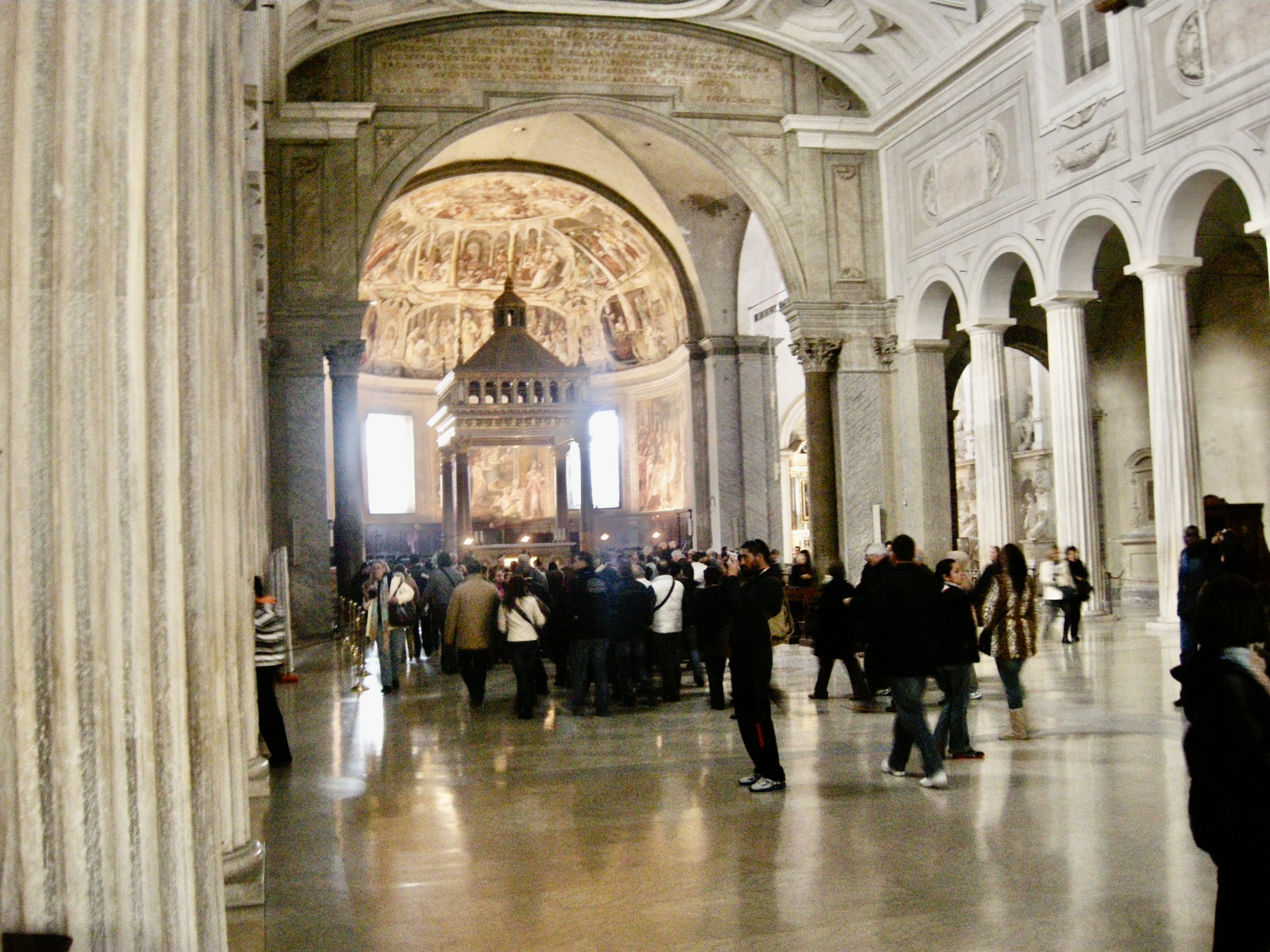
The Vatican Basilica where Peter the Apostle is buried is a prime destination for pilgrims to Rome today, but another important place dedicated to the memory of the apostle is the Church of St. Peter in Chains. It was built in the 5th century by the Empress Eudoxia on the western slope of the Esquiline Hill, next to the site of the early Roman Prefecture, not far from the Colosseum and the Roman Forum.

Justice was still being dispensed at the Roman Prefecture in Eudoxia’s day. Rome’s main prison was also nearby, where suspected criminals were tortured, questioned and judged. Not far away, just outside the city, those condemned were beheaded or strangled.

I would guess that Eudoxia was inspired to build this church next to the Roman Prefecture by the dramatic story we read today from the Acts of the Apostles of Peter being freed from his chains from a Jerusalem prison. (Acts 12:1-11) I imagine she saw the Prefecture as the place where judgment was carried out for so many Christians, even Peter and Paul.

Eudoxia gathered chains from the prisons in Jerusalem and Rome and placed them under the altar of this church she built, according to reports. Modern visitors usually turn to Michelangelo’s famous statue of Moses, located in the same church, but they should keep the chains in mind. They represent the imprisonment of Christian martyrs like Peter and Paul, and so many others.

A strong tradition among early Christian communities — affirmed today by many historians and archeologists — says that Peter met his death at Nero’s circus on the Vatican and Paul was beheaded along the Via Ostia near the place where Constantine later built a church in his honor. The apostles Peter and Paul, were martyred late in the persecution. Many details of their martyrdom are unknown, but like others they must have been arrested, put in chains, questioned, and sentenced before being executed.

Were Peter and Paul and many of the Christian martyrs who died in Nero’s persecution arrested, enchained and sentenced here?

There are later legends, of course. One says Peter and Paul were imprisoned in the Mamertime Prison, near the Capitoline Hill, where they converted and baptized their jailers. Peter, freed from his chains, escaped and fled along the Via Appia until he reached the place where the chapel, Domine, Quo Vadis? now stands. There he met Jesus coming into the city. “Where are you going, Lord?” Peter asked. When Jesus told him he was going to join those suffering, the apostle turned to embrace the same fate.

In the apse of the church of St Peter in Chains there’s a 16th century painting of Eudoxia presenting the chains to the pope. According to some 8th century homilies, one is from a Jerusalem prison. The other is from a Roman prison, possibly the one nearby? Eudoxia was a woman who listened to the scriptures with her imagination and saw connections. Good example for us who listen to the scriptures today.

Basilica di s.pietro in vincoli, A.P.Frutaz, Rome ?

The Roman Catacombs and Their Martyrs, l. Hertling SJ and E.Kirschbaum,SJ, Milwaukee, USA 1956

Reading the Gospel of Mark

MarkThe Gospel of Mark, the first of the four gospels, written sometime between the year 65 to 70 AD. Each year it’s read on weekdays, from chapter 1-9, following the Feast of the Baptism of Jesus until Tuesday before Ash Wednesday. This year it’s also read on Sundays through the year.

Mark’s gospel begins. not with Jesus’ birth, but with his Baptism, announced by John the Baptist.After his temptation in the desert, Jesus immediately goes into Galilee proclaiming the kingdom of God is at hand.

In each weekday reading Jesus proclaims the Kingdom of God, first in Galilee and then in Jerusalem, by miracles and powerful signs. He also faces growing opposition that eventually brings him to death.

From its very beginning, Mark’s Gospel offers intimations of the tragic mystery of the Passion of Jesus. Coming from the Jordan River where he is baptized by John, Jesus is led “at once” by the Spirit into the wilderness to be tempted by Satan. “ He was among wild beasts, and the angels ministered to him.” (Mark 1,13) In Mark’s Gospel, Jesus constantly faces the forces of evil and death.

Almost half of Mark’s 16 chapters describe the final period of Jesus life, when he went up to Jerusalem and suffered, died and rose again. As chapter 8 ends, Jesus asks his disciples who people say he is. “You are the Messiah,” Peter answers, but Jesus announces he must go up to Jerusalem and be rejected and killed and raised up. Peter will have nothing to do with it. In response, Jesus calls him “Satan” and tells him he’s thinking as man thinks and not as God does.

In God’s thinking, Jesus, his Son, must die and rise again. All who follow him must do the same. Peter’s not alone in not understanding God’s thinking; all the disciples, including us, are slow to understand. Our lack of understanding is emphasized in Mark’s gospel, which some have called “A passion narrative with an extended introduction,”

Many commentators say that Mark’s Gospel was written in Rome for the Christians of that city who suffered in the first great persecution of the church by Nero after a fire consumed the city in 64 AD.

I lived in Rome for a few years in the Monastery of Saints John and Paul on the Celian Hill. The monastery was built over the Temple of Claudius; its gardens were once part of Nero’s gardens. From its heights you could see the Circus Maximus a short distance away where the great fire of 64 AD started and the extensive area that burned in the fire, up to Tiber River. Probably over a million people were affected by it.

The Roman historian Tacitus says that Nero blamed the Christians for the fire and had many of them arrested and put to death in his gardens and at the Vatican circus across the city.

I was living in the gardens where some of those early Christians were put to death, I believe. On the other side of the Colosseum, a short distance away, was the Roman prefecture and prison were many of them would likely have been held and sentenced. The Church of St. Peter in Chains stands there today.

I narrated a video about that church and the early persecution which may help you understand the church Mark wrote for. The persecution must have had a devastating affect on the Christians of Rome at the time, innocent people completely taken by surprise by this brutal injustice. They didn’t understand it at all. Neither did his first disciples understand, Mark’s gospel says.

June 30th

June 30th, following the Feast of Saints Peter and Paul, we celebrate the early Christian martyrs put to death by Nero after the disastrous fire that burned down much of the city July 19, 64 AD. If I were in Rome today I would go to the church of Saint Peter in Chains or to the gardens of Saints John and Paul on the Celian Hiill to remember them.

The two apostles were put to death around this time and many (we don’t know how many) followed them.

There’s a blog and a video on the church of St. Peter in Chains here and here.And a video on the Stations of the Cross in the gardens of Saints John and Paul here. There’s also a video on the Quo Vadis story here.

The persecution and martyrdom  in 64 throws light on the creation of the Gospel of Mark, which many think was written in Rome afterwards.

One thing I think this feast and the Gospel of Mark suggests: the Church of Rome did not flee from the uncertainty and persecution it faced then. I think the Quo Vadis story indicates that. It didn’t give up.

We pray today:

Father,

you sanctified the Church of Rome

with the blood of its first martyrs.

May we find strength from their courage

and rejoice in their triumph.

We ask this through our Lord, Jesus Christ, your Son.

Start Somewhere

I was happy to see the Vatican launch out onto Youtube.  The digital generation spends a lot a time there, so why not reach out to them? Maybe we don’t have all the whistles and bells, but let’s start somewhere.

At the Travel Show in the Javits Center in New York City last Sunday, crowds of people were looking for places to go and see around the world. Some of them may end up in churches and shrines, which have wonderful stories to tell.

Here’s a church in Rome I’ve always liked, and it tells a powerful story.  Saint Peter in Chains.

I have other clips on Youtube. Type vhoagland into the search box and see for yourself.