Tag Archives: St. Augustine

The Bread of Christ

bread wine
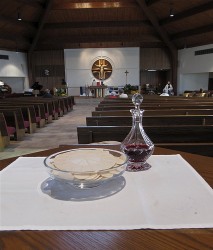
Besides being one body, the Body of Christ, we are also one Bread in him. When we celebrate the Eucharist, we listen first to God’s word and then offer bread and wine. The prayer over the bread points to its meaning:

“Blessed are you, Lord God of all creation, for through your goodness we have received the bread we offer you; fruit of the earth and work of human hands, it will become for us the bread of life.”

We receive the bread, “fruit of the earth and work of human hands,” from our Creator. St. Augustine calls the bread we pray for in the Lord’s Prayer and the bread we offer at Mass “the bread of everything.” The gift of everything is acknowledged at Mass through the bread and wine; we’re blessed with everything, we’re reminded, and through them, we give thanks to the God of goodness for it all. “What do you have that you have not received?”

The greatest of God’s blessings is Jesus Christ who, on the night before he died took bread into his hands, the “bread of everything,” and gave himself to his disciples through this sign. “Take and eat, this is my body which will be given up for you.” In a similar way, he gave them the cup of wine that signifies his blood “poured out” for us.

“Do this in memory of me,” he said.

A mystery of faith, we say in our prayer. We believe through these signs. We can’t let their humble circumstances– the place, the people, the simple acts and words dissuade us. We’re called to wonder at what’s hidden here.

LOST, ALL LOST IN WONDER
Godhead here in hiding, whom I do adore,

Masked by these bare shadows, shape and nothing more,

See, Lord, at thy service low lies here a heart

Lost, all lost in wonder at the God thou art.


Seeing, touching, tasting are in thee deceived:

How says trusty hearing? that shall be believed;

What God’s Son has told me, take for truth I do;

Truth himself speaks truly or there’s nothing true.


On the cross thy godhead made no sign to men,

Here thy very manhood steals from human ken:

Both are my confession, both are my belief,

And I pray the prayer of the dying thief.

I am not like Thomas, wounds I cannot see,

But can plainly call thee Lord and God as he;

Let me to a deeper faith daily nearer move,

Daily make me harder hope and dearer love.

O thou our reminder of Christ crucified,

Living Bread, the life of us for whom he died,

Lend this life to me then:
feed and feast my mind,

There be thou the sweetness
man was meant to find.

Bring the tender tale true of the Pelican;

Bathe me, Jesu Lord, in what thy bosom ran—

Blood whereof a single drop has power to win

All the world forgiveness of its world of sin.

Jesu, whom I look at shrouded here below,

I beseech thee send me what I thirst for so,

Some day to gaze on thee face to face in light

And be blest for ever with thy glory’s sight. Amen.

(translation of Gerard Manley Hopkins, S.J.)

Daily Prayer

Pope Francis seems to be giving us a new model of the papacy. He has the common touch, to be sure, and the spontaneity of the man is refreshing.

I wonder if his spontaneity is partially explained by the investment he makes in daily prayer. He’s made the daily Mass in the chapel at St. Martha at the Vatican an important part of his day and his ministry. The daily Eucharist seems to be a “daily bread” that provides him with the spontaneous wisdom and insight he has.

I, for one, usually go each day to the Vatican Radio site on the internet to see what he’s up to and what he has to say. By the way, there’s a new app called ThePope that gives you all he’s doing and saying each day.

In his Letter to Proba, St. Augustine says that when we say “Give us this day our daily bread” everything is included. The bread we bring for the Eucharist is the bread of everything; all creation is there, but in particular we bring this day’s creation to God to be blessed through Jesus Christ, who enables us to interpret and find meaning in the world at hand.

Is Pope Francis giving us a new appreciation of the role of daily prayer? Everything is there at Mass. Besides putting us in touch with God, it puts us in touch with the world we live in.

Moving On

Tomorrow we’re moving from Union City, NJ to Jamaica, NY. Not a big move in distance, but a big move in other ways. I wonder about the place where I’m going and hold on to the place where I’ve been.

It happens that today’s reading is St. Augustine’s famous reflection about finding God. “Place” isn’t the main issue, he says, moving on means more than that:

“Where did I find you first? You could not have been in my memory before I learned to know you. Where then could I have found you in order to learn of you, if not in yourself, far above me?

“Place” has here no meaning: further away from you or toward you we may travel, but place there is none. O Truth, you hold sovereign sway over all who turn to you for counsel, and to all of them you respond at the same time, however diverse their pleas.

“Clear is your response, but not all hear it clearly. They all appeal to you about what they want, but do not always hear what they want to hear. Your best servant is the one who is less intent on hearing from you what accords with his own will, and more on embracing with his will what he has heard from you.

“Late have I loved you, Beauty so ancient and so new, late have I loved you!

Lo, you were within,

but I outside, seeking there for you,

and upon the shapely things you have made

I rushed headlong – I, misshapen.

You were with me, but I was not with you.

They held me back far from you,

those things which would have no being,

were they not in you.

You called, shouted, broke through my deafness;

you flared, blazed, banished my blindness;

you lavished your fragrance, I gasped; and now I pant for you;

I tasted you, and now I hunger and thirst;

you touched me, and I burned for your peace.

“When at last I cling to you with my whole being there will be no more anguish or labor for me, and my life will be alive indeed, alive because filled with you. But now it is very different. Anyone whom you fill you also uplift; but I am not full of you, and so I am a burden to myself. Joys over which I ought to weep do battle with sorrows that should be matter for joy, and I do not know which will be victorious. But I also see griefs that are evil at war in me with joys that are good, and I do not know which will win the day. This is agony, Lord, have pity on me! It is agony! See, I do not hide my wounds; you are the physician and I am sick; you are merciful, I need mercy.”


Knowing Jesus Christ

St. Augustine has an important reflection in his commentary on the psalms in today’s Office of Readings. It’s about the way we see Jesus Christ, who is God and also human, the Word made flesh.

“We contemplate his glory and divinity when we listen to these words: In the beginning was the Word, and the Word was with God, and the Word was God. He was in the beginning with God. All things were made through him, and without him nothing was made. Here we gaze on the divinity of the Son of God, something supremely great and surpassing all the greatness of his creatures. Yet in other parts of Scripture we hear him as one sighing, praying, giving praise and thanks.

We hesitate to attribute these words to him because our minds are slow to come down to his humble level when we have just been contemplating him in his divinity. It is as though we were doing him an injustice in acknowledging in a man the words of one with whom we spoke when we prayed to God. We are usually at a loss and try to change the meaning. Yet our minds find nothing in Scripture that does not go back to him, nothing that will allow us to stray from him.

Our thoughts must then be awakened to keep their vigil of faith. We must realise that the one whom we were contemplating a short time before in his nature as God took to himself the nature of a servant; he was made in human likeness and found to be human like others; he humbled himself by being obedient even to accepting death; as he hung on the cross he made the psalmist’s words his own: My God, my God, why have you forsaken me?

We pray to him as God, he prays for us as a servant. In the first case he is the Creator, in the second a creature. Himself unchanged, he took to himself our created nature in order to change it, and made us one with himself, head and body. We pray then to him, through him, in him, and we speak along with him and he along with us.”

In these final weeks of Lent John’s gospel sees Jesus claiming to be “I am,” the Word confronting his opponents in the temple. Soon, we will see him praying with fear in the garden, silent before his enemies, struggling to bear his cross, dying a cruel death.

If we neglect his divinity, we call into question God’s gift of redemption to our world and our our own call to be God’s children. If we neglect his humanity, we call into question our own humanity, becoming other-worldly and ignoring the lowliness of our human condition.

We need to keep a “vigil of faith” as Augustine says.

Temptations are Teachers

There are two wonderful posts in the blogs from Commonweal Magazine for March 22,

One by  Fr. Joseph Komonchak, “Finding  out who you are,” the other by J.Peter Nixon “Spiritual Excercises.”

The first is a quote from St. Augustine on temptation. I hope Fr. Komonchak wont mind if  I give in to the temptation to steal from him:

“Is God so ignorant of things, does he know so little about the human heart, that he can find what a man is only by testing him? Of course not, the testing is so that the man can find himself….

“You should recognize that God does not need to test in order to learn something he did not know before; it’s so that by his testing, by his investigating, what is hidden in someone might come out. A person is not as well known to himself as he is to his Creator, an ill person doesn’t know himself as well as his doctor. Someone becomes ill, and he’s the one suffering, not the doctor, but it’s from the one not suffering that the sufferer expects to hear what’s wrong.

“The Psalmist cries out: “Cleanse me, Lord, from my hidden things” (Ps 18:13). In any person there are things hidden to the very one in whom they exist. They don’t come out, aren’t laid open, aren’t discovered, except by his being tested. If God ceases to test, the teacher ceases to teach….

“Why do I say this? Because a person is ignorant of himself until he learns who he is by being tested. But once he has learned who he is, let him not be careless about himself. If he was careless when he lay hidden from himself, let him not be careless now that he knows himself.” (Augustine, Sermon 2, 2-3; PL 38-28-29)

St. Paul of the Cross has a similar view of temptation, as far as my reading of him teaches me. He tells people not to be afraid of temptations, or be ashamed of them; they’re teachers of humility and messengers to remind us who we are.  They lead us to God, our teacher, our doctor, the One who makes us whole.

J.Peter Nixon’s blog is about taking care of your body. See what he says for yourself.


Desiring God

Here’s a wonderful reflection from St. Augustine on desiring God, from today’s Office of Readings:

“The entire life of a good Christian is in fact an exercise of holy desire. You do not yet see what you long for, but the very act of desiring prepares you, so that when he comes you may see and be utterly satisfied.
“Suppose you are going to fill some holder or container, and you know you will be given a large amount. Then you set about stretching your sack or wineskin or whatever it is. Why? Because you know the quantity you will have to put in it and your eyes tell you there is not enough room. By stretching it, therefore, you increase the capacity of the sack, and this is how God deals with us. Simply by making us wait he increases our desire, which in turn enlarges the capacity of our soul, making it able to receive what is to be given to us.
“So, my brethren, let us continue to desire, for we shall be filled. Take note of Saint Paul stretching as it were his ability to receive what is to come: Not that I have already obtained this, he said, or am made perfect. Brethren, I do not consider that I have already obtained it. We might ask him, “If you have not yet obtained it, what are you doing in this life?” This one thing I do, answers Paul, forgetting what lies behind, and stretching forward to what lies ahead, I press on toward the prize to which I am called in the life above. Not only did Paul say he stretched forward, but he also declared that he pressed on toward a chosen goal. He realised in fact that he was still short of receiving what no eye has seen, nor ear heard, nor the heart of man conceived.”
I’m reading “The Education of Henry Adams”  now, by one of the great observers of our time. Adams was overwhelmed by the complexity of life brought about by the machine and rapid industrialization he experienced in the latter part of the 19th century. Though seen as progress, the changes caused a loss of a unified vision of life. There were too many things going on; too many facts to evaluate, too much happening to look ahead to the future. The world was entering a dizzying stage. 

We are still in that stage.

How does our time affect the way we desire God? In a more settled time, God had a recognized place. Not so now. Augustine speaks of desire as a container, a sack that we must enlarge to be filled. We might  use the image today of a shopping cart that’s filled to the brim with stuff, and there’s still more to come.

How can we make room for desiring God?

I Wonder

I wonder as I wander out under the sky,

why Jesus, our Savior, was born for to die,

for poor, orn’ry people like you and like I

I wonder as I wander out under the sky.

Wonder is a word we use often at Christmas.It describes our reaction to something  beyond what we expect, beyond our experience and our understanding. It’s so big it leaves us lost for words.

We describe the mystery we celebrate today as the wonder of the Incarnation.The wonder that God, who made all things could become human like us, and in such startling circumstances.

A woman was telling me about her little girl, Isabel. She’s in the first grade in a little Catholic school down the street from us and they were into the Christmas story recently.

“She can’t wait to go to school, ” her mother said. “They’re putting together a creche for the Baby Jesus and they’re learning all about the angels, and the wise men who come to the stable on camels, and Mary and Joseph, and the shepherds and the wicked king who want to kill all the babies in Bethlehem. They’re offering little prayers that the whole world be blessed when he comes.”

Isabel is enthralled by it all. “Mommy, did you know Jesus had to sleep on straw. That  straw we put in the crib would  hurt him when he slept on it.”

Isabel was asking what she was going to get for Christmas, and her mother told her that before we open our hand to get anything we have to open it to give something. So Isabel wants enough money to buy presents for everyone in the world. She’s going to have to see the Secretary of the Treasury of the United States for a bailout like that, her mother says.

The Christmas story is a wonderful story. Children are delighted by it: it touches the oldest and wisest of us.

I was reading a Christmas sermon of St. Augustine recently. You can see him wondering  too about this great mystery. Listen to him.

The Word of God, maker of time, becoming flesh was born in time.

Born today, he made all days.

Ageless with the Father, born of a mother, he began counting his years.

Man’s maker became man; the ruler of the stars sucked at a mother’s breasts,

Bread hungered,

the Fountain thirsted,

the way was wearied by the journey,

the truth was accused by false witnesses,

the life slept in death,

the judge of the living and the dead was judged by a human judge,

justice was condemned by injustice,

the righteous was beaten by whips,

the cluster of grapes was crowned with thorns,

the upholder of all hung from a tree,

strength became weak,

health was stricken with wounds,

life died.

He humbled himself that we might be raised up.

He suffered evil that we might receive good,

Son of God before all days, son of man these last days,

from the mother he made, from the woman who would never be, unless he made

her.  (Augustine, Sermon 191, 1; PL 38, 1010)

Through the years, this mystery of God made so many wonder. May it bring us to  wonder today.