Tag Archives: Rome

Feast of the Dedication of the Church of St. John Lateran

Today, is the feast of the Dedication of Church of St. John Lateran in Rome. It seems to me you can see much of the history of the Roman Catholic Church here in this building, one of the great pilgrim churches of Rome.I wrote about this ancient 4th century church, the “mother of all churches” elsewhere.

In a homily for this feast, St. Caesarius of Arles says that this church, like all churches, reminds us we’re temples of God. “And if we think more carefully about the meaning of our salvation, we shall realize that we are indeed living and true temples of God. God does not dwell only in things made by human hands, nor in homes of wood and stone, but rather he dwells principally in the soul made according to his own image and fashioned by his own hand. Therefore, the apostle Paul says: The temple of God is holy, and you are that temple.”

The ancient baptistery at the Lateran church, pictured above, is an entrance to this church. Through baptism we belong to the great church whose Lord, Jesus Christ, shares his life with us.

The beauty of a church reminds us of the beauty of our souls, Caesarius says: “Whenever we come to church, we must prepare our hearts to be as beautiful as we expect this church to be… Just as you enter this church building, so God wishes to enter into your soul, for he promised: I shall live in them, I shall walk through their hearts.”
Pope Benedict XVI

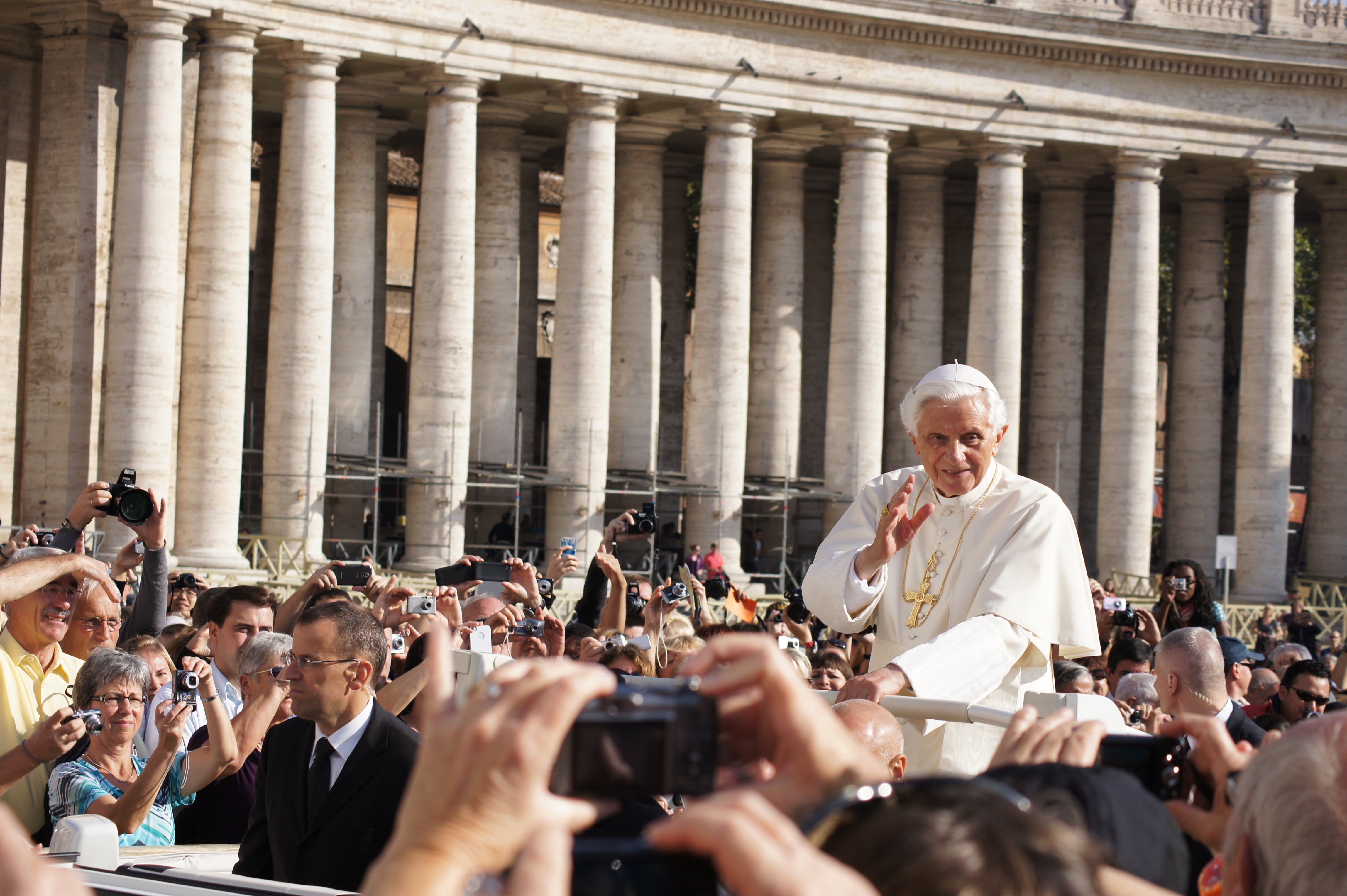
The pope gave us a beautiful example of humility in his resignation today, just before we begin the season of Lent.

SONY DSCIt was a conscious decision, “before God” he makes it, not simply on his own.

It was a brave decision. No pope in recent times has resigned. He was not afraid of going out into uncharted waters.

It was not his own good he looked out for, but the good of the church. The office of the papacy is demanding and he saw it beyond his strength.

I think he leaves a powerful legacy that will be more appreciated in time. His books on Jesus of Nazareth are treasures that will last. His homilies and letters will be mined for years to come. He’s a beautiful writer and religious thinker.

God bless him.

Fighting in Church

Today’s Office of Readings has the letter to the Corinthians by Pope St. Clement 1, written about 95 AD,  just after the last of the New Testament writings were written.

Fighting erupted among the members of the church in Corinth, once cared for by Paul the Apostle, who scolded them for the same thing. There’s slander and backbiting and complaining going on; people like to hear themselves talk, Clement remarks, quoting scripture: If you talk a lot you only hear yourself. A big talker thinks he’s always right.

The Corinthians were a scrappy bunch, it seems.

Clement tells them that their fighting makes the church look bad among their unbelieving neighbors. Who wants to belong to a community like that? Paul wrote to the Romans; I guess Clement thought he should write to the Corinthians.

Stop fighting among yourselves and do some good, the pope says. Obey your leaders, but above all, obey God. Bow down in respect before God and be silent before his holy will, as the Prophet Isaiah bowed silently  before the overwhelming presence of God in the temple.

“Our boasting and our confidence must rest on him. Let us be subject to his will. Look carefully at the whole host of his angels; they stand ready and serve his will. Scripture says: Ten thousand times ten thousand stood before him, and a thousand thousand served him, and cried out: Holy, holy, holy is the Lord of hosts; the whole creation is full of his glory.”

“Holy, Holy, Holy, Lord God of hosts…” We say at Mass. We bow down before God; our thoughts, our judgments, our plans are nothing before God’s thoughts, judgments and plans. We know so little. Be humble before your God, Clement says, then you’ll get along with your neighbor.

Good advice for all of us.

Clement’s letter also gives the earliest testimony to the deaths of Peter and Paul at Rome.

June 30th

June 30th, following the Feast of Saints Peter and Paul, we celebrate the early Christian martyrs put to death by Nero after the disastrous fire that burned down much of the city July 19, 64 AD. If I were in Rome today I would go to the church of Saint Peter in Chains or to the gardens of Saints John and Paul on the Celian Hiill to remember them.

The two apostles were put to death around this time and many (we don’t know how many) followed them.

There’s a blog and a video on the church of St. Peter in Chains here and here.And a video on the Stations of the Cross in the gardens of Saints John and Paul here. There’s also a video on the Quo Vadis story here.

The persecution and martyrdom  in 64 throws light on the creation of the Gospel of Mark, which many think was written in Rome afterwards.

One thing I think this feast and the Gospel of Mark suggests: the Church of Rome did not flee from the uncertainty and persecution it faced then. I think the Quo Vadis story indicates that. It didn’t give up.

We pray today:

Father,

you sanctified the Church of Rome

with the blood of its first martyrs.

May we find strength from their courage

and rejoice in their triumph.

We ask this through our Lord, Jesus Christ, your Son.

Peter and Paul

Today, the Feast of Saints Peter and Paul, the Vatican began a new website on the internet that combines a number of their websites under one portal: www.news.va

Good idea, nice and simple. Begun on the Feast of the two apostles who are considered the founders of the church of Rome it’s a website addressed to the world. And on its opening page there’s the pope playing with what’s surely an iPad. May others do likewise. I’m not quite sure about Peter, but I’m sure Paul would have loved one of those things.

One story on the new site is about a new discovery archeologists made of a 6th century portrait of St. Paul, the Apostle, from a catacomb near Naples. Paul, is described in the story as looking like a Roman philosopher. He peers out from the side of an arcosolium, a burial place, at the mourners who come to honor their dead. He who saw the Risen Christ carries news of new life.

His portrait looks like other early portraits of him, just a Peter’s portrait is pretty much established early on. Peter looks like a rough and ready fisherman–which I’m sure he was. I think he would be uncomfortable to hear himself described as “the prince of the apostles.”

Not that he was a shrinking violet. In today’s readings, St. Augustine claims that the three affirmations of love Jesus called him to make, according to the Gospel of John, were to conquer Peter’s “self-assurance.”

“Quite rightly, too, did the Lord after his resurrection entrust his sheep to Peter to be fed. It is not, you see, that he alone among the disciples was fit to feed the Lord’s sheep; but when Christ speaks to one, unity is being commended to us. And he first speaks to Peter, because Peter is the first among the apostles.

“Do not be sad, Apostle. Answer once, answer again, answer a third time. Let confession conquer three times with love, because self-assurance was conquered three times by fear. What you had bound three times must be loosed three times. Loose through love what you had bound through fear. And for all that, the Lord once, and again, and a third time, entrusted his sheep to Peter.”

“There is one day for the passion of two apostles. But these two also were as one; although they suffered on different days, they were as one. Peter went first, Paul followed. We are celebrating a feast day, consecrated for us by the blood of the apostles. Let us love their faith, their lives, their labours, their sufferings, their confession of faith, their preaching.”

The First Christian Martyrs of Rome

The old churches of Rome are wonderful guides to its Christian past. As a student almost 50 years ago I went through them with books like Hertling and Kirschbaum’s The Roman Catacombs and Their Martrys, a book I still keep at hand along with newer ones.

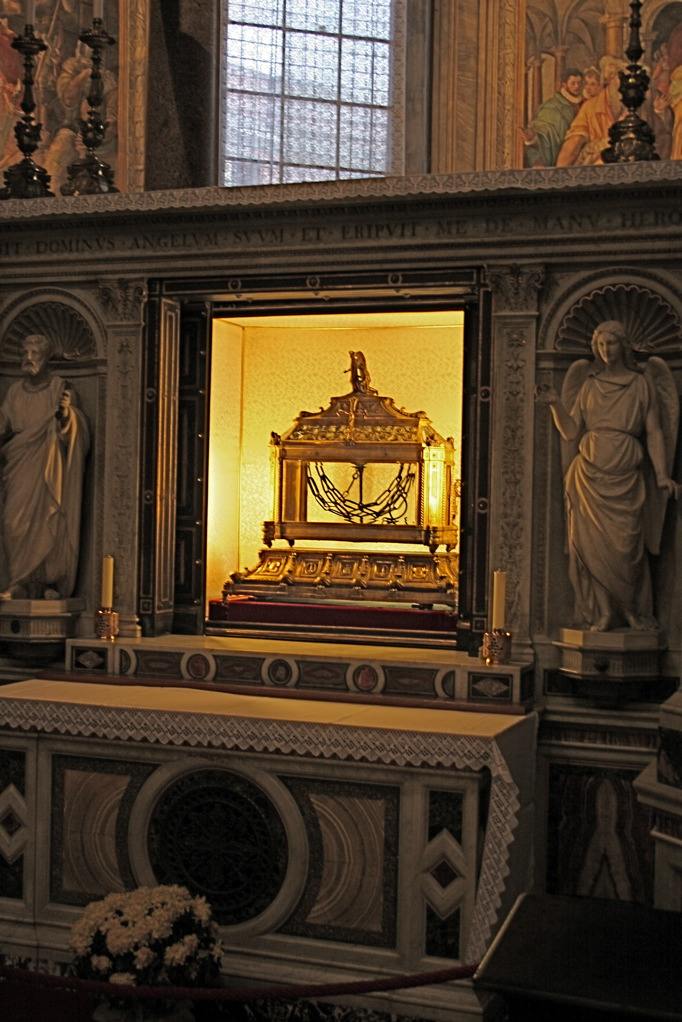
The 5th century church of Saint Peter in Chains is a church I’ve always associated with the First Marytrs of the Church of Rome, a feast we celebrate today, right after the feast of the apostles, Peter and Paul.

17

It was built near the Roman Prefecture, where people were dragged in chains to be interrogated, tortured, and made to face Roman justice. The Romans were sticklers for procedure. You had to be tried in court. Many Christians–we are not sure how many–were brought to justice near this church. Those chains above may actually come from the nearby Roman jail.

I wrote about it here , and I have a video you can see here.

Vodpod videos no longer available.

more about “untitled“, posted with vodpod

Veronica’s Veil

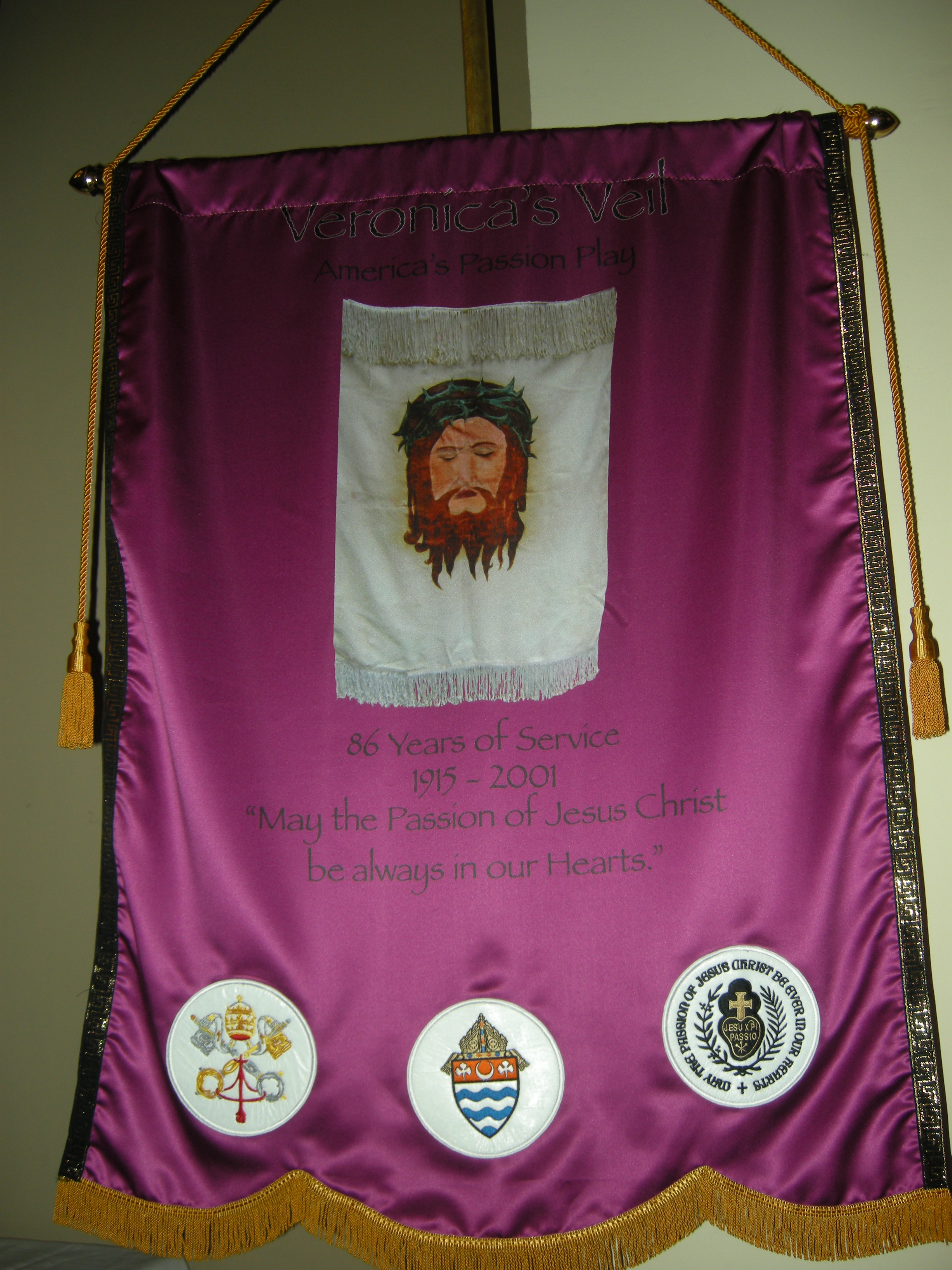
DSCN1721The Passionists, the community I belong to, were founded by St. Paul of the Cross (+1874) to keep alive the memory of the Passion of Jesus Christ. For 86 years, from 1915-2001, people from Saints Joseph and Michael’s parish in Union City, NJ,  a parish nearby where the Passionists served for many years, presented a Passion play, “Veronica’s Veil,” during Lent.  Two Passionists , Father Bernardine Dusch, CP, and Father Conrad Eiben, CP,  were the play’s creators.

Patrick Allen, a Union City native and the last stage manager of the play in 2001, has begun to bring the play “back into service,” he says. Last Lent, on Good Friday, the Veronica Veil players processed through the streets of New York’s Little Italy near Old St. Patrick’s Cathedral, reenacting the Lord’s journey to Calvary, and ended up in the church itself.

Patrick hopes to present the play again in Union City and New York City this coming Lent. This Thursday, June 25th, he’s accompanying Archbishop Timothy Dolan, the new archbishop of New York, to Rome where the archbishop will receive the pallium from Pope Benedict XIV.

At the Mass, Allen will bring a service banner from Veronica’s Veil as part of the offertory gifts. Afterwards, the banner will be placed with the original relic of the veil presently enclosed in one of the great pillars in St. Peter’s Basilica next to the main altar.

For centuries, Passion plays have told the story of the Passion of Jesus. The banner to be blessed by the pope this Saturday explains why they are created. “May the Passion of Jesus Christ be always in our hearts.”

Here’s Patrick talking about Veronica’s Veil.

The Stations of the Cross

Vodpod videos no longer available.

more about "The Stations of the Cross on Vimeo", posted with vodpod

Start Somewhere

I was happy to see the Vatican launch out onto Youtube.  The digital generation spends a lot a time there, so why not reach out to them? Maybe we don’t have all the whistles and bells, but let’s start somewhere.

At the Travel Show in the Javits Center in New York City last Sunday, crowds of people were looking for places to go and see around the world. Some of them may end up in churches and shrines, which have wonderful stories to tell.

Here’s a church in Rome I’ve always liked, and it tells a powerful story.  Saint Peter in Chains.

I have other clips on Youtube. Type vhoagland into the search box and see for yourself.

Thanksgiving

Rome is filled with unexpected delights. Yesterday evening, I went to St. John Lateran for a free concert: Haydn’s “Seven Last Words of Jesus on the Cross.” Beautifully performed in the semi-darkness of the great church, each word narrated by an Italian monsignor, followed by a sonata.

Instead of turkey, we had some pasta. Not the same.

Today, I got to the Museo Capitoline, which Fr. Adriano assures me is the second best museum in the city. The rain kept people away from the place, so it seemed to be all mine.  I was interested in the little collection of 2nd-3rd century funeral monuments of Roman soldiers, many of them once stationed on the Coelian Hill near our church, one of the favorite bases for soldiers in the city. A further clue for soldier martrys housed and honored here?

Long rows of statues and sculptures from early Rome peer out at you as you walk through this great museum which thoughtfully lets you look out at the Roman forum from time to time. I noticed many of them are gifts from Benedict XIV, the greatest of the 18th century popes, who loved to look at the past and draw wisdom for it.

Tomorrow I’m off to San Pudentiana, where I’ll be meeting two archeology students from Oxford and go down under the church to the excavations below. I hope, anyway.They are interested in house churches.