Tag Archives: Rembrandt

Palm Sunday

The Gospel of Mark, the first of the Gospels to appear in written form, presents Jesus going to his death in utter desolation, draining the cup of suffering given him by his Father.

His enemies viciously reject him; his disciples mostly betray him or desert him. Only a few remain as he goes on his way.

His cry from the cross is a cry of faith mingled with deep fear and sorrow: “My God, my God, why have you forsaken me?”

As we read this Gospel, taut and fast-paced, we share with Jesus the dark mystery of unexplained suffering that all of us face in life. Yet, this mystery leads to life, a risen life. The desolation Jesus experienced takes many forms, some quite hidden from what people see. Yes, the cross can mean physical pain, but suffering may also come from spiritual and psychological situations.

Jesus reveals that God can be found even here: “In Mark’s account, Jesus dies with a wordless scream that echoes from that dread hill, splitting the veil of the temple and igniting faith in the centurion’s heart. This unlikely witness sees in the manner of Jesus’ death for others the true revelation of God. The sight of the Crucified Jesus triggers in him the full first confession of faith expressed in the gospel: “Truly this man was the Son of God!” (15:39). A startling revelation–God’s power revealed not through staggering prodigies but in a selfless death motivated by love.” Donald Senior, CP

 Donald Senior’s beautiful account of Mark’s Passion narrative can be found here.

Here’s Rembrandt’s account of the Crucifixion.

Mission at St. Thomas More: Tuesday Evening

Tuesday evening at our mission in St. Thomas More Parish, Sarasota, Florida, we’re going to reflect on the Passion of Jesus Christ. Those who can’t attend our service at 7 PM (and maybe some who attended too) may find this great presentation by Rembrandt something to study. He’s a great visual teacher of scripture.


Here’s some thoughts on it:

Rembrandt’s Crucifixion.

Light from above falls on this dreadful scene, falling first on Jesus Christ, who is the Light of the World, even in this dark hour.

The same light bathes those on his left (Is it because blood and water from his pierced heart flows on them?). The thief, his face turned already toward Paradise, has a place among those who followed Jesus from Galilee. Some of them sit on the ground overwhelmed by it all; some comfort Mary his mother; some stand looking on. Mary Magdalene comes close to kiss his nailed feet.

The centurion kneels before Jesus and cries out his confession of faith, “Yes, this is the Son of God.” But his soldiers look ready to leave their grim duty for the barracks and dinner.

On the left, Jesus’ enemies are heading home too, into the darkness. The other thief’s face is turned to them, as if he wished he could go with them, away from this place.

But I notice some light seems to reach out to them too. “Father, forgive them, for they know not what they do.”


The Temptations of Jesus

As supreme ruler in China from 1949-1976  Mao Zedong began the practice of sending young recruits for the Communist party on what was called the  “Long March.”  They retraced the 8,000 miles that Mao and his army took in 1935 through some of the toughest parts of western China to evade their enemies and eventually become the fighting force that conquered China. The recruits were expected to learn from people like Mao and his soldiers who made that difficult journey what made you into a good Communist.

Lent is our “Long March.”  For 40 days, we retrace the 40 years the Israelites journeyed through the desert from Egypt to the Promised Land and the great journey that Jesus Christ took to his death and resurrection.

This Sunday we begin that journey with Jesus in the desert after his baptism where he is tempted by the devil. Mark’s gospel describes it succinctly:

“The Spirit drove Jesus out into the desert,

and he remained in the desert for forty days,

tempted by Satan.

He was among wild beasts,

and the angels ministered to him.”

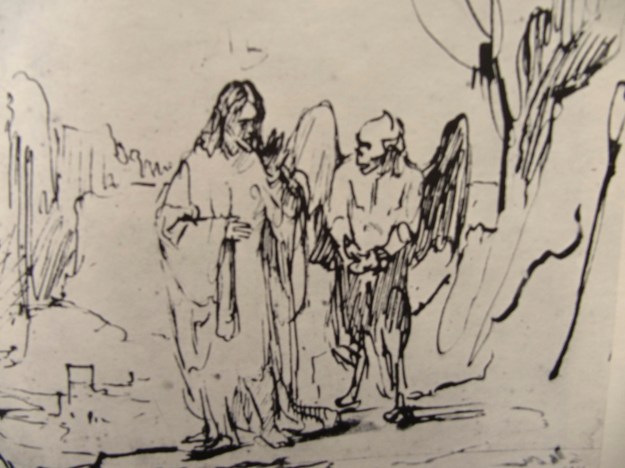
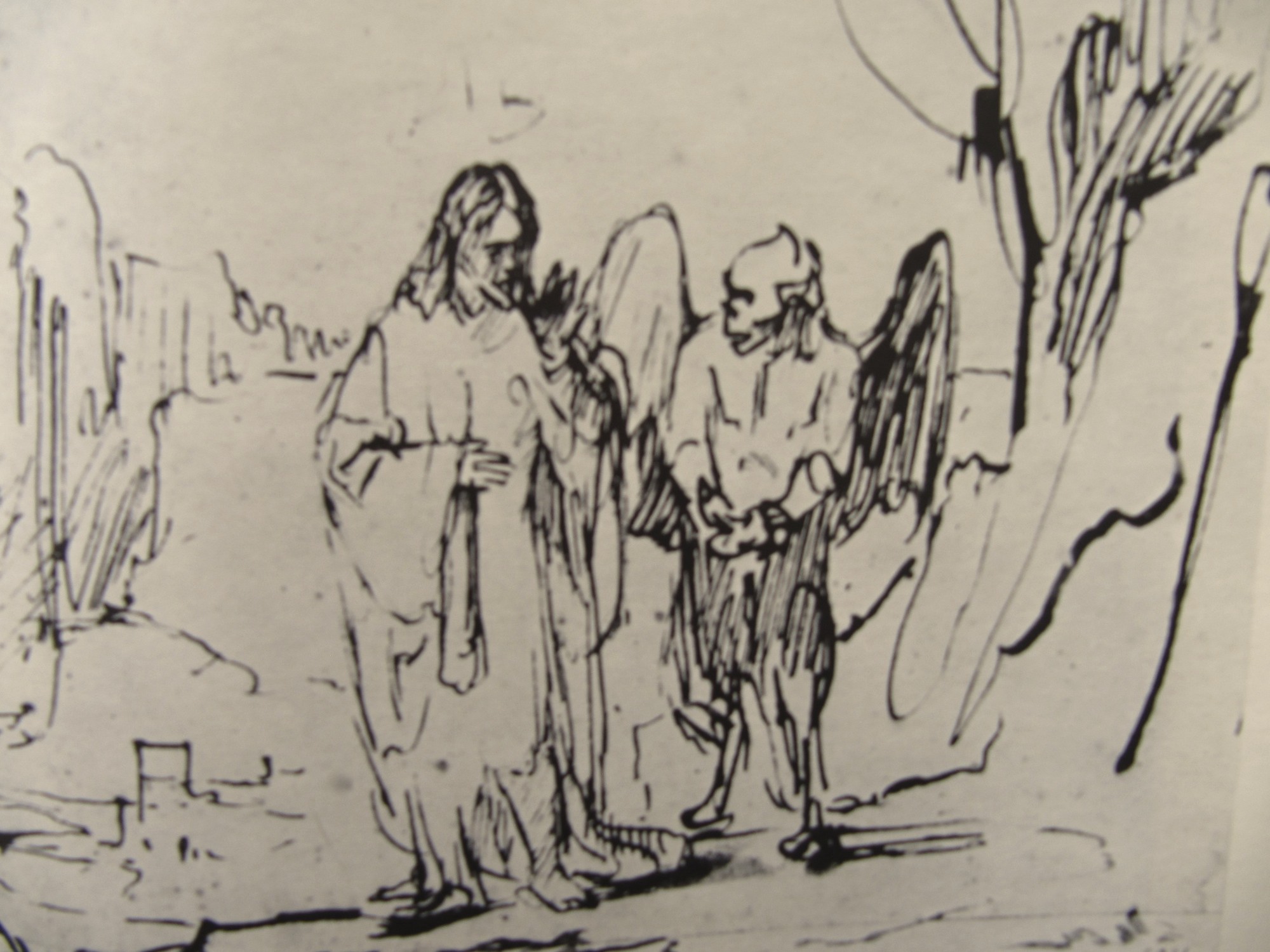
The experience of Jesus in the desert mirrors his experience in his life. At his baptism, God calls him his “Beloved Son” and tells us to “listen to him.” He is the Messiah, sent by God to save his people. But in the desert he is tempted by Satan to be a Messiah of another kind.

In his recent reflection on Lent, Pope Benedict said that in the desert Satan “offers Jesus another messianic way, far from God’s plan, because it passes through power, success, dominion and not through the total gift on the Cross. This is an alternative messianism of power, of success, not the messianism of gift and selfless love.”

Matthew and Luke’s gospels speak more than Mark’s gospel does about the temptations of Jesus in the desert. Jesus is hungry; “Turn these stones into bread,” Satan says. You’re above the ordinary laws of life.  From a mountain, Satan shows Jesus all the kingdoms of the world. “Here’s political power,” Satan says. From the pinnacle of the temple in Jerusalem, Satan says “Throw yourself down; you can have religious power.”

Mark’s gospel goes on from his account, saying simply:

“After John had been arrested,

Jesus came to Galilee proclaiming the gospel of God:

“This is the time of fulfillment.

The kingdom of God is at hand.

Repent, and believe in the gospel.’”

Instead of Satan’s suggestion, Jesus follows John the Baptist and the way of the prophets. He goes to Galilee, not Jerusalem, and proclaims the gospel of God.

Jesus’ ministry in Galilee has all the ambivalence of the journey of the Jews in the desert. He’s a sign of God’s presence. Like a cloud by day and a pillar of fire by night he teaches in the synagogues and along the seashore in Galilee.  He gives manna to the hungry and strengthens the poor and heals the sick. He pitches his tent among them and makes his home with them.

But he finds murmuring and rejection there too. You can hear it in the constant questions and doubts that he faces. Demons cry out against him. Finally, going up to Jerusalem, Jesus faces death; he becomes the sacrifice that saves his people from their sins. As he did in the desert, Jesus accepts his role as the Servant of God in his life–he “ renounces himself and lives for others and places himself among sinners, to take upon himself the sins of the world. “ (Benedict XVI)

So what do we learn from Jesus on our long march of 40 days? Our great temptations will be like his. We like to control things, we like the world to be on our side; we like to control God. His great wish was “ your will be done, your kingdom come.” Our temptation is “my will, my kingdom come.”

Our world is a lot like his. We wish God were more visible, not hidden in signs or limited to believing eyes. We wish for a world more supportive of good values, not a desert where Satan’s voice is strong and wild beasts roam.

This Lent we make the Long March with Jesus Christ who is with us today and all days. He has pitched his tent with us. We’ll have manna to eat and rocks will give water for our thirst. A fire goes before us in darkness and a pillar of cloud marks our path in the day. Angels still minister to us.

Rembrandt

Among the books we have in our library are some art books from the years when The Sign Magazine was published here and books were accumulated for their illustrations. One of them is “Rembrandt’s Drawings and Etchings for the Bible.”

Though he’s known best for his portrayal of the Dutch world of his time, Rembrandt was very interested in stories from the Bible, both from the Old and New Testament. Possibly one third of his work is devoted to biblical subjects, about 700  drawings among them.

What led him to paint and draw biblical events? It wasn’t mainly a patron’s commission, as was the case of  his contemporaries– Rubens, for instance.  Rembrandt seems genuinely attracted to the bible and felt compelled to draw something from the biblical narrative, not because he could make money on it, but because it said something to him and his situation in life.

“Rembrandt’s relation to the biblical narrative was so intense that he repeatedly felt impelled to depict what he read there. These sketches of Rembrandt have the quality of a diary. It is as though he made marginal notes to himself…The drawings are testimonies, self-revelations of Rembrandt the Christian”  ( p. 6)

It seems he got this interest in the bible from his mother, a devout woman, who had a Catholic prayerbook that featured  the Sunday gospels with illustrations on facing pages. As she prayed from this book, did she show them to her little boy growing up?

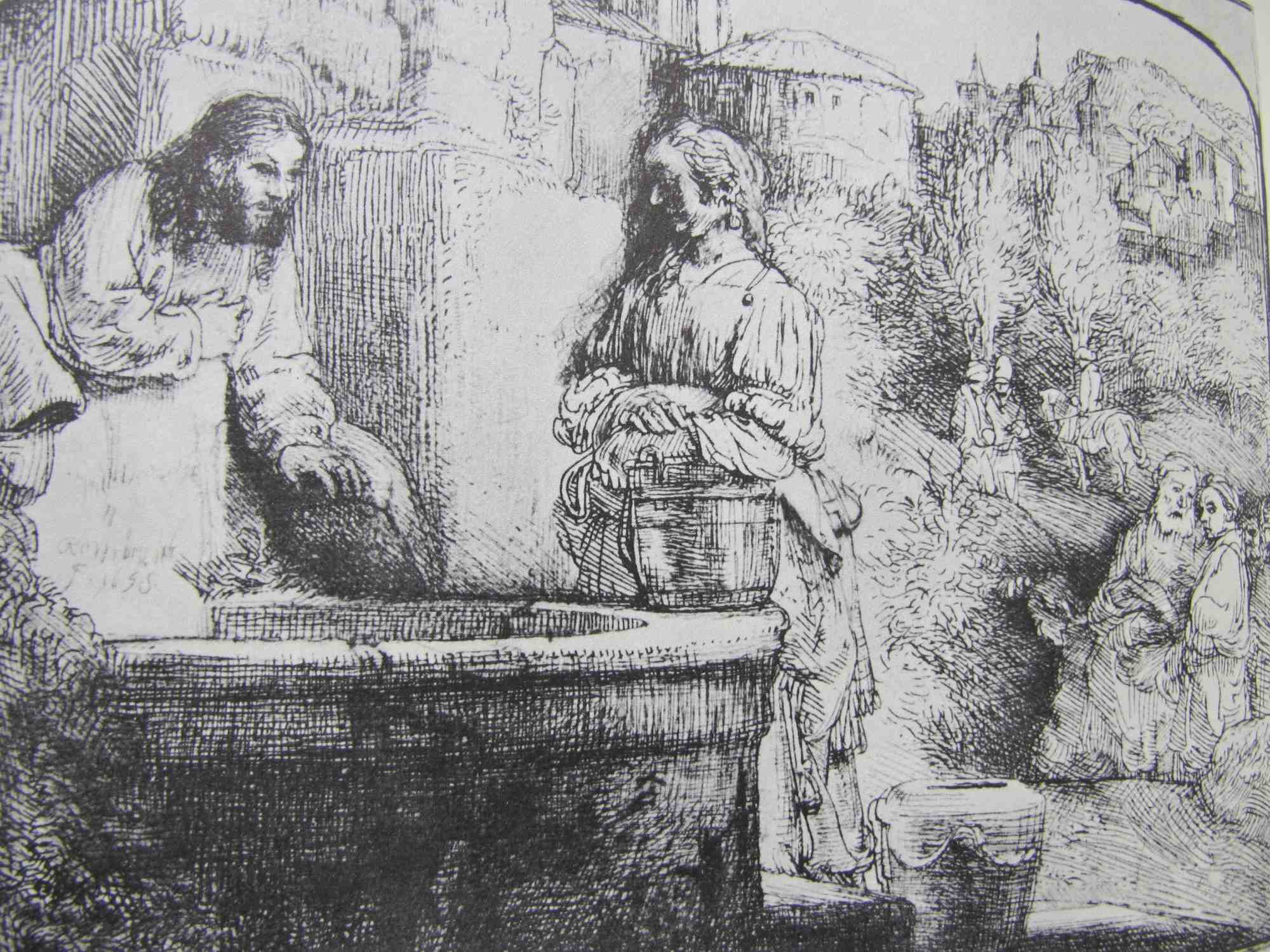
His portrayal of the scriptural stories are so insightful. Just look at his portrayal of Jesus at the well with the Samaritan woman, which is found in John’s gospel. Jesus deferentially asks for a drink of water, bowing to the woman as he points to the well. And she stands in charge, her hands firmly atop her bucket. She’s a Samaritan and a woman, after all. He wont get the water until she says so. Jesus looks tired, bent over by the weariness of a day’s long journey.

Certainly, this is no quick study of a gospel story. Obviously, Rembrandt has thought about the Word who made our universe and the Savior who came to redeem us. Perhaps he’s also thinking of the way Catholics and Protestants were clashing among themselves, their picture of Jesus a strong, vigorous warrior. There he stands humbly outside a little Dutch village that the artist’s contemporaries might recognize. Some of them may be pictured looking on at the two.

Artists have a powerful role in relating truth and beauty.

And what about Rembrandt’s mother? A 19th century French Sulpician priest, Felix Dupanloup, who had a lot to do with early American Catholic catechetical theory said,

“Till you have brought your children to pray as they should, you have done nothing.”

Looks like she did her job.