In his homily on the readings for Mass on Monday, Pope Francis spoke of two creations, the first described in the Book of Genesis and the second described in the Gospel of Mark where Jesus goes among the people, and “as many of those who touched him were saved.”
Regarding the first creation, God gives us the responsibility to nurture creation, Pope Francis said.
“It’s our obligation as Christians. For us there is a responsibility to nurture the Earth, to nurture creation, to keep it and make it grow according to its laws. A Christian who does not protect creation, who does not let it grow, is a Christian who does not care about the work of God, that work that was born from the love of God for us. And this is the first response to the first creation: protect it and make it grow.”
We advance the second creation by advancing in faith, by touching Jesus in faith.
The popes daily homilies can be found here. Gems of spirituality.
This year we’re remembering the Consecrated Life in the Catholic Church. Pope Francis asked religious and religious communities this year to remember their past with gratitude, to live in the present with passion and to embrace the future with hope.
The other day I was on the internet browsing through iTunes University, where you can get courses–most for free– from various universities on all kinds of subjects. I noticed a course from Yale, given by Professor Paul Freedman on monasticism and early religious life. I have an interest in that period, so I thought I’d see what the historian said to his students about monks in monasteries and hermits in the desert.
Freedman knows a lot about early monasticism and its history, people like Benedict , Augustine, Anthony, Martin of Tours. He offers some interesting insights, as you would expect from a Yale professor, but after listening to his lecture I’m not sure he really appreciates or understands what religious life is all about.
For him monks and the hermits were people who turned their back on the world to pursue a life of prayer. They gave up everything to be with God and separated themselves from everyday life. Because they did that, other people sought them out as intercessors. Ordinary people looked up to them because they’re above them, as it were. They’re holy people who intercede before God for you.
Certainly religious have that intercessory role. But the Epistle to the Hebrew, which we’re reading these days at Mass, reminds us that the one who intercedes must know and experience human life and its weakness. Jesus did that. He is a compassionate high priest, not because he turned his back on human life but because he embraced it. A compassionate high priest, he embraced the cross of human experience.
I’m not sure Professor Freedman appreciates that element of the consecrated life. Anthony in the desert and Martin of Tours in Gaul were wise teachers to whom others came, not just to ask for prayers, but because they knew the human heart. Freedman gives the example of Simon Stylites, the Syrian who lived on top of a pillar for years. People came from all over and built ladders to reach him and ask for prayers, Freedman says.
They weren’t only asking for his prayers; they wanted Simon’s advice, because from his high pillar Simon saw more clearly into their busy lives than they themselves did.
Indeed, the consecrated life goes beyond intercession and wisdom. Over the centuries, religious communities blazed trails into the future for the church and the world. They created new forms of life and culture, they provided missionaries who drew distant peoples together and thinkers who saw beyond the present. They saw what had to be done and did it. Christopher Dawson shows us the reach of religious life and monasticism in the period Freedman covers in his classic The Making of Europe.
It’s important to reflect on the consecrated life this year. It can be unappreciated. Even people in the consecrated life can get it wrong and miss its dimensions, so let’s do what the pope asks: remember our past with gratitude, live the present with passion and embrace the future with hope.
To hear the audio of today’s homily please select the audio slider below:
“Love God and love your neighbor as yourself,” Jesus says. The question then is: How do we love God and neighbor in the world we live in, for example, in our families? That’s the question the recent Synod of Bishops considered, the synod convened by Pope Francis who invited church leaders from around the world to join him in looking at the times in which we live, “the signs of the times,” and see how we can adapt to the changing conditions of society.
For two weeks in Rome, leaders of the Catholic church studied reports they received previously from all parts of the world, shared their reflections and made some preliminary recommendations. Now, the pope asked them to bring their reflections home to be discussed by their local churches and then return to Rome to continue the process with him next year.
It’s a long, extended process, over two years; it’s not finished yet.
You can read about the synod in your diocesan paper or online, and I hope you do, because it gives us an interesting look at family life in all parts of the world. You can find the working paper from the synod on the Vatican website.
Let me mention a few things from the working paper for the synod. As you might suspect, it reflected on the family from the perspective of the bible and church tradition, but then in Part II it takes up the challenges a family faces today.
One is a perennial challenge: lack of communication in families. Husband and wife not talking to each other, children not talking to parents. Where there’s no communication in a family, there’s a loss of meaning and an experience of love. (64)
Families can also be torn apart by violence and abuse, an abuse that can be psychological, physical or sexual. Families can be damaged by addictions to alcohol and drugs. The synod then mentions some dangers today from the social media and the internet, particularly pornography. (66)
Let me quote from its document: “… Television, smart phones and computers can be a real impediment to dialogue among family members, leading to a breakdown and alienation in relationships within a family, where communication depends more and more on technology. In the end, the means of communication and access to the Internet replace real family relationships with virtual ones. This situation runs the risk of leading to not only the disunity and breakdown of the family but also the possibility that the virtual world will replace the real one.” (68) The people on television, video games, become more real than the people in your home.
The economy and work also influence families. Let me quote again: “The pace of work can be fast and sometimes even exhausting…and increasingly hectic life leaves little opportunity for moments of peace and family togetherness…Increasing job insecurity, together with the growth of unemployment and the consequent need to look for work elsewhere, have taken their toll on family life. “ (70)
There’s a need for governments and businesses to make sure there are decent jobs and just wages, as well as programs that assist families and children. (71)
I think you can see from these few examples that the synod is looking at real life situations.
The 3rd chapter of the synod document gets most attention in the media. “Difficult Pastoral Situations.” The first difficult situation it mentions is the increasing number of couples, particularly in North America and Europe who are living together, without getting married. They do this for different reasons, the surveys say. Sometimes its because of “financial need, unemployment and lack of housing.” Sometimes it the “fear of making a commitment and the idea of having children. They don’t want to make definitive decisions or have responsibilities that come with marriage. The leaders of the church are asking–and we all have to ask– how can we help young people enter into the long term relationship which is marriage? (82)
Another difficult situation, “especially in Europe and across America is the very high number of people who are separated, divorced or divorced and remarried.” Because of their situation, many of them can’t receive Holy Communion. The questions being asked is what can we do to help these people and how can we make them and their children feel at home in the church? (86)
The final difficult situation is about same sex marriage. The synod is rejecting the view that homosexual unions are the same as the traditional union of man and woman. “Yet, at the same time, we need to make clear that men and women with homosexual tendencies ‘must be accepted with respect, compassion and sensitivity.’” (110)
There’s an opposition, then, to “redefining” marriage between a man and a woman through laws permitting a union between two people of the same sex. We’re trying to find a balance between the Church’s teaching on the family and a respectful, non-judgmental attitude towards people living in such unions. (113)
I began with the simple words of Jesus, “You shall love God and your neighbor. Not easy in a complex world, but we’re called to do just that.
When Pope Francis called for the synod he asked the bishops to consult their people and listen to them. He asked for transparency in discussing these issues. He recognizes there will be different ideas and different solutions concerning these challenges. He said we are on a journey. It’s a unique process the pope has begun and I hope we all can enter into it.
To hear the audio of today’s homily please select the audio below:
Religious education programs begin in most parishes this month. Many of the programs involve young people, of course, but we are all called to grow in faith, no matter how old we are.
Unfortunately, adults often see faith as something you learn as a child and that’s it.
The Catholic writer Frank Sheed once said the problem with adult Catholics is that they don’t keep engaged in the faith they learned as children. He used the example of our eyes. We have two eyes. Let’s say one of them is the eye of faith; the other is the eye of experience.
As children we may see the world with two eyes; but as adults we may see the world only with the eye of experience, losing the focus that faith gives, another dimension. Faith helps us to see.
Jesus said to his disciples “you are all learners.” Not only children learn, all of us learn. We’re lifelong learners, lifelong believers, even till the end.”
I was talking to a man last week who said “You know, I go to church pretty regularly; I try to live a good life, but I would like to know Jesus.”
I told him that’s what we’re trying to do all our lives–to know Jesus.
I told him to get a good bible, like the New American Bible, and start reading it. Listen to the readings in church that tell us what Jesus said and did. This is a time he reveals himself to us, as one of the Eucharist prayers says it so well:
“You are indeed Holy and to be glorified, O God, who love the human race and always walk with us on the journey of life. Blessed indeed is your Son, present in our midst when we are gathered by his love, and when as once for the disciples, now for us, he opens the scriptures and breaks the bread.”
From what we know of Jesus, he bravely faced the issues of his time and its questions and challenges.Knowing Jesus, then, means that we face the issues and challenges of our time as bravely as we can.
Let me point out one of today’s challenges– our changing climate.Last Tuesday evening at the United Nations Summit on Climate Change,the Vatican Secretary of State Cardinal Pietro Parolin brought a message from Pope Francis.
He said that after thirty years of study we have to admit there are critical days ahead. We know that “the entire international community is part of one interdependent human family…There is no room for the globalization of indifference, the economy of exclusion or the throwaway culture so often denounced by Pope Francis,”
Our faith “warns agains the risk of considering ourselves the masters of creation. Creation is not some possession that we can lord over for own pleasure; nor, even less, is it the property of only some people, the few: creation is a gift, it is the marvelous gift that God has given us, so that we will take care of it and harness it for the benefit of all, always with great respect and gratitude” (Pope Francis, General Audience, 21 May 2014).
It’s not just a matter of some technical changes like emission reductions, the cardinal continued. We need “ to change our lifestyles and the current dominant models of consumption and production.”
Knowing Jesus means living as Jesus would if he were with us today.
We’re all learners. The consoling thing is that we can start anywhere, anytime to know Jesus. The gospel readings for this week and last week tell us that. The workers going into the vineyard and two sons in today’s reading tell us the invitation is always there, so let’s take it.
Pope Francis made a one day trip on September 21, 2014 to Albania, a small mountainous country on the Adriatic Sea. One newspaper said “Francis’s decision to choose tiny, poverty-ridden Albania instead of one of the continent’s big Catholic powers for his first European trip as pontiff is in keeping with a papacy that wants to give priority to the poor and the neglected.”
He had other reasons too. Albania, with a Muslim majority, has Catholics and Orthodox Christians among its citizens. The pope praised the respect and trust between these groups as a powerful sign in today’s world. Other countries in Europe and the rest of the world, experiencing the effects of immigration and resettlement, need to emulate its example.
“May no one use religion as a pretext for actions against human dignity and against the fundamental rights of every man and woman, above all to the right to life and the right of everyone to religious freedom,” Pope Francis said.
“This is especially the case in these times where an authentic religious spirit is being perverted by extremist groups and where religious differences are being distorted and instrumentalised.”
Here’s a great story of Albanian inter-religious cooperation from ABCnews.
The pope raised some eyebrows a month or so ago when he saw a little baby crying in its mother’s arms as he was going through the crowds in St. Peter’s Square in his pope mobile. “Give the baby something to eat, Madam,” he was reported to have said to the baby’s mother. Breast feeding in St. Peter’s Square! It seems he did the same thing last week on the Feast of the Baptism of Jesus in the Sistine Chapel when he baptized 35 infants. “If your baby is hungry, don’t be afraid to feed it,” he said to the mothers there according to reports.
In one of the magazines, an art historian wrote asking why should we be surprised at the pope’s words. Catholic artists have pictured nursing Madonnas for centuries. That’s what Mary did.
I spoke about Mary to priests on retreat from the Austin diocese this morning. We easily forget Mary’s fundamental role in the life of Jesus.
“Blessed is the womb that bore you and the breasts that nursed you.” “Blessed is the fruit of your womb, Jesus.”
Her role meant more than giving him birth. The apocryphal gospels often picture Jesus as showing signs of divine powers growing up, but the church condemned them because they negate the role of Mary and Joseph and the whole extended family that raised him in Nazareth.
Mary especially raised him as his mother. She did all those things a mother does for an infant, a young child and an adolescent. She fed him and took care of his basic needs. Her motherly care embodied a spirituality that’s still fundamental for the advance of human life.
The church makes her motherly spirituality its own.
If you extrapolate Mary’s spirituality to a wider arena, as I think Pope Francis does, you have to be concerned with the children of God in our world who hunger. We have to feed them. We can’t let poverty weigh them down with worries and cares. We have to relieve global poverty.
Now that Black Friday is over maybe we can get down to thinking about Christmas. For four weeks we prepare for that feast in the season of Advent.
The best place to look for the meaning of Christmas is the scriptural readings for these next four weeks. A timely source I suggest we add to them is the recent Apostolic Exhortation of Pope Francis, “The Joy of the Gospel.”
The Old Testament readings for today and all through the 1st Week of Advent are from Isaiah. Even if you can’t get to Mass, take a look at them, they make wonderful readings for Advent.
Isaiah promises salvation for all people, and one of his favorite images to describe God’s promise is found in this Sunday’s reading: Isaiah 2:1-5. All nations will stream to God’s mountain for instruction. “They will beat their swords into plowshares and their spears into pruning hooks.” Wars are no more; a fragmented humanity becomes one.
Quite a claim, considering that Assyrian armies were laying waste the towns and cities of Israel and Judea as Isaiah spoke. But God’s promise trumps all human conquests.
For Isaiah, the mountain of the Lord is Jerusalem, on which the Jewish temple is built. All nations will come there; they will be fed a rich banquet (Wednesday), the poor will be welcomed there (Thursday), the blind will see there (Friday); it’s the rock where people will dwell safely, where children play around the cobra’s den, and the lion and the lamb lie down together (Tuesday). The prophet’s imagery in these readings is strikingly beautiful.
The Gospels for the 1st week point to the fulfillment of the Isaian prophecies in Jesus Christ. The Roman centurion humbly approaching Jesus in Capernaum represents all the nations that will come to him. (Monday) Jesus praises the childlike, who will enter the kingdom of heaven. (Tuesday) He feeds a multitude on the mountain.(Wednesday) He affirms that his kingdom will be built on rock. (Thursday) He gives sight to the blind. (Friday)
Remember, too, that Matthew’s gospel, source of many of our Advent readings, portrays Jesus teaching on a mountain (Isaiah’s favorite symbol) and working great miracles there that benefit all who come. He is the new temple, the new Presence of God, Emmanuel, God with us.
Prophets like Isaiah were brave people, brave enough to speak when all seemed lost. They’re strong people, strong enough to hope when hope seems gone. And something of that prophetic spirit is in Pope Francis, I believe, who last week issued an important exhortation to the church.
He says that we can’t bring the gospel to the world if we don’t know what our world needs. We can’t bring greater human life to our world if we don’t realize what disfigures human dignity now.
What disfigures human dignity today is social inequality. Money had become our god. He speaks of the “tyranny of the financial markets.” We pay attention to a 2% drop in the stock market and ignore the death of a homeless man who dies in the cold. We’re a throw-away society. Not only do we discard things, we discard people. We tend to exploit immigrants and then throw them away. We ignore the economically unproductive, who may be without jobs or skills or socially deprived through sickness or being displaced.
The pope’s message is a hard-hitting restatement of traditional Catholic social teaching. It’s interesting to see a papal document quoted so freely on Tweeter, Facebook and the social media. It’s because he’s touched on something we need to hear.
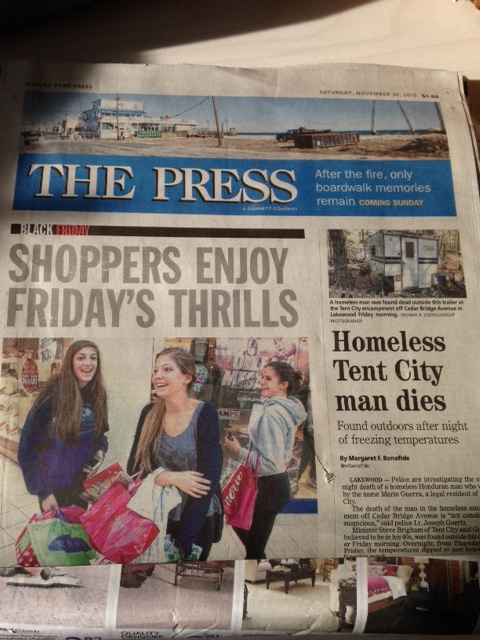
The front page of the Asbury Park Press this morning seemed to echo the picture the pope painted in his recent address. There’s the big picture of smiling shoppers fresh from the stores on Black Friday holding their precious treasures. Next to it is a story of a homeless man who died in the cold yesterday.
If you follow Pope Francis– and many people are following him these days–you notice that since the pope has moved downstairs to the guest house in the Vatican he’s making the daily Eucharist there one of his most important sources for learning and teaching God’s word. Some of his best insights are found in his daily homilies at morning Mass.
These are not elaborate sermons but simple remarks that usually come as he reflects on the scripture readings or the feast that’s being celebrated. He’s reflecting on the “daily bread” God gives him, and all of us.
This morning we read the story of Zacchaeus, the tax-collector in Jericho, whom Jesus calls to salvation as he makes his way to Jerusalem. How many times we’ve heard his story from Luke’s gospel, yet I noticed today something I didn’t see before: Jesus doesn’t call Zacchaeus to follow him, as he told another tax-collector, Matthew.
Jesus doesn’t tell Zacchaeus to give up his job and go somewhere else. No, salvation comes to his house, Jesus says. As far as we know, when Jesus left, the chief tax-collector stayed in Jericho, doing what he was doing, probably still wealthy, but now a changed man.
Does salvation come to us too like that? Does it come to our house, where we live and for what we do? Does it make us see things differently? Does it help us do things more justly and lovingly? Does it enable us to be the presence of Jesus where we are?
Last Wednesday in St. Peter’s Square, the Pope embraced and kissed a man suffering from a rare disease called neurofibromatosis, which causes his skin to be covered with awful tumors and sores. Most people would find it hard to look at him; much harder to embrace him.
A writer in the New Yorker Magazine said “The image was electrifying, in a way that mercy can be.”
That phrase is also true of the image at the center of our faith.
Pope Francis seems to be giving us a new model of the papacy. He has the common touch, to be sure, and the spontaneity of the man is refreshing.
I wonder if his spontaneity is partially explained by the investment he makes in daily prayer. He’s made the daily Mass in the chapel at St. Martha at the Vatican an important part of his day and his ministry. The daily Eucharist seems to be a “daily bread” that provides him with the spontaneous wisdom and insight he has.
I, for one, usually go each day to the Vatican Radio site on the internet to see what he’s up to and what he has to say. By the way, there’s a new app called ThePope that gives you all he’s doing and saying each day.
In his Letter to Proba, St. Augustine says that when we say “Give us this day our daily bread” everything is included. The bread we bring for the Eucharist is the bread of everything; all creation is there, but in particular we bring this day’s creation to God to be blessed through Jesus Christ, who enables us to interpret and find meaning in the world at hand.
Is Pope Francis giving us a new appreciation of the role of daily prayer? Everything is there at Mass. Besides putting us in touch with God, it puts us in touch with the world we live in.


 The Victor's Place